
Golden-crowned Emerald
Scientific name: Cynanthus auriceps
The Golden-crowned Emerald is a small, dazzling “emerald” hummingbird endemic to western Mexico. An estimated 50,000–499,999 mature individuals exist, the population is decreasing, it is considered non-migratory, and it is currently listed as Least Concern and monotypic, with no recognized subspecies.
At a Glance
Family: Trochilidae (hummingbirds)
Clades: Trochilini – Emeralds
Genus group: Cynanthus — small, bright green emeralds with mostly red-based bills (6 species total)
Range: Western and central Mexico from Sinaloa south along the Pacific slope through Nayarit, Jalisco, Colima, and Michoacán to eastern Oaxaca, and inland up the Balsas River basin to southern Morelos.
Habitat: Primarily tropical dry forest and semi-arid scrub, including thorn forest, open woodland, hedgerows, and gardens, often in foothills and interior valleys.
Elevation: From sea level up to about 1,800 m (5,900 ft).
Length: About 8–9 cm (3.1–3.5 in).
Weight: About 2.5–3 g (0.09–0.11 oz).
Number of mature individuals: 50,000–499,999
Population trend: Decreasing
Status: Least Concern (IUCN)
Name Origin
The genus name Cynanthus likely derives from Greek for “flower-hunter,” reflecting this hummingbird’s constant movement among blossoms. The species name auriceps means “golden-headed,” referring to the warm golden or bronzy tones on the male’s crown. The English name “Golden-crowned Emerald” emphasizes this glowing crown and its place among the emerald hummingbirds.
Taxonomy & Distribution
Monotypic — no recognized subspecies.
Distribution: Endemic to western Mexico, found from coastal and foothill Sinaloa south along the Pacific slope through Nayarit, Jalisco, Colima, and Michoacán to eastern Oaxaca, and inland along the Balsas River drainage into southern Morelos. It is closely associated with tropical dry forest and nearby semi-open country within this range.
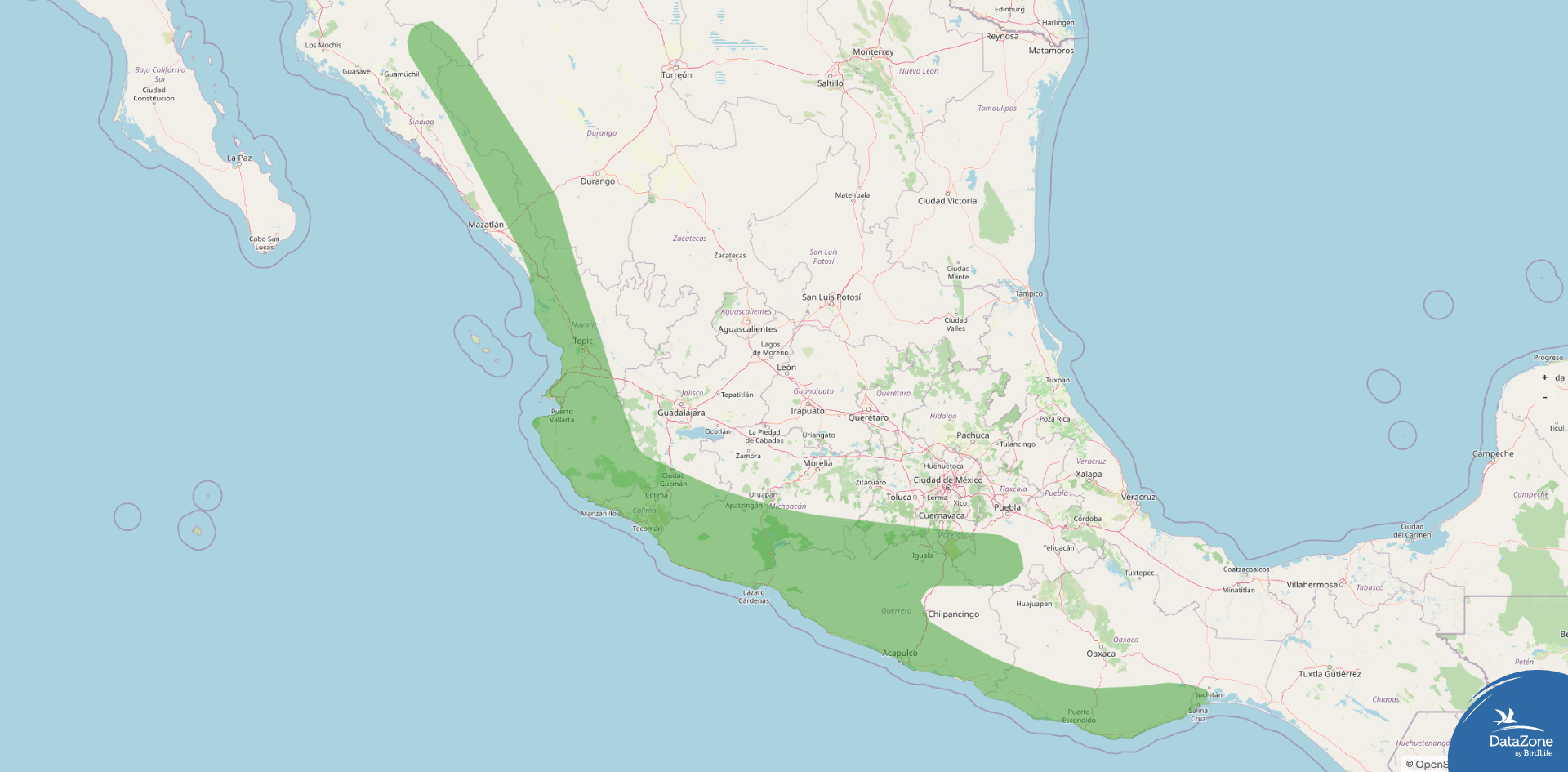
Legend
Green Resident
Species Overview
The Golden-crowned Emerald is a characteristic hummingbird of tropical dry forests and foothill scrub in western Mexico, where it frequents flowering trees, shrubs, and hedgerows. It is often fairly common locally in areas with a mosaic of dry forest, edges, and semi-open farmland. Its moderate range and dependence on dry forest under pressure from agriculture and development underpin concern about a decreasing trend, even though the species currently qualifies as Least Concern.
Male Description
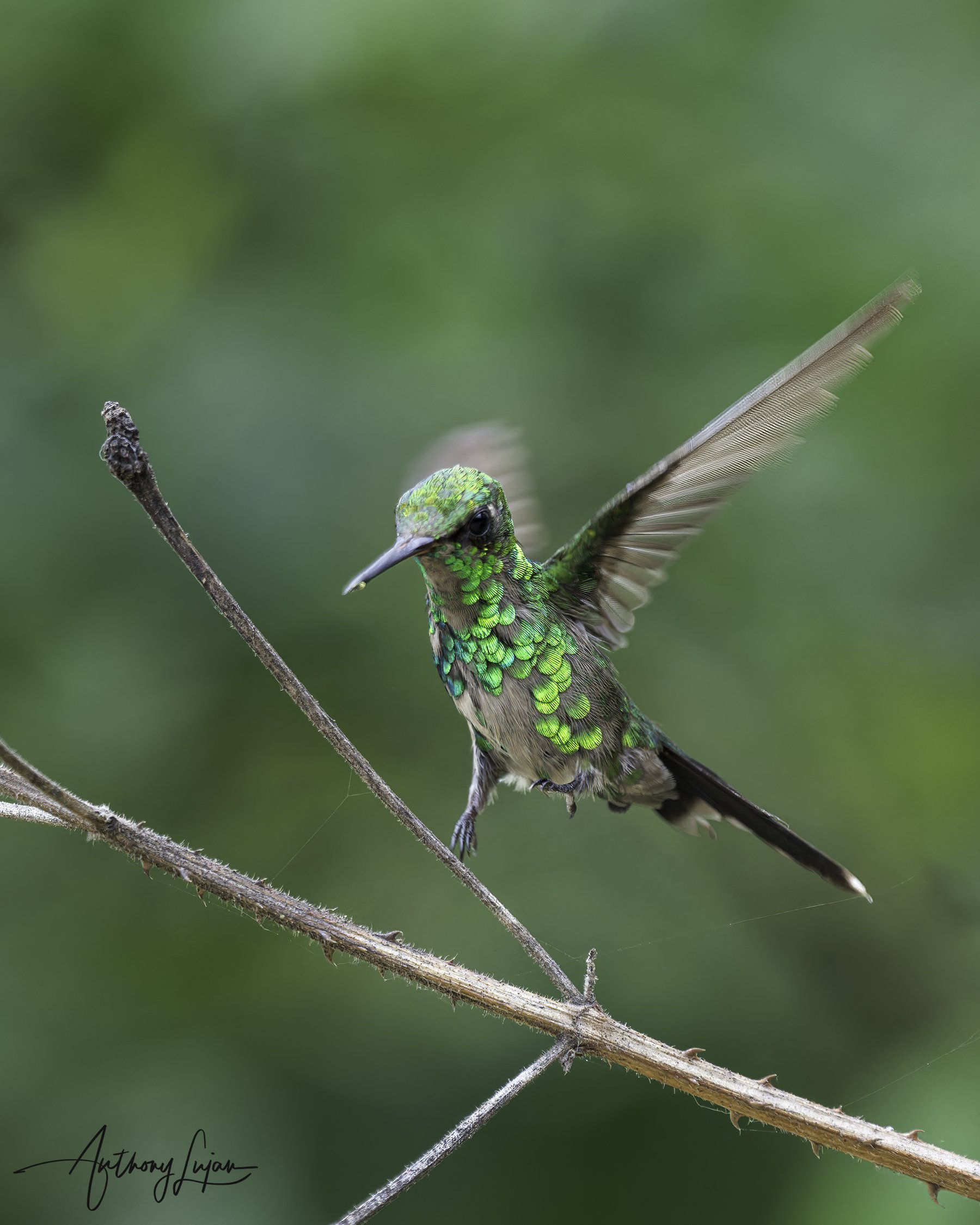
Adult males are tiny with a straight, mostly red bill tipped black. The crown shows warm golden to bronzy tones that glow in good light, blending into bright emerald-green upperparts. The face is green with a darker cheek and a small pale mark behind the eye. The throat and breast are glittering green, sometimes with golden highlights, grading into slightly paler green underparts. The tail is deeply forked and dark blue-black, often looking scissor-like in flight. In the field, males appear as small, golden-crowned emeralds with a red bill, solid green underside, and a deeply forked dark tail.
Female Description
Adult females have green upperparts like the male but lack the intense golden crown. The underparts are dusky gray or brownish-gray, usually darker than in many other Cynanthus females, giving a relatively dusky underside. The face shows a pale stripe behind the eye on a darker cheek. The tail is forked and dark with pale or whitish tips on the outer feathers, forming white tail corners. Overall, females look like small green-backed hummingbirds with dusky underparts and a dark forked tail with pale corners.
Habitat & Behavior
Golden-crowned Emeralds inhabit tropical dry forest, thorn scrub, semi-arid woodland, hedgerows, and gardens in foothills and lowlands along the Pacific slope and in interior valleys. They often forage in the mid-story, visiting tubular and brushy flowers on shrubs, trees, and vines, and readily use ornamental plantings around rural homes. Like other hummingbirds, they also take small insects and spiders gleaned from foliage or caught in short sallies. Birds can be territorial around rich nectar resources, especially flowering trees or dense patches of shrubs. The species is considered resident throughout its range, with only local shifts following flowering and seasonal rains.
Breeding
The breeding season aligns with regional rainy periods and peaks in flowering, generally during the wet season in western Mexico. The female constructs a tiny cup-shaped nest of plant fibers and spiderweb, often decorated with bits of lichen, placed on a slender branch or fork. She lays two eggs and alone incubates them and cares for the chicks; timing is probably similar to other small emeralds, with roughly two weeks of incubation and about three weeks to fledging.
Population
With an estimated 50,000–499,999 mature individuals, the Golden-crowned Emerald has a relatively modest but currently viable population. It is fairly common in suitable dry forest and semi-open habitats within its range, yet its status as an endemic confined to western and central Mexico makes it vulnerable to regional habitat loss. Ongoing conversion of tropical dry forest and scrub to agriculture, ranching, and urban areas is believed to be causing a slow decline.

Conservation
The Golden-crowned Emerald is listed as Least Concern, but its endemic status, decreasing trend, and dependence on tropical dry forest and associated scrub warrant continued monitoring. Conservation priorities include protecting remaining patches of tropical dry forest, maintaining hedgerows and tree-rich agricultural mosaics, and preserving flowering native shrubs and trees in rural and peri-urban landscapes. Such measures benefit this species and many other dry-forest birds of western Mexico.

Related species in the Cynanthus genus (6 species total):


Please note: The content provided in this article reflects Anthony’s personal experience and photographic approach. Results can vary depending on light, weather, location, equipment, subject behavior, and field conditions.