
Green-fronted Hummingbird
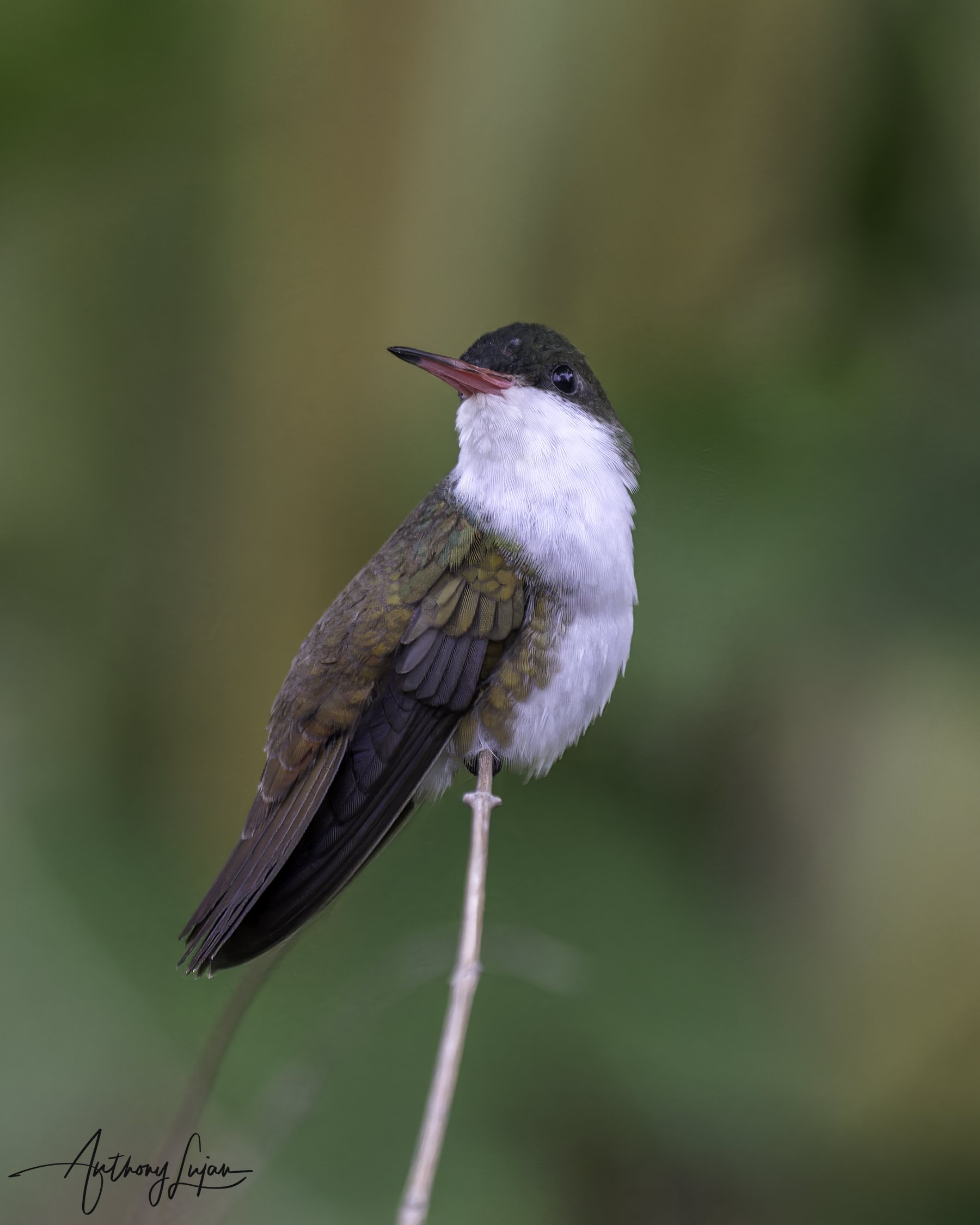
Scientific name: Ramosomyia viridifrons
The Green-fronted Hummingbird is a small emerald hummingbird of dry forest, thorn scrub, and semi‑open woodland in southern Mexico and adjacent west‑central Guatemala. The total number of mature individuals is unknown, its overall population trend is decreasing, it is considered non‑migratory, and it is currently assessed as Least Concern.
At a Glance
Family: Trochilidae (hummingbirds)
Clade: Trochilini – Emeralds
Genus: Ramosomyia — 2 species in total
Range: Southern Mexico (Guerrero, Oaxaca, Chiapas) and west‑central Guatemala (Huehuetenango)
Habitat: Deciduous and semi‑deciduous forest, thorn forest, arid to semi‑arid scrub, gallery forest, and semi‑open country with scattered trees and bushes
Elevation: Mostly from about 60 to 1,400 m (200–4,600 ft)
Length: About 9–10 cm (3.5–3.9 in)
Weight: About 3–4 g (0.11–0.14 oz)
Number of mature individuals: Unknown
Population trend: Decreasing
Movement: Not a migrant (resident, with only local movements)
IUCN Red List category: Least Concern
Name Origin
The common name “Green-fronted Hummingbird” refers to the male’s bright green forehead and crown that contrast with the whitish underparts. The genus name Ramosomyia was established to group this species with the Violet‑crowned Hummingbird based on new genetic work, separating them from older genera such as Amazilia and Leucolia. The species name viridifrons means “green‑fronted,” directly describing the colored forehead.
Taxonomy & Distribution
Ramosomyia viridifrons belongs to the emerald clade (tribe Trochilini) within the hummingbird family. It is one of two species in the genus Ramosomyia, the other being the Violet‑crowned Hummingbird (Ramosomyia violiceps). The Green-fronted Hummingbird occurs in southern Mexico from eastern Guerrero across Oaxaca into central Chiapas, and in west‑central Guatemala in the department of Huehuetenango. It is primarily a bird of dry and semi‑dry habitats, including deciduous woodland and thorn scrub, but also uses gallery forest along watercourses and semi‑open country with scattered trees.
Subspecies and Distribution
Three subspecies:
Ramosomyia viridifrons viridifrons (Green-fronted)
Distribution: Southern Mexico, from eastern Guerrero to western Oaxaca, and from eastern Oaxaca to central Chiapas.Ramosomyia viridifrons wagneri (Cinnamon-sided)
Distribution: Southern Mexico, primarily in central and southern Oaxaca.Ramosomyia viridifrons villadai (Villadai)
Distribution: Southern Mexico (eastern Oaxaca and Chiapas) extending into west‑central Guatemala (Huehuetenango).
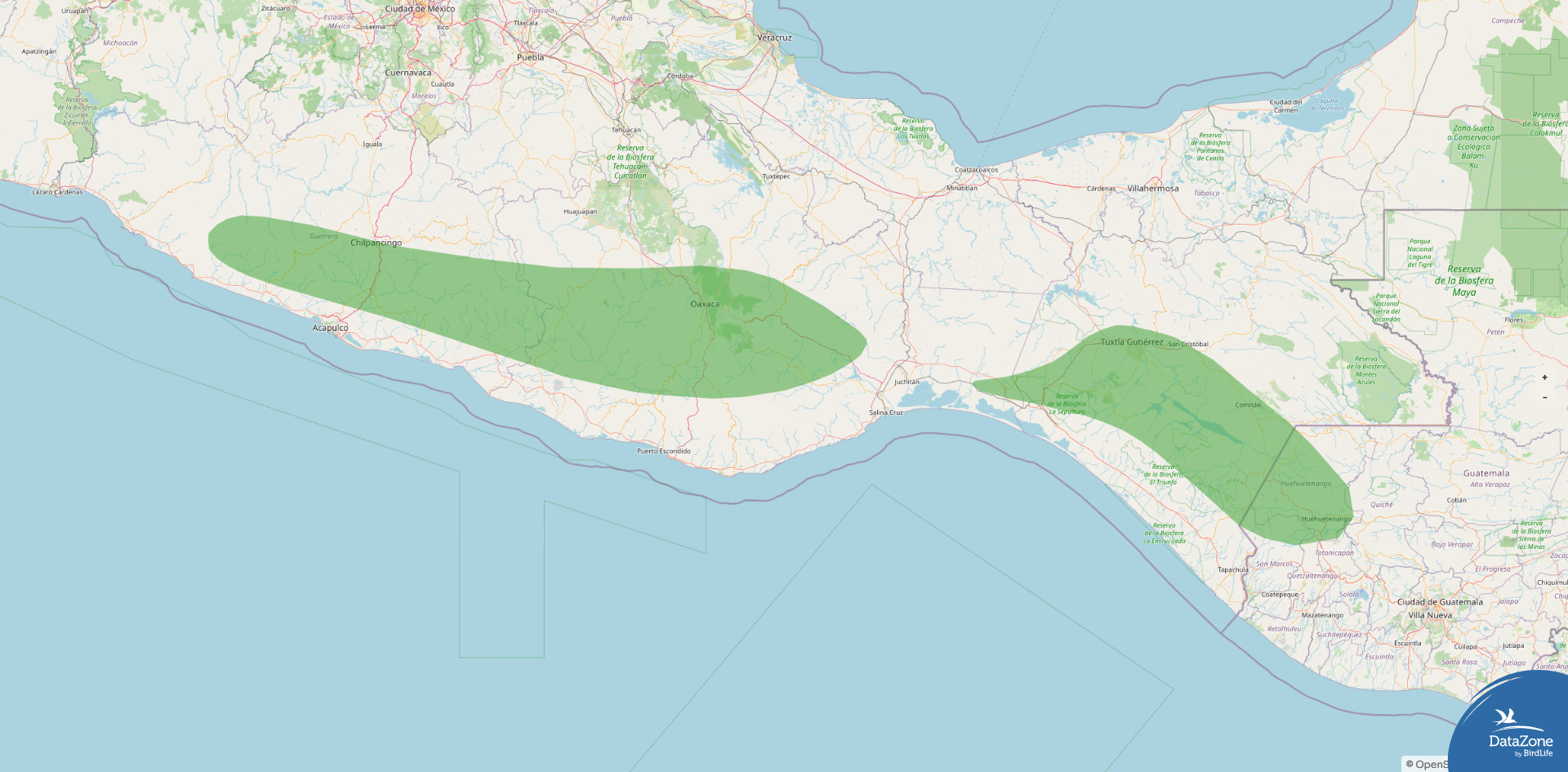
Legend
Green Resident
Species Overview
The Green-fronted Hummingbird is a localized but distinctive hummingbird of dry woodlands and scrub on the Pacific slope of southern Mexico and nearby Guatemala. It is best recognized by its green crown and upperparts contrasting with a white throat and underparts, and a relatively straight, mostly red bill with a dark tip. Within its limited range it can be fairly common in suitable semi‑open habitats, particularly in areas with flowering trees and shrubs and in gallery forests along seasonal streams.
Male Description
Adult males have a glittering green forehead and crown, with the green extending over the nape and back and shading into slightly bronzier tones on the rump. The face is mostly green with a dark eye line and a small whitish spot behind the eye. The throat and most of the underparts are white to pale grayish, sometimes with a faint buffy or gray wash on the flanks. The tail is green to bronze‑green above, with darker tips; the underside appears dusky with greenish tones. The bill is straight and fairly long, bright red or orange‑red with a black tip. Overall the male gives a clean, green‑and‑white appearance with a bright green “front” on the head.
Female Description
Females are similar in structure but somewhat duller. The upperparts are green, and the underparts are whitish to pale gray, often with more extensive gray or buffy wash on the sides than in males. The green crown can be slightly less intense, and the contrast between head and underparts is a bit softer. The tail pattern is similar, though the outer tail feathers may show subtle pale edging or small pale tips. Juveniles resemble adult females, with duller green upperparts and more mottled or washed underparts; young males gradually develop the brighter green crown and cleaner white underparts characteristic of adults.
Habitat & Behavior
Green-fronted Hummingbirds inhabit deciduous and semi‑deciduous woodland, thorn forest, arid and semi‑arid scrub, and semi‑open landscapes with scattered trees and bushes, often on hillsides and in canyons. They also occur along gallery forests and riparian strips where trees and shrubs border seasonal streams, and they will use coffee plantings, hedgerows, and rural gardens that retain native flowering plants. Birds usually forage from low shrubs up to mid‑canopy level, visiting flowers on trees, shrubs, vines, and cacti.
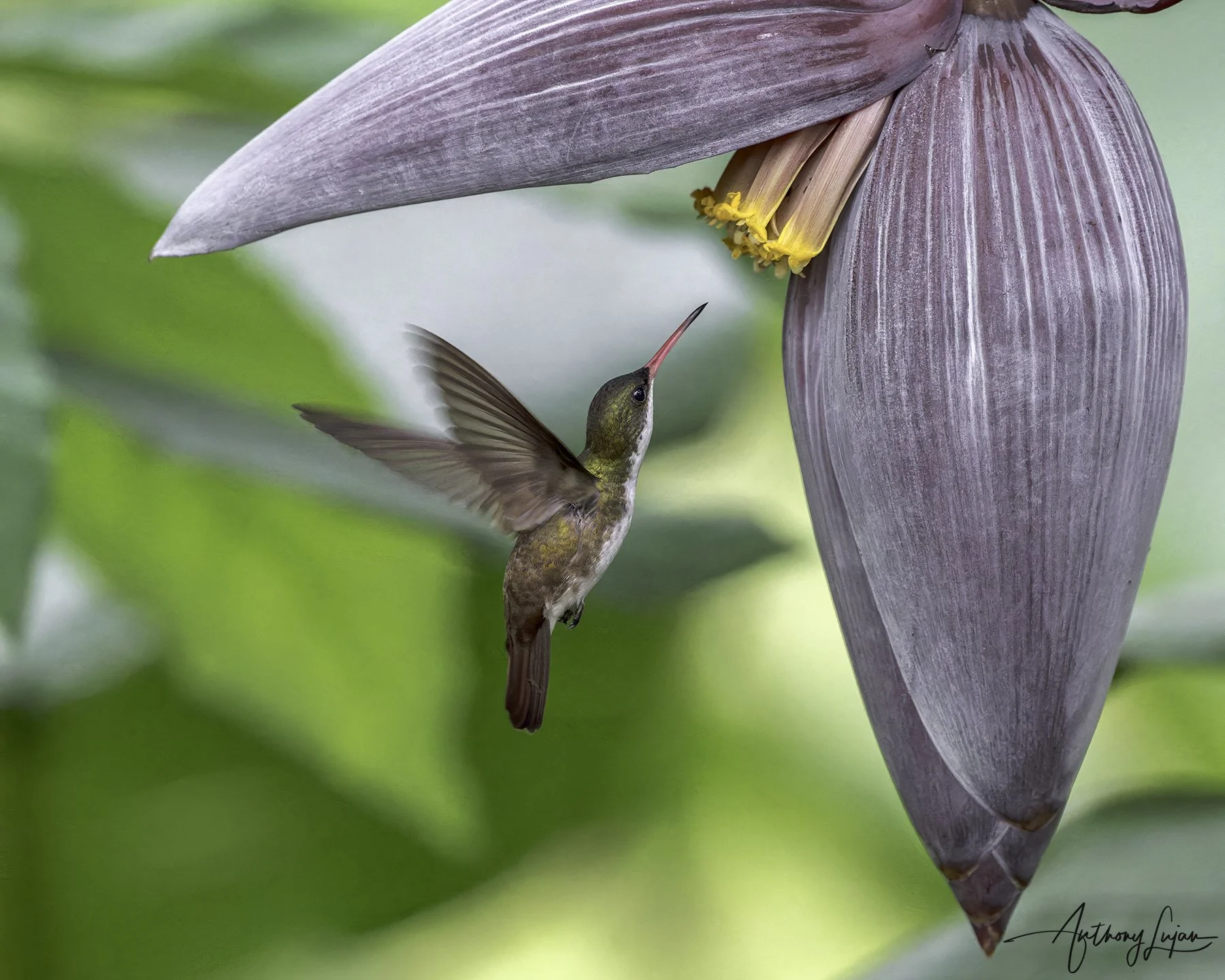
They feed primarily on nectar, hovering at blossoms or perching to reach flowers, and they supplement this diet with small insects and spiders taken in short aerial sallies or gleaned from foliage. Males may defend small, flower‑rich territories, especially in dry forest and scrub where nectar is concentrated at certain plants. Their flight is typically direct and purposeful, commuting between favored perches and feeding sites within semi‑open habitats.
Breeding
The breeding season appears to coincide with local spring and early summer, when flowering peaks in dry forest and scrub, though exact timing varies regionally within southern Mexico and Guatemala. The female constructs a small cup nest of plant fibers and spiderweb, often decorated externally with bits of lichen and bark for camouflage. Nests are typically placed on horizontal branches or in forks of shrubs or small trees within open woodland, along forest edges, or in riparian strips, usually a few meters above the ground.
The typical clutch consists of two white eggs. The female alone performs incubation and chick‑rearing, as is typical for hummingbirds. Incubation lasts around two weeks, and the young fledge about three weeks after hatching, though exact durations can vary with weather and local food availability.
Movement
The Green-fronted Hummingbird is considered a resident species and is classed as not a migrant. There is no evidence of long‑distance migration, but some short‑range seasonal movements likely occur as birds track flowering across dry forest, scrub, and gallery habitats. These shifts may involve movements between slightly different elevations or between more arid slopes and more mesic ravines and riparian zones, but the species remains within southern Mexico and adjacent Guatemala year‑round.
Population
The total number of mature individuals is unknown, and the species has a relatively small global range restricted to parts of southern Mexico and neighboring Guatemala. Within that range it can be fairly common in suitable habitat but is absent from large areas of more humid forest or heavily altered landscapes that lack woody vegetation. Habitat loss through deforestation, conversion of dry forest and scrub to agriculture or pasture, and degradation of riparian corridors likely contribute to the observed decreasing population trend.

Conservation
The Green-fronted Hummingbird is currently assessed as Least Concern, reflecting its still relatively wide though localized distribution and the absence of documented rapid declines across its entire range. However, its reliance on dry forest, thorn scrub, and semi‑open woodland makes it vulnerable to ongoing habitat loss and fragmentation in southern Mexico and western Guatemala. Conservation of deciduous forest remnants, thorn forest, and native scrub, as well as protection of gallery forests along streams and canyons, is important for maintaining healthy populations. Promotion of shade coffee, hedgerows, and rural plantings that retain native flowering trees and shrubs can also support this species in human‑dominated landscapes.
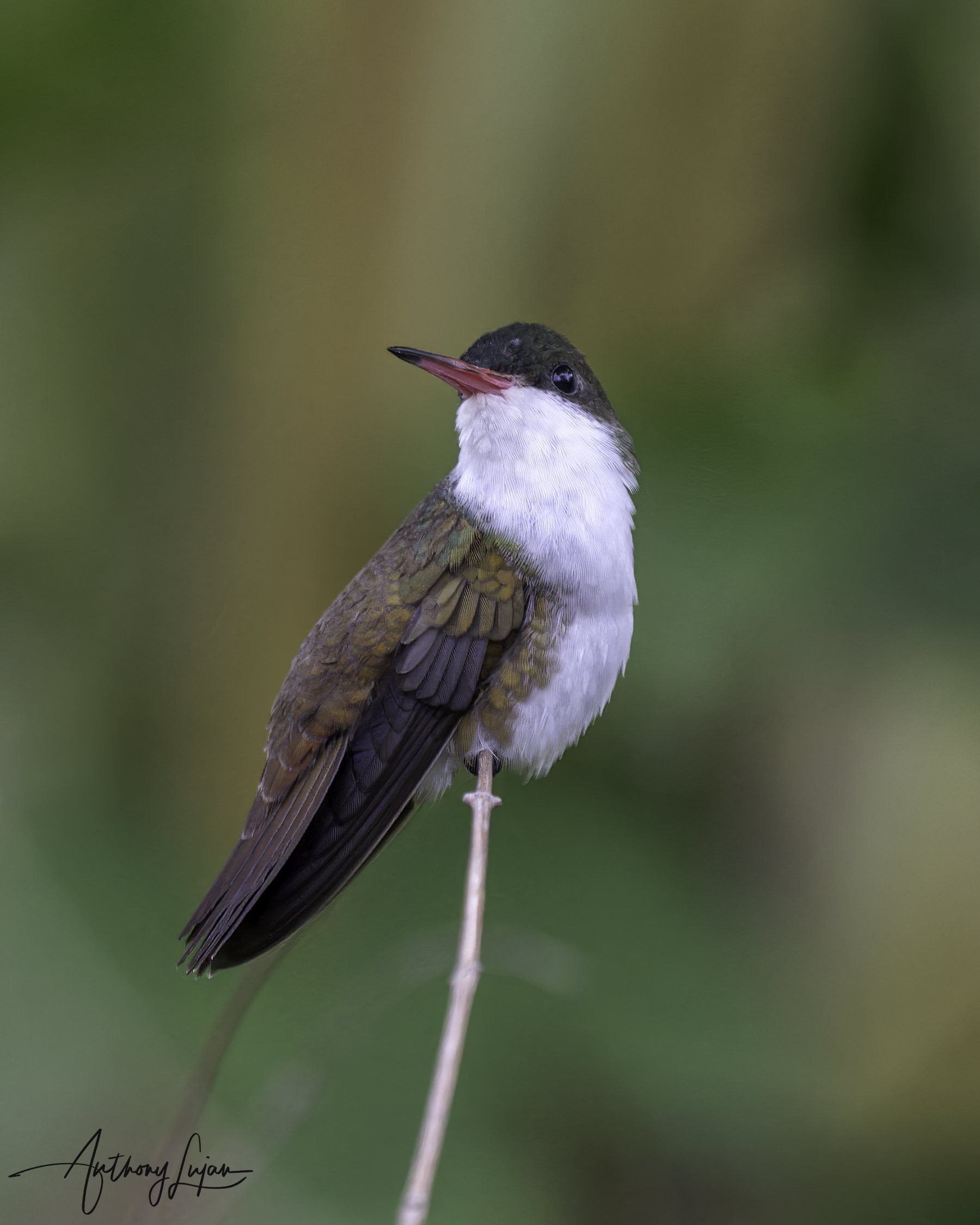
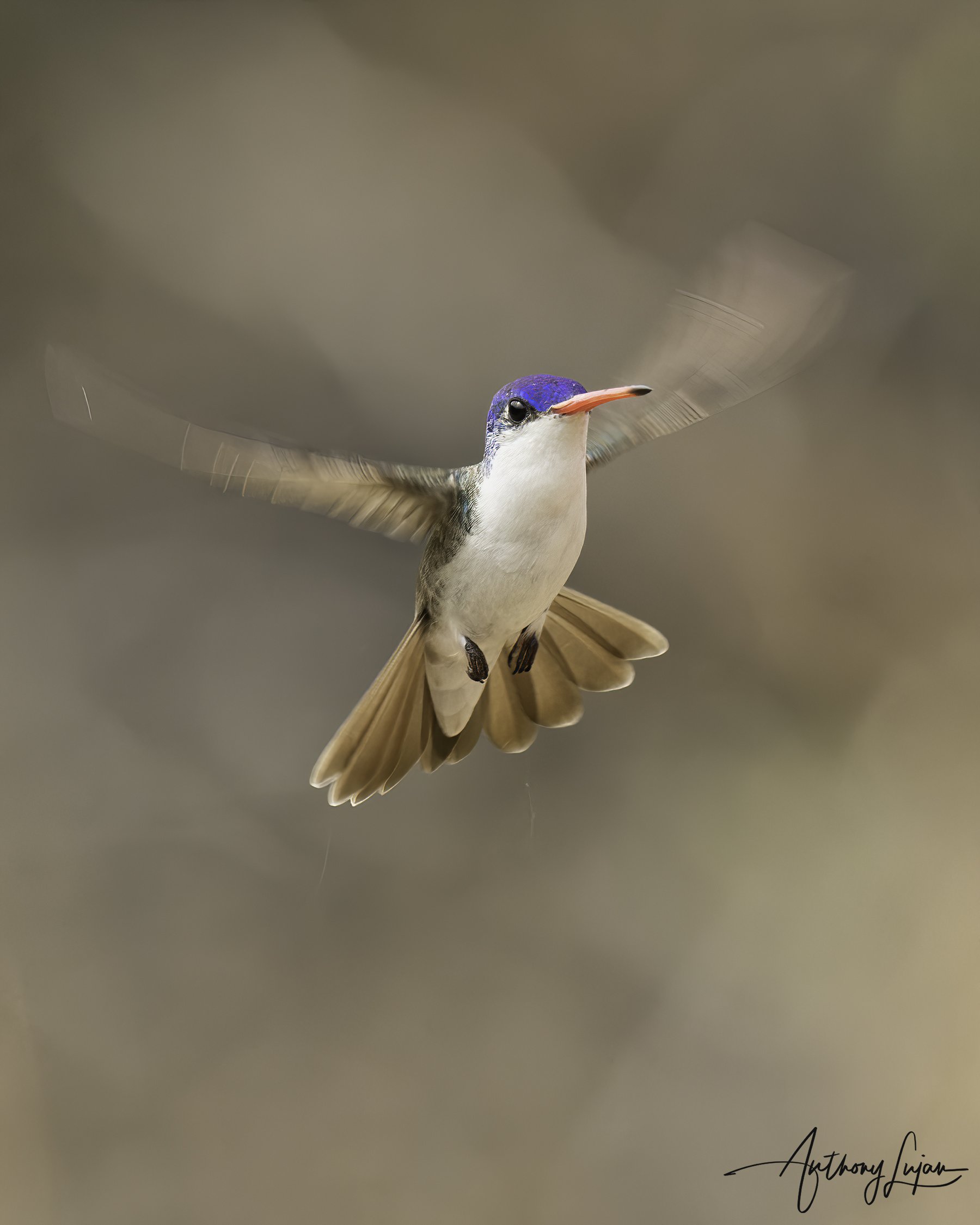
Below is the Green-fronted Hummingbird (Ramosomyia viridifrons viridifrons)
Photographed at La Pintada, Atoyac de Álvarez, Guerrero, Mexico
This individual belongs to the nominate subspecies viridifrons, which ranges along the Pacific slope of southern Mexico from eastern Guerrero through western Oaxaca, extending to central Chiapas. It inhabits dry to semi-humid pine–oak forest, scrub, and coffee plantations between 600 and 1,800 meters.
Checkout Anthony’s playlist of this species! Click the top right dropdown to see all the videos.
Related species in the Ramosomyia genus (2 species in total):
Please note: The content provided in this article reflects Anthony’s personal experience and photographic approach. Results can vary depending on light, weather, location, equipment, subject behavior, and field conditions.