
Green-fronted Lancebill
Scientific name: Doryfera ludovicae
The Green-fronted Lancebill is a long-billed hummingbird of humid Central and South American mountains, strongly tied to forested streams and ravines. An estimated 500,000–4,999,999 mature individuals exist, the population is considered stable, it is an altitudinal migrant, and it is currently listed as Least Concern with two recognized subspecies.
At a Glance
Family: Trochilidae (hummingbirds)
Clades: Polytminae – Mangoes
Genus group: Doryfera — straight, lance-billed hummingbirds of humid forests (2 species total)
Range: Disjunct between the Talamancan mountains of Costa Rica–Panama and the northern Andes from western Venezuela and Colombia south to northwestern Bolivia.
Habitat: Subtropical and tropical moist montane forest, cloudforest, and forest edges, especially along fast-flowing streams, ravines, and waterfalls.
Elevation: Roughly 400–2,500 m (1,300–8,200 ft), most common between about 1,000 and 2,000 m.
Length: About 11–13 cm (4.3–5.1 in), much of it bill.
Weight: About 5–6 g (0.18–0.21 oz).
Number of mature individuals: 500,000–4,999,999
Population trend: Stable
Status: Least Concern (IUCN)
Name Origin
The genus name Doryfera combines Greek roots for “spear” and “bearing,” referring to the very long, straight, spear-like bill of lancebills. The species name ludovicae honors a person named Ludovica (or Ludovico) commemorated in the original description. The English name “Green-fronted Lancebill” highlights the shimmering green patch on the forehead and the characteristic lance-like bill.
Subspecies & Distribution
Two subspecies:
Doryfera ludovicae veraguensis
Distribution: North-central Costa Rica to western Panama (Veraguas), occupying humid forested mountain slopes, cloudforest, and stream corridors of the Talamancan montane forests.Doryfera ludovicae ludovicae
Distribution: Extreme eastern Panama (Cerro Tacarcuna) and the Andes from western Venezuela and Colombia south to northwestern Bolivia, occurring mainly on the eastern Andean slope south from central Ecuador.
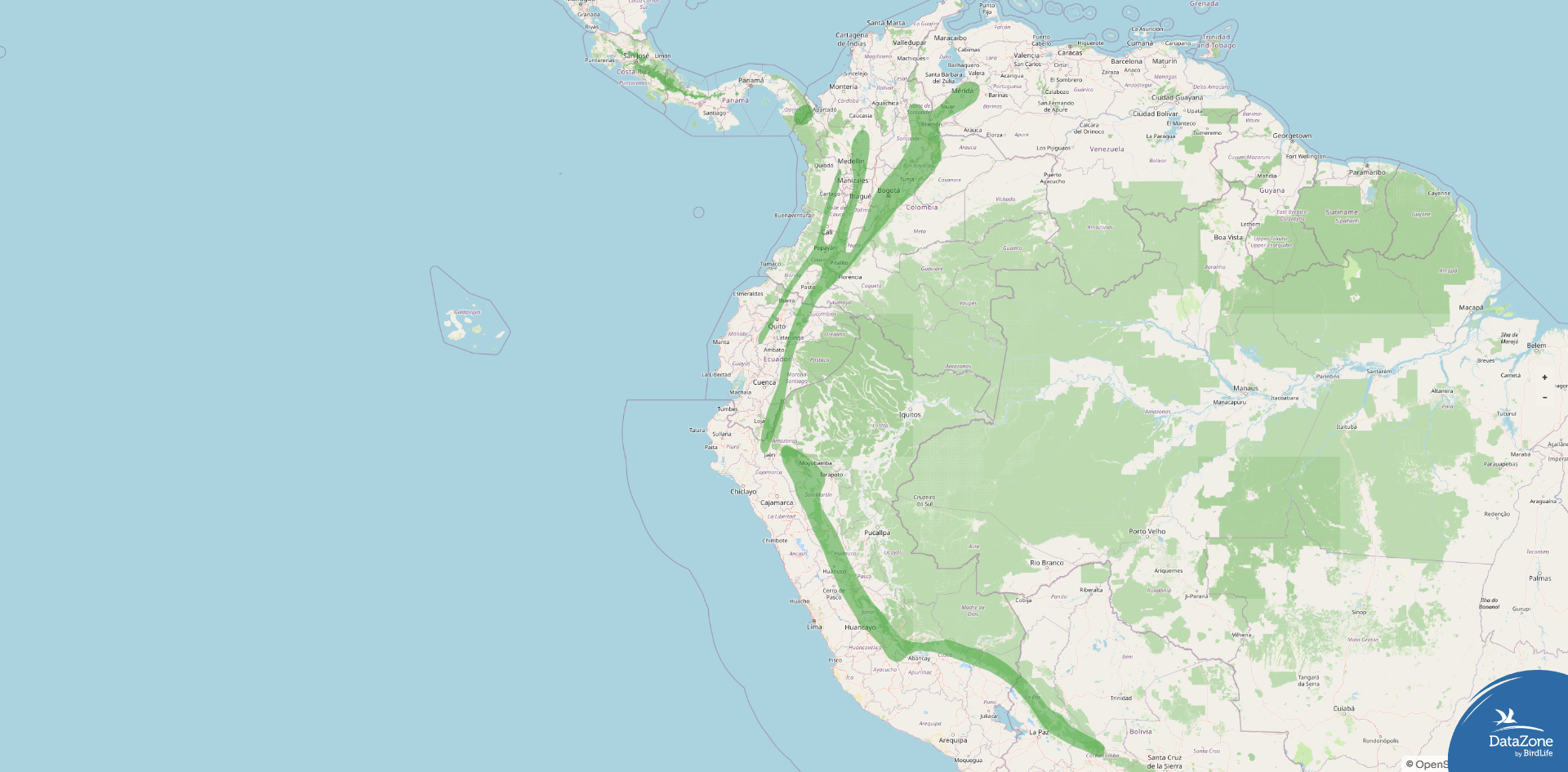
Legend
Green Resident
Species Overview
The Green-fronted Lancebill is a medium-sized hummingbird with an exceptionally long, straight bill and a glittering green forehead, adapted to life along fast-moving mountain streams. It inhabits humid montane forests and cloudforests, particularly ravines and waterfalls where spray-loving plants bloom. Although its range is broad and fragmented between Central America and the Andes, it remains locally fairly common where intact streamside forest persists.
Male Description
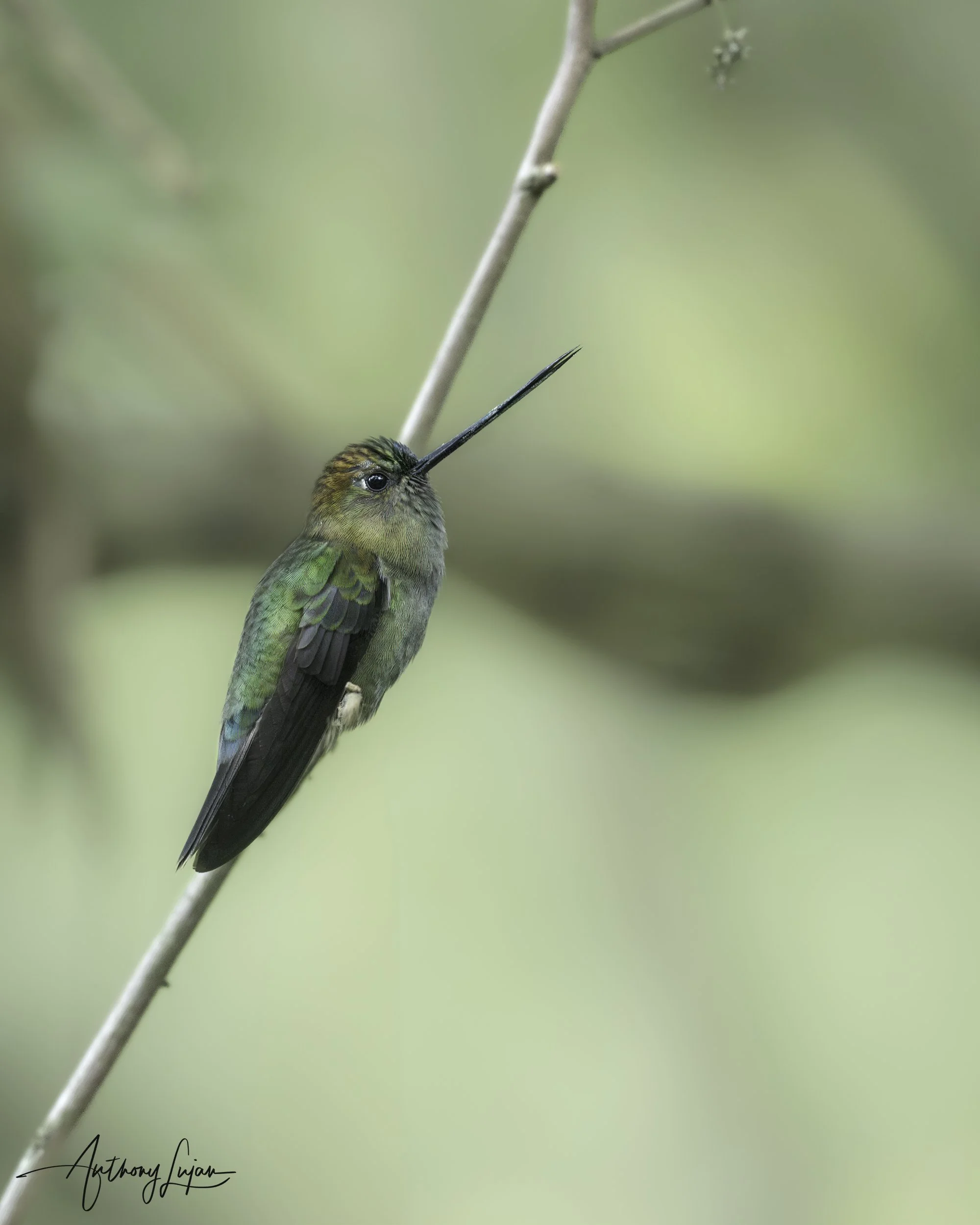
Adult males have a very long, straight, spear-like black bill and a distinctive glittering green patch on the forehead (“green-fronted”). The crown and upperparts are dark bronzy to metallic green, and the wings are dusky. The throat and chest are dark gray to sooty with a slight green gloss, fading to paler grayish or buffy underparts toward the belly. The tail is relatively short, dark, and slightly forked or rounded. In the field, males appear as dusky, long-billed hummingbirds whose forehead flashes bright green when light hits at the right angle.
Female Description
Adult females resemble males in overall structure, including the long, straight bill, but are somewhat duller. The green forehead patch may be less extensive or less intense, and the underparts are paler grayish to buff with more diffuse shading. Females often show slightly more contrast between the darker throat and paler belly, and may have subtle spotting or mottling on the throat. The tail is similar to the male’s, dark and slightly notched. Overall, females present as long-billed, mostly dark hummingbirds with a muted green forehead and paler underparts.
Habitat & Behavior
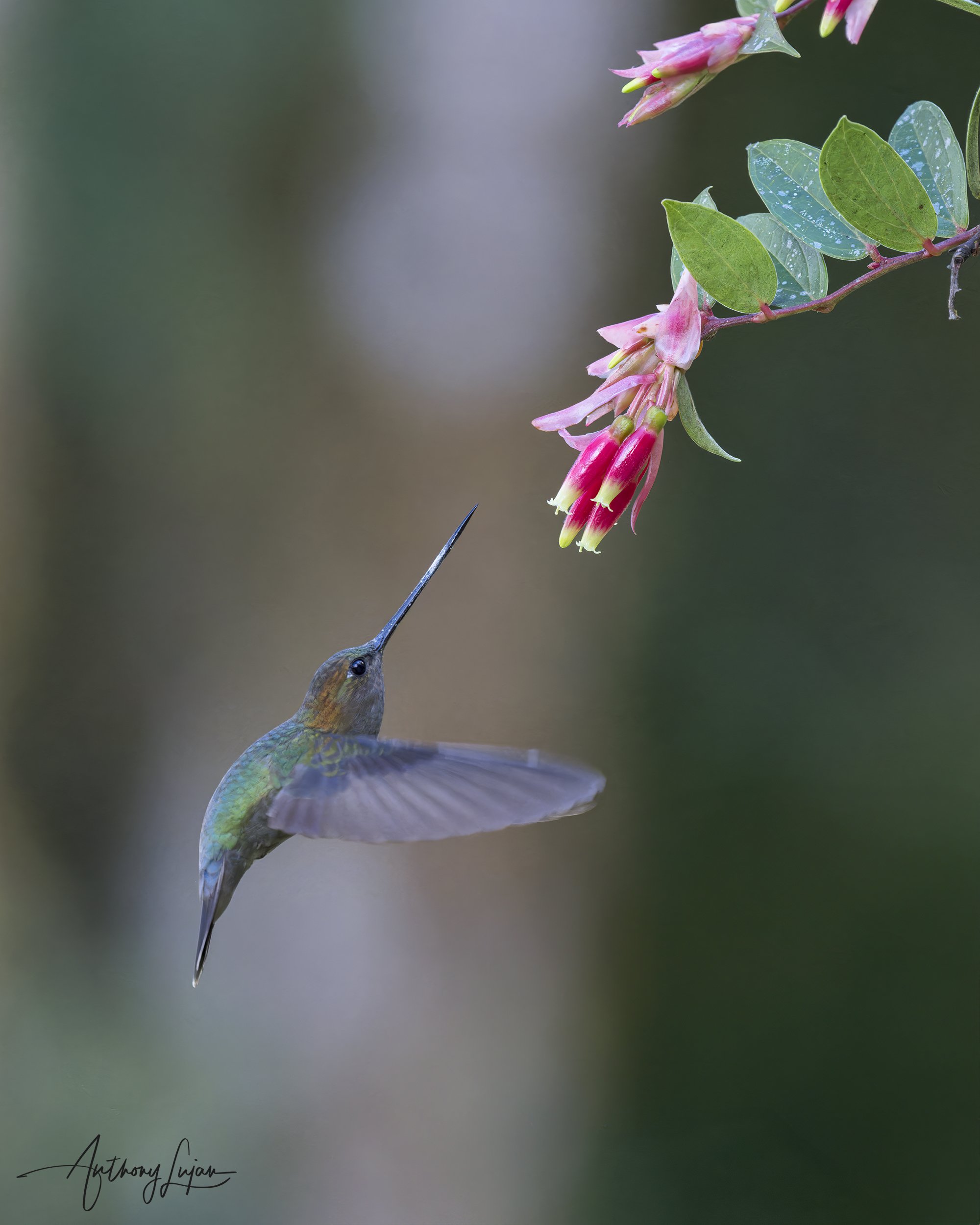
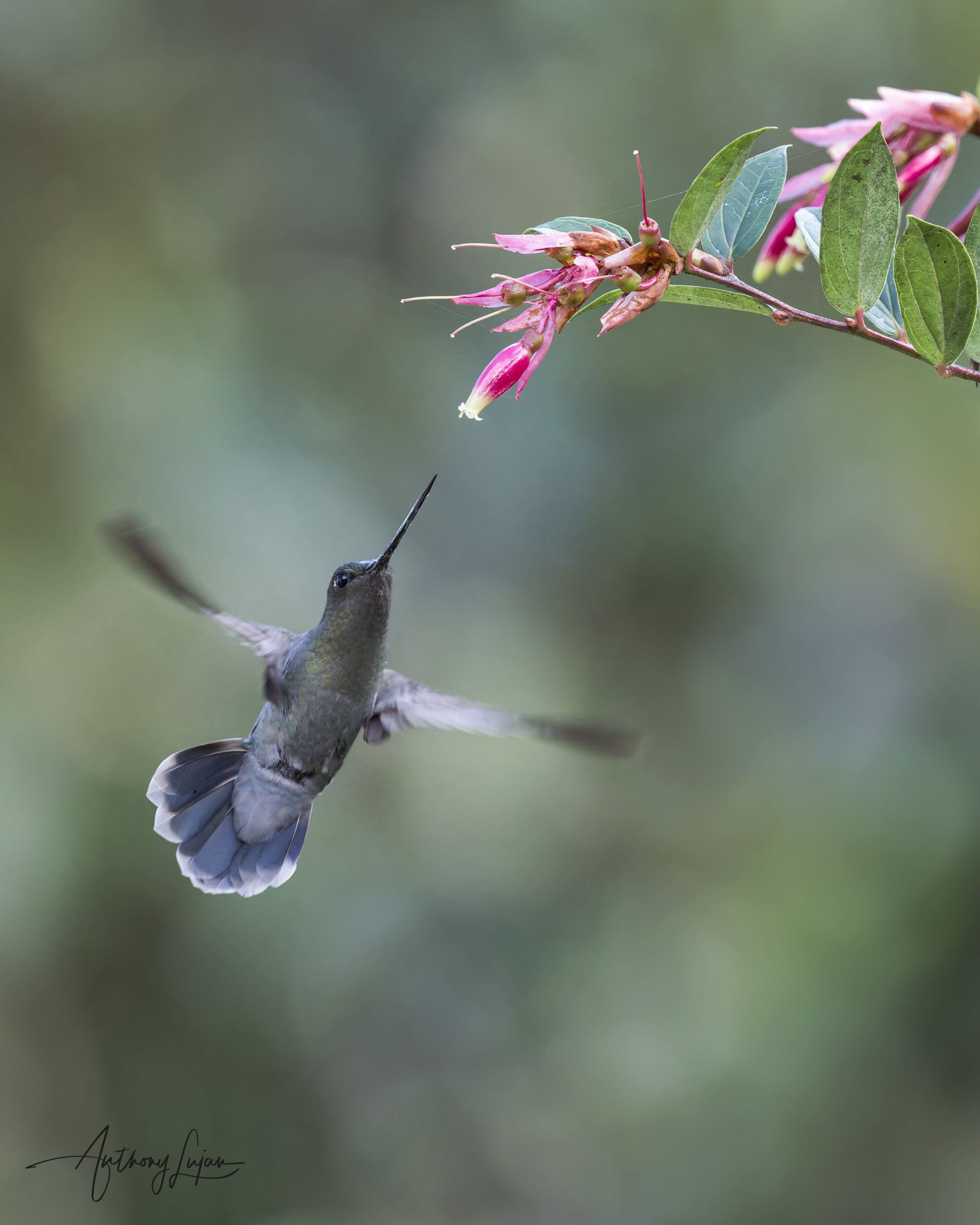
Green-fronted Lancebills are closely associated with humid montane and cloudforests, especially along fast-flowing rivers, streams, and waterfalls where spray nourishes dense epiphytes and tubular flowers. They typically forage in the middle strata and lower canopy, probing deep, tubular flowers on overhanging vegetation along ravines and stream banks using their long, straight bills. They also capture small insects, often sallying out from perches over or near water. The species is an altitudinal migrant, shifting up and down mountain slopes in response to flowering and seasonal conditions, but it does not undertake long-distance migrations.
Population
With an estimated 500,000–4,999,999 mature individuals across Central America and the northern Andes, the Green-fronted Lancebill is still relatively numerous. It is patchily distributed, concentrating around suitable forested streams and waterfalls rather than evenly spread through the forest matrix. Because many such habitats remain in rugged terrain and in protected areas, its overall population is currently assessed as stable, despite localized habitat loss.

Conservation
The Green-fronted Lancebill is listed as Least Concern, aided by its broad range from Costa Rica to Bolivia and its occurrence in several national parks and reserves. However, deforestation, road building, hydroelectric projects, and other disturbances that affect forested rivers and ravines can degrade its specialized habitat. Protecting riparian corridors, maintaining intact cloudforest and montane forest along streams, and limiting large-scale alteration of mountain river systems will help secure this species and other stream-dependent hummingbirds.
Below is the Green-fronted Lancebill (Doryfera ludovicae veraguensis)
Photographed at Reserva Ecológica Río Blanco, Caldas; RN Retorno del Colibrí, Tolima; and Owlet Lodge, Amazonas, Peru
These individuals belong to the subspecies veraguensis, which ranges from eastern Panama south through Colombia, Ecuador, and into Peru. It inhabits humid montane forest, particularly along fast-flowing streams, between 1,000 and 2,400 meters.

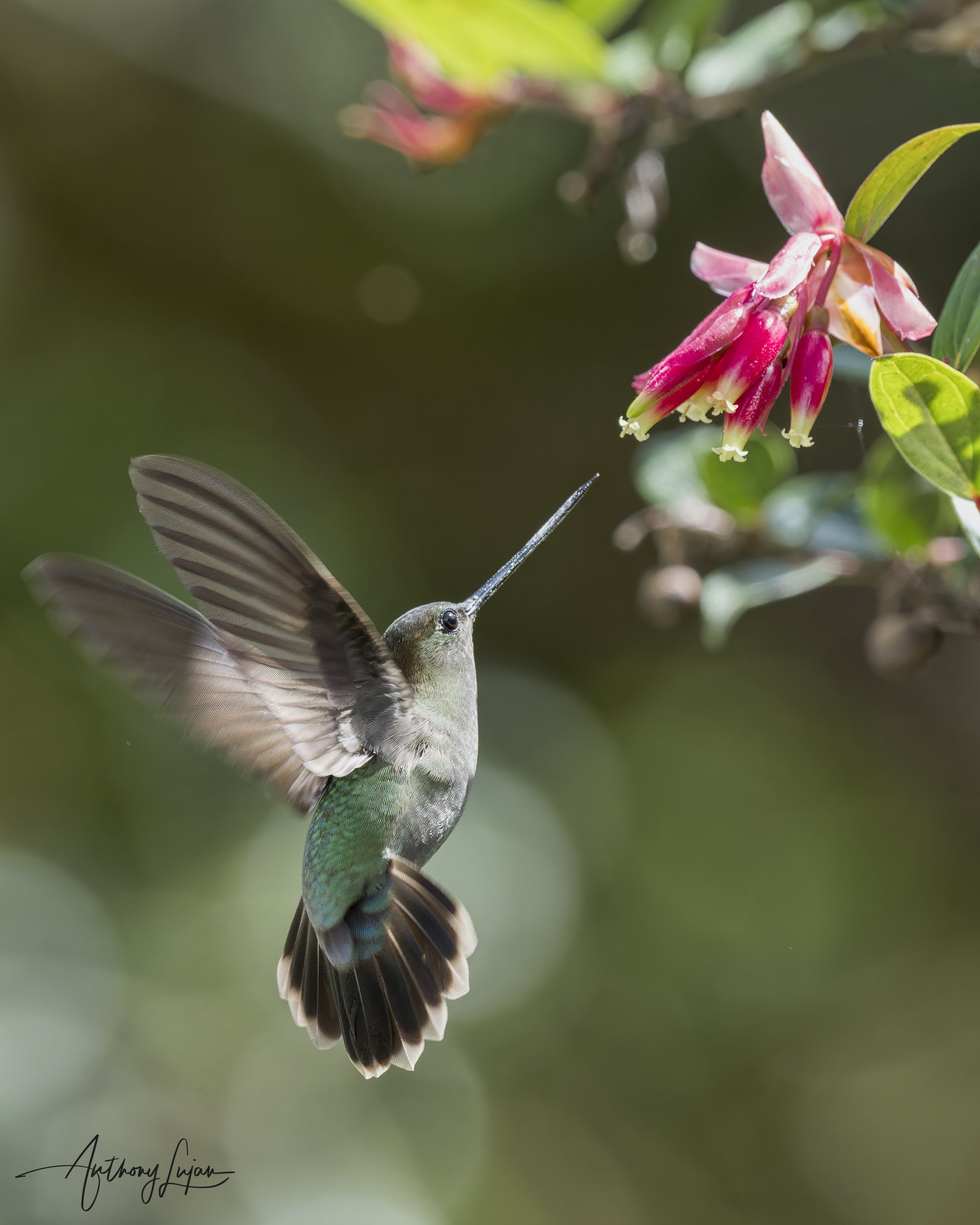
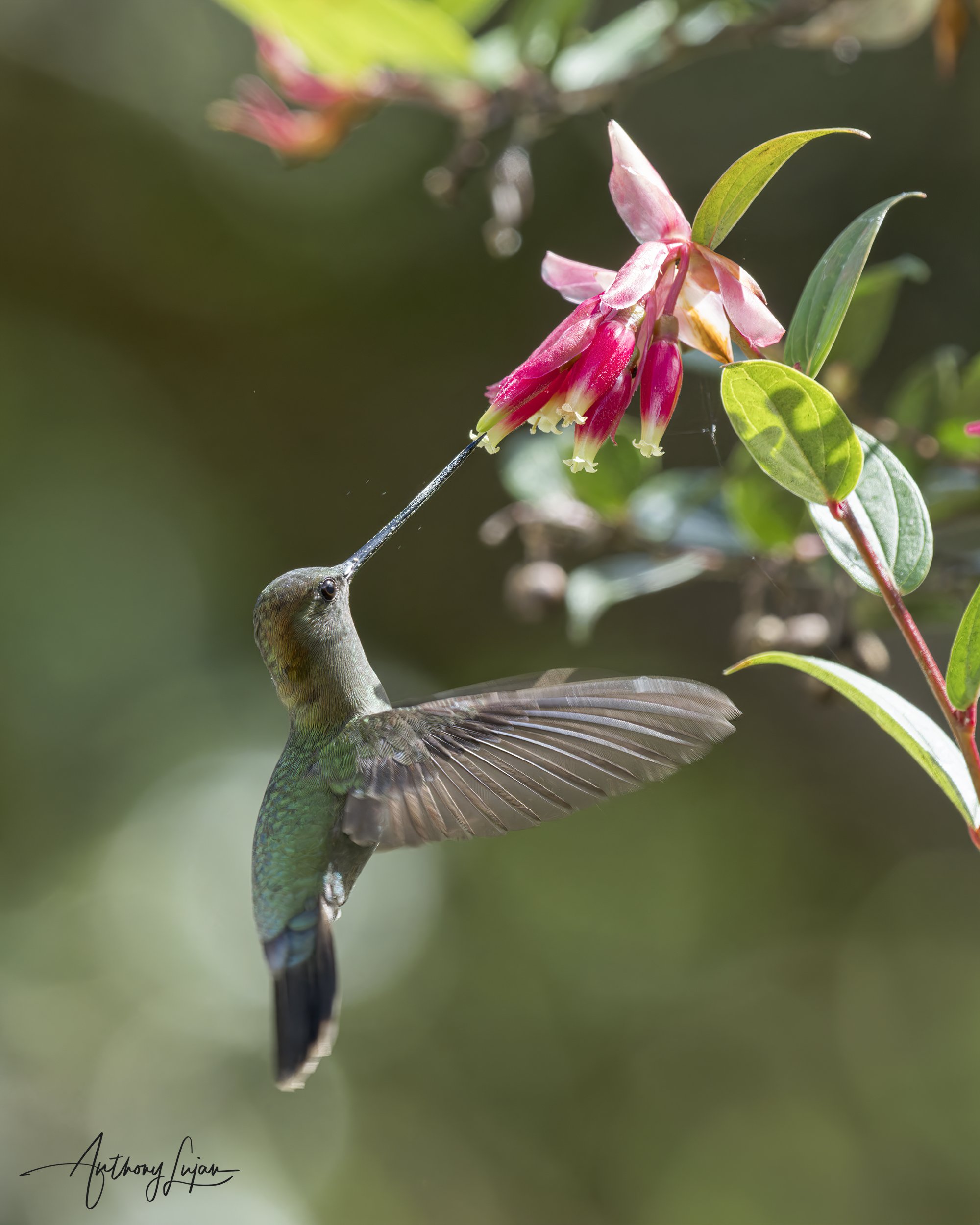
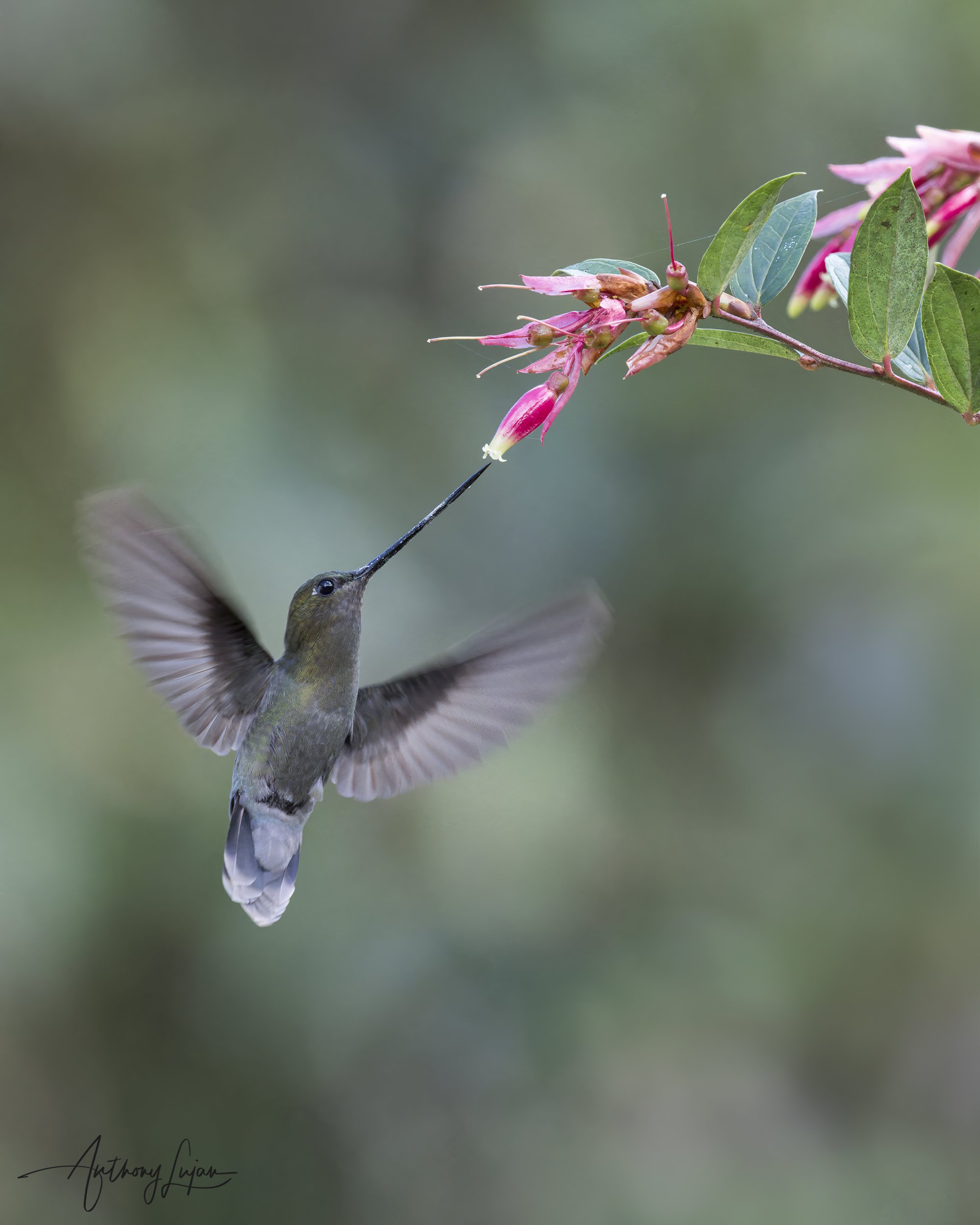
Checkout Anthony’s playlist of this species! Click the top-right dropdown to see all the videos.
Below is the Green-fronted Lancebill (Doryfera ludovicae ludovicae)
Photographed at Hotel Quelitales, Cartago, Costa Rica
This individual belongs to the subspecies ludovicae, found in the highlands of Costa Rica and western Panama, typically along forested mountain streams between 900 and 2,000 meters.
Related species in the Doryfera genus (2 species total):
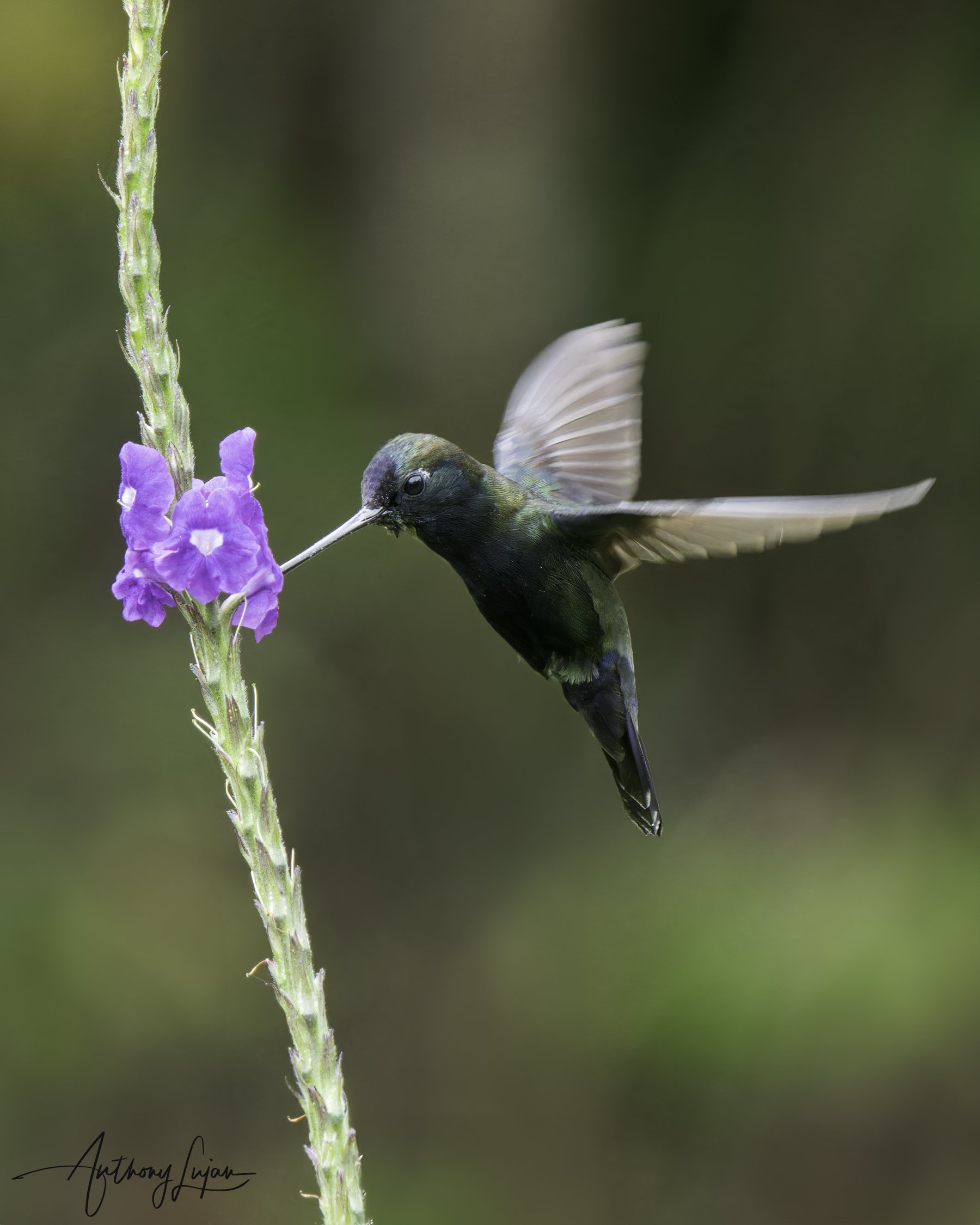
Please note: The content provided in this article reflects Anthony’s personal experience and photographic approach. Results can vary depending on light, weather, location, equipment, subject behavior, and field conditions.