
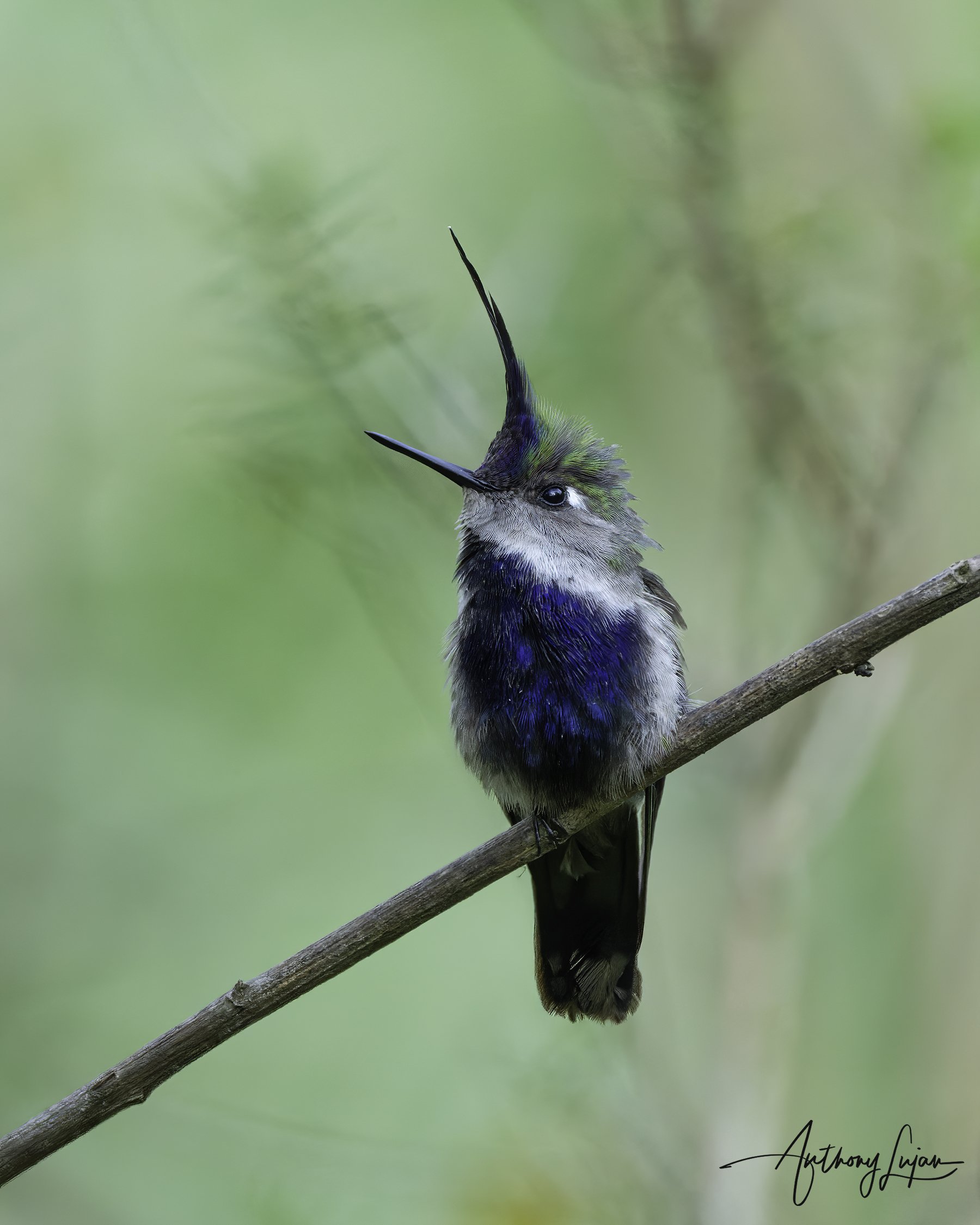
Scientific name: Stephanoxis loddigesii
The Purple-crowned Plovercrest is a small, crested hummingbird of forest understory, scrub, and riverine vegetation in southern Brazil, eastern Paraguay, and far northeastern Argentina. Its number of mature individuals and population trend are both unknown, it is considered non‑migratory, and it is currently assessed as Least Concern.
At a Glance
Family: Trochilidae (hummingbirds)
Clade: Trochilini – Emeralds
Genus: Stephanoxis — 2 species in total
Range: Southern Brazil, eastern Paraguay, and far northeastern Argentina
Habitat: Understory of forest, scrublands, and vegetation along watercourses; also forest edges and semi‑open woodland with patches of scrub
Elevation: From near sea level up to about 900 m (3,000 ft)
Length: About 8.5–9.5 cm (3.3–3.7 in)
Weight: Males about 3.7 g; females slightly lighter
Number of mature individuals: Unknown
Population trend: Unknown
Movement: Not a migrant (mostly sedentary, with short local shifts)
IUCN Red List category: Least Concern
Name Origin
The common name “Purple-crowned Plovercrest” refers to the male’s prominent purple crest, recalling the shape of a plover’s raised crown feathers. The genus name Stephanoxis combines Greek elements meaning “crown” and “sharp,” referring to the pointed, elevated crest. The species name loddigesii honors the English nurseryman and naturalist Conrad Loddiges, for his contributions to early ornithology and plant collections.
Taxonomy & Distribution
Stephanoxis loddigesii belongs to the emerald clade (tribe Trochilini) within the hummingbird family Trochilidae. It forms one of two species in the genus Stephanoxis, alongside the Green-crowned Plovercrest (Stephanoxis lalandi). Historically these two were lumped as a single species (“Plovercrest”), but they are now widely treated as separate, monotypic species based on differences in plumage, range, and genetics. The Purple-crowned Plovercrest is found in southern Brazil (south from southern São Paulo into Paraná, Santa Catarina, and Rio Grande do Sul), eastern Paraguay, and far northeastern Argentina (Misiones), where it occupies forest and scrubby habitats within and around the southern Atlantic Forest region.
Subspecies and Distribution
Monotypic — no subspecies recognized.
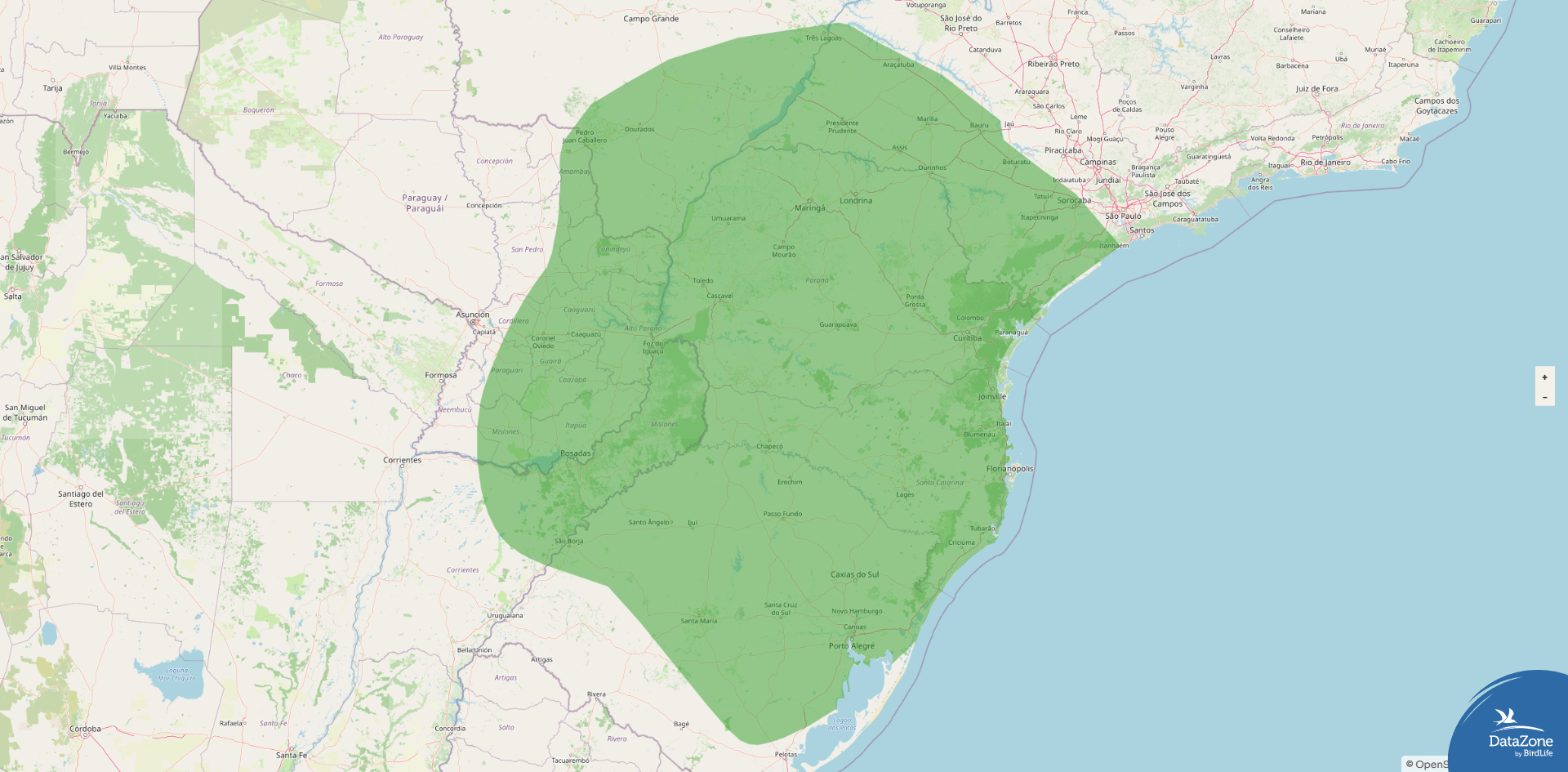
Legend
Green Resident
Species Overview
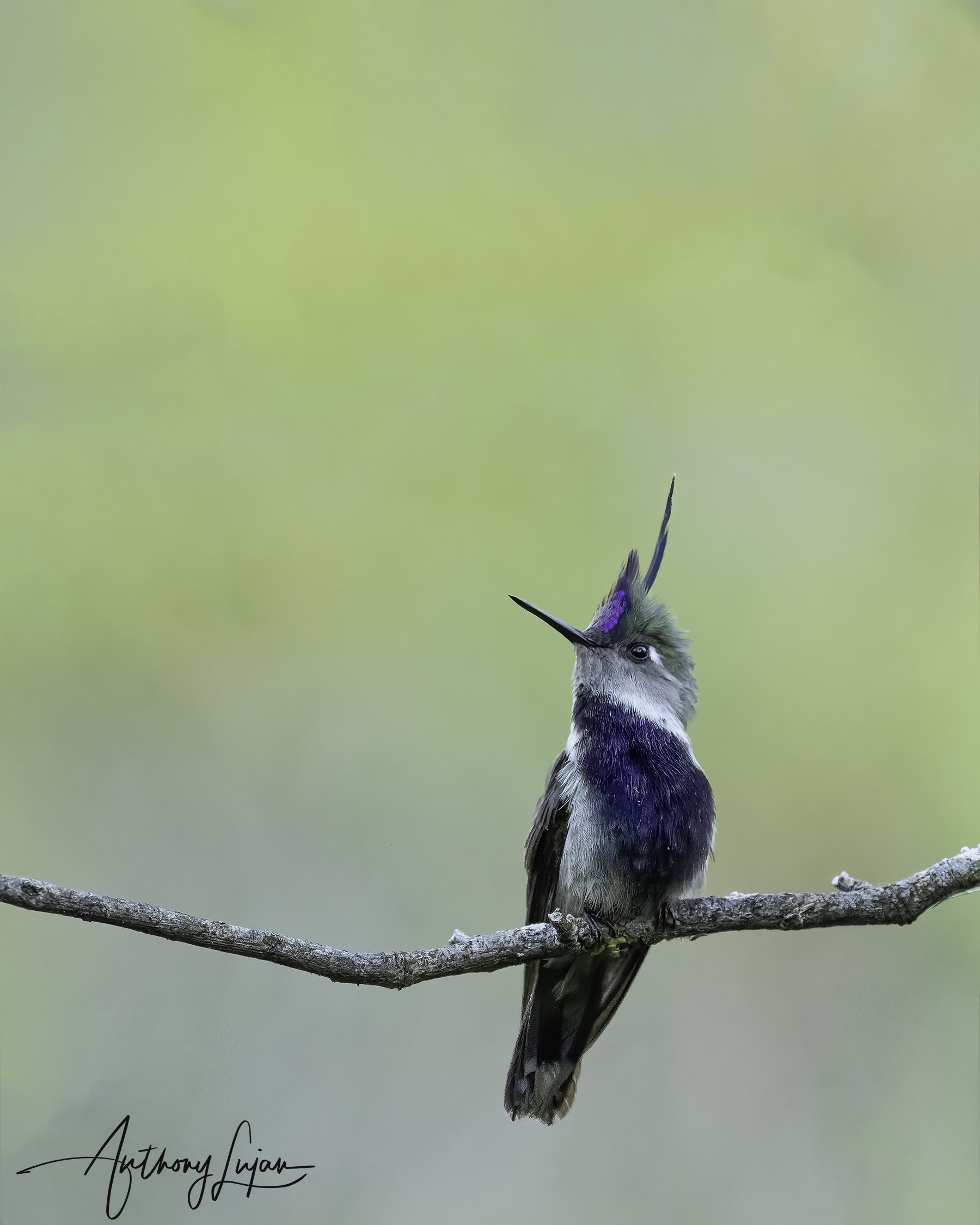
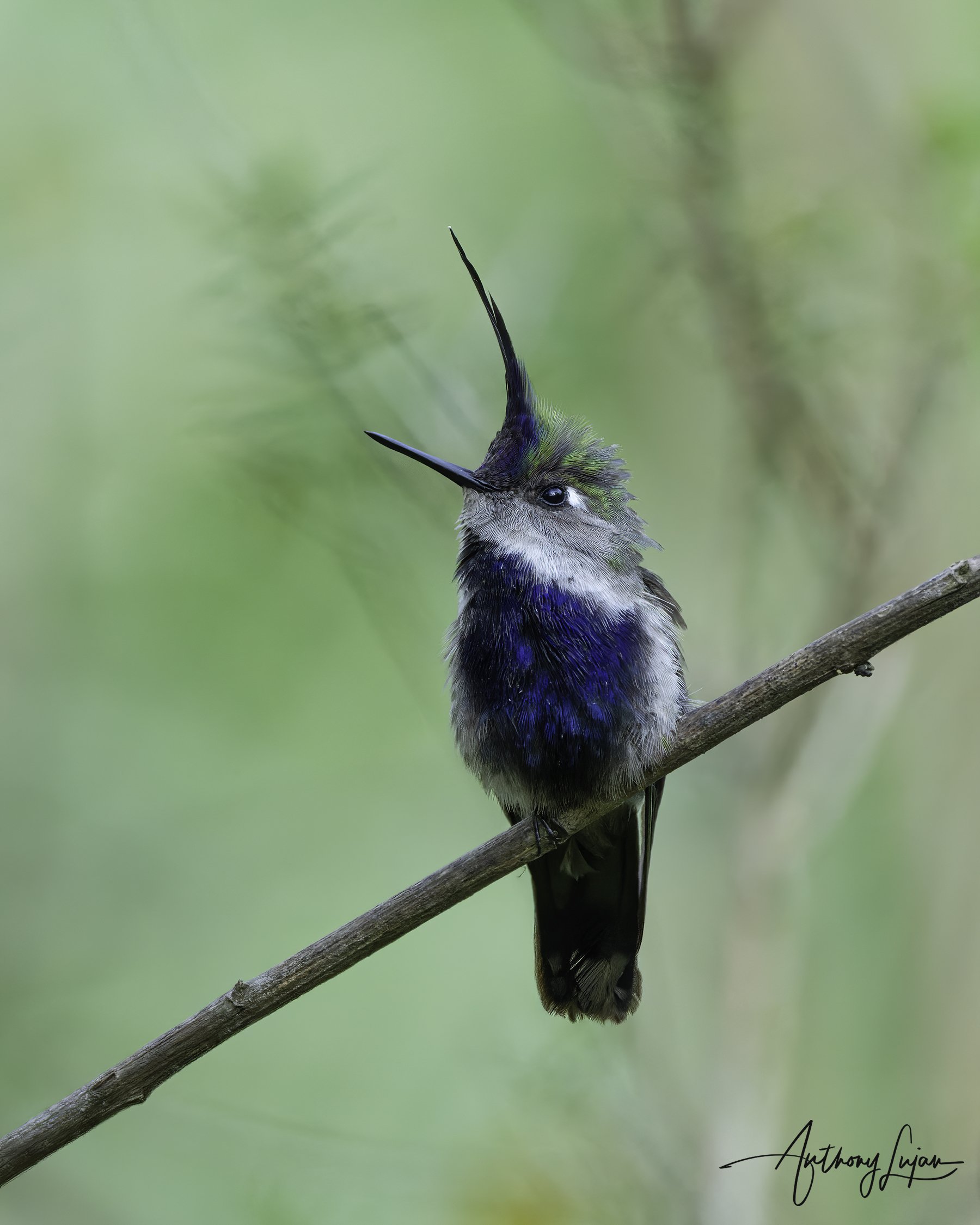
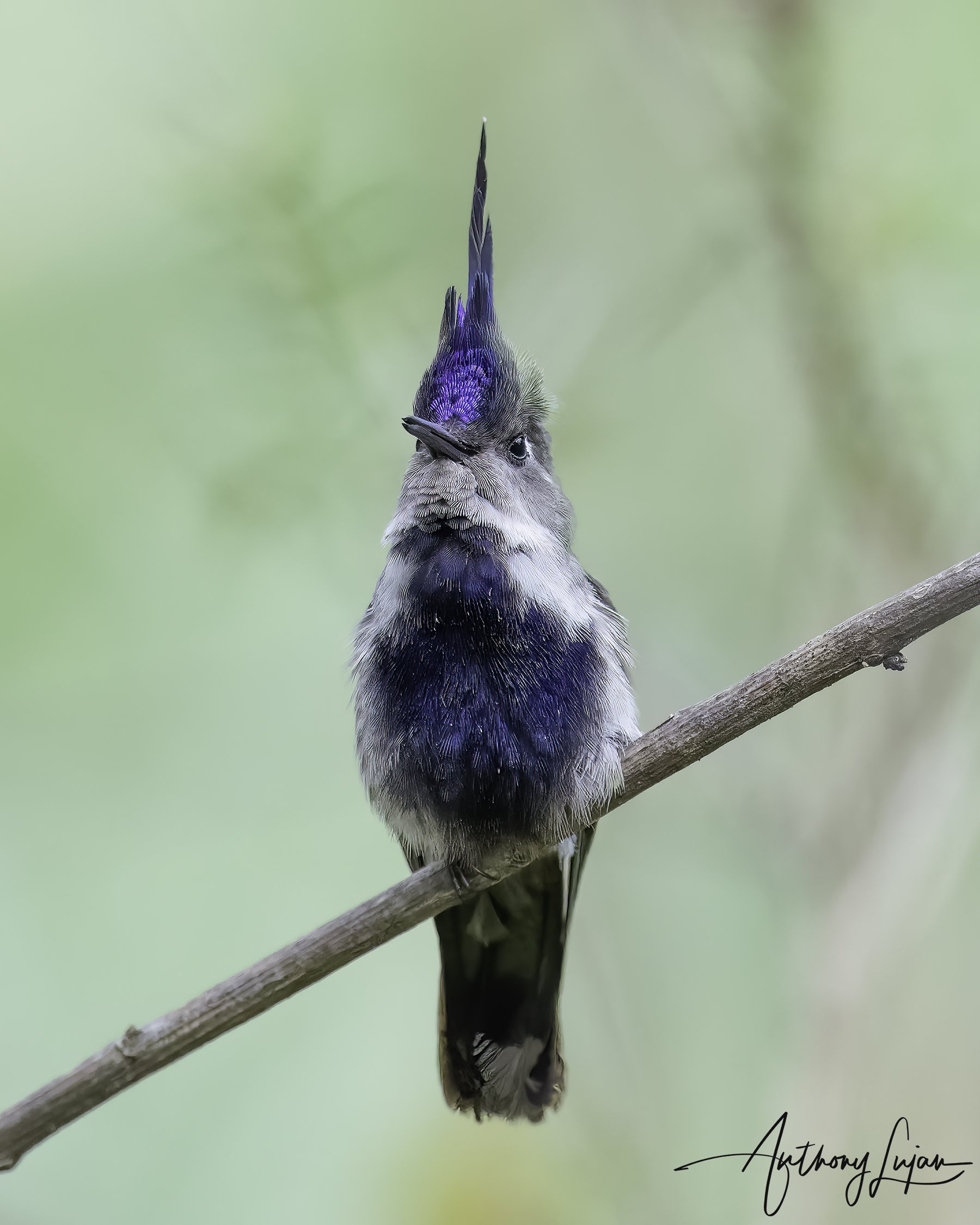
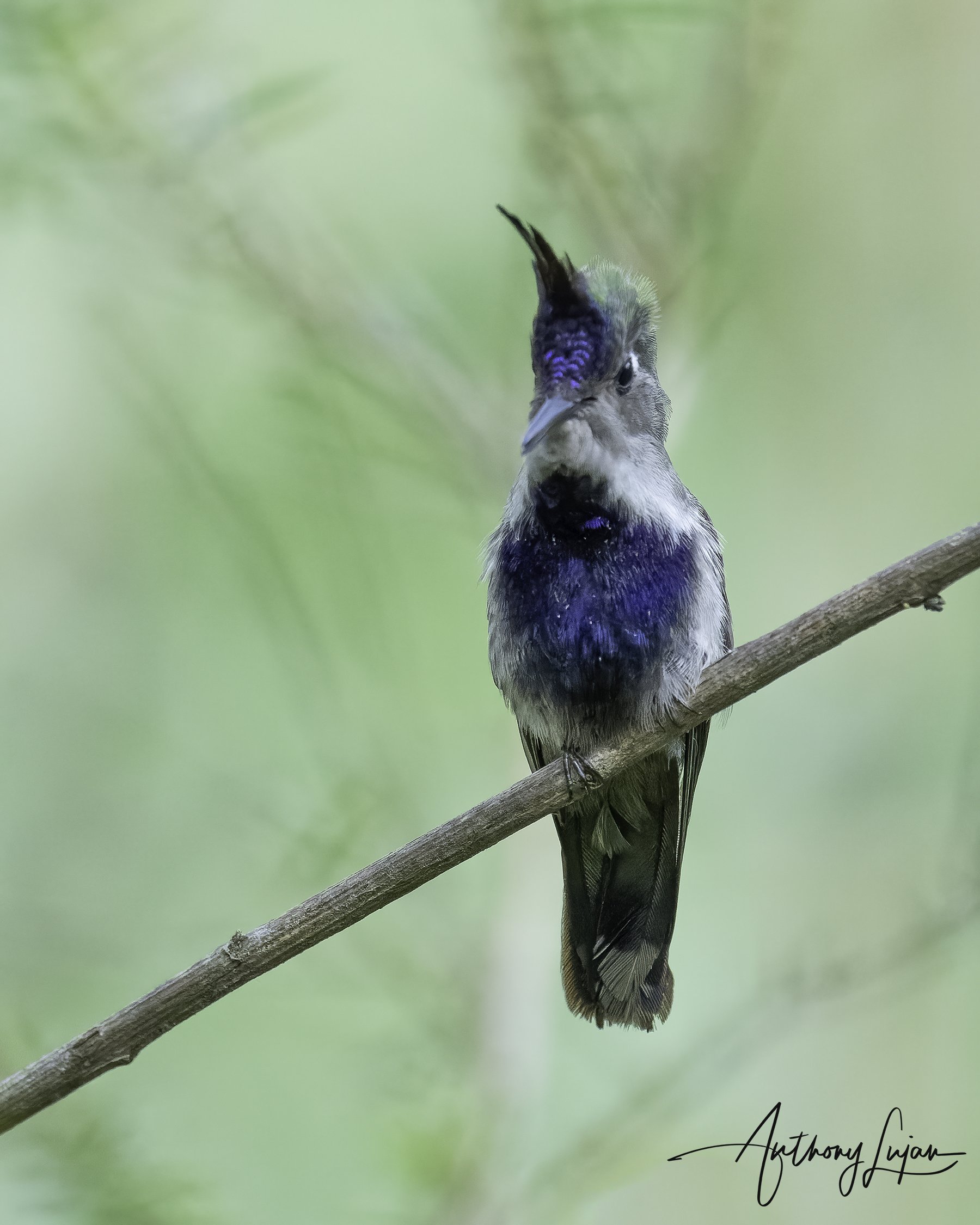
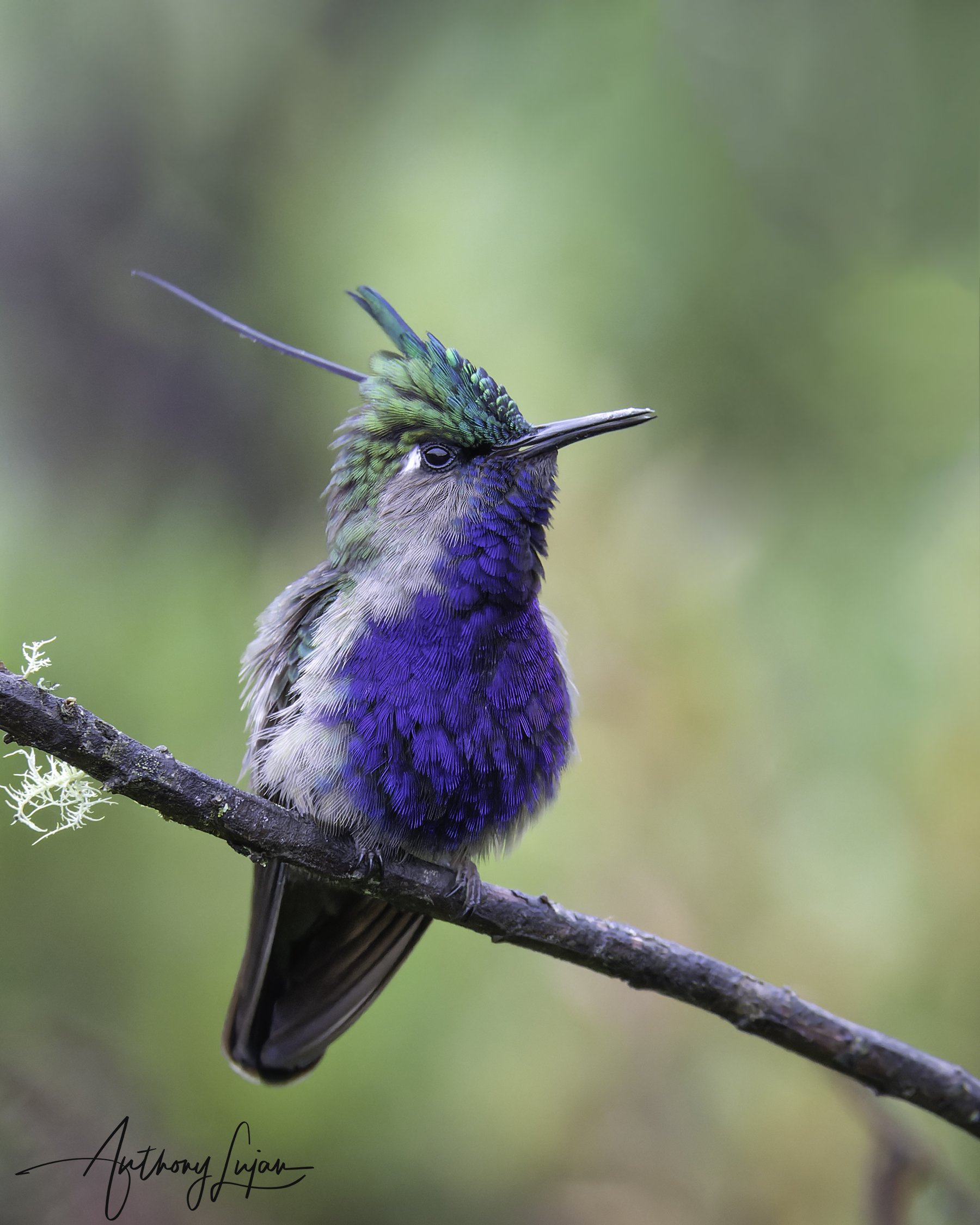
The Purple-crowned Plovercrest is a striking hummingbird whose male sports a tall, violet‑purple crest and richly colored underparts, making it one of the most distinctive small hummingbirds in southern Brazil and neighboring regions. It inhabits forest understory and scrubby edges, often near streams or in moist ravines, and regularly uses semi‑open, man‑modified landscapes that retain patches of native scrub or woodland. Though patchily distributed, it can be locally common where suitable habitat persists, especially in and near protected areas.
Male Description
Adult males have metallic green upperparts and a short, straight black bill. The most distinctive feature is the elongated, upright purple crest, which can be raised dramatically during display or flattened at rest. The throat and upper breast are violet to purplish, blending into grayish to whitish lower underparts with some green mottling along the flanks. A small white post‑ocular spot is usually visible behind the eye. The tail is relatively short, greenish with small white tips on the outer tail feathers, less extensive than in the Green-crowned Plovercrest. When displaying, the male raises the crest, fans the tail, and flares his violet throat to emphasize his colors.
Female Description
Females lack the male’s large, vivid purple crest, instead showing a much shorter, less conspicuous green crest. The upperparts are green, and the underparts are mostly grayish to whitish with a faint buff or greenish wash on the flanks, lacking the solid violet breast of the male. A white post‑ocular spot is present and often more obvious than in males. The outer tail feathers show white tips, usually slightly larger than in males, and overall the female appears plainer and lighter below. Juveniles resemble females, with reduced crest and duller colors; young males gradually develop the full purple crest and richer underparts as they age.
Habitat & Behavior
Purple-crowned Plovercrests inhabit the understory of subtropical and tropical moist forests, scrublands, and dense vegetation along watercourses within the southern Atlantic Forest region and adjacent wooded areas. They also occur in semi‑open woodland, forest edges, and farmland mosaics where patches of scrub or secondary forest remain. Birds typically forage at low to mid‑levels, visiting tubular flowers of shrubs, vines, and small trees, and they are frequent users of flowering garden plants in rural areas.
They feed primarily on nectar, hovering at blossoms or briefly perching to reach flowers, and they supplement their diet with small insects and spiders captured in short aerial sallies or gleaned from foliage. Males often display from favored perches, raising their crest and singing or calling, and may gather in loose leks where several males perform within earshot of one another. Outside the breeding season, birds usually occur singly or in pairs and may defend small, flower‑rich feeding territories.
Breeding
The breeding season varies locally but generally falls within the austral spring and summer, roughly from September through February, when flowers and insects are most abundant. Males display at leks or solitary display sites, where they repeatedly raise their crests and give vocalizations to attract females. After mating, the female alone constructs the nest and cares for the young.
The nest is a tiny cup composed of plant fibers, down, and spiderweb, often generously adorned on the outside with lichen or small bits of bark for camouflage. It is typically placed on a horizontal branch or in a fork in shrubs or small trees, in the forest understory or at edges, a few meters above the ground. The clutch consists of two white eggs. The female handles all incubation and chick‑rearing; incubation lasts around two weeks, and fledging follows after roughly three weeks, with some variation depending on weather and local conditions.
Movement
The Purple-crowned Plovercrest is mostly sedentary throughout its range and is classed as not a migrant. In the southernmost parts of its distribution, some individuals may move to slightly lower elevations during the cooler months, shifting between lowland and foothill sites or between more closed forest and more open, scrubby habitats as flowering patterns change. These movements are short‑distance and local, and the species remains within southern Brazil, eastern Paraguay, and nearby Argentina year‑round.
Population
The total number of mature individuals is unknown, and the overall population trend is also considered unknown. Within its range, the species is patchily distributed, being locally common in suitable habitats in parts of southern Brazil but uncommon to rare in Paraguay and more restricted in northeastern Argentina. Its ability to use man‑modified landscapes that retain patches of scrub or woodland helps it persist outside extensive primary forest, though historical deforestation in the Atlantic Forest region has almost certainly reduced the total amount of optimal habitat.

Conservation
The Purple-crowned Plovercrest is currently assessed as Least Concern, with no immediate, large‑scale threats identified, but the lack of robust data on population size and trend introduces some uncertainty. Ongoing habitat loss and fragmentation in the Atlantic Forest region, conversion of forest and scrub to agriculture or pasture, and local degradation of riverine vegetation all have the potential to impact this species. It occurs in several national parks, reserves, and private protected areas, and it readily accepts farmland and semi‑open landscapes as long as patches of scrub or forest remain. Conservation actions that protect and restore Atlantic Forest remnants, riparian corridors, and shrubby edges will benefit this species, along with many other endemic and near‑endemic birds of the region.
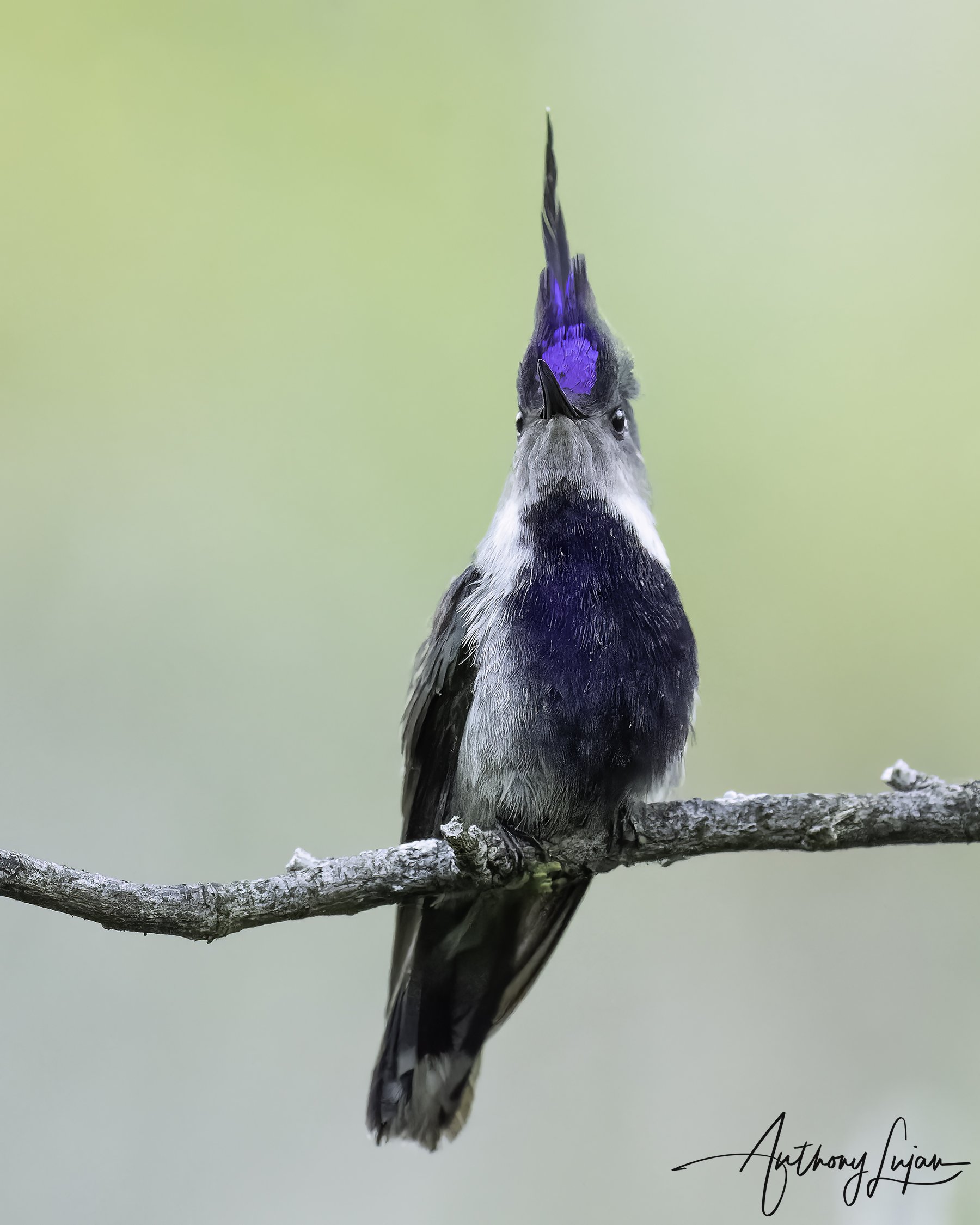
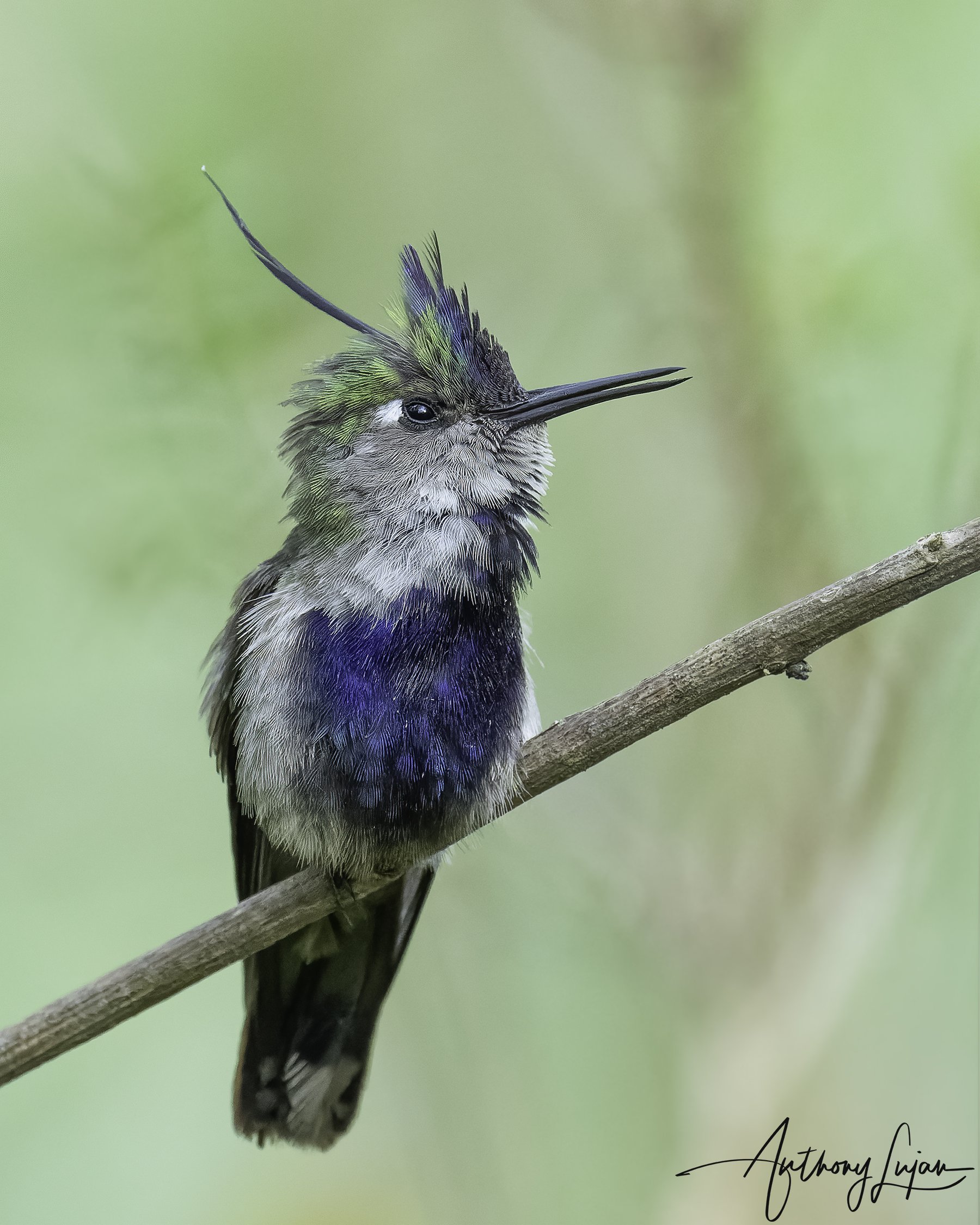
Checkout Anthony’s playlist of this species! Click the top right dropdown to see all the videos.
Related species in the Stephanoxis genus (2 species in total):
Please note: The content provided in this article reflects Anthony’s personal experience and photographic approach. Results can vary depending on light, weather, location, equipment, subject behavior, and field conditions.