
Purple-crowned Fairy
Scientific name: Heliothryx barroti
The Purple-crowned Fairy is a slim, long-tailed hummingbird found from southeastern Mexico through Central America to western Colombia and southwestern Ecuador. The number of mature individuals is unknown, its population trend is Decreasing, and it is currently assessed as Least Concern.
At a Glance
Family: Trochilidae (hummingbirds)
Clade: Polytminae – mangoes and fairies
Genus: Heliothryx — fairies, slim long-tailed hummingbirds with bright white and iridescent green contrasts
Range: From southeastern Mexico south through Belize, Guatemala, Honduras, Nicaragua, Costa Rica, and Panama to the Pacific slopes of Colombia, Ecuador, and far northern Peru
Habitat: Canopy and edges of humid lowland forest, shady plantations, and mature secondary forest
Elevation: From sea level to about 500 m in Mexico and northern Central America, up to around 1,675 m in Costa Rica, 1,000 m in Colombia, and 800 m in Ecuador
Length: About 9–13 cm (3.5–5.1 in)
Weight: Around 5–6 g
Number of mature individuals: Unknown
Population trend: Decreasing
Status: Least Concern (IUCN)
Name Origin
The genus name Heliothryx combines elements meaning “sun” and “hair,” likely referring to the bright, shining plumage and fine feathering of these fairies. The species name barroti honors French ornithologist and collector Charles B. Barrot. The English name “Purple-crowned Fairy” emphasizes the male’s shimmering violet crown and the bird’s light, graceful, fairy-like appearance.
Subspecies & Distribution
Purple-crowned Fairy is monotypic, with no recognized subspecies.
It occurs from eastern Chiapas and southern Tabasco in Mexico south through the Caribbean slopes of Belize, Guatemala, and Nicaragua; both slopes of Costa Rica; much of Panama; and the Pacific slopes of Colombia, Ecuador, and far northern Peru, also reaching the lower Magdalena Valley in Colombia. Across this range it inhabits humid lowland and foothill forests, especially the canopy and edges, shady plantations, and mature secondary forest, occurring from sea level in some areas up to mid-elevations depending on the country.
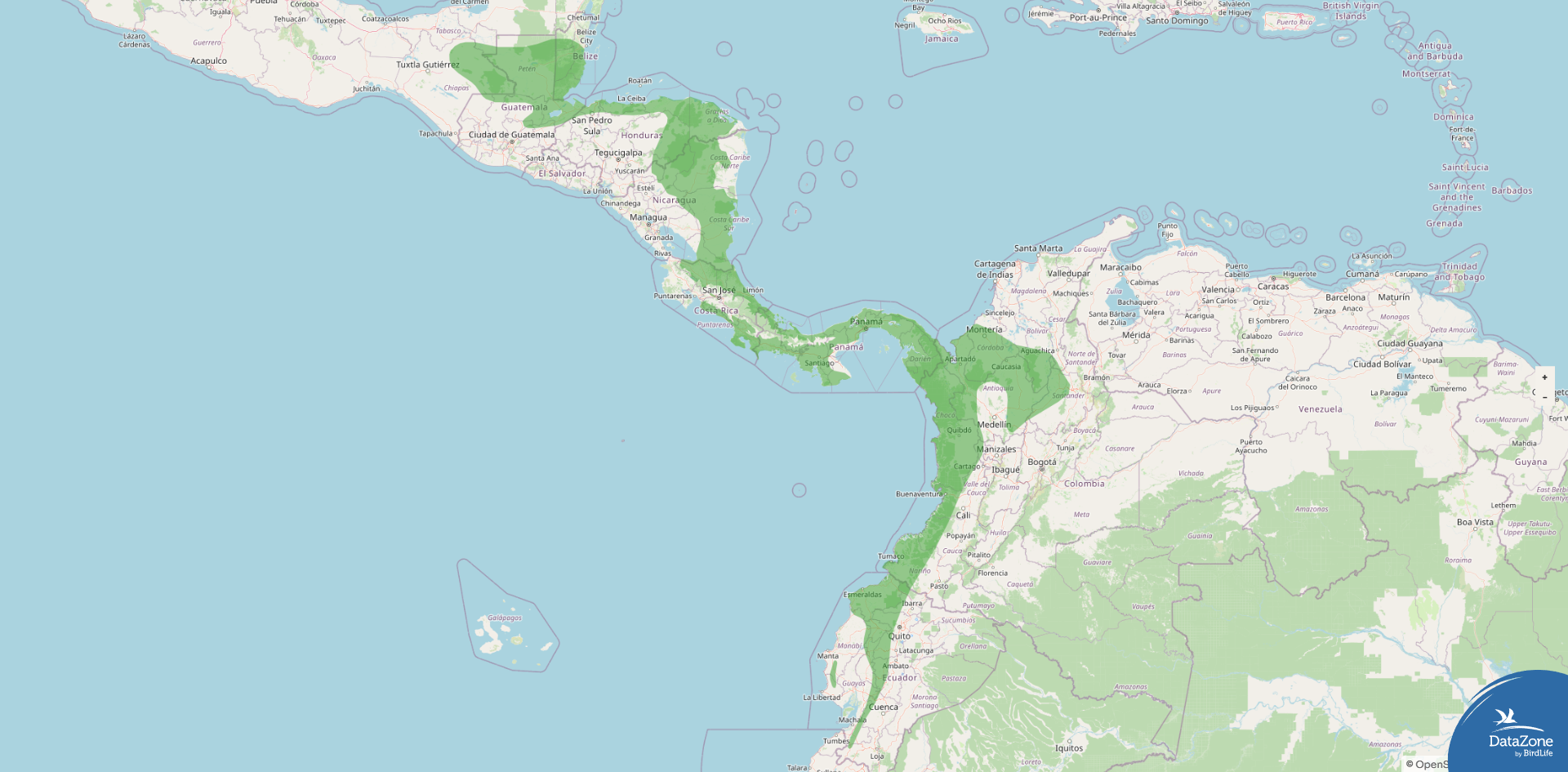
Ledged
Green Resident
Yellow Breeding
Blue Non-breeding
Species Overview
The Purple-crowned Fairy is a distinctive forest hummingbird, easily recognized by its white underparts, long bicolored tail, and the male’s violet crown. It typically works the canopy and upper midstory of humid forest and shaded plantations, making it more often heard or glimpsed overhead than seen at close range. Despite its broad geographic range and use of both primary and secondary habitats, forest loss and degradation across Mesoamerica and northwestern South America are contributing to a decreasing population trend, though numbers remain sufficient for a Least Concern listing.
Male Description
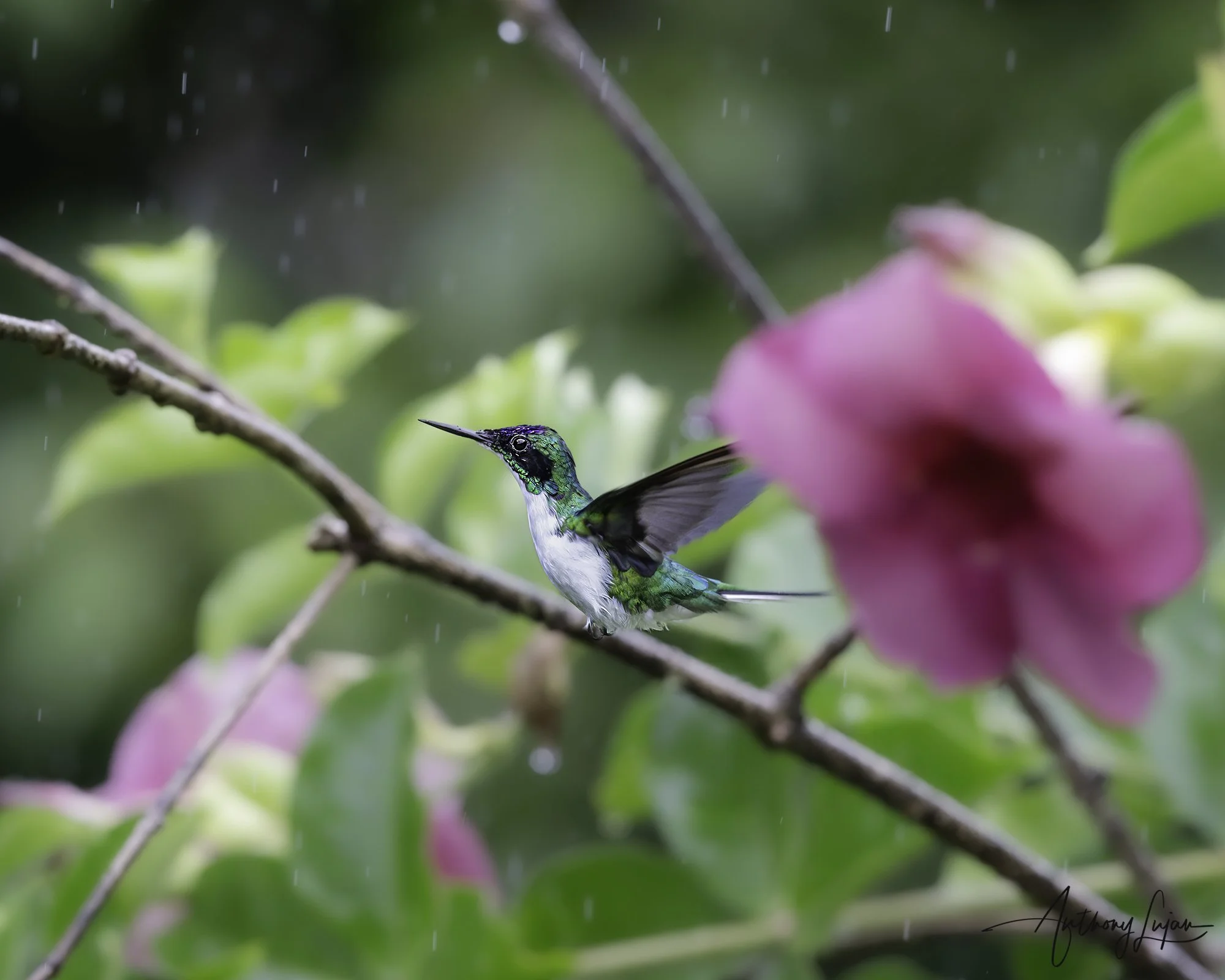
Adult males are slender and elegant, with bright emerald green upperparts, pure white underparts, and a long pointed tail with blue-black central feathers and white outer tail feathers. The crown is a shimmering violet or purple, which can be striking in good light and gives the species its English name. The bill is straight, medium-length, and black, matching the dark mask and contrasting with the pale face and white underparts. In flight, the combination of glittering crown, clean white belly, and long, contrasting tail makes the male stand out against the forest canopy.
Female Description
Females lack the vivid violet crown of the male and are generally duller above. They share the green upperparts and white underparts but often show some grayish or dusky spotting on the throat and breast, softening the contrast. The tail is similarly patterned with dark central feathers and white outer ones, though the overall effect can appear slightly less crisply defined than in males. Immature birds resemble females, sometimes with additional buffy or cinnamon fringes on the upperparts that give a more subdued appearance.
Habitat & Behavior
Purple-crowned Fairies inhabit the canopy and edges of humid lowland forest, shady plantations (such as cacao and coffee), and mature secondary forest. They primarily forage in the midstory and canopy, though at forest edges they may come lower to feed. Their diet consists mainly of nectar taken from a variety of flowering trees and shrubs, both by inserting the bill into the corolla and by piercing the base of flowers to rob nectar. They also feed on small arthropods, especially spiders, by hovering and gleaning from foliage rather than catching insects on the wing. Although not strongly territorial, they can be surprisingly aggressive, often standing up to more territorial hummingbirds around good nectar sources.
Population
The total number of mature individuals is unknown, but within its wide range the Purple-crowned Fairy is generally considered uncommon to locally fairly common in suitable habitat. It occurs across a broad swath of Mesoamerica and northwestern South America, from southeastern Mexico to southwestern Ecuador and northern Peru. However, the overall population trend is Decreasing, reflecting the cumulative impacts of deforestation, forest fragmentation, and the loss of shaded plantations and mature secondary forest across its range.

Conservation
Purple-crowned Fairy is listed as Least Concern because of its extensive distribution and presence in multiple protected areas, even though its population is declining. The main threats are ongoing deforestation, conversion of forest to pasture and intensive agriculture, and loss of shaded, structurally complex plantations in favor of more intensive, sun-grown systems. Conservation measures that protect remaining humid lowland and foothill forests, encourage shade-grown agroforestry, and maintain mature secondary forest and riparian corridors will benefit this species. Continued monitoring of its status, especially in regions undergoing rapid land-use change, is important to prevent more serious declines.
For more details on the trips behind this species, visit the Costa Rica Hummingbird Expedition | July 2025 page and explore My Travel 2025-05 Costa Rica for guides and trip reports.
Checkout Anthony’s playlist of this species! Click the top right dropdown to see all the videos.
Related species in the Heliothryx genus (2 species total):


Please note: The content provided in this article reflects Anthony’s personal experience and photographic approach. Results can vary depending on light, weather, location, equipment, subject behavior, and field conditions.