
Stripe-breasted Starthroat

Scientific name: Heliomaster squamosus
The Stripe-breasted Starthroat is a medium-sized, striking starthroat hummingbird endemic to eastern Brazil. The number of mature individuals is unknown, the population is decreasing, it is considered non-migratory, and it is currently listed as Least Concern and monotypic, with no recognized subspecies.
At a Glance
Family: Trochilidae (hummingbirds)
Clades: Lampornithini – Mountain Gems
Genus group: Heliomaster — long-billed “starthroats” with bold gorgets and patterned tails (4 species total)
Range: Eastern Brazil from Pernambuco south to São Paulo state.
Habitat: Subtropical and tropical moist lowland forest, dry savanna, edges of Atlantic Forest remnants, open woodland, and heavily degraded former forest and semi-open areas.
Elevation: Mostly from sea level to about 800 m (2,600 ft).
Length: About 11.2–12.4 cm (4.4–4.9 in).
Weight: About 5–6.5 g (0.18–0.23 oz).
Number of mature individuals: Unknown
Population trend: Decreasing
Status: Least Concern (IUCN)
Name Origin
The genus name Heliomaster combines Greek roots for “sun” and “master,” referring to the way starthroats’ gorgets and crowns blaze when they catch the light. The species name squamosus means “scaled,” likely referencing the fine, scale-like pattern on the breast. The English name “Stripe-breasted Starthroat” highlights the distinctive streaked or striped breast pattern and its membership in the starthroat group.
Taxonomy & Distribution
Monotypic — no recognized subspecies.
Distribution: Endemic to Brazil, found in eastern regions from Pernambuco south through Bahia, Minas Gerais, and Espírito Santo to São Paulo. It frequents Atlantic Forest edges, semi-open woodland, dry savanna, and degraded or partially cleared areas, and has been recorded as a rare vagrant just across the border in northeastern Argentina.
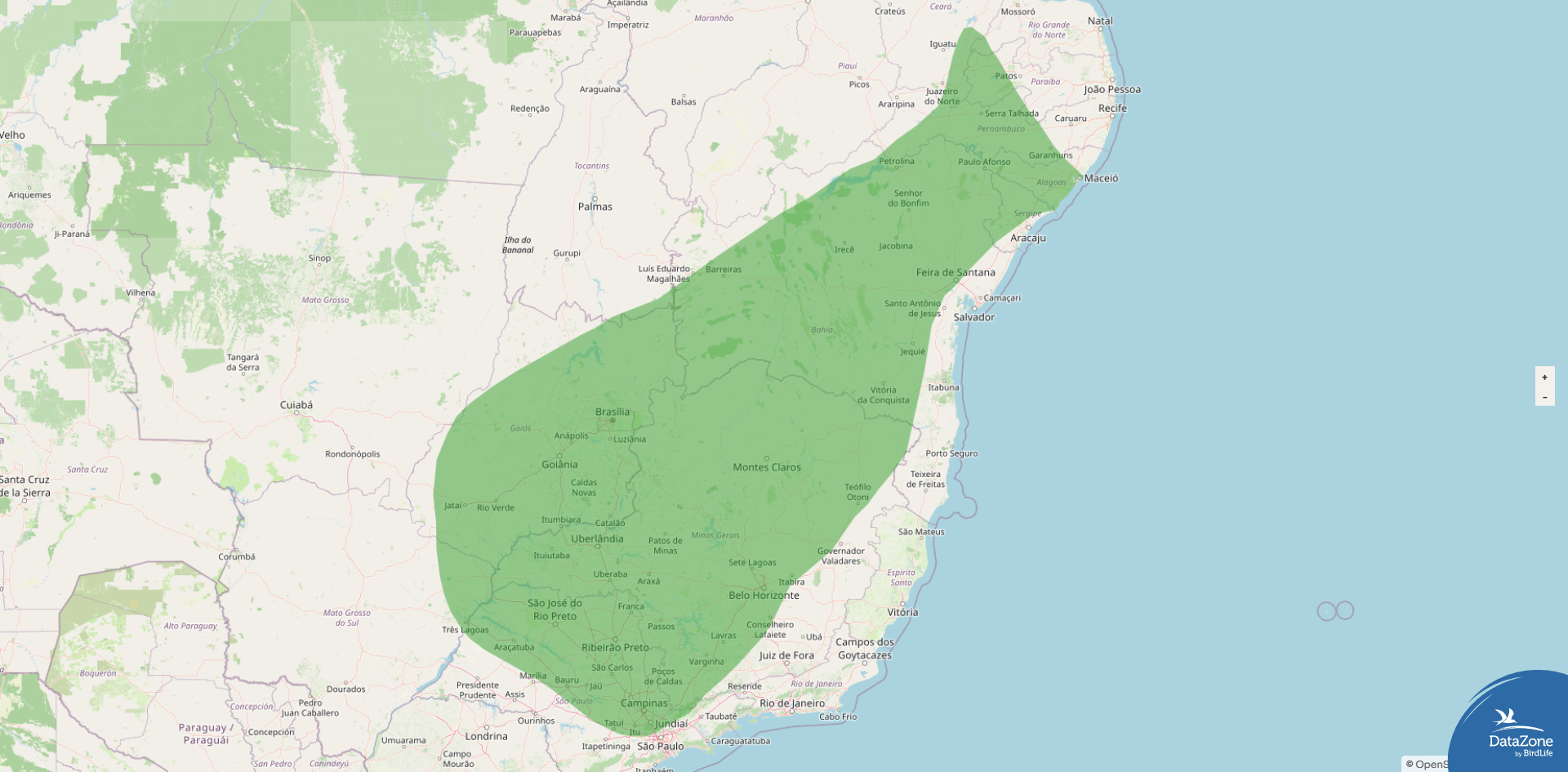
Legend
Green Resident
Species Overview
The Stripe-breasted Starthroat is a dazzling Brazilian endemic that bridges forest and open-country hummingbird communities. It is often associated with forest margins, semi-open woodland, savanna, and disturbed habitats where flowering trees and shrubs are available. Despite being locally fairly common in some regions and present in at least one national park, ongoing habitat loss and fragmentation across eastern Brazil are thought to be driving a gradual decrease.
Male Description
Adult males have a long, slightly decurved black bill and a white streak behind the eye, often accompanied by a white “moustache” stripe. The crown and upperparts are bronzy to dark green. The throat bears a bold, iridescent gorget that can flash violet, magenta, or rosy tones depending on the light, set off from the patterned breast. The breast and upper belly show distinct pale streaks or “scales” on a darker background, giving the stripe-breasted appearance; the lower underparts are paler grayish. The tail is dark with yellowish or greenish-bronze spots or edges and may show pale tips on outer feathers, forming a subtle pattern in flight. In the field, males appear as long-billed hummingbirds with a bright throat, conspicuous facial stripes, and a finely streaked breast.
Female Description
Adult females share the long, slightly decurved bill, white post-ocular stripe, and white moustache, but are duller overall. The throat is whitish to pale gray with fine dusky spotting rather than a solid iridescent gorget. The breast and belly are pale grayish with less pronounced striping than in males, though a scaled or streaked impression may remain. The upperparts are bronzy green, and the tail is dark with pale or whitish tips on outer feathers, giving pale tail corners. Females therefore look like bronzy-green hummingbirds with a pale, lightly patterned underside and bold facial stripes, but lacking the intense throat color of males.
Habitat & Behavior
Stripe-breasted Starthroats inhabit a mix of forest and semi-open environments, including moist lowland forest, dry savanna with trees, forest edges, and heavily degraded former forest where flowering shrubs and trees persist. They typically forage between about 3 and 8 m (10–30 ft) above the ground, visiting a wide variety of flowers on shrubs, trees, and vines for nectar. They also take small insects, often hawking from exposed perches. Birds may be territorial around rich nectar sources, defending flowering trees or shrubs from other hummingbirds. The species is considered resident within its Brazilian range, with no major migratory movements known, although local movements likely respond to flowering and seasonal rainfall patterns.
Breeding
The breeding season in much of the range falls in the warmer, wetter months, when flowering is abundant. The female builds a small cup nest of plant fibers and spiderweb, often camouflaged with lichens, placed on a horizontal branch or in a fork a few meters above the ground. She lays two eggs, incubates them for roughly two weeks, and the chicks typically fledge about three weeks after hatching.
Population
Although the exact number of mature individuals is unknown, the Stripe-breasted Starthroat is considered locally common in suitable habitats within its limited Brazilian range. It benefits from some degree of disturbance where forest is partially opened but retains flowering trees and shrubs. However, widespread deforestation, conversion of Atlantic Forest and savanna to agriculture and pasture, and urban expansion reduce and fragment its habitat, contributing to a decreasing overall trend.

Conservation
The Stripe-breasted Starthroat is assessed as Least Concern because it remains relatively widespread within eastern Brazil and occurs in at least one national park. Nonetheless, ongoing habitat loss and fragmentation in the Atlantic Forest and associated savannas are significant concerns. Protecting and restoring forest edges, gallery forests, and semi-open wooded landscapes, and maintaining flowering native trees and shrubs within agricultural and peri-urban areas, will help conserve this endemic species and other regional hummingbirds.

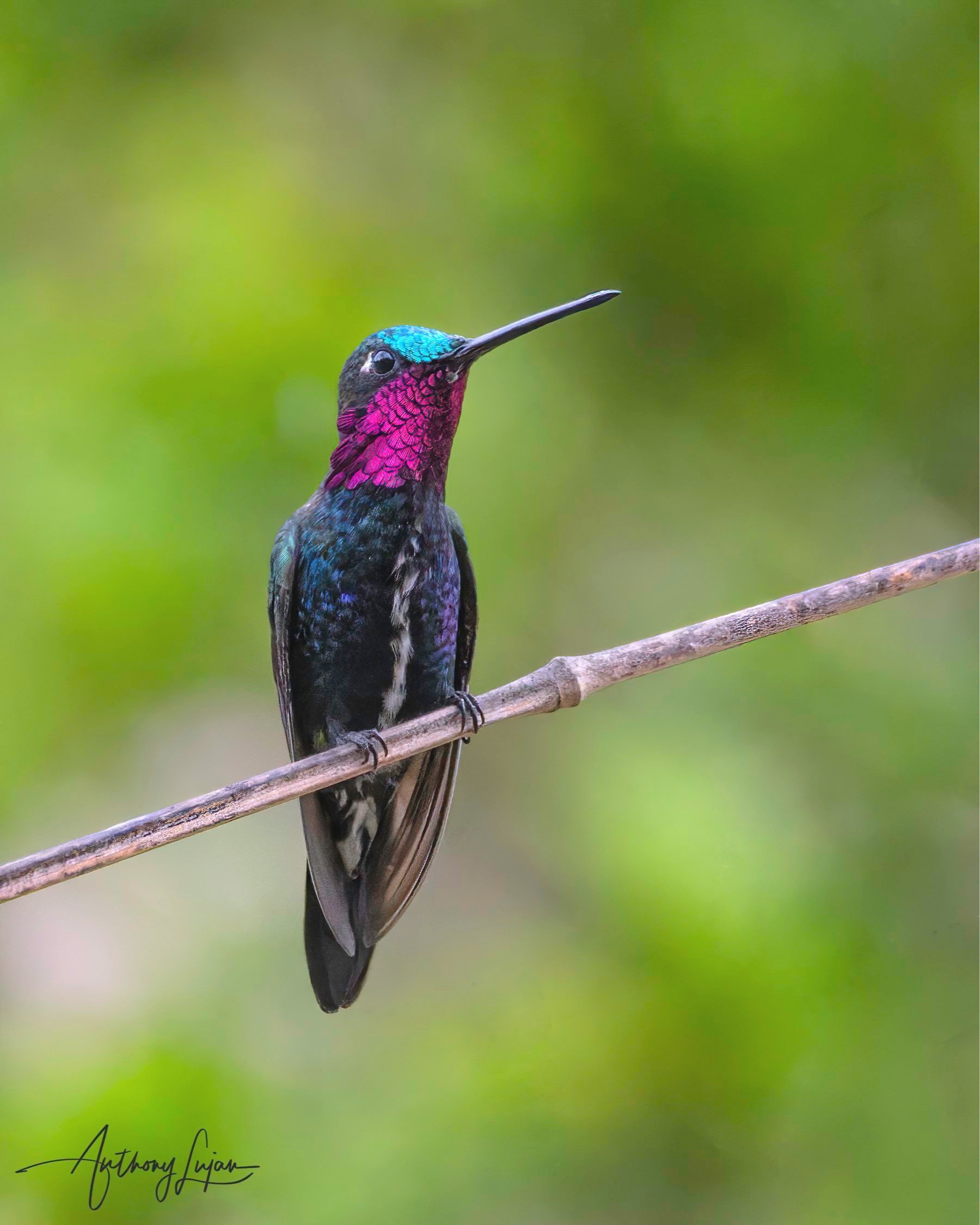
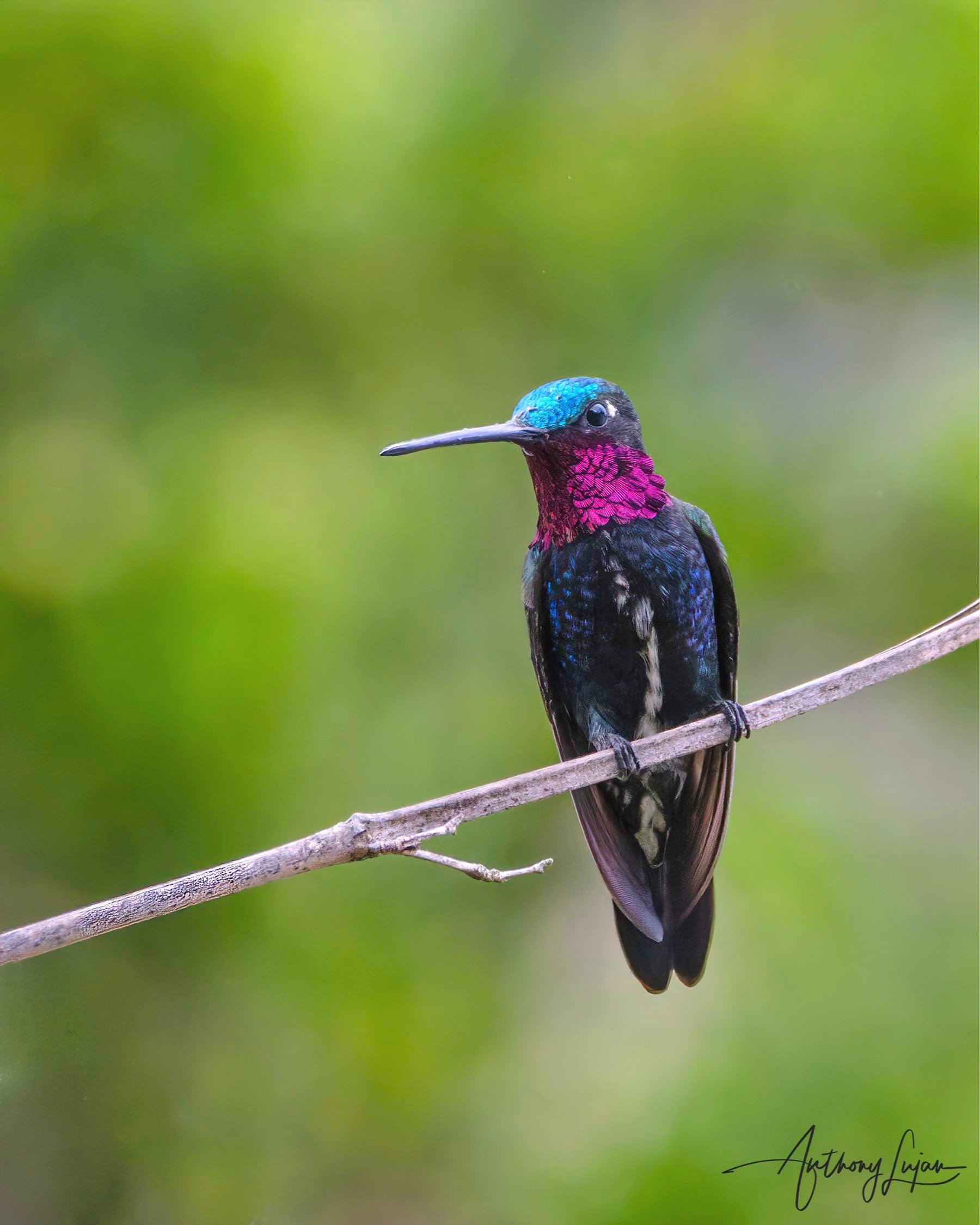
Checkout Anthony’s playlist of this species! Click the top right dropdown to see all the videos.
Related species in the Heliomaster genus (4 species total):


Please note: The content provided in this article reflects Anthony’s personal experience and photographic approach. Results can vary depending on light, weather, location, equipment, subject behavior, and field conditions.