
Violet-tailed Sylph
Scientific name: Aglaiocercus coelestis
The Violet-tailed Sylph is a medium-sized, long‑tailed hummingbird of humid montane and cloud forests on the Pacific slope of the western Andes in Colombia and Ecuador. Its number of mature individuals is unknown, the global population trend is decreasing, it is considered non‑migratory, and it is assessed as Least Concern.
At a Glance
Family: Trochilidae (hummingbirds)
Clade: Lesbiini – Coquettes
Genus: Aglaiocercus — 3 species in total
Range: Pacific slope of the Western Andes of Colombia south into central and southwestern Ecuador
Habitat: Humid montane and cloud forests, forest edges, and semi‑open areas with trees and shrubs, especially within the Chocó bioregion
Elevation: Mostly from about 900 to 2,100 m (3,000–6,900 ft), most numerous around 1,000–1,800 m
Length: Males about 18–19 cm (7.1–7.5 in) including tail; females about 10–12 cm (3.9–4.7 in)
Weight: About 4–5 g (0.14–0.18 oz)
Number of mature individuals: Unknown
Population trend: Decreasing
Movement: Not a migrant (resident, with local elevational shifts)
IUCN Red List category: Least Concern
Name Origin
The name “Violet-tailed Sylph” refers to the male’s long, iridescent violet‑blue tail and the term “sylph,” evoking a slender, fairy‑like bird. The genus name Aglaiocercus means “splendid‑tailed,” highlighting the striking tail plume. The species name coelestis means “heavenly” or “sky‑colored,” likely referencing the bird’s brilliant blue‑green and violet hues.
Taxonomy & Distribution
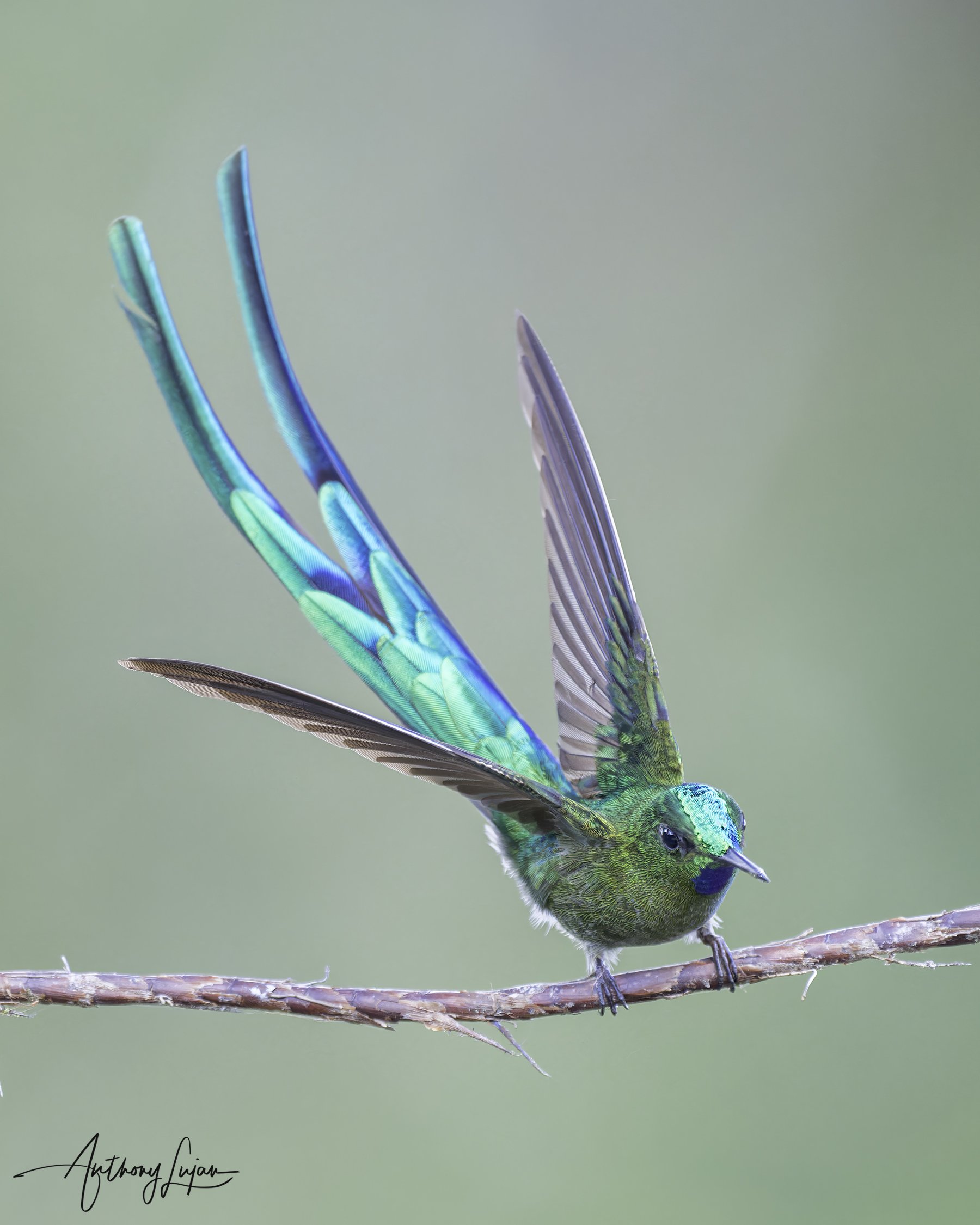
Aglaiocercus coelestis belongs to the coquette tribe Lesbiini within the hummingbird family. It is one of three species in the genus Aglaiocercus, along with Long-tailed Sylph (A. kingii) and Venezuelan Sylph (A. berlepschi). The Violet-tailed Sylph is endemic to the Chocó biogeographic region and is found on the Pacific slope of Colombia’s Western Andes south into central and southwestern Ecuador, where it inhabits humid montane and cloud forests and adjacent semi‑open habitats at mid elevations.
Subspecies and Distribution
Two subspecies:
Aglaiocercus coelestis coelestis
Distribution: Pacific slope of the Western Andes of Colombia and north to central Ecuador, from western Colombia south into Pichincha and neighboring provinces.Aglaiocercus coelestis aethereus
Distribution: Southwest Ecuador, from El Oro south to Loja, on the Pacific slope of the Andes.
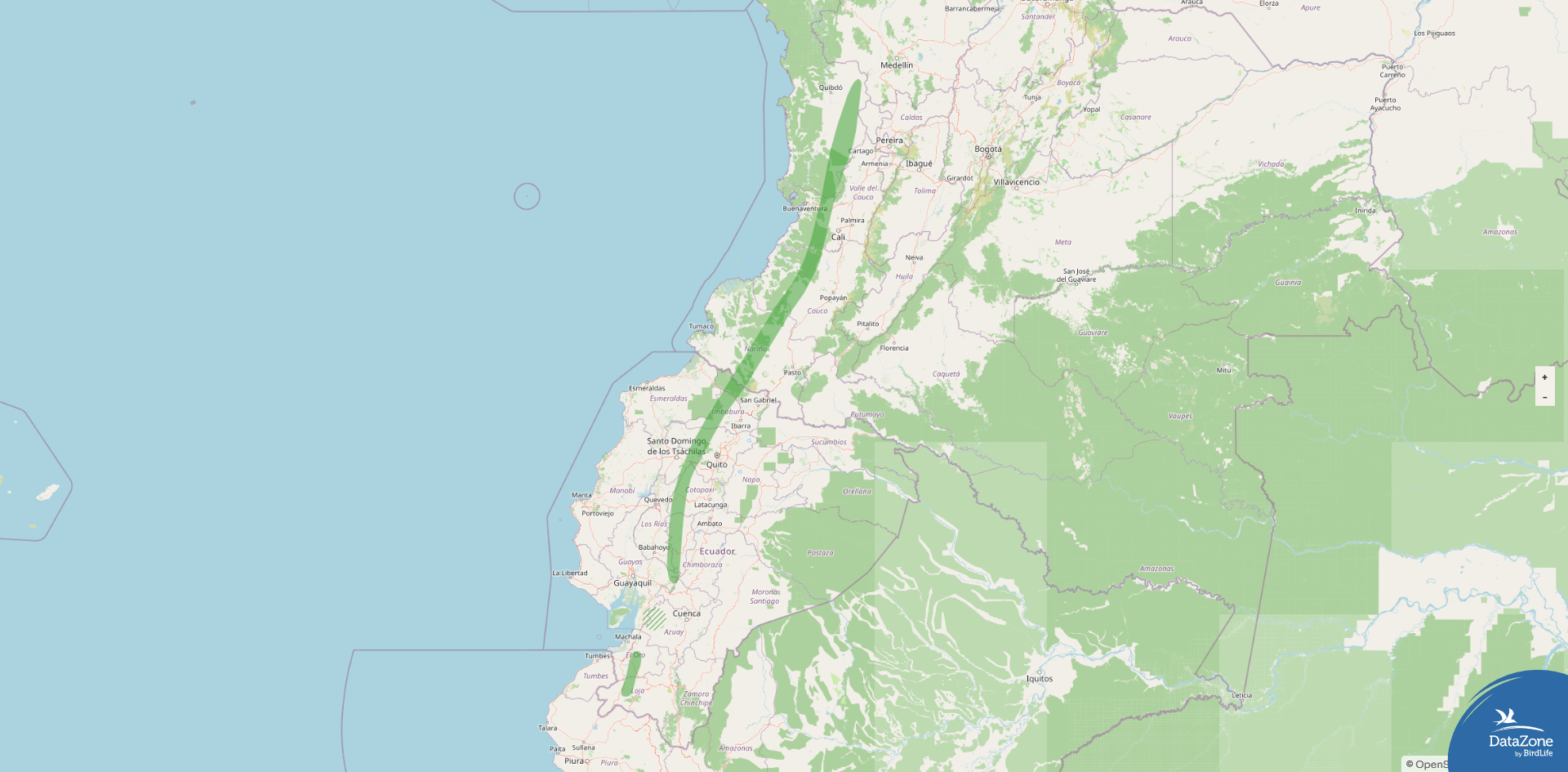
Legend
Green Resident
Species Overview
The Violet-tailed Sylph is one of the most spectacular hummingbirds of the western Andes, with males showing a shimmering green body and a very long tail of iridescent violet feathers tipped blue. It is closely associated with humid cloud forests and edges, especially mossy areas and clearings rich in flowering vines and shrubs. Within suitable habitat it can be common and is a frequent visitor to feeders and gardens in Andean foothill and montane zones of Colombia and Ecuador.
Male Description
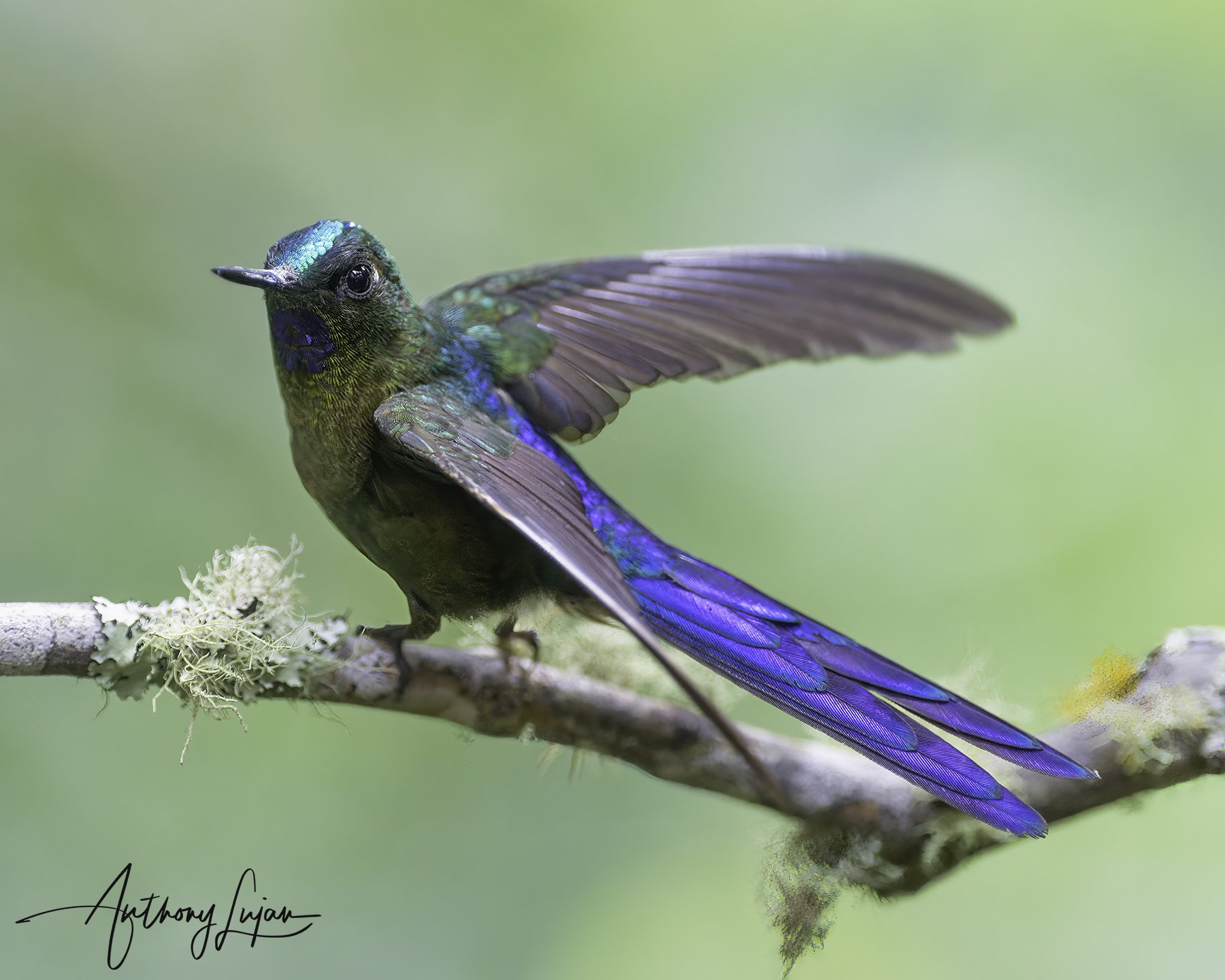
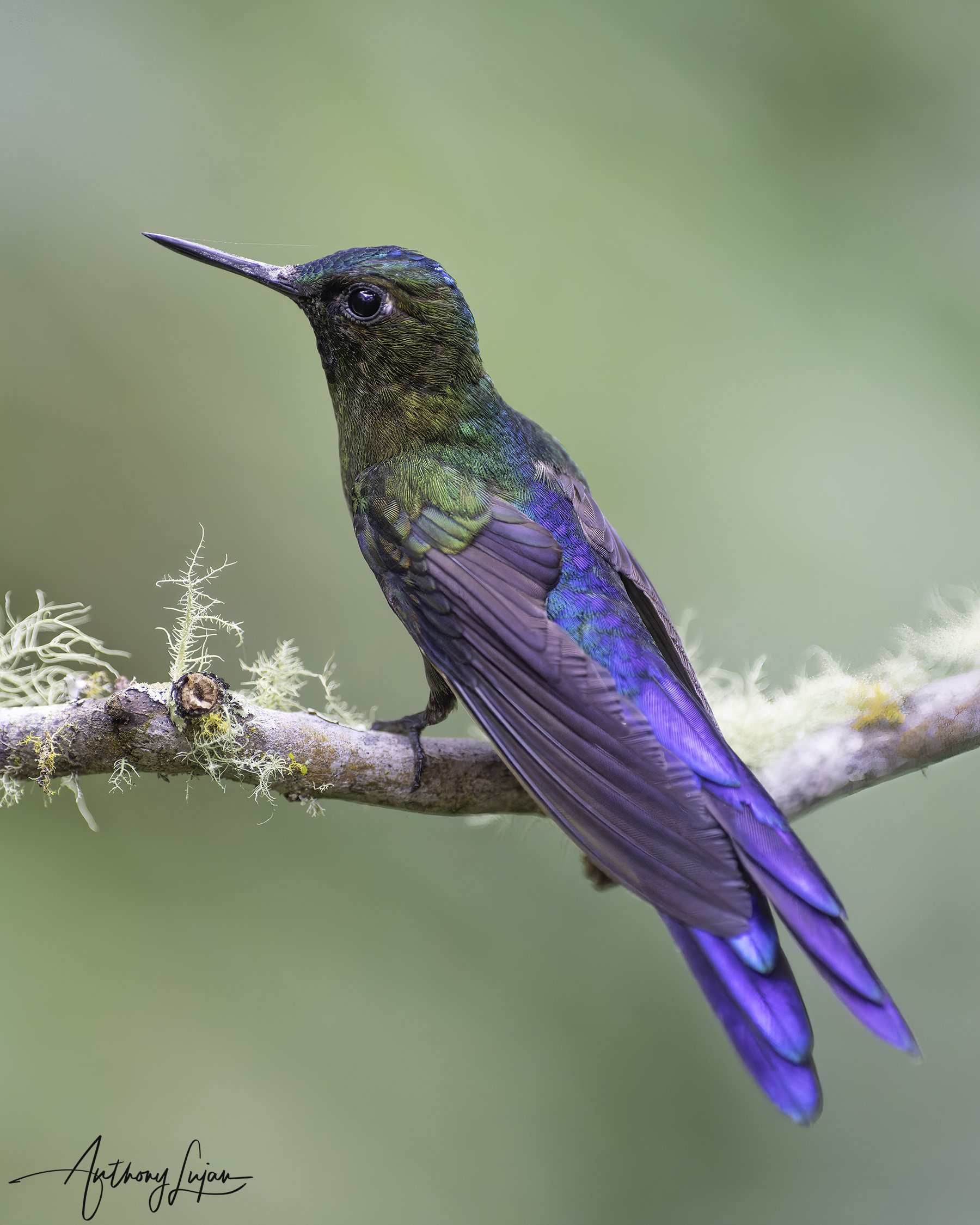
Adult males have a glittering green head, throat, and upperparts, with the green sometimes shading toward bluish on the head in certain light. The underparts are green to bluish‑green with a slightly paler belly. The most striking feature is the long, deeply forked tail: the inner tail feathers are short, while the outer tail feathers are very long, iridescent violet to violet‑blue with brighter blue tips. The bill is straight, short, and black. In display or flight, the contrasting green body and long violet tail make the male unmistakable.
Female Description
Females are much shorter‑tailed and lack the elongated violet outer tail feathers. The upperparts are metallic green, while the underparts are whitish or buffy with green spotting or streaking on the throat and sides, and a buffy or grayish belly. The tail is shorter and only slightly forked, with green central feathers and white tips or edges to the outer feathers. Juveniles resemble females, with short tails and spotted throats; young males gradually develop the much longer violet tail feathers and cleaner green underparts as they mature.
Habitat & Behavior
Violet-tailed Sylphs inhabit humid montane and cloud forests, forest edges, and semi‑open areas with scattered trees and shrubs, typically within the Chocó bioregion on the western slopes of the Andes. They are most often found between about 900 and 2,100 m, especially around 1,000–1,800 m where cloud‑forest conditions and flowering plants are abundant. They favor forest borders, clearings, and areas with flowering vines and shrubs, as well as gardens and lodge grounds that retain native vegetation.
They feed mainly on nectar from a variety of flowering plants, including epiphytes and tubular flowers of vines, shrubs, and small trees. Birds typically forage by hovering at flowers or briefly perching to access blooms and also take small insects and spiders, caught by hawking from perches or gleaning near flowers. Males can be territorial around rich nectar sources, chasing other hummingbirds and performing short display flights that show off their long tails.
Breeding
The breeding season varies with local climate but generally coincides with wet seasons and peaks in flower availability. The female builds a small cup nest of soft plant fibers and spiderweb, often placed on a horizontal branch or fork in a sheltered location within forest, along edges, or near clearings. The nest is usually camouflaged with moss, lichen, and small bits of bark.
The typical clutch consists of two white eggs. The female alone incubates and cares for the chicks. Incubation lasts around two weeks, and the nestling period is about three weeks, similar to other small Andean hummingbirds. During nesting, females may be inconspicuous, foraging near the nest and returning frequently with food for the young.
Movement
The Violet-tailed Sylph is considered resident and is classed as not a migrant. It does not undertake long‑distance migrations, though local elevational and short‑range movements likely occur as birds track flowering plants along the Pacific slope. These movements may involve shifting between different elevations and microhabitats within the humid montane belt but remain within the same general regions of western Colombia and Ecuador throughout the year.
Population
The total number of mature individuals is unknown, but the Violet-tailed Sylph has a relatively limited range confined to the Pacific slope of the western Andes in Colombia and Ecuador. Within this range it can be common in suitable habitats, especially in well‑preserved cloud forests and at feeders near forest edges, but habitat loss and fragmentation in the Chocó region are contributing to an overall decreasing trend. Local declines are most likely where forest is heavily cleared for agriculture, cattle, or infrastructure.

Conservation
The species is assessed as Least Concern due to its occurrence in multiple protected areas and its ability to use forest edges and semi‑open habitats with flowering shrubs and trees. However, ongoing deforestation and fragmentation of cloud forests and humid montane forests in the Chocó bioregion threaten its habitat. Conservation of cloud‑forest belts, maintenance of forest edges and second‑growth corridors, and protection of nectar‑rich gardens and reserves along the western Andes are important for sustaining healthy populations.
Below is the Violet-tailed Sylph (Aglaiocercus coelestis coelestis)
Photographed at 'Doña Dora', Valle del Cauca, Colombia
These individuals belong to the subspecies coelestis, found on the Pacific slope of the Western Andes from Colombia into north and central Ecuador. It favors humid montane forest edges and clearings between 900 and 2,100 meters. Males of this form are notable for their ultra-long violet tails, while females are more subdued but still glitter with green and blue iridescence.
Related species in the Aglaiocercus genus (3 species in total):
Please note: The content provided in this article reflects Anthony’s personal experience and photographic approach. Results can vary depending on light, weather, location, equipment, subject behavior, and field conditions.