

Scientific name: Oxypogon stuebelii
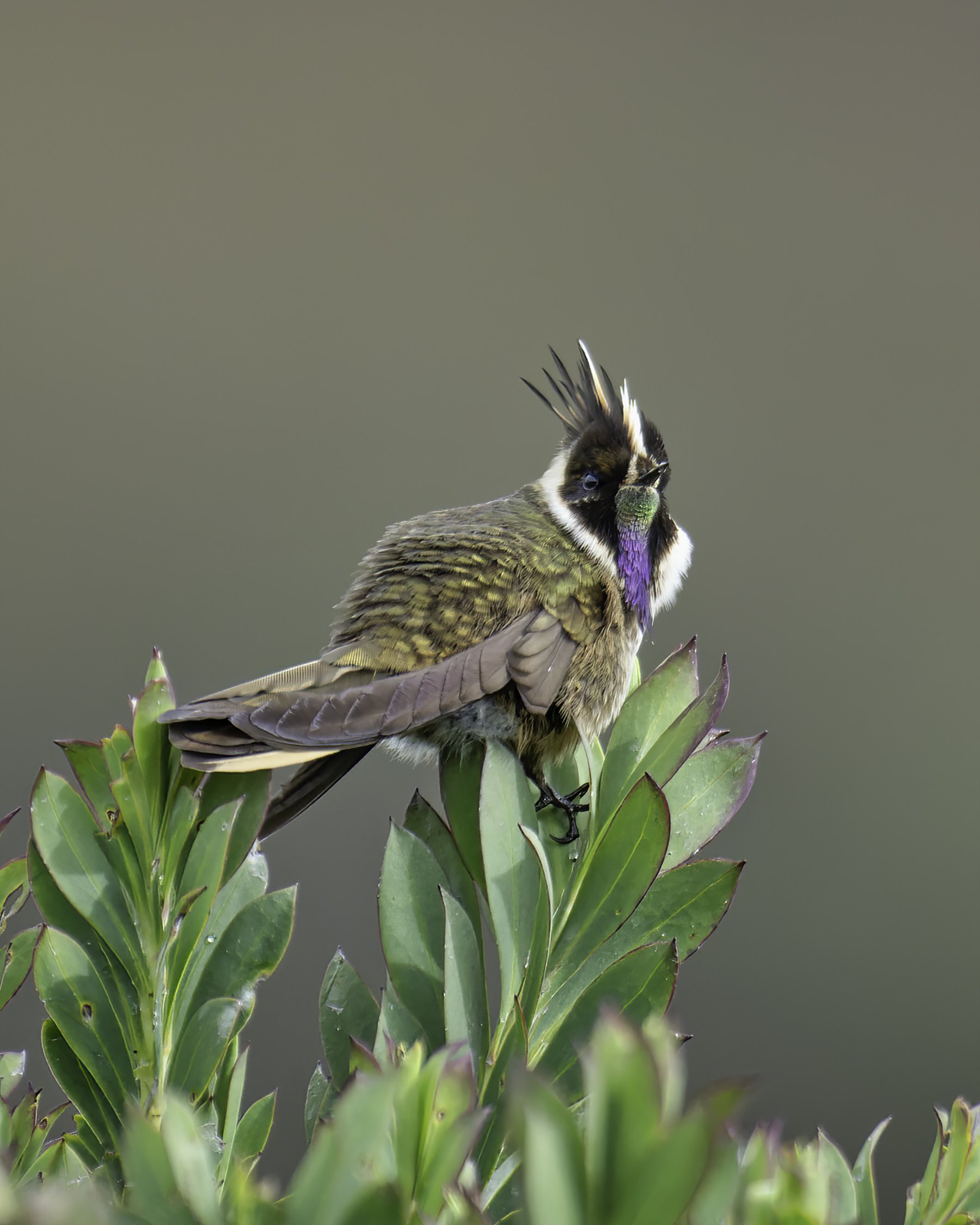
The Buffy Helmetcrest is one of Colombia’s rarest and most specialized hummingbirds, perfectly adapted to the harsh, windswept páramo of the Central Andes. With golden‑buff plumage, a long white crest, and ornate facial plumes, it represents one of four Oxypogon “helmetcrest” species, each isolated on separate Colombian cordilleras.
At a Glance
Family: Trochilidae (hummingbirds)
Clade: Lesbiini (“coquettes”)
Genus group: Oxypogon — helmetcrests
Related species: Blue‑bearded Helmetcrest (O. cyanolaemus), Green‑bearded Helmetcrest (O. guerinii),
White‑bearded Helmetcrest (O. lindenii)
Endemic to Colombia’s Central Andes (Nevado del Ruiz and surrounding páramo)
Habitat: High‑elevation páramo grasslands and shrubby slopes dominated by Espeletia (“frailejones”)
Length: about 4.4–5.0 in (11.2–12.7 cm)
Weight: about 0.16–0.18 oz (4.5–5 g)
Status: Vulnerable (very small range and declining páramo habitat)
Name Origin
The genus name Oxypogon combines Greek roots meaning “sharp” or “pointed” and “beard,” referring to the elongated facial and throat plumes characteristic of helmetcrests. The species name stuebelii honors Moritz Alphons Stübel, a 19th‑century German geologist and explorer who worked extensively in the Colombian Andes.
Subspecies and Distribution
Buffy Helmetcrest is considered monotypic, with all individuals placed in a single subspecies.
Subspecies: Oxypogon stuebelii (monotypic)
Distribution: Confined to the Central Andes of Colombia, centered on Nevado del Ruiz and adjacent páramo in Tolima and Caldas departments. It inhabits humid open páramo and rocky slopes between roughly 3,800 and 5,200 m (12,470–17,060 ft), favoring areas with abundant Espeletia rosettes.
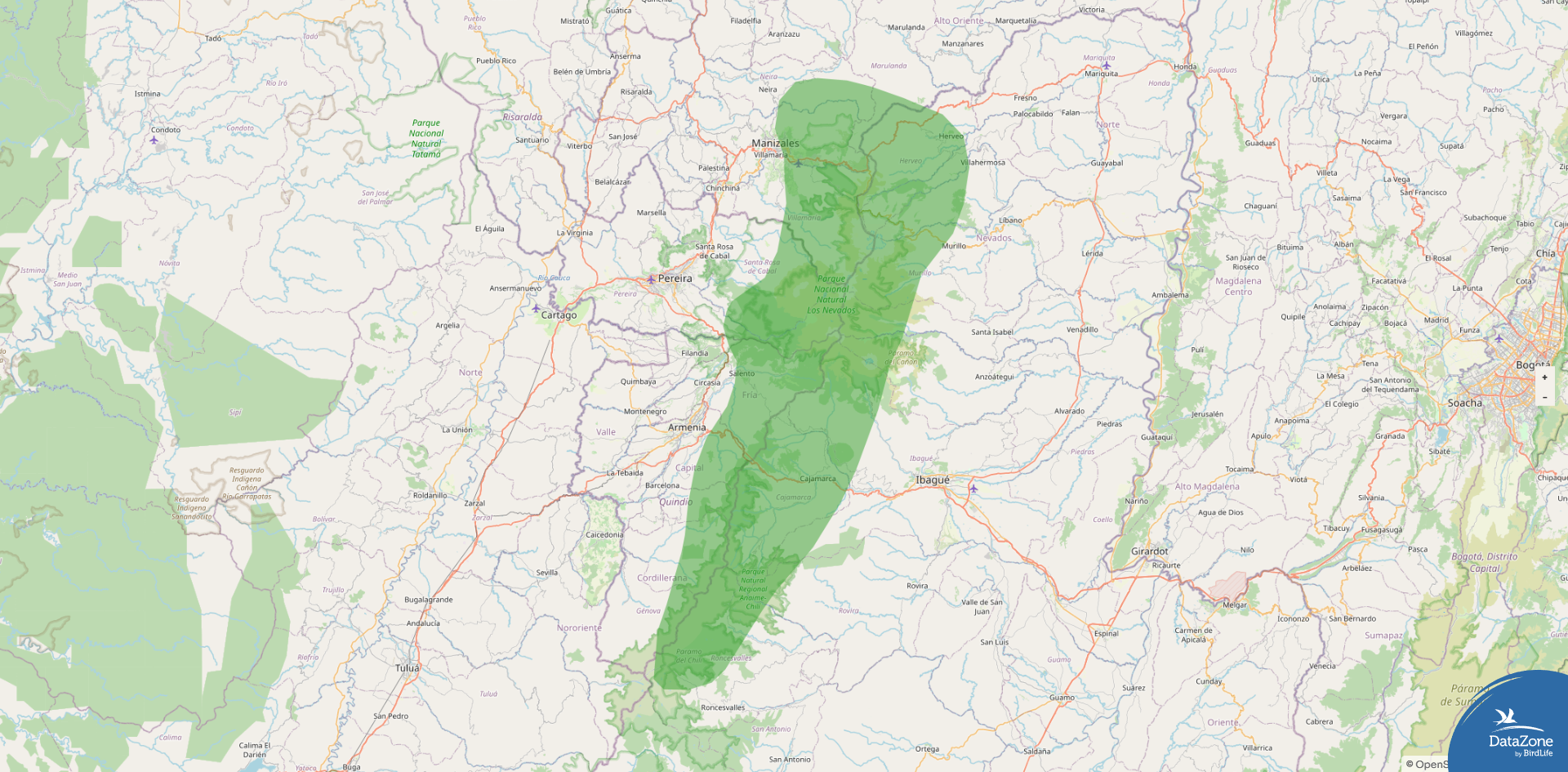
Legend
Green resident
Identification
Male
The male Buffy Helmetcrest is a medium‑sized mountain hummingbird with bronzy‑green upperparts, buffy throat and breast, and rich golden‑buff underparts. It shows a long, pointed black‑and‑buff crest, buffy facial plumes, and a narrow, glittering green‑to‑blue gorget that gives the genus its “bearded” look. The bill is short, straight, and black, and the tail is bronze‑green with buffy tips, often fanned when the bird perches atop Espeletia stalks or rocks.
Female
Females are smaller and duller, with shorter crest feathers and paler buff coloration on the face and underparts. Their upperparts are bronzy‑green with less vivid iridescence, and the facial plumes and gorget are reduced, giving them a more subdued appearance against the high‑páramo background. Both sexes have a compact body, short straight bill, and often cling to flowers or even step onto the ground while foraging.
Habitat and Behavior
Buffy Helmetcrests inhabit open páramo grasslands, rocky slopes, and shrubby patches at extreme elevations in the Central Andes. They feed primarily on nectar from Espeletia, Puya, and Castilleja flowers, supplementing their diet with small insects captured by sallying or gleaning. Foraging birds frequently cling to Espeletia inflorescences or other flowers and have been observed walking on the ground and lunging at insects. Movements are mostly local and seasonal, tracking flowering cycles; the species is largely sedentary but may shift slightly with weather and resource availability. Like other high‑Andean hummingbirds, Buffy Helmetcrests likely enter nocturnal torpor to survive freezing páramo nights.
Distribution and Status
The Buffy Helmetcrest is endemic to Colombia and restricted to the high‑elevation páramo of the Central Andes, especially around Nevado del Ruiz and neighboring ridges within and near Los Nevados National Natural Park. It has a very small range, occupying scattered páramo patches above treeline, where it depends on intact Espeletia–dominated vegetation. The global population is estimated at fewer than 1,000 mature individuals and is believed to be decreasing.
Population and Threats
Estimated mature individuals: under 1,000 (BirdLife/IUCN estimate).
Population trend: Decreasing.
Despite partial protection within Los Nevados National Natural Park, Buffy Helmetcrest’s páramo habitat is being degraded outside protected zones by livestock grazing, intentional burning, and expansion of potato and other crops into sub‑páramo and páramo. Repeated fire to maintain pasture, along with trampling by cattle and sheep, reduces Espeletia stands and other flowering shrubs that provide critical nectar. Its very restricted distribution and dependence on intact páramo vegetation make the species highly vulnerable to land‑use changes and climate‑driven shifts in the high‑Andean zone.
Assessment history: currently assessed as Vulnerable by the IUCN due to its small range, small population, and continuing decline in habitat quality.

Conservation
Conservation of the Buffy Helmetcrest hinges on protecting and restoring high‑elevation páramo habitats in the Central Andes, especially Espeletia‑rich grasslands around Nevado del Ruiz. Priorities include limiting burning in páramo, managing livestock grazing, and preventing further agricultural expansion into sub‑páramo and páramo zones. Strengthening management inside Los Nevados National Natural Park and working with local communities on sustainable land use can help secure the future of this Vulnerable high‑Andean hummingbird.


Checkout Anthony’s playlist of this species! Click the top‑right dropdown to see all the videos.
Related species in this genus:


Please note: The content provided in this article reflects Anthony’s personal experience and photographic approach. Results can vary depending on light, weather, location, equipment, subject behavior, and field conditions.