
Glittering-bellied Emerald
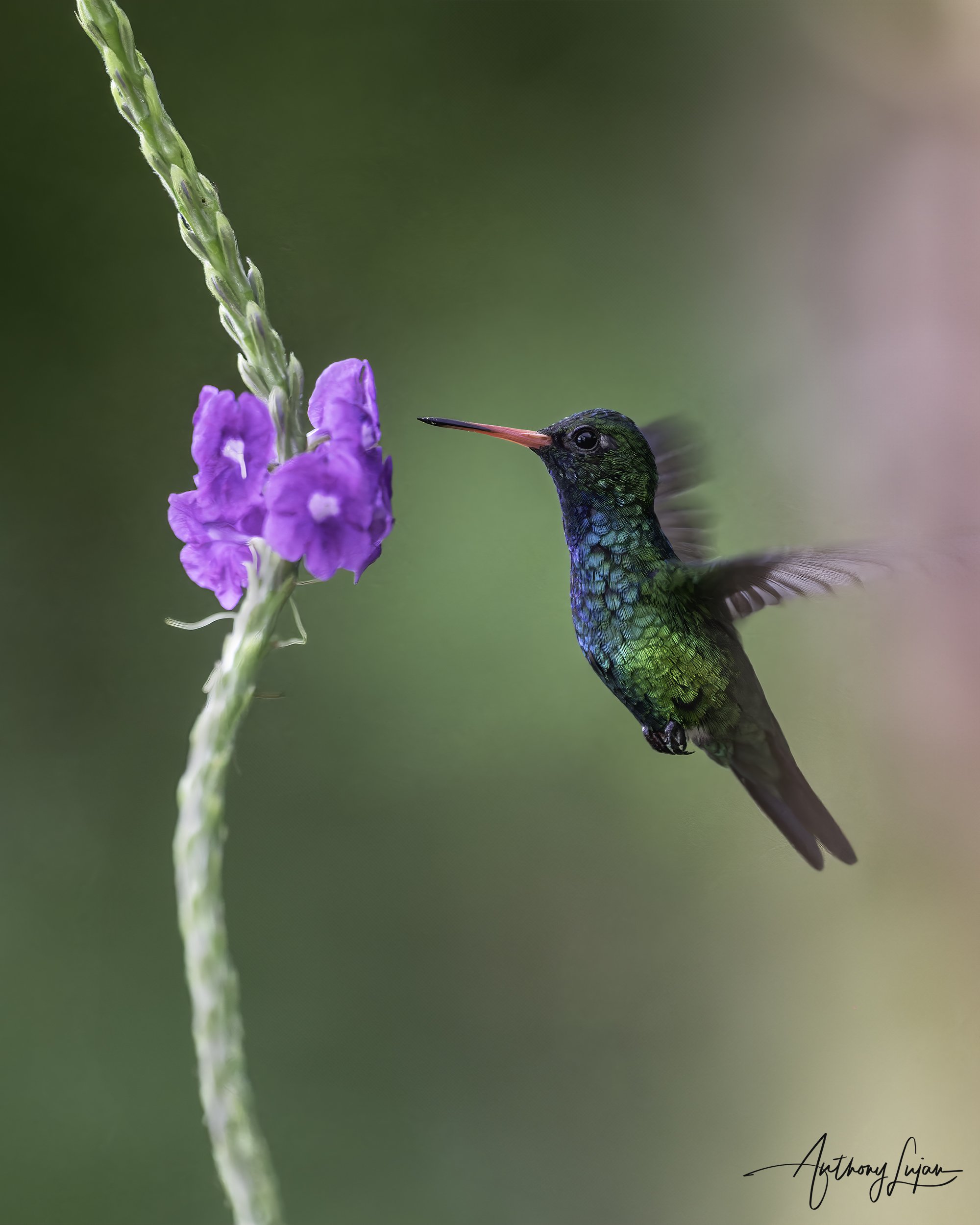
Scientific name: Chlorostilbon lucidus
The Glittering-bellied Emerald is a small “emerald” hummingbird of open and semi-open habitats in eastern and southern South America. The number of mature individuals is unknown, the global population trend is unknown, it is considered a full migrant (with significant seasonal movements in parts of its range), and it is currently listed as Least Concern with four recognized subspecies.
At a Glance
Family: Trochilidae (hummingbirds)
Clades: Trochilini – Emeralds
Genus group: Chlorostilbon — small, iridescent green “emerald” hummingbirds of the Neotropics (10 species total)
Range: Eastern and central Brazil south through Paraguay and Uruguay into northern and western Argentina and eastern Bolivia, with some populations undertaking seasonal movements.
Habitat: Semi-arid to moderately humid scrub, savanna, cerrado, grassland with scattered trees, forest edges, second growth, plantations, and parks and gardens.
Elevation: From near sea level up to about 3,500 m (11,500 ft), most common between roughly 500 and 3,000 m (1,600–9,800 ft).
Length: About 8–9 cm (3.1–3.5 in).
Weight: About 3–4 g (0.11–0.14 oz).
Number of mature individuals: Unknown
Population trend: Unknown
Status: Least Concern (IUCN)
Name Origin
The genus name Chlorostilbon comes from Greek roots meaning “green” and “shining,” referring to the bright metallic green plumage typical of these emeralds. The species name lucidus means “bright” or “shining,” emphasizing the bird’s vivid, glittering belly and overall sheen. The English name “Glittering-bellied Emerald” captures both the jewel-like effect of the plumage and the particularly brilliant underside.
Subspecies & Distribution
Four subspecies:
Chlorostilbon lucidus lucidus
Distribution: Southeastern Brazil (from Espírito Santo and Minas Gerais south through São Paulo, Paraná, and Santa Catarina) to Uruguay, Paraguay, and northeastern Argentina (Misiones, Corrientes, Entre Ríos). This nominate form inhabits a range of semi-open habitats, including savanna, scrub, forest edge, plantations, and gardens.Chlorostilbon lucidus berlepschi
Distribution: Central Brazil, mainly in Bahia, Goiás, and Minas Gerais, extending westward into eastern Mato Grosso and south to São Paulo. It occupies cerrado, semi-open woodland, scrub, and human-modified landscapes with scattered trees.Chlorostilbon lucidus pucherani
Distribution: Northeastern Brazil (Pernambuco and Paraíba south to Alagoas), occupying drier Caatinga zones and semi-arid scrub and woodland, plus more open, human-modified areas.Chlorostilbon lucidus igneus
Distribution: Western Argentina, from Catamarca and Tucumán south to Mendoza and La Rioja, inhabiting arid Andean foothills and valleys, dry shrublands, and open woodland.
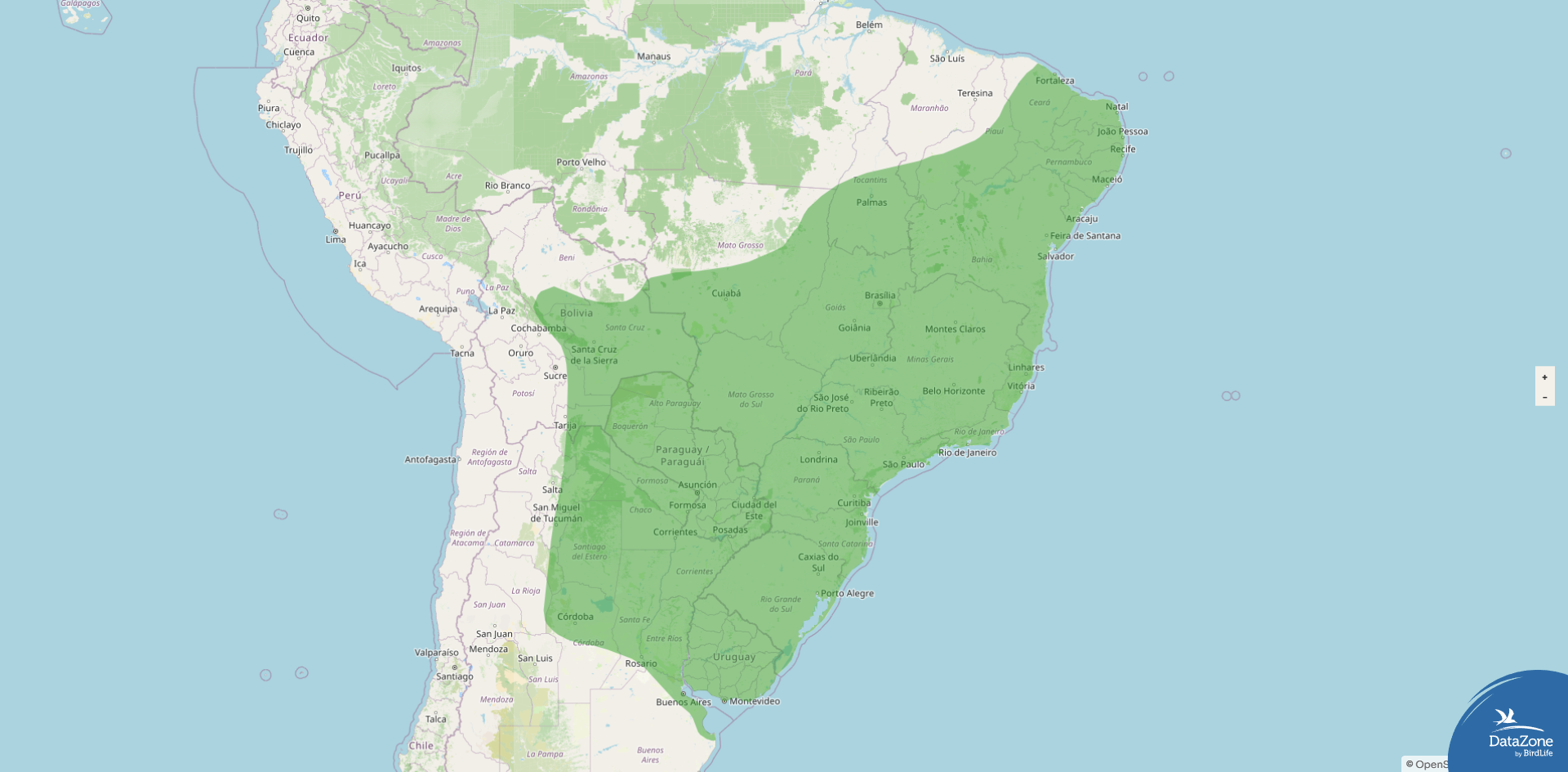
Legend
Green Resident
Species Overview
The Glittering-bellied Emerald is a highly adaptable hummingbird of semi-open country, from dry scrub and cerrado to gardens and parks in towns and cities. It forages at flowering shrubs, trees, and herbs, often in sunny, open patches rather than dense forest. Some populations are sedentary, while others undertake seasonal movements, making the species a full migrant at a broad scale, tracking flowering and climatic conditions across its range.
Male Description
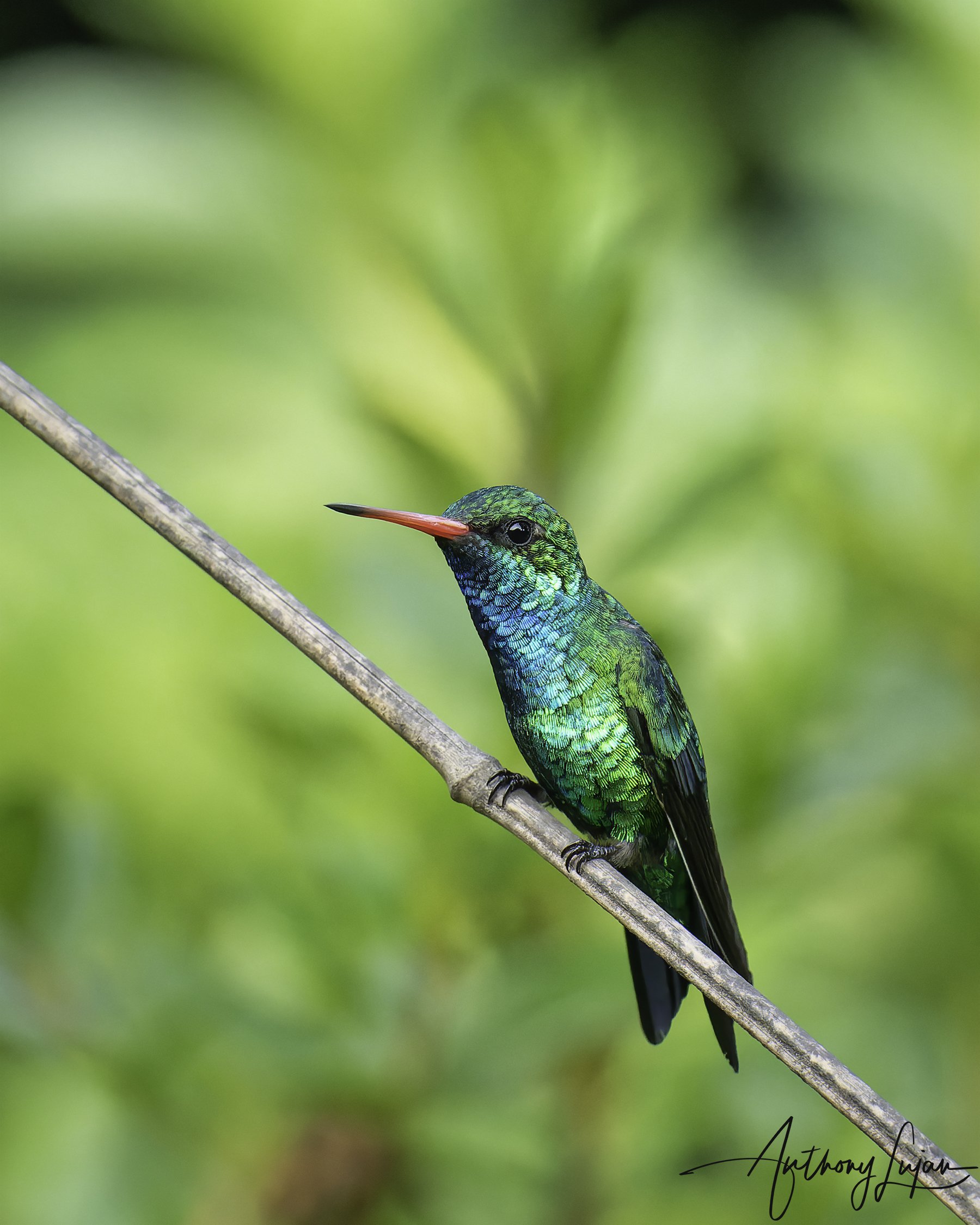
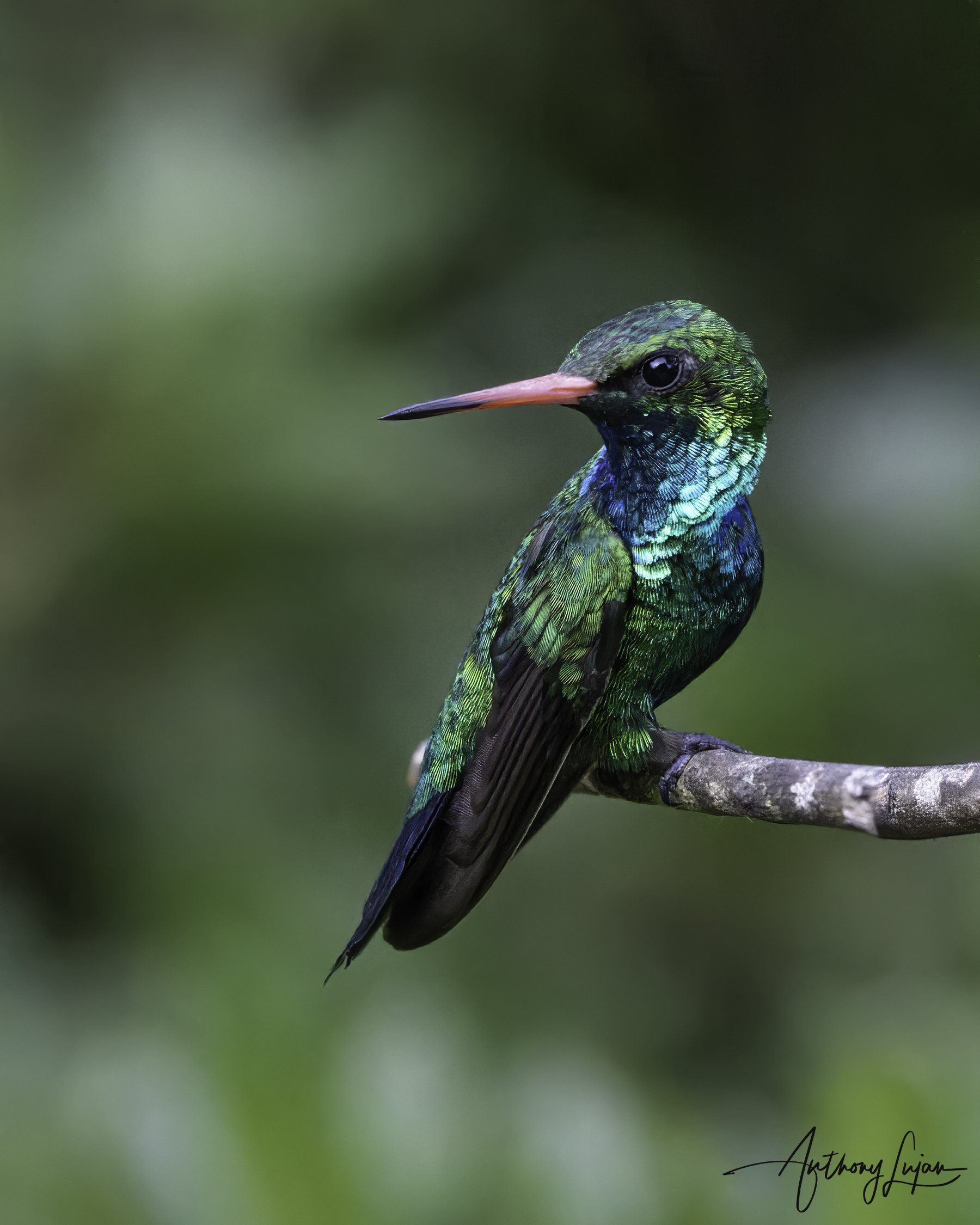
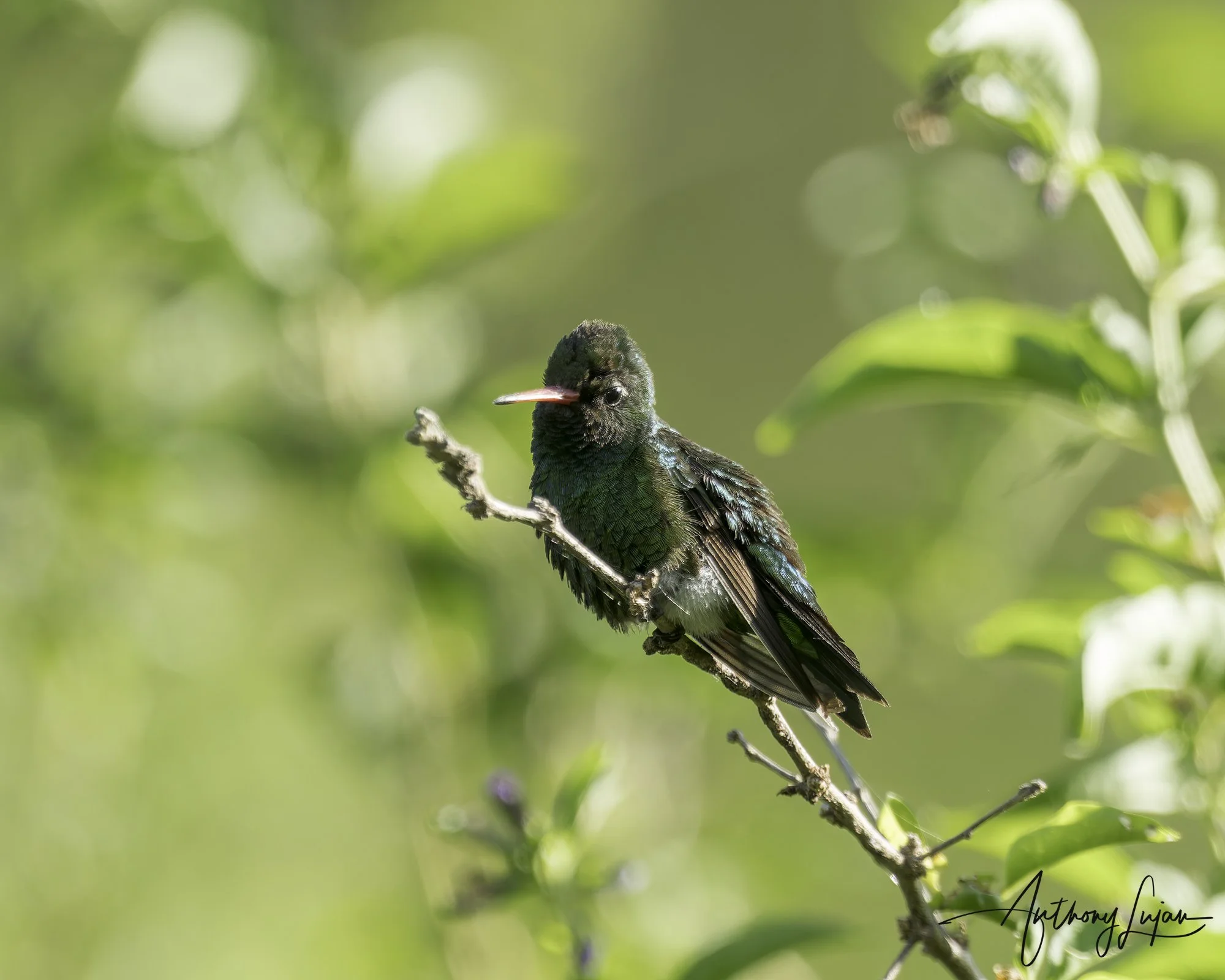
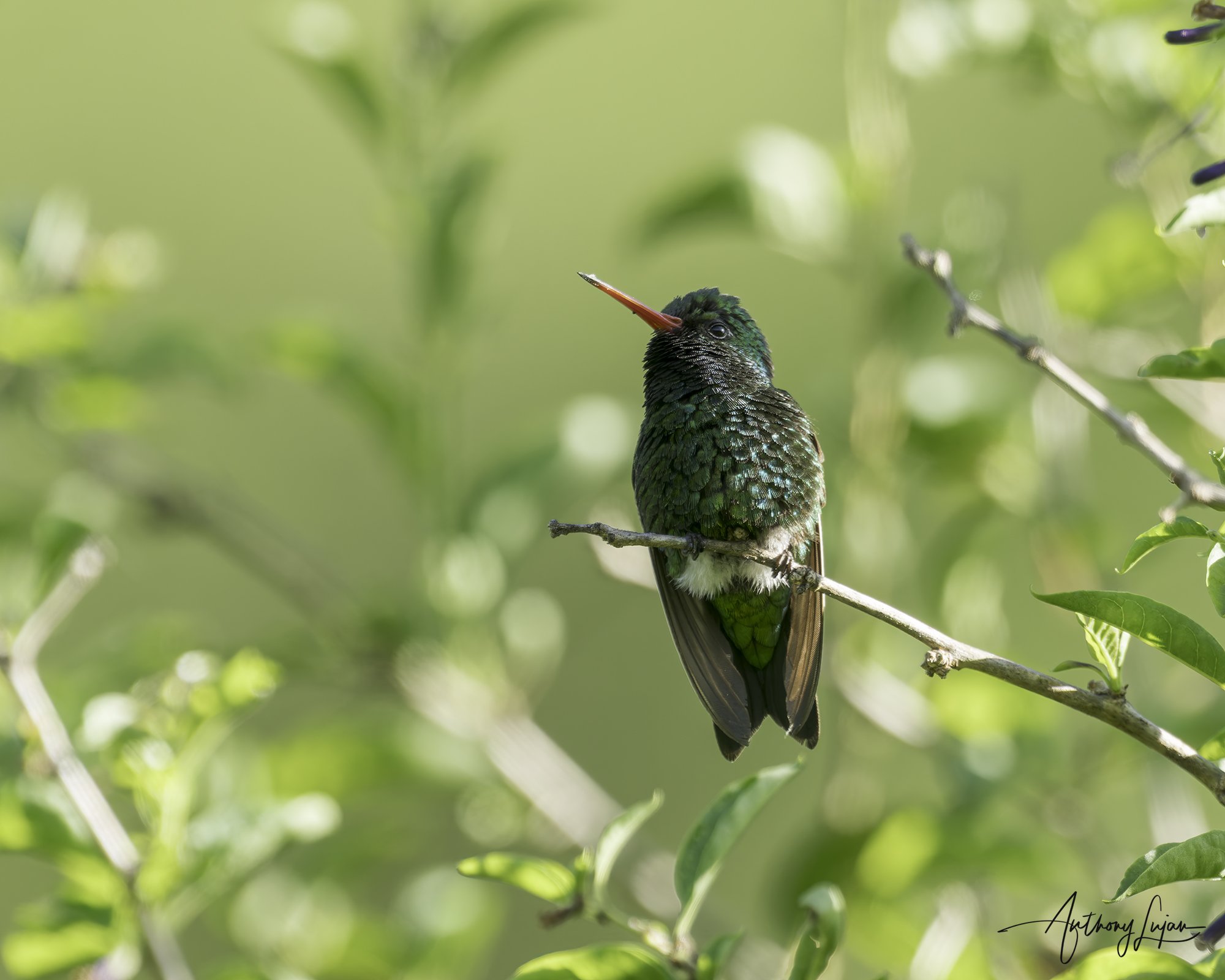
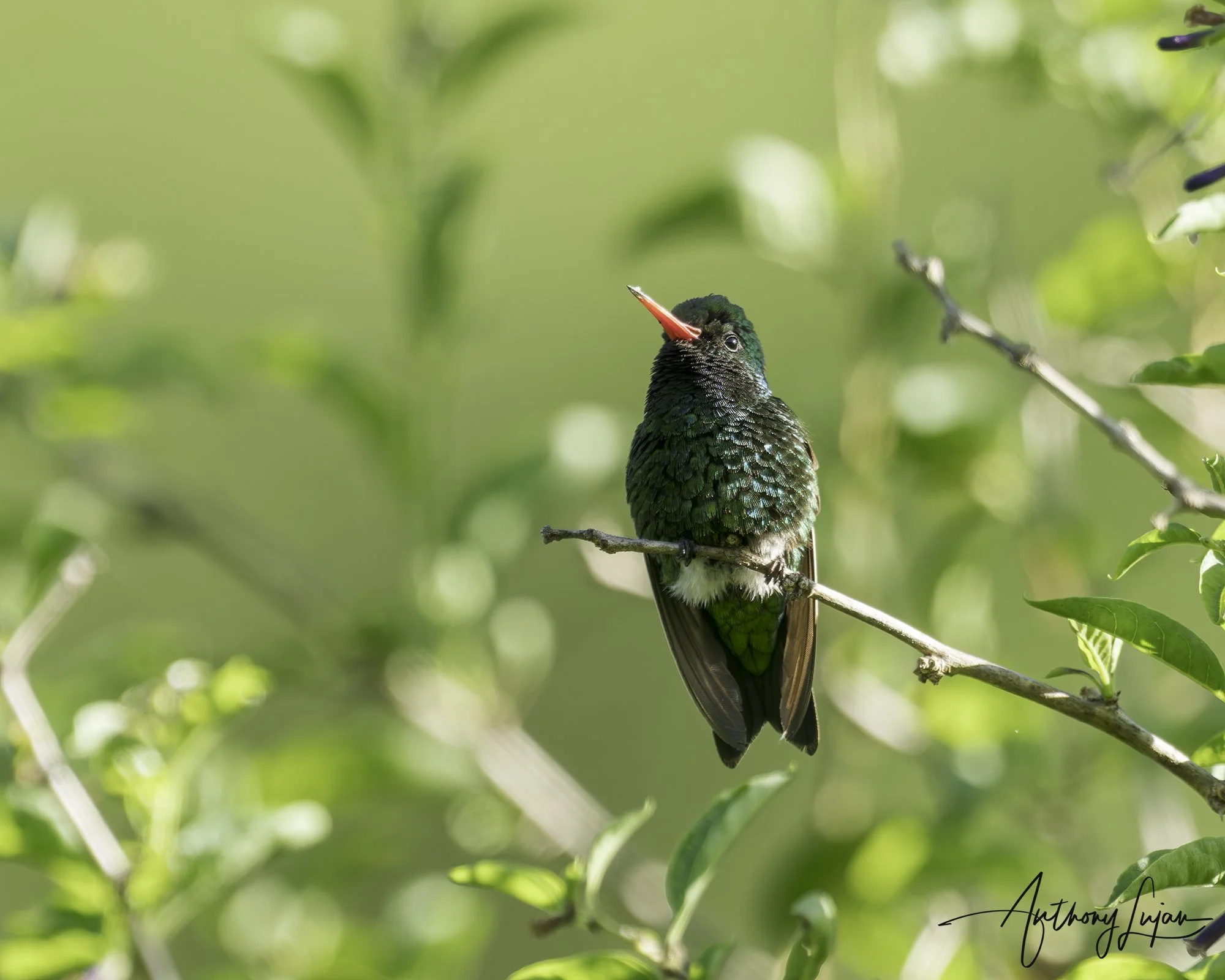
Adult males are small, slender hummingbirds with a straight, mostly red bill tipped black. The head, back, and flanks are bright metallic green, often with a more intense golden-green glow on the forehead and a slightly bluish tinge on the neck. The belly is glittering green to golden-green, giving the characteristic “glittering-bellied” look. The tail is relatively short, slightly forked, and dark blue to blue-green with a metallic sheen. In the field, males appear as vivid green hummingbirds with a glowing green belly, red-and-black bill, and dark blue tail.
Female Description
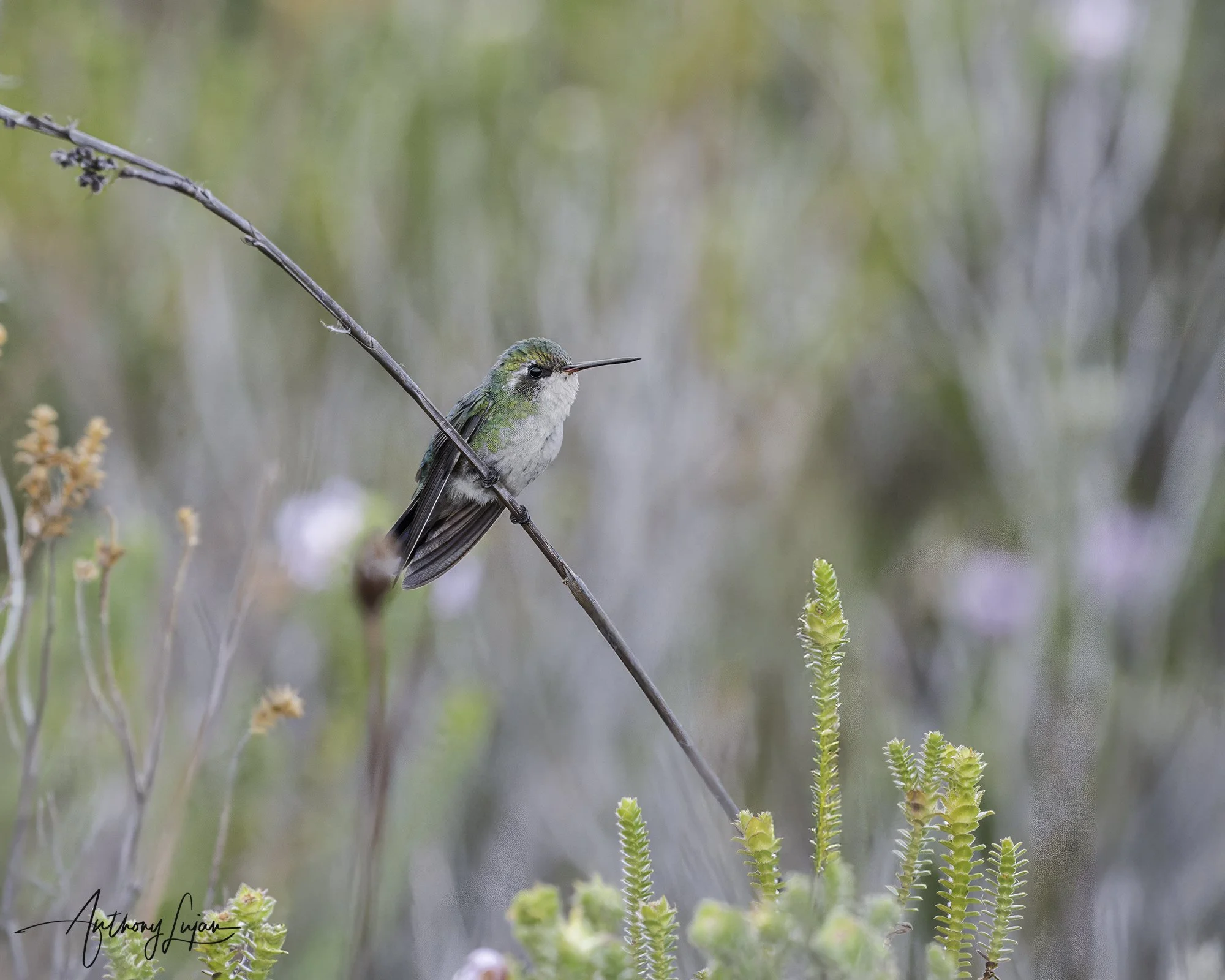
Adult females have green upperparts similar to the male but are much paler below. The face shows a white curved stripe behind the eye and a darker cheek patch. The throat and belly are whitish to pale gray with a light greenish wash or small spots on the sides, but overall the underparts look pale. The tail is dark with whitish tips on the outer feathers, making pale tail corners obvious in flight. Females therefore appear as small green-backed hummingbirds with a pale underside, distinct white post-ocular stripe, and a dark tail with white tips.
Habitat & Behavior
Glittering-bellied Emeralds use a wide variety of semi-open to open habitats, including scrublands, savanna, cerrado, dry valleys, forest edges, second growth, plantations, and urban parks and gardens. They feed mainly on nectar, often trap-lining between a circuit of flowering plants and sometimes piercing the base of flowers to access nectar. They typically forage from low to mid-levels, and also take small insects and spiders gleaned from vegetation or caught in short sallies. The species is considered a full migrant: in some regions it shows clear seasonal movements, shifting between breeding and non-breeding areas or moving altitudinally along slopes in response to flowering and weather.
Population
The total number of mature individuals is unknown, but the Glittering-bellied Emerald is generally common to abundant in many parts of its range. Its ability to thrive in human-modified landscapes, including gardens, farms, and urban areas, supports stable or locally increasing numbers in some regions. However, because it occupies such a wide range of habitats and areas with varying degrees of disturbance, its overall population trend is assessed as unknown rather than clearly increasing or decreasing.

Conservation
The Glittering-bellied Emerald is listed as Least Concern due to its broad range, ecological flexibility, and high local densities in suitable habitats. It appears tolerant of moderate habitat alteration, especially where flowering plants and trees are maintained. Nonetheless, extensive conversion of natural savannas, scrub, and woodland to intensive agriculture or heavily urbanized landscapes can reduce the diversity and abundance of nectar sources. Conservation measures that retain native flowering shrubs and trees in agricultural and urban areas, and that protect patches of cerrado, scrub, and open woodland, will help sustain this species and other lowland emeralds.
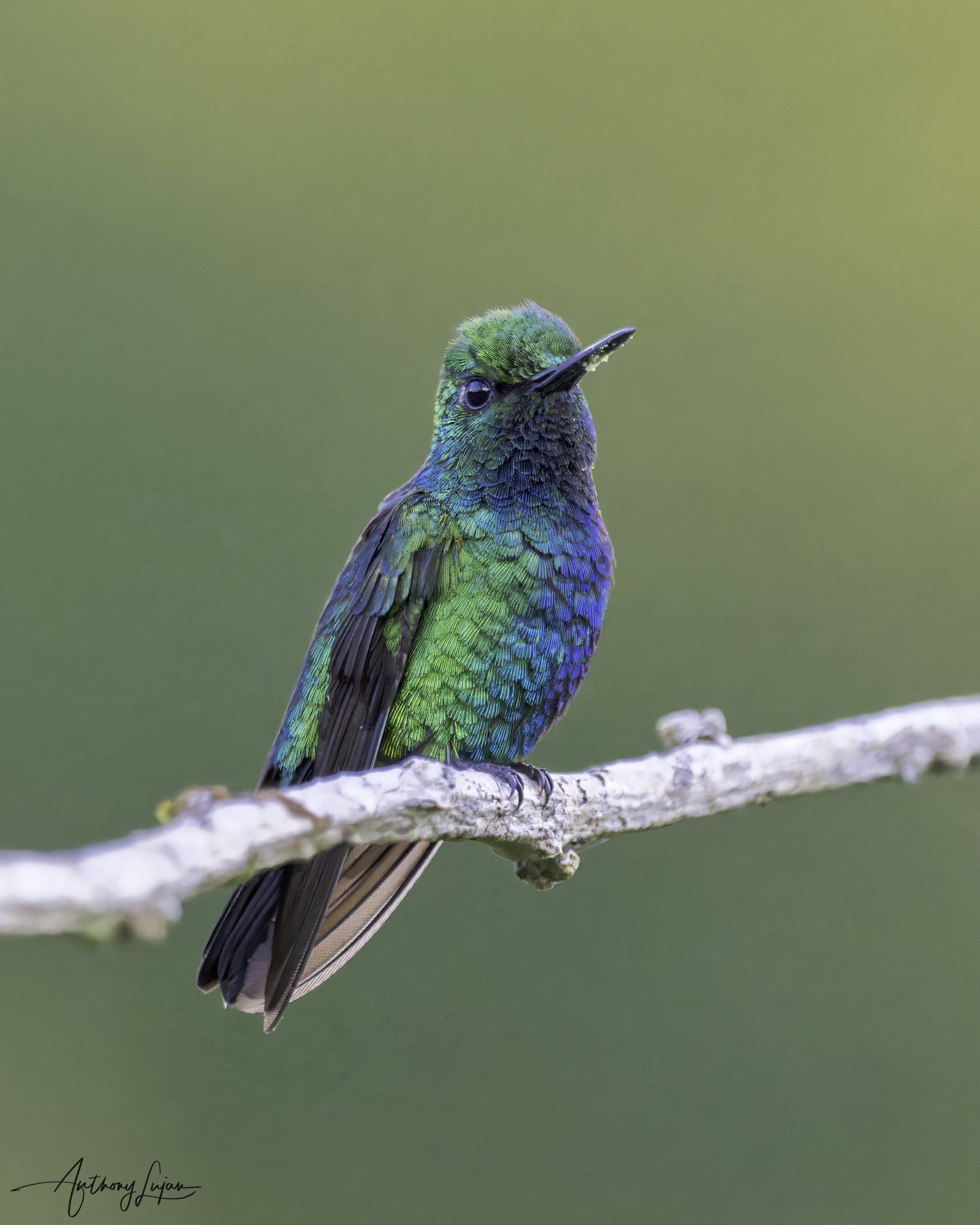
Below is the Glittering-bellied Emerald (Chlorostilbon lucidus lucidus)
Photographed at Lajedo dos Beija-Flores, Boa Nova, Bahia; Pousada Casa de Geleia, Lençóis, Bahia; Pico da Lapinha, Santana do Riacho, Minas Gerais; and Pousada da Fazenda, Monte Alegre do Sul, São Paulo, Brazil
These individuals belong to the nominate subspecies lucidus, which occurs from eastern and southern Brazil south through Uruguay and northern Argentina. It inhabits semi-open habitats, woodland edges, savanna, and dry forest clearings, often near flowering trees and shrubs between 200 and 1,800 meters.
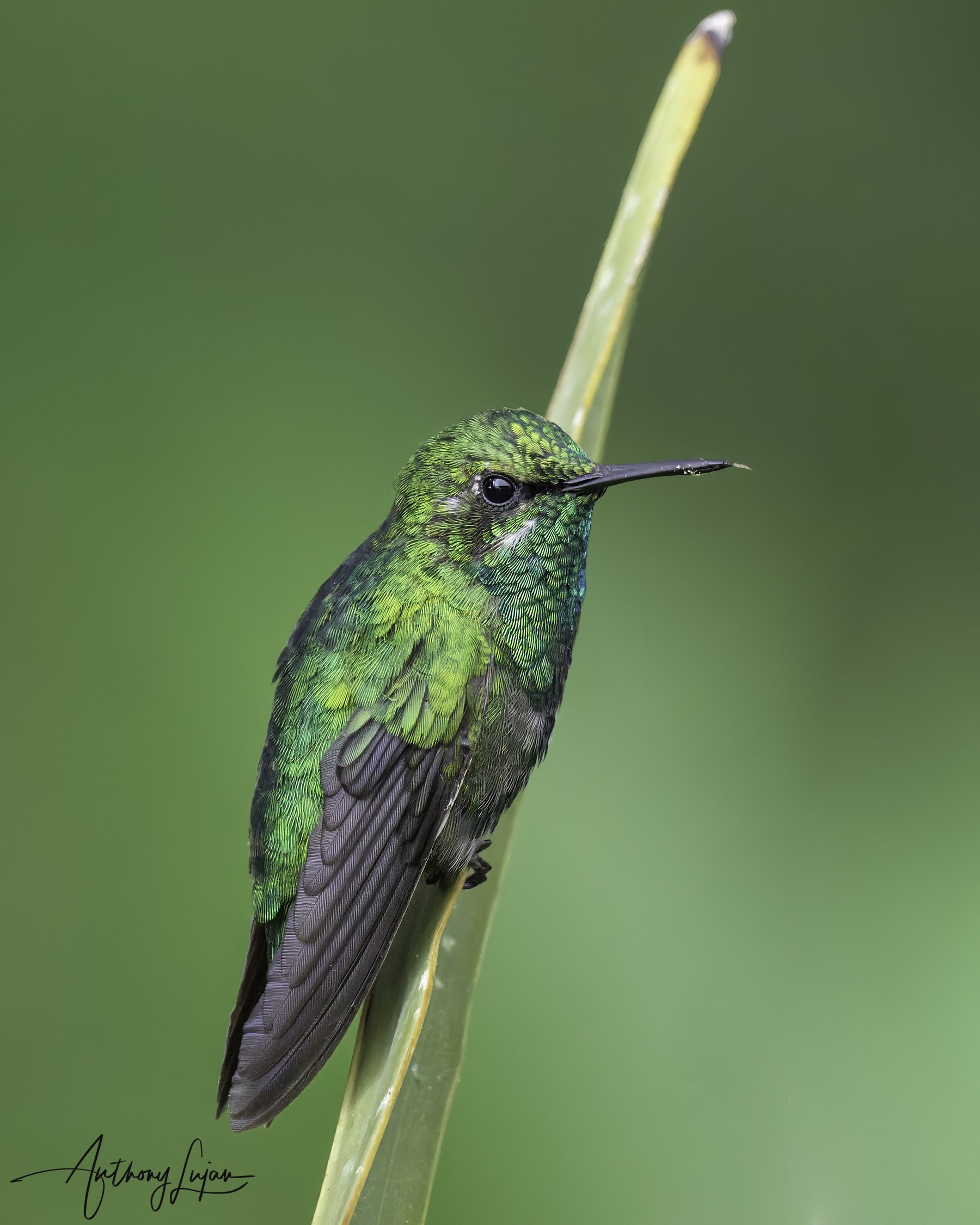
Below is the Glittering-bellied Emerald (Chlorostilbon lucidus igneus)
Photographed at Reserva Natural Privada Eco-Portal de Piedra, Santa Bárbara, Jujuy, Argentina
This individual belongs to the subspecies igneus, which inhabits the Andean foothills and dry valleys of northwestern Argentina (Jujuy, Salta, Tucumán) and adjacent southern Bolivia. It occupies arid scrub, open woodland, and montane slopes between 800 and 2,200 meters.
The igneus form is slightly darker green and more bronzy below than the nominate lucidus, with a slightly longer tail and bill. It forages actively at flowering trees and shrubs along dry ravines and semi-arid forest edge.
Related species in the Chlorostilbon genus (10 species total):


Please note: The content provided in this article reflects Anthony’s personal experience and photographic approach. Results can vary depending on light, weather, location, equipment, subject behavior, and field conditions.