
Green Hermit
Scientific name: Phaethornis guy
The Green Hermit is a large hermit hummingbird of humid forest understory from southern Central America south along the northern Andes to southeastern Peru and northeastern Venezuela, including Trinidad. Its global population is estimated at 500,000–4,999,999 mature individuals, the population trend is decreasing, it is not a migrant, and it is currently assessed as Least Concern.
At a Glance
Family: Trochilidae (hummingbirds)
Clade: Phaethornithinae – Hermits
Genus: Phaethornis — 27 species in total
Range: Costa Rica south through Panama, Colombia, Ecuador, and eastern Andes to southeastern Peru, plus northeastern Venezuela and Trinidad
Habitat: Humid forest undergrowth and lower levels, usually near water; prefers primary rainforest and wet premontane forest, avoids heavily degraded secondary forest when better habitat is available
Elevation: Roughly 500–2,000 m, locally a bit lower or higher depending on region
Length: About 13.5–15 cm (5.3–5.9 in)
Weight: Around 6–7 g
Number of mature individuals: 500,000–4,999,999
Population trend: Decreasing
Movement: Not a migrant
IUCN Red List category: Least Concern
Name Origin
The genus name Phaethornis derives from Phaethon, meaning “shining” or “radiant,” reflecting the iridescence typical of hummingbirds. The species name guy honors Étienne Geoffroy Saint-Hilaire’s contemporary or patron (usage varies by source). The English name “Green Hermit” refers to its overall green plumage and its placement among hermits.
Taxonomy
Phaethornis guy is a hermit hummingbird in the subfamily Phaethornithinae. It is one of 27 species in the genus Phaethornis, a large group of hermits found from southern Mexico through Central and much of South America.
Subspecies and Distribution
Four subspecies:
Phaethornis guy coruscus
Distribution: Costa Rica south to northwestern Colombia.Phaethornis guy emiliae
Distribution: Colombia, mainly in the river valleys of all three Andean ranges.Phaethornis guy apicalis
Distribution: Eastern Andes from northwestern Venezuela (Lara) and Colombia south to southeastern Peru; also the Sierra de Perijá.Phaethornis guy guy
Distribution: Mountains of northeastern Venezuela and the island of Trinidad.
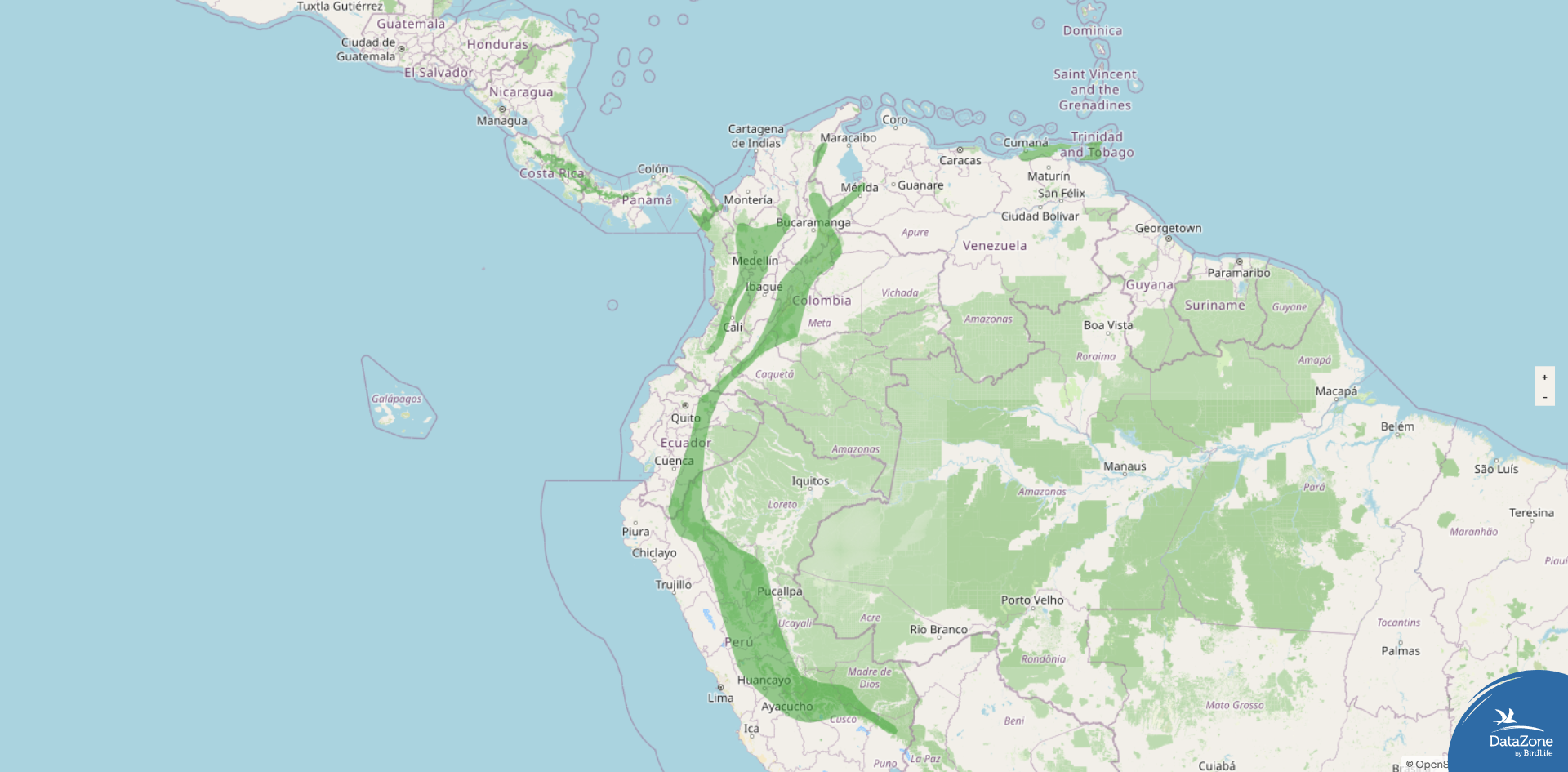
Legend
Green Resident
Species Overview
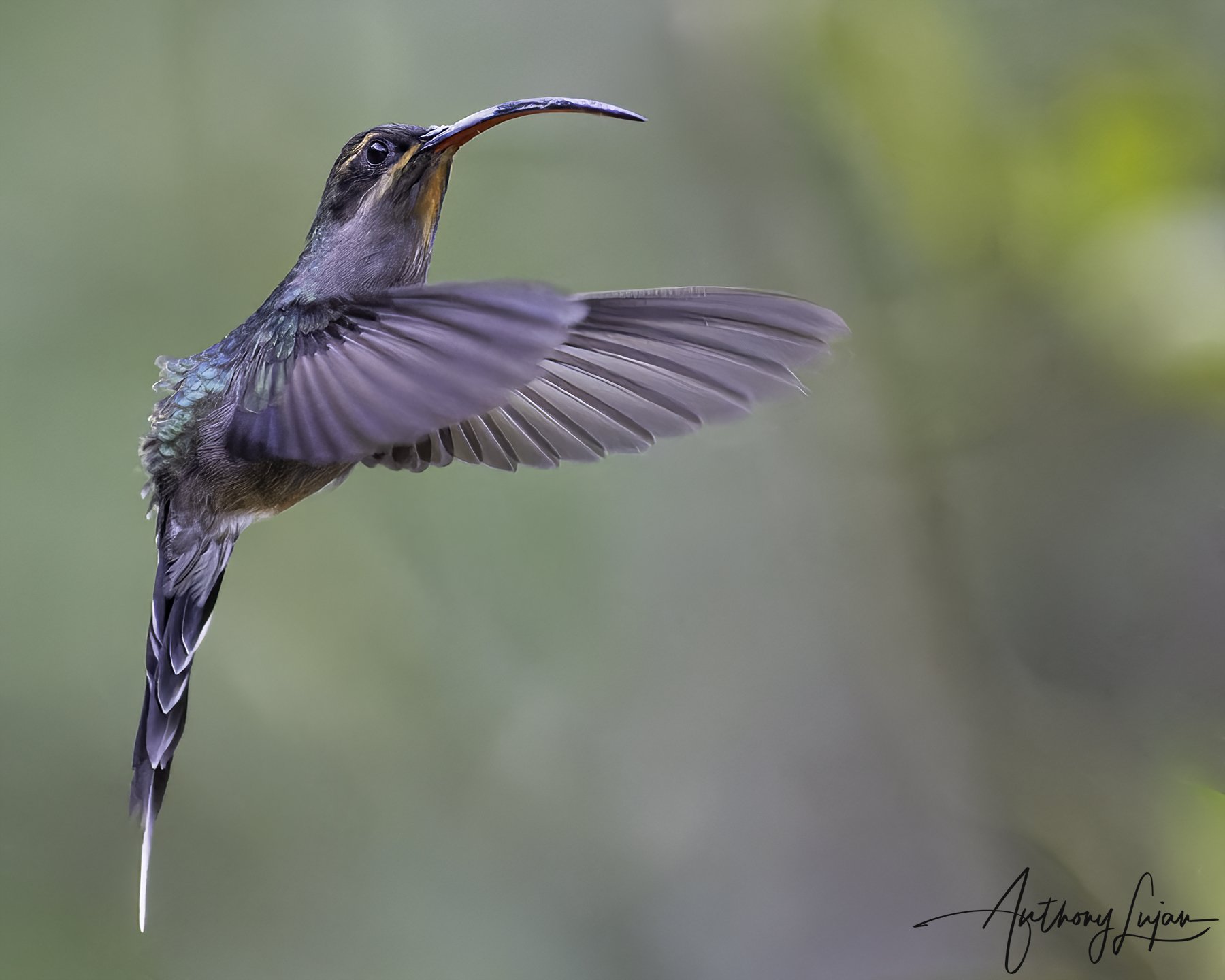
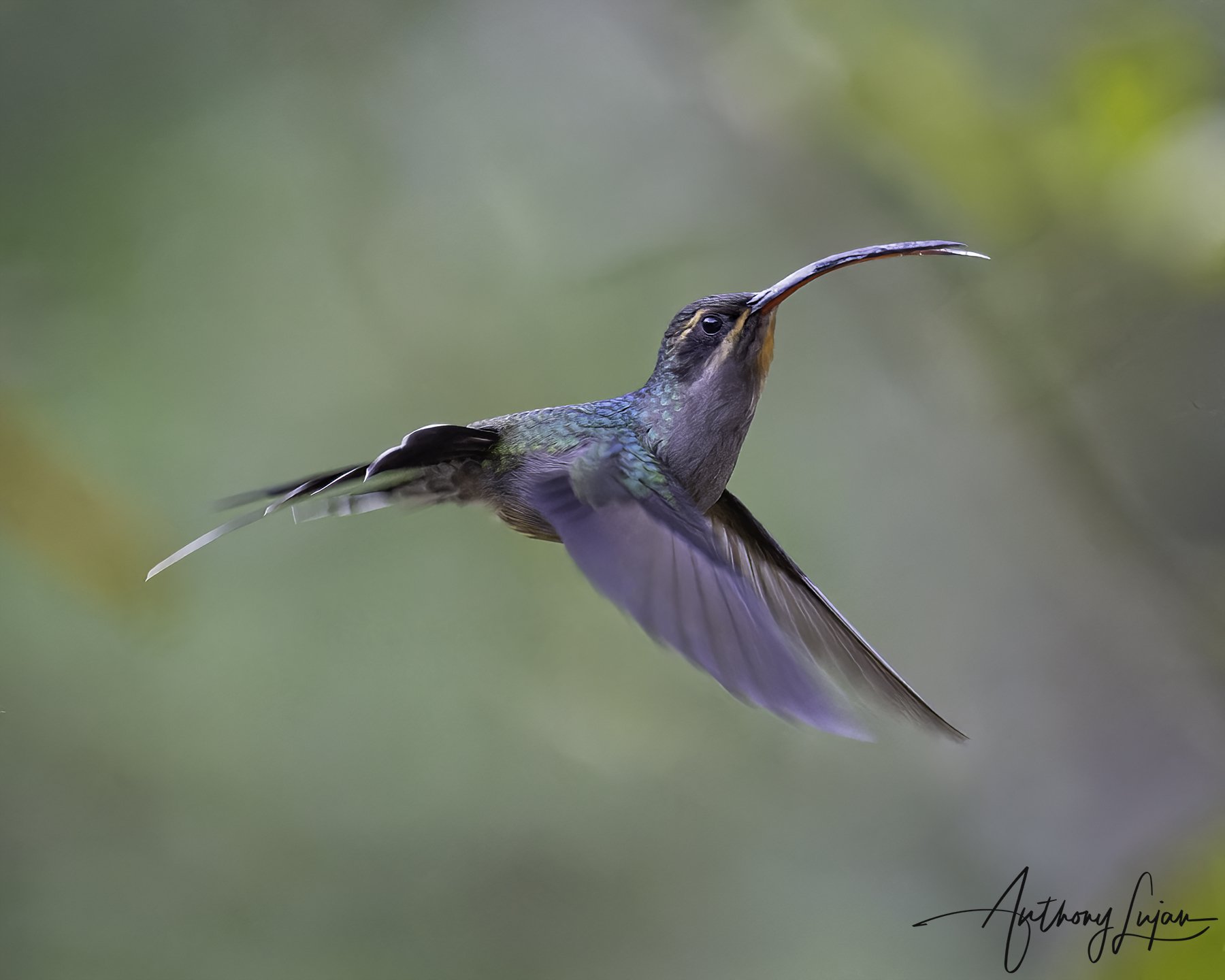
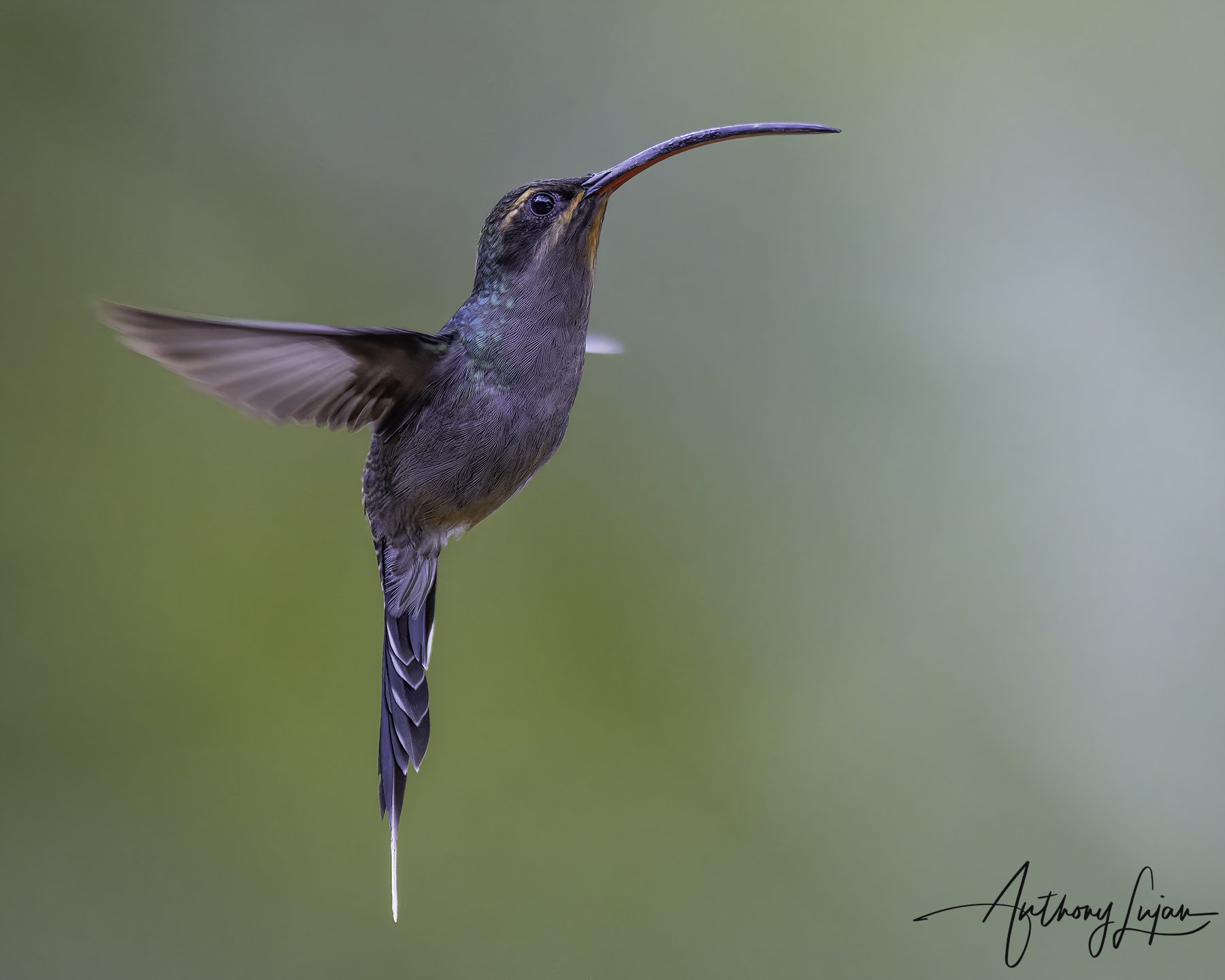
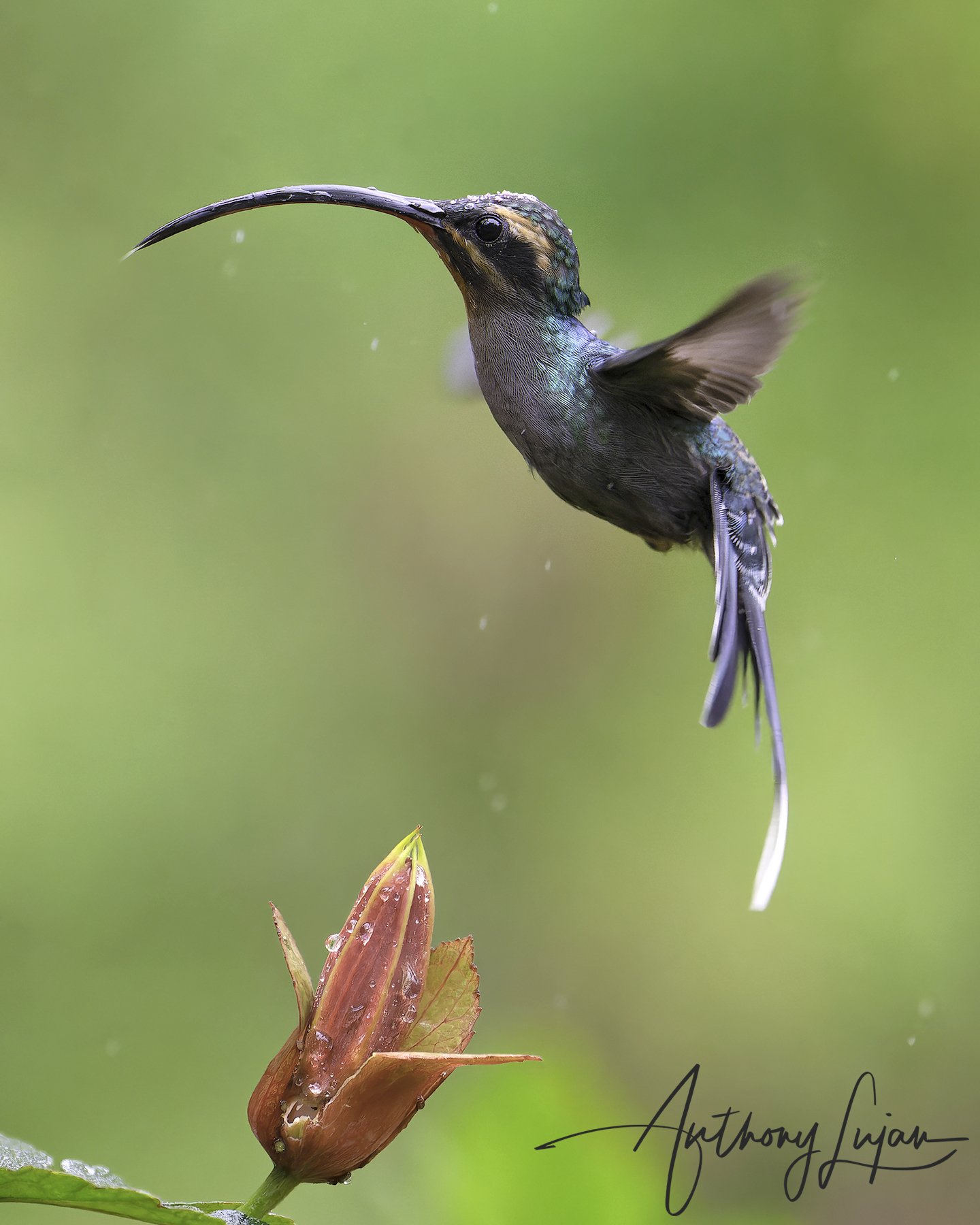
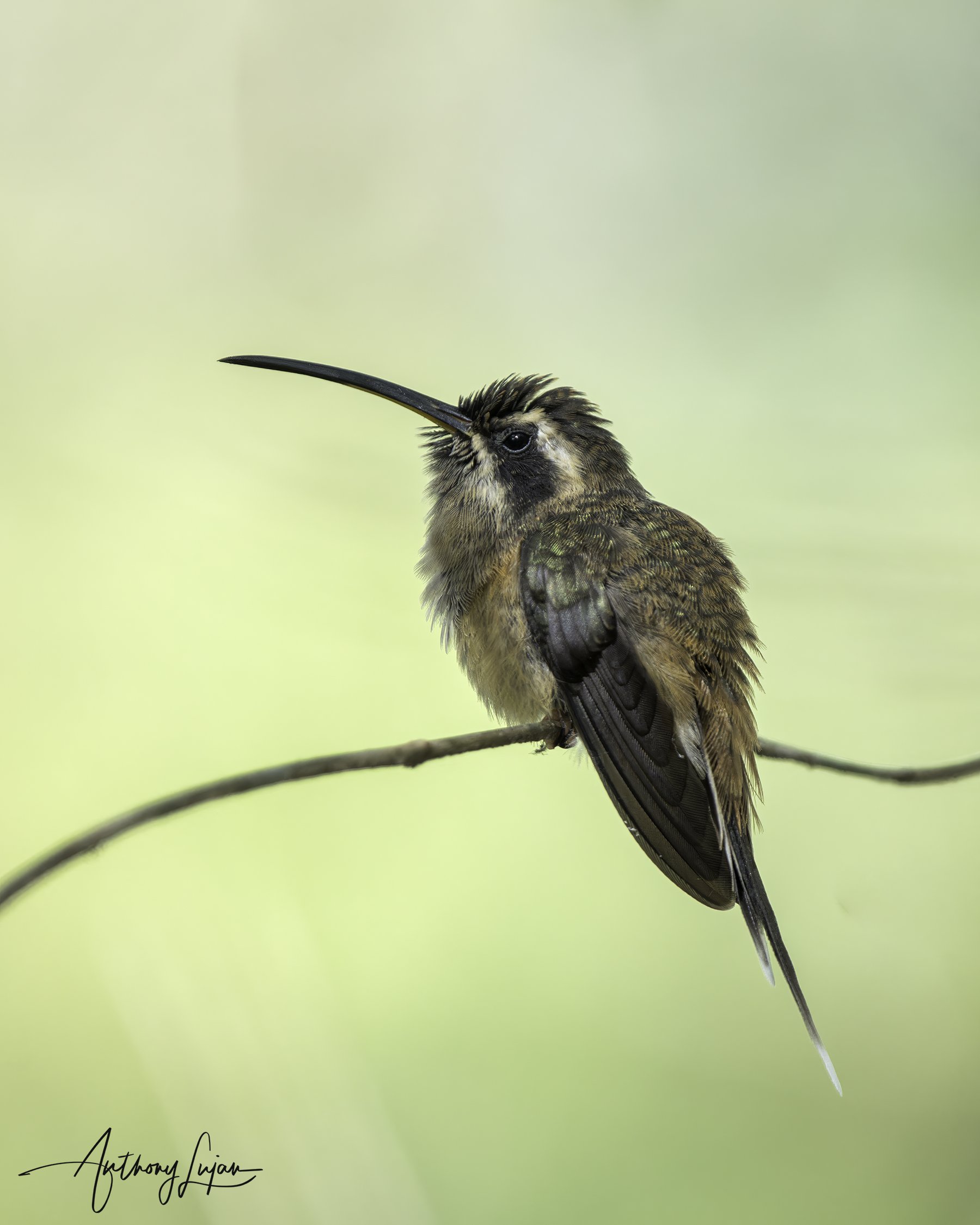
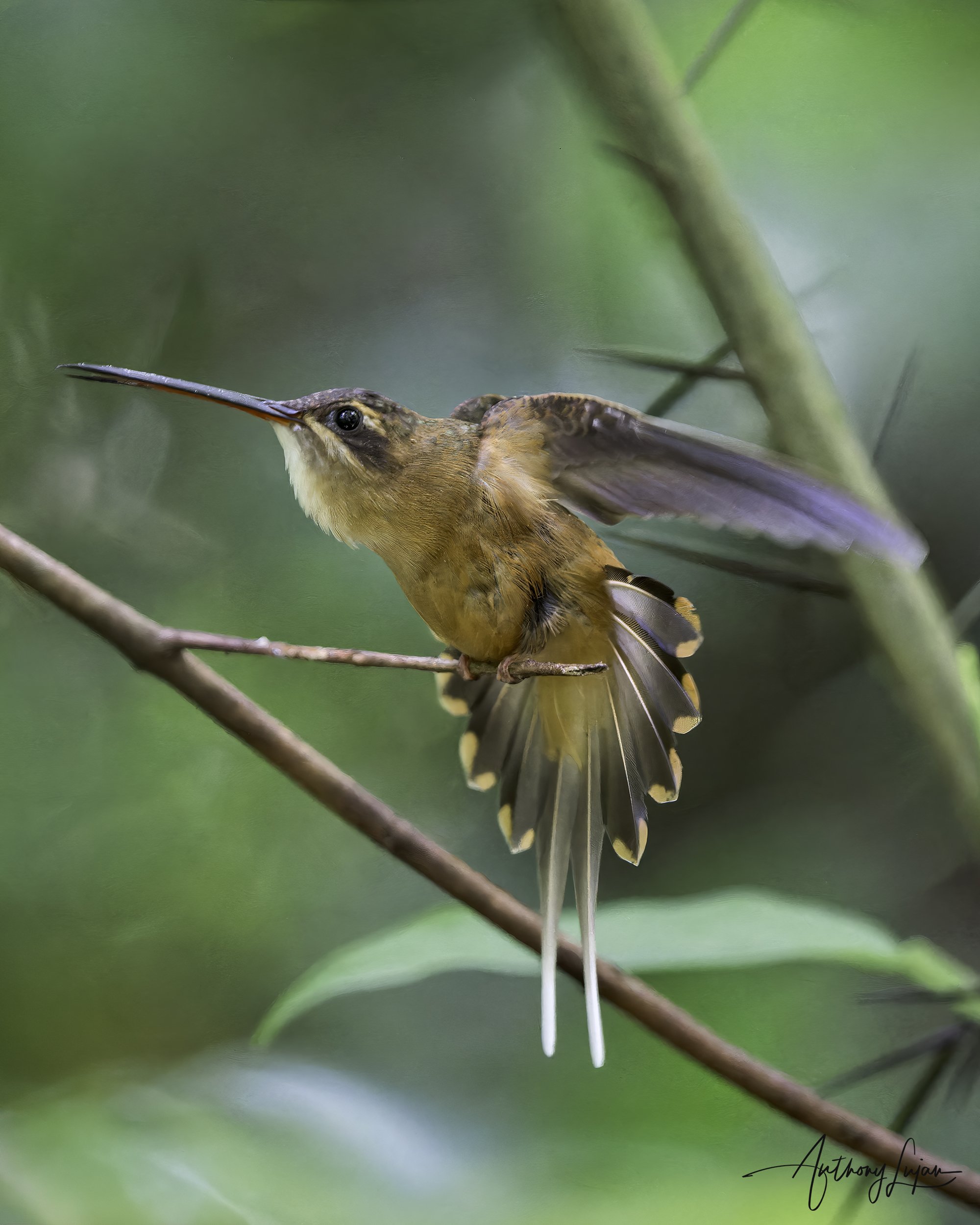
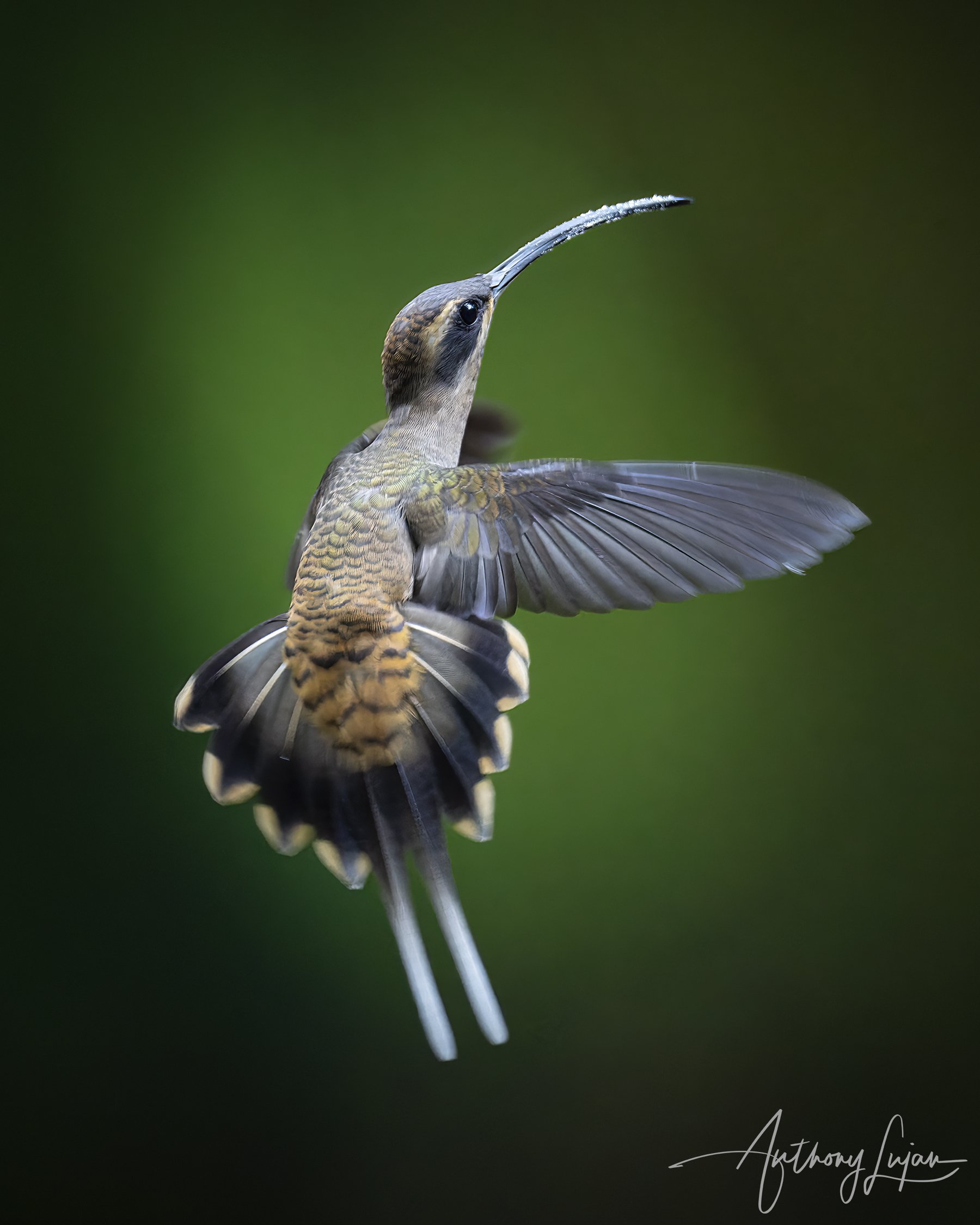
The Green Hermit is a large, striking hermit with bluish‑green metallic upperparts, sooty green to grayish underparts, and a strong hermit facial pattern of blackish mask with buff stripes above and below the eye and down the throat center. It has an especially long, decurved bill and long central tail feathers tipped with white, giving it a distinctive silhouette. It favors hilly, humid forests and is strongly associated with primary rainforest and wet premontane forest, especially near water.
Male Description
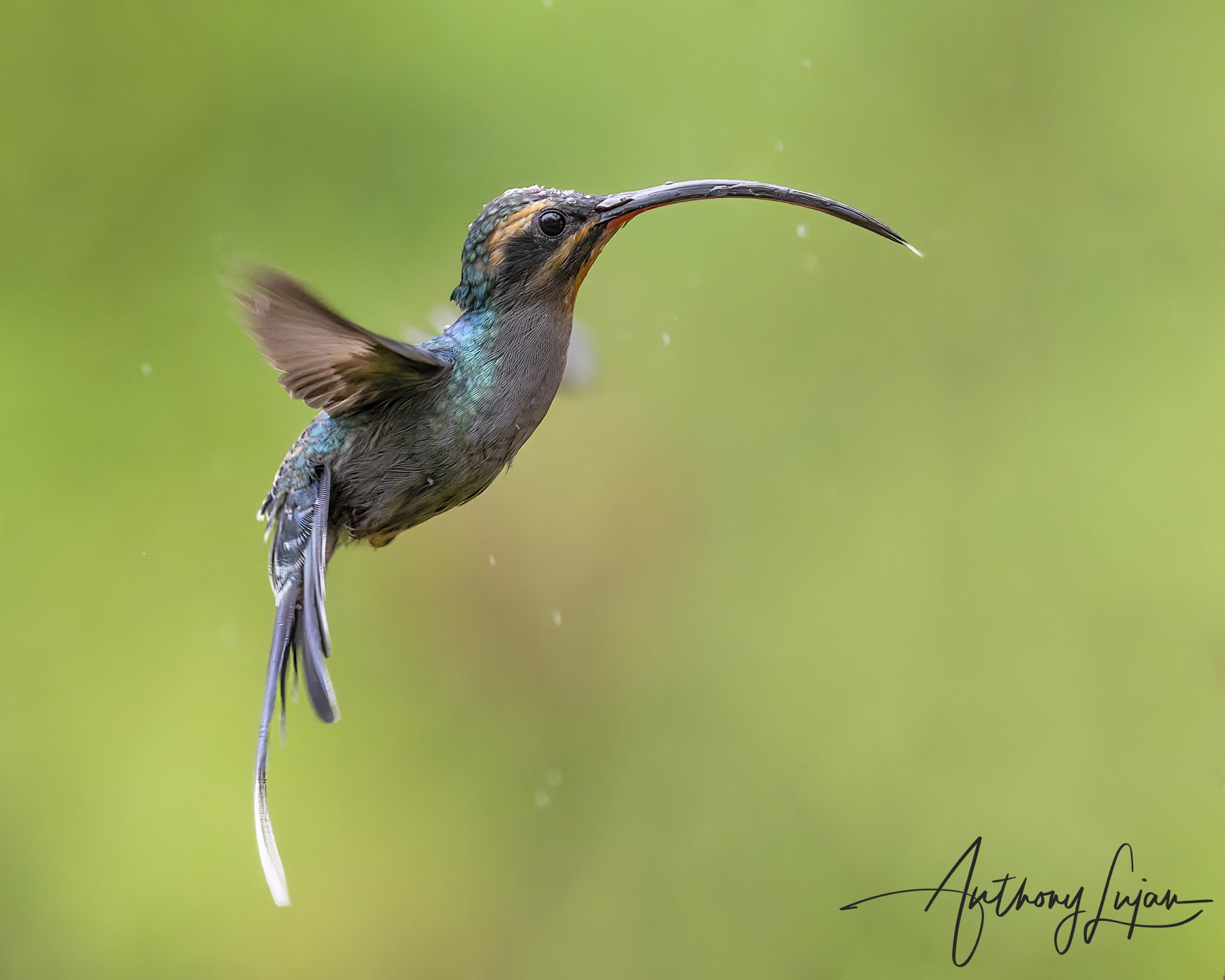
Males average about 13.5–15 cm in length. The upperparts are bluish to metallic green, with a blue‑green rump. The underparts are sooty green to grayish, often darker on the chest with a paler central belly. The face shows a dark mask through the eye, bordered by buff stripes above and below and typically a pale stripe down the middle of the throat. The bill is long, slender, and decurved, with a red base to the lower mandible. The tail is graduated, with very long central tail feathers tipped with white, giving an extended tail projection.
Female Description
Females are similar to males but may show paler or buffier underparts and slightly different bill curvature. They have shorter central tail feathers on average, though still long and white‑tipped. Both sexes share the same overall green and gray color scheme and facial pattern. Juveniles resemble females but can have duller metallic tones and less sharply defined facial stripes.
Habitat & Behavior
Green Hermits inhabit forest undergrowth and lower levels in humid lowland and premontane forests, especially near streams and moist ravines. They favor primary rainforest and wet premontane forest and will use lightly disturbed areas and subsistence farmland adjacent to good forest, but generally avoid heavily degraded secondary forest when better habitat is available.
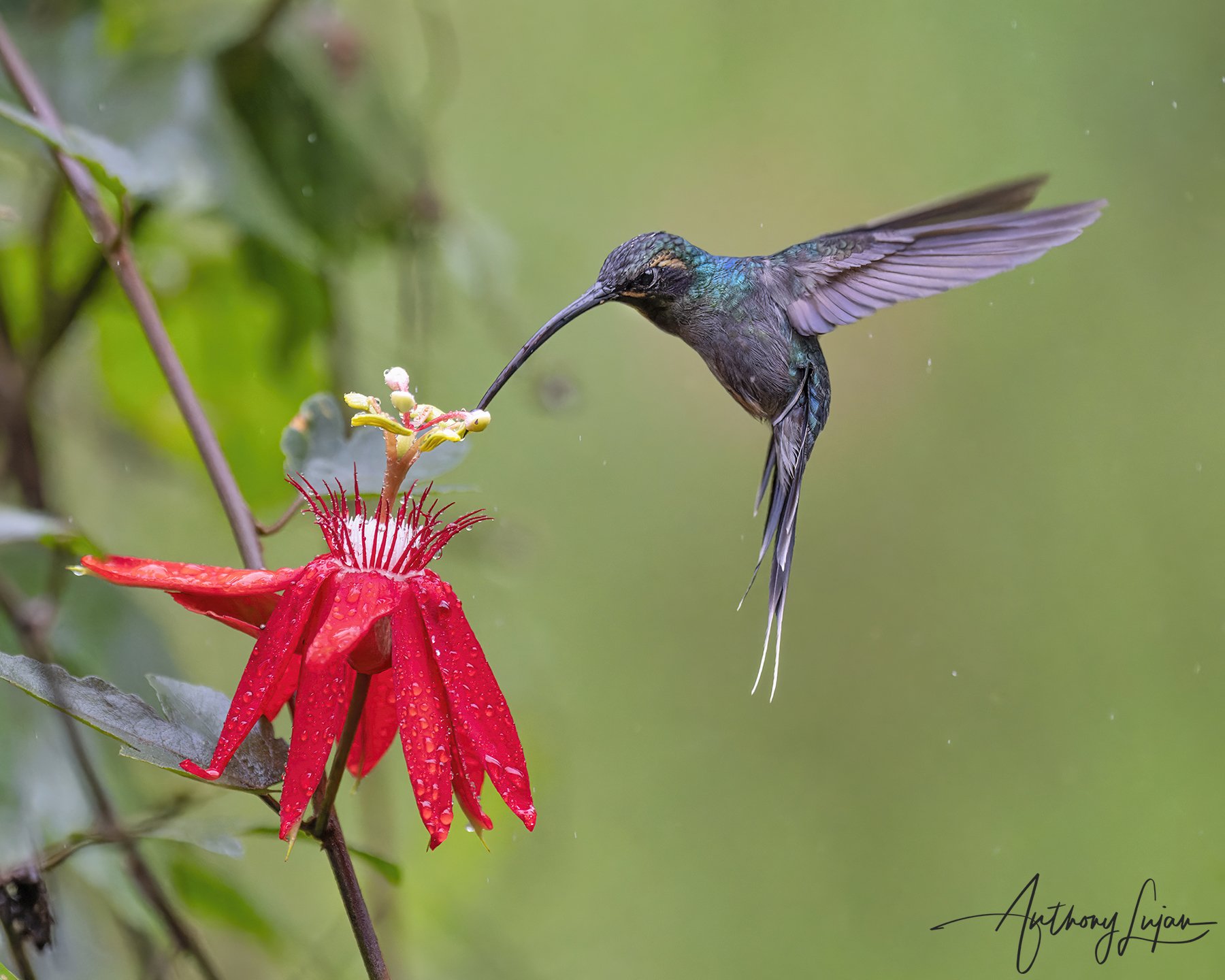
They are typical hermit trapliners, flying a regular route between widely spaced nectar sources. They feed mainly on nectar from tubular flowers—often in shady understory or along forest edges—and also take small insects and spiders as a protein supplement. Males may gather at leks, singing from fixed perches to attract females; females visit leks to choose mates, then nest and rear young alone.
Breeding
The Green Hermit has a polygynous breeding system with males displaying at leks and females providing all parental care. The female builds a cone‑shaped nest of plant down and spider silk, attached to the underside of large leaves such as Heliconia, palms, or ferns, often 1–4 m above the ground and usually above or near water.
The clutch is typically one or two white eggs (often recorded as one in some regions). Incubation lasts about 17–18 days, and fledging occurs around 21–23 days after hatching. The female spends 5–10 days building the nest and frequently repairs it during incubation and chick rearing.
Movement
The Green Hermit is considered non‑migratory. It is resident throughout its range from Costa Rica to southeastern Peru, northeastern Venezuela, and Trinidad, though birds may move locally along elevational gradients and between forest types as flowering patterns and water availability change. These shifts are local and not true long‑distance migrations.
Population
The global population is estimated at 500,000–4,999,999 mature individuals. It is generally described as fairly common in suitable habitat, especially in humid foothill and premontane forests, but its dependence on quality forest understory makes it vulnerable to deforestation and degradation. Habitat loss throughout its range is believed to be driving a gradual decrease in population, even though it remains widespread.

Conservation
The Green Hermit is currently assessed as Least Concern, reflecting its broad distribution and relatively large global population. However, ongoing deforestation, fragmentation, and degradation of humid forests—particularly in Andean foothills, premontane zones, and on Trinidad—pose long‑term risks. Conservation of primary and older secondary forest, protection of riparian corridors, and maintenance of dense understory vegetation are important for sustaining healthy populations.
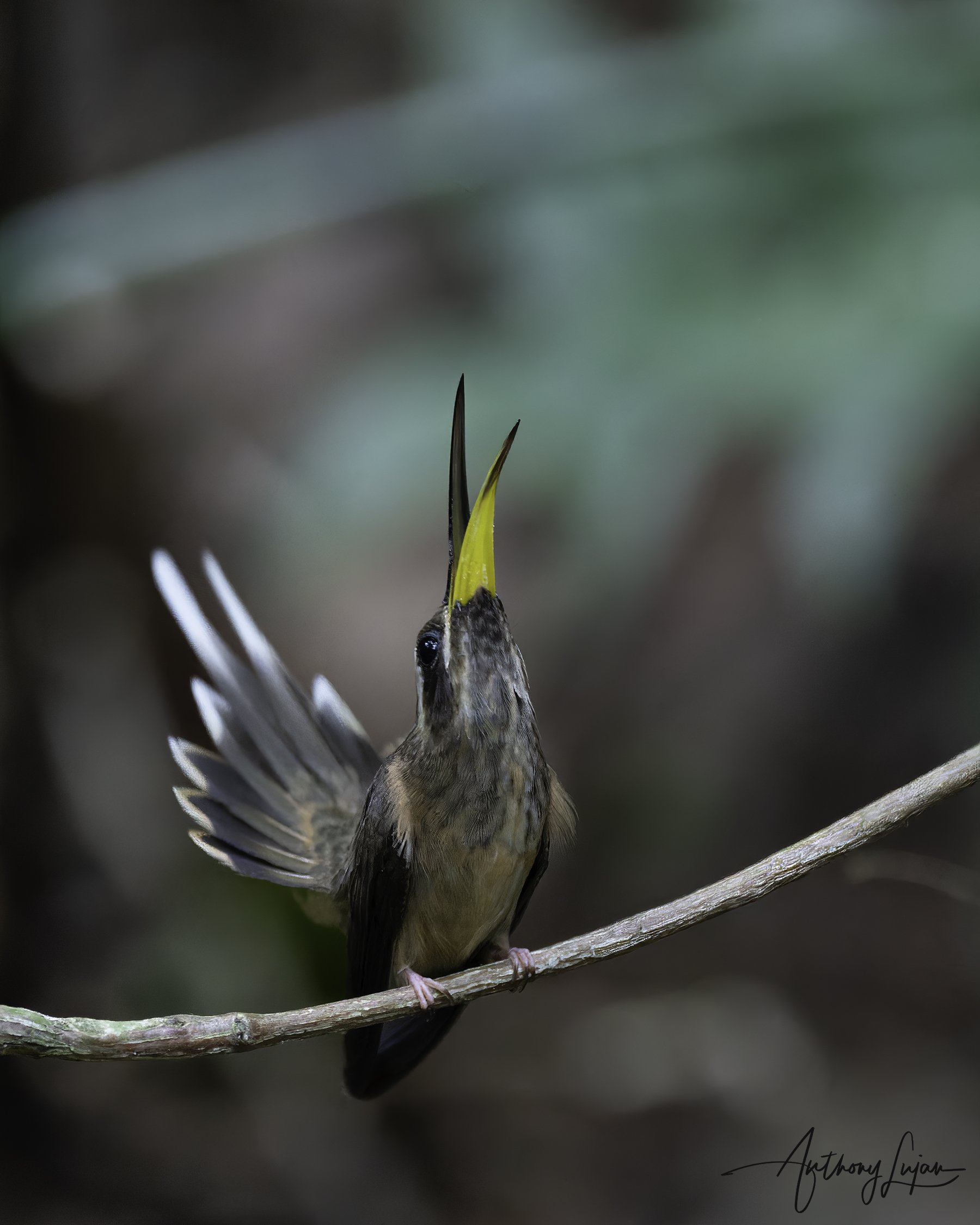
Below is the Green Hermit (Phaethornis guy emiliae)
Photographed at:
Finca Alejandría "El Paraiso de Los Colibries", Valle del Cauca, Colombia
Finca La Araucana, Valle del Cauca, Colombia
These individuals belong to the subspecies emiliae, which is found in the river valleys of Colombia's three Andean ranges. It inhabits humid forest and ravine zones, particularly in transitional foothill elevations. Compared to other forms, it shows slightly shorter bill and tail streamers, and the underparts are typically darker with a more grayish tone.
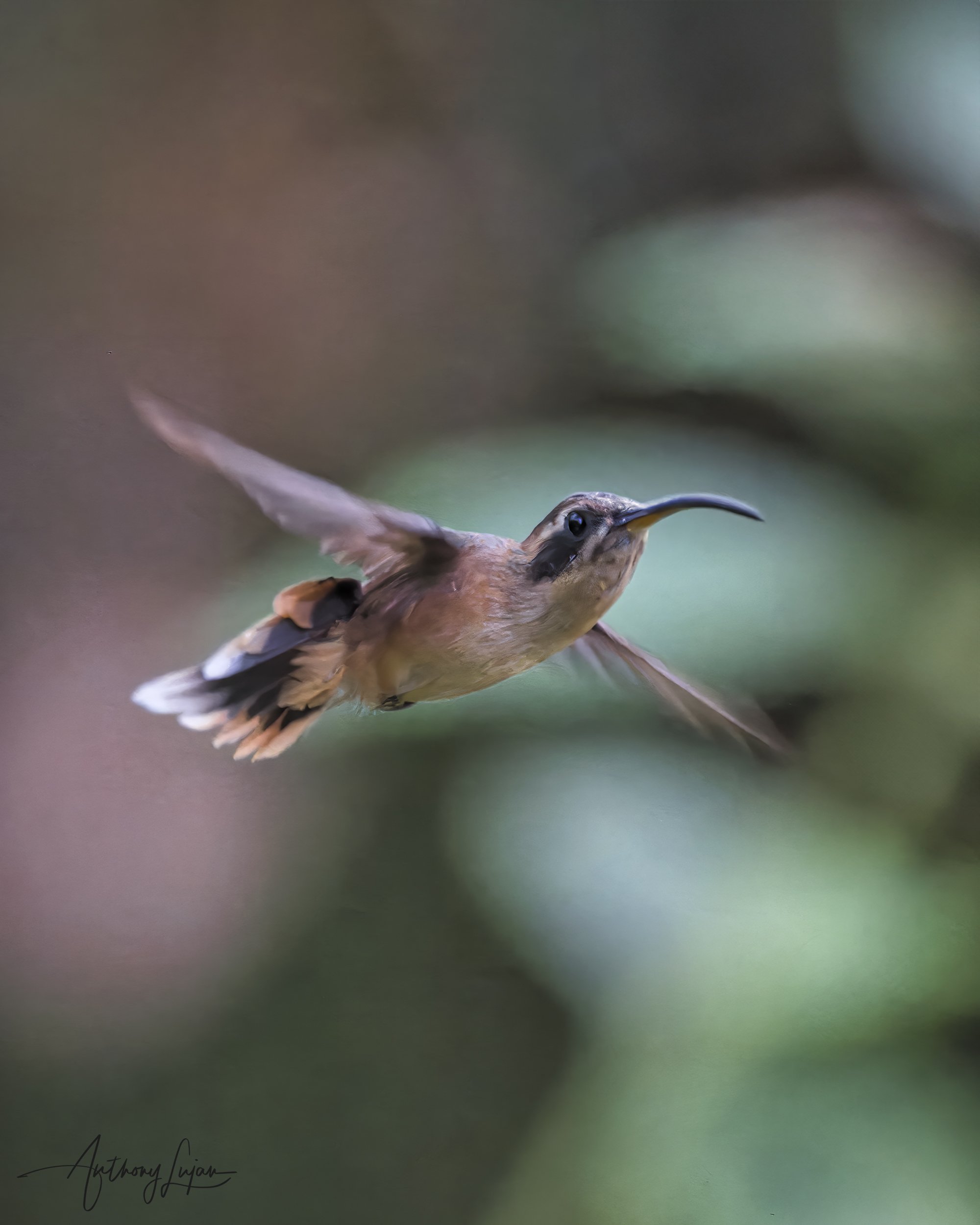
Below is the Green Hermit (Phaethornis guy coruscus)
Photographed at:
Catarata del Toro, Alajuela, Costa Rica
Nectar & Pollen Reserve, Limón, Costa Rica
Hotel Quelitales, Cartago, Costa Rica
These individuals belong to the subspecies coruscus, which ranges from Costa Rica south into northwestern Colombia. It inhabits humid forest understory and stream corridors from the lowlands up into foothill zones. This form is slightly larger than others, with a longer bill and tail streamers, and may show a subtle green wash on the underparts.
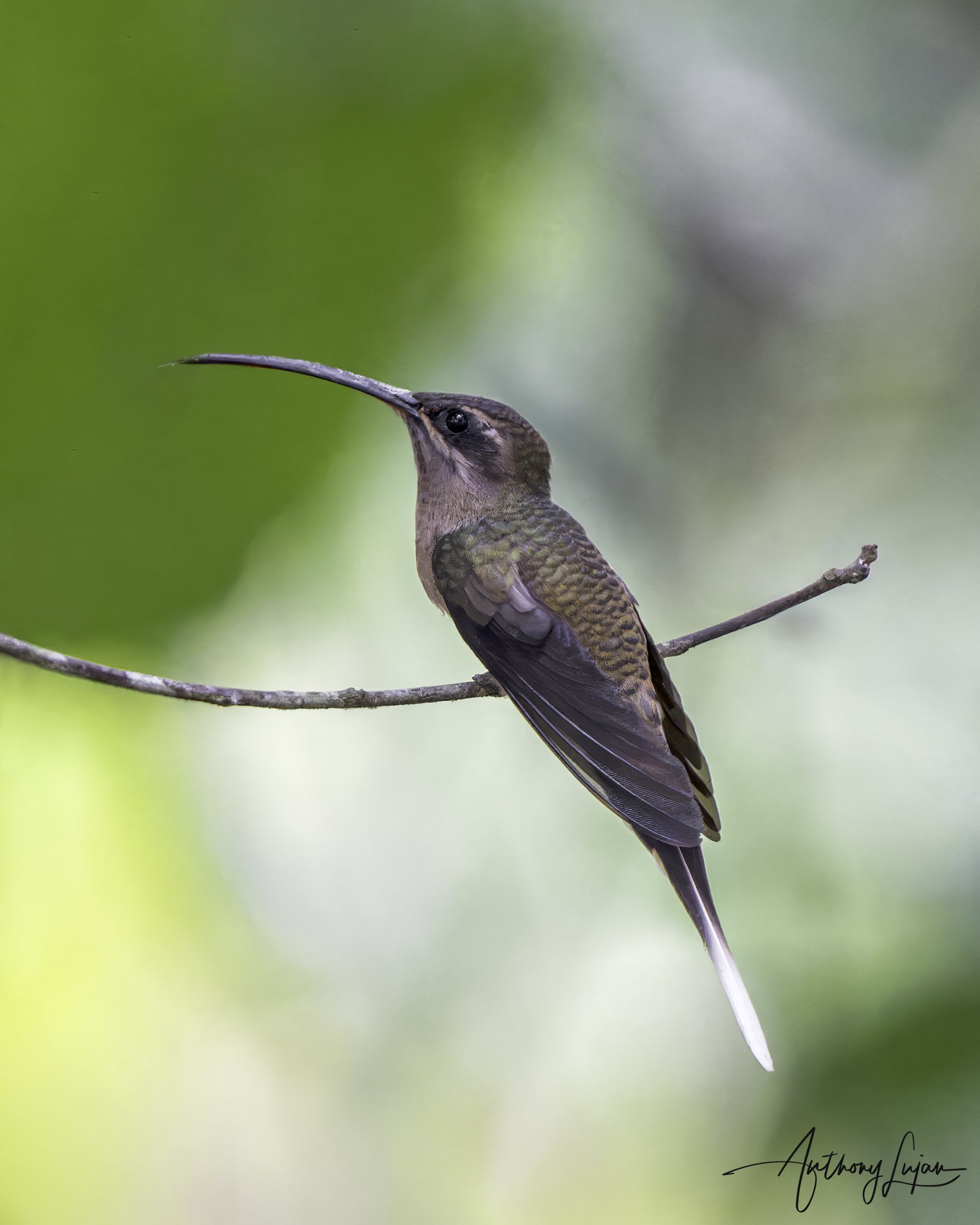
Below is the Green Hermit (Phaethornis guy guy)
Photographed at:
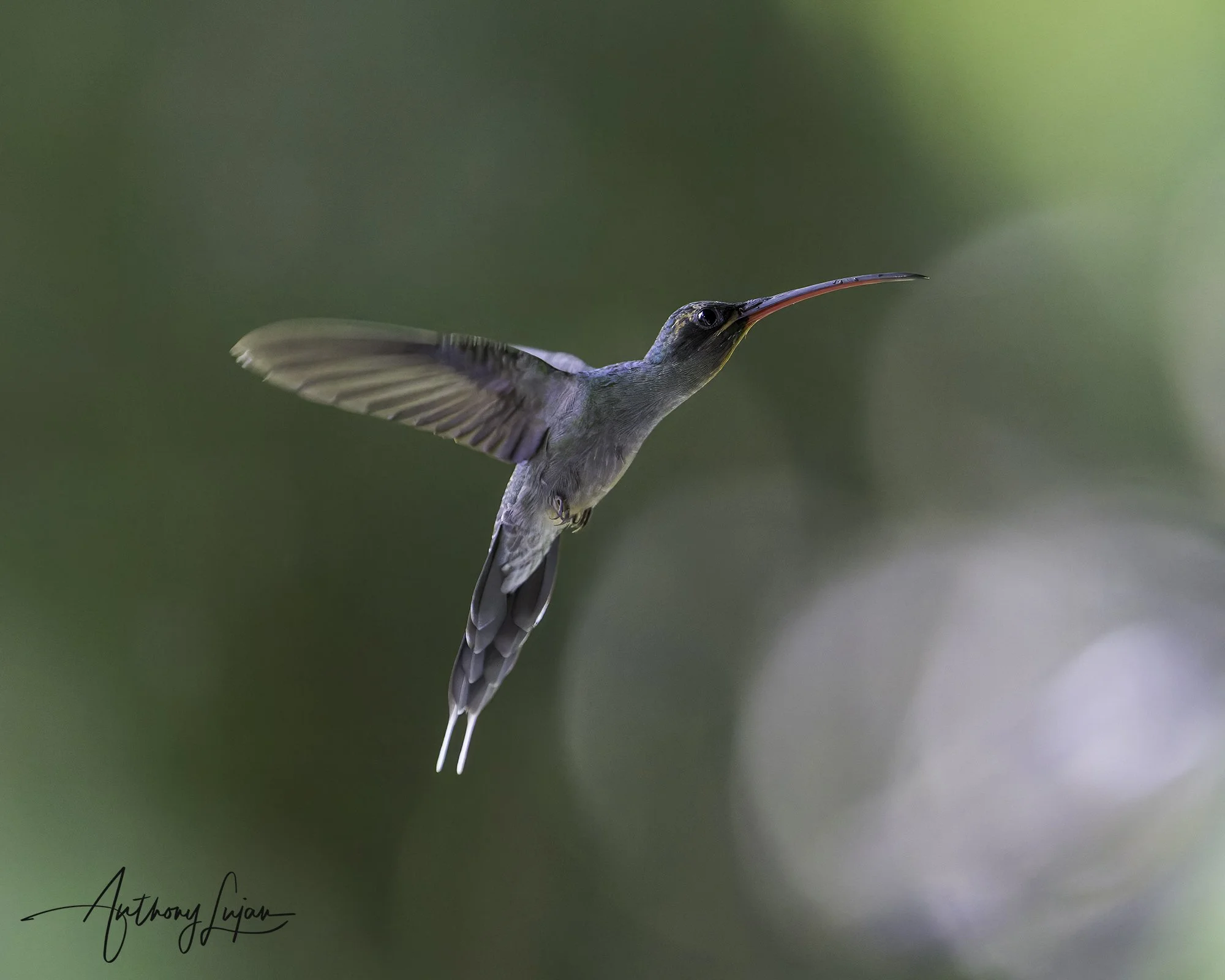
Café Mariposa Gardens, Tunapuna-Piarco, Trinidad and Tobago
Yerette Home of the Hummingbird, Tunapuna-Piarco, Trinidad and Tobago
This individual belongs to the nominate subspecies guy, found in the mountains of northeastern Venezuela and on the island of Trinidad. It favors humid mountain forest and stream corridors. As the reference form for the species, it features strong contrast between the dark green upperparts and grayish underparts, with bold buff facial stripes and prominent white-tipped tail streamers.
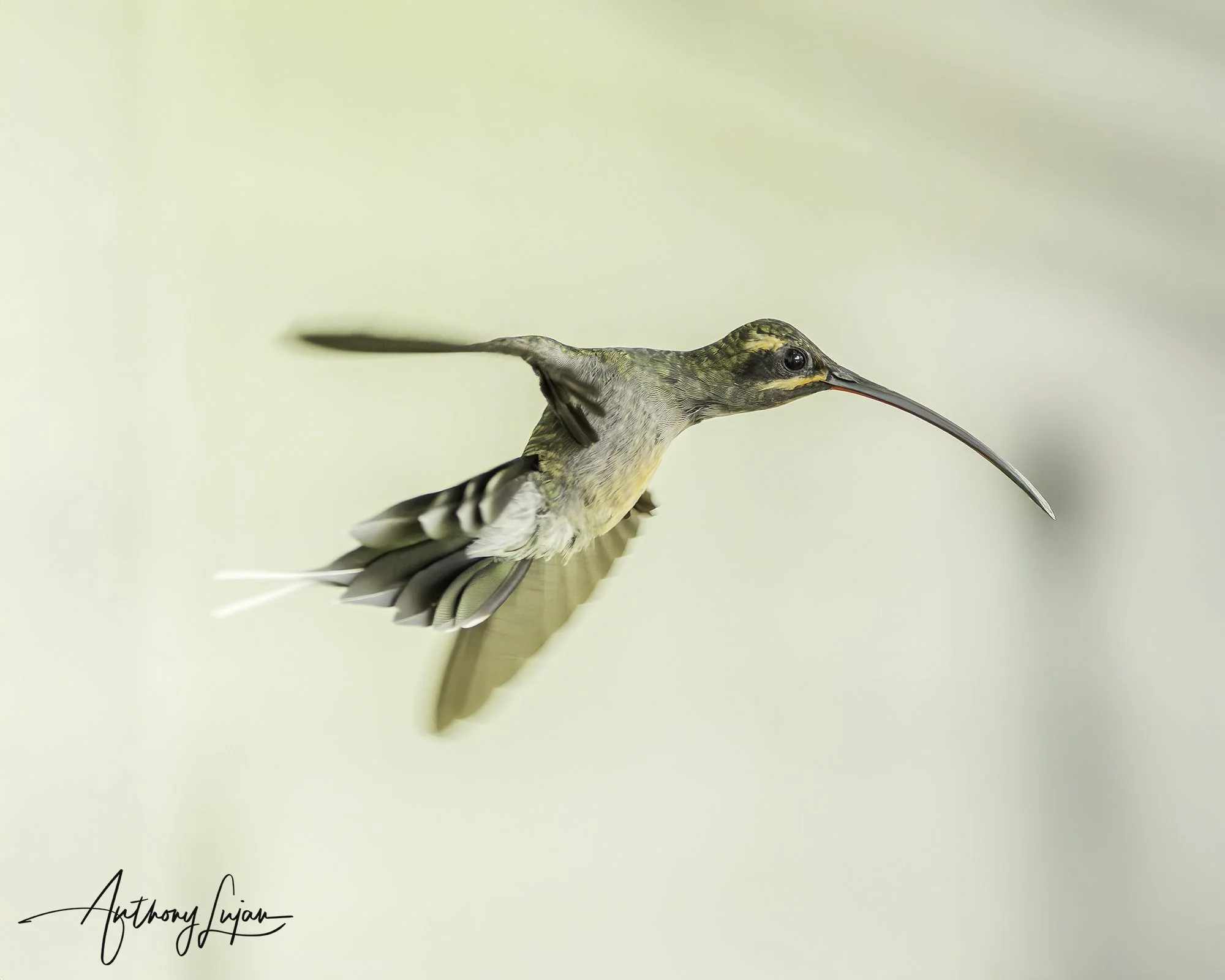
Below is the Green Hermit (Phaethornis guy apicalis)
Photographed at:
Bosque de Protección Alto Mayo--Llanteria/Afluente vicinity, San Martín, Peru
This individual belongs to the subspecies apicalis, which occurs on the eastern slope of the Andes from northwestern Venezuela through Colombia and south into southeastern Peru. It is typically found in humid lower montane forest. This form is slightly smaller overall, with sexes appearing more similar; the underparts tend to be darker, and the tail and bill are of moderate length.
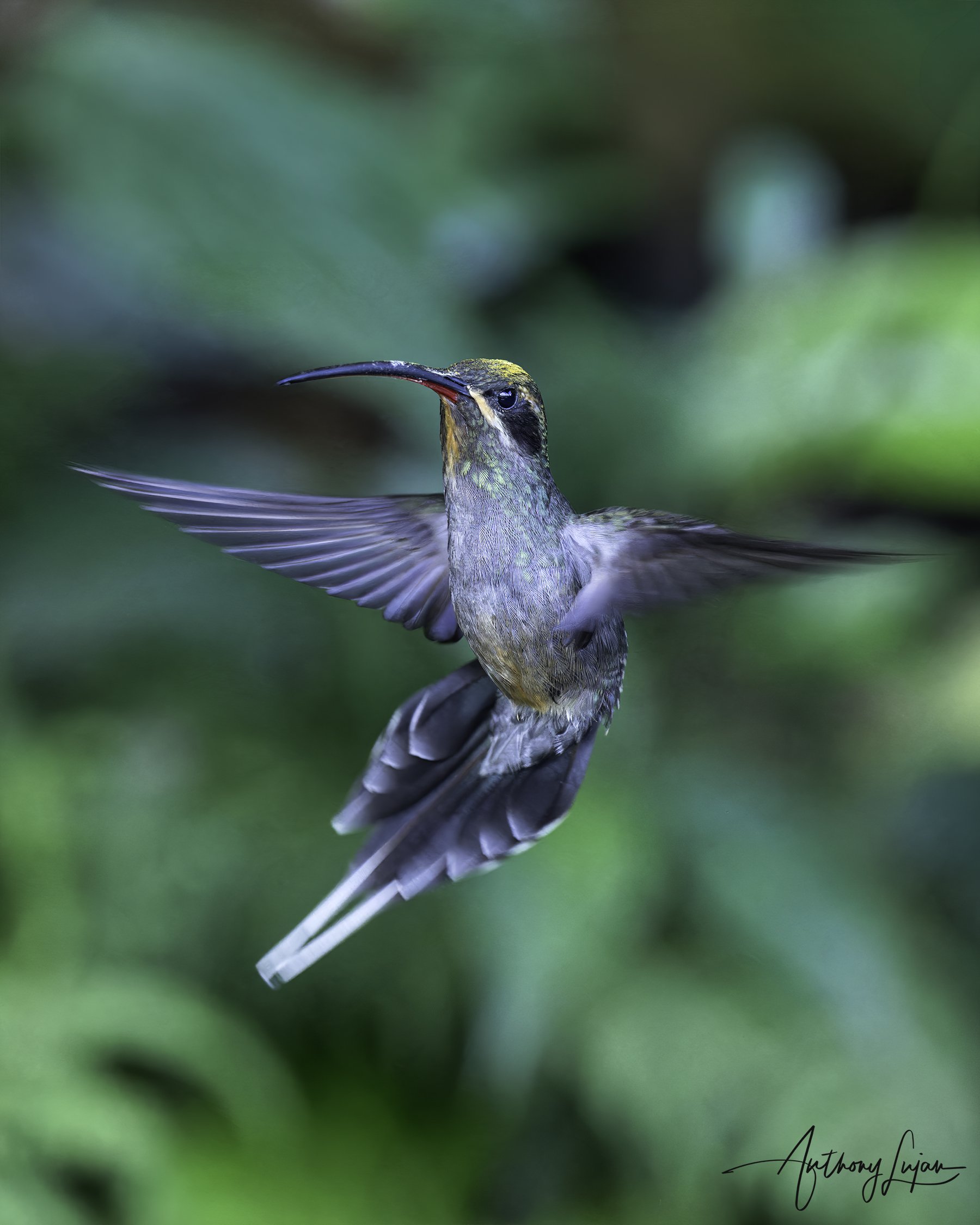
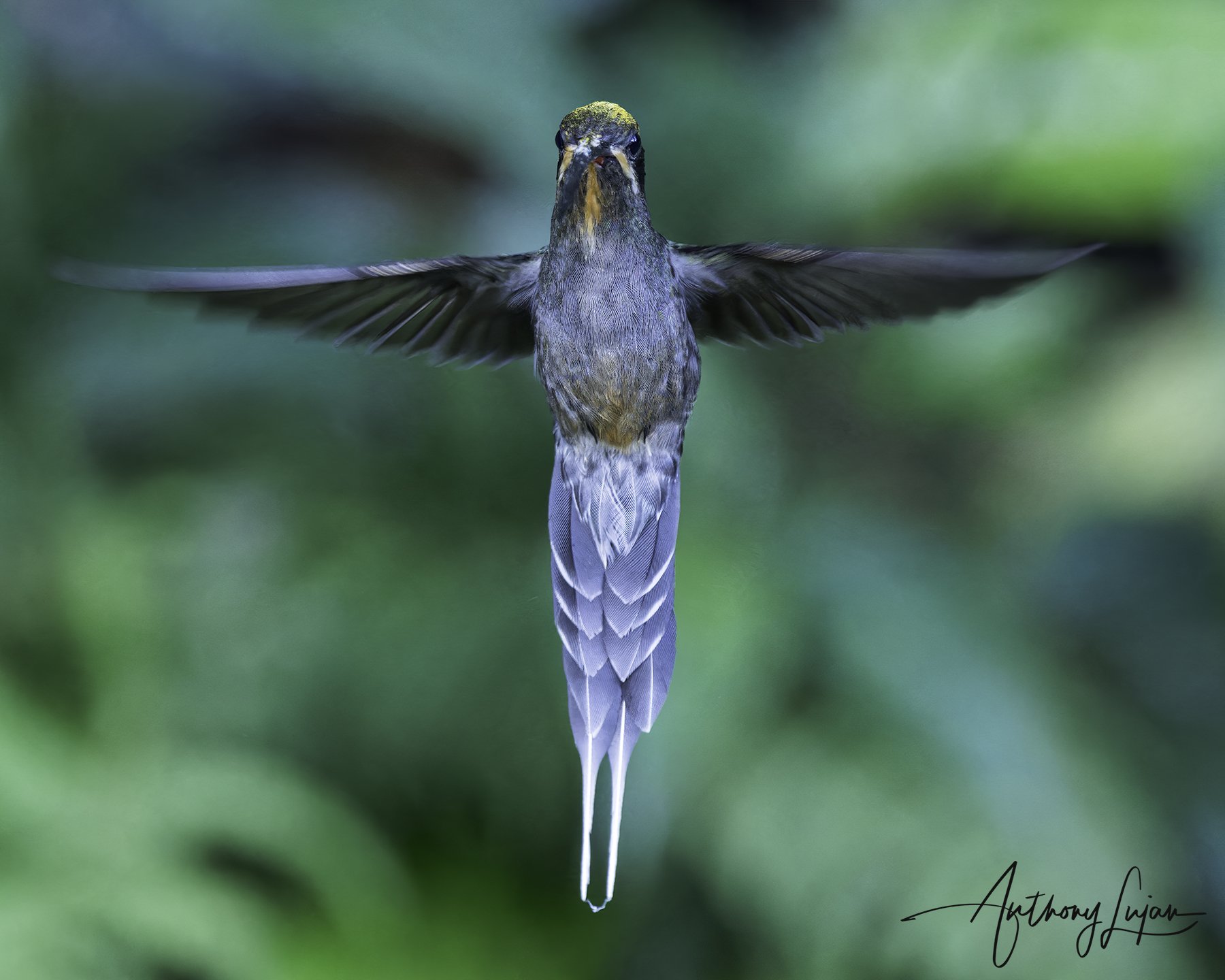
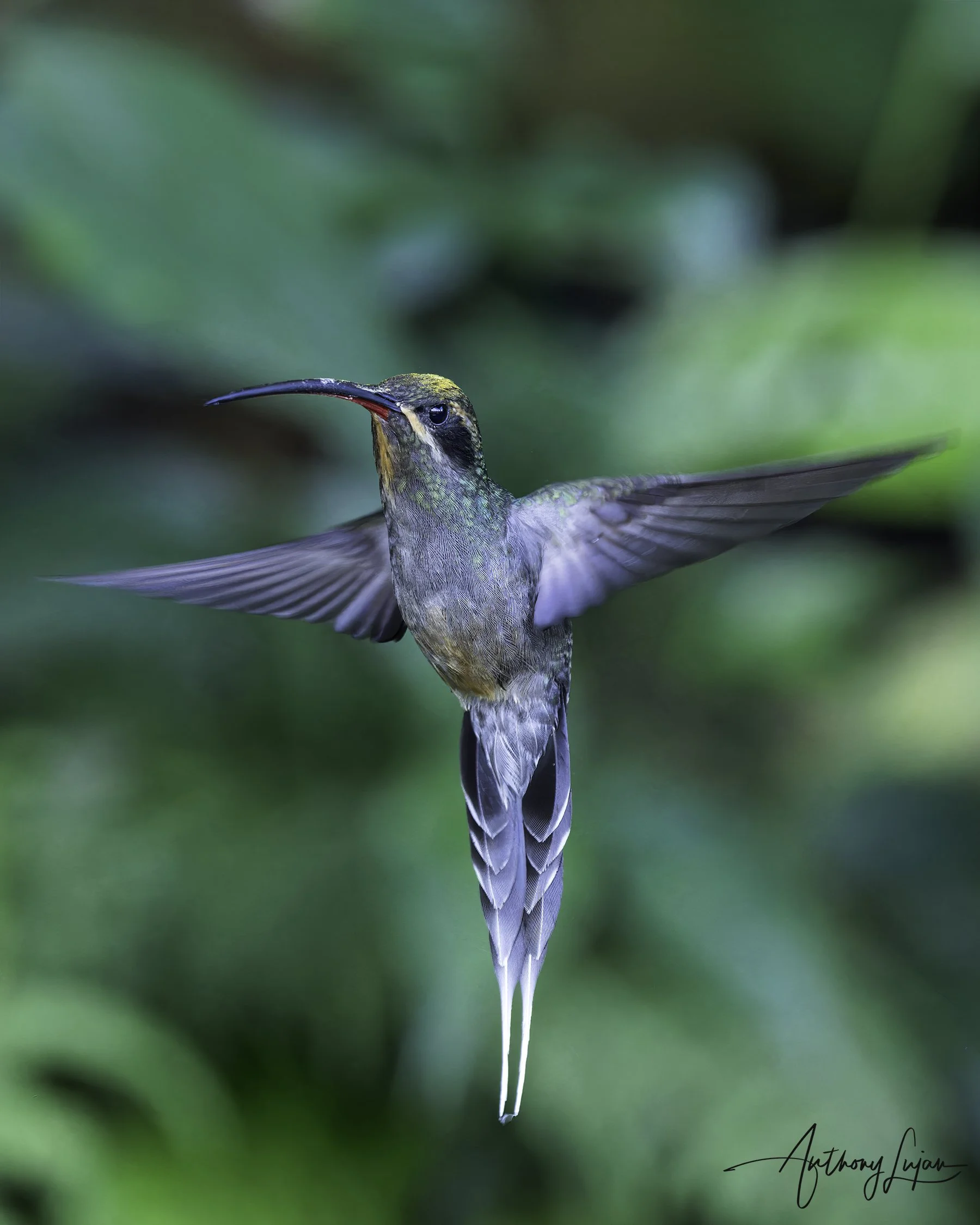
For more details on the trips behind this species, visit the Costa Rica Hummingbird Expedition | July 2025 page and explore My Travel 2025-05 Costa Rica for guides and trip reports.
Related species in the Phaethornis genus (27 species total)



Please note: The content provided in this article reflects Anthony’s personal experience and photographic approach. Results can vary depending on light, weather, location, equipment, subject behavior, and field conditions.