
Hook-billed Hermit
Scientific name: Glaucis dohrnii
The Hook-billed Hermit is a very rare hermit hummingbird of lowland Atlantic Forest in southeastern Brazil. The global population is estimated at 2,500–9,999 mature individuals, the population trend is decreasing, it is not a migrant, and it is currently assessed as Vulnerable.
At a Glance
Family: Trochilidae (hummingbirds)
Clade: Phaethornithinae – Hermits
Genus: Glaucis — 3 species in total
Range: Endemic to southeastern Brazil (Bahia and Espírito Santo)
Habitat: Humid lowland evergreen Atlantic Forest, especially along streams in interior and coastal forest
Elevation: From sea level to about 500 m
Length: About 12–13 cm (4.7–5.1 in)
Weight: Males about 6–9 g; females about 5.5–7 g
Number of mature individuals: 2,500–9,999
Population trend: Decreasing
Movement: Not a migrant
IUCN Red List category: Vulnerable
Name Origin
The genus name Glaucis comes from a Greek word for “bluish‑gray” or “gleaming.” The species name dohrnii honors Heinrich Dohrn, a German naturalist. The common name “Hook-billed Hermit” refers to its nearly straight but distinctly hooked bill tip and its membership in the hermit group.
Taxonomy
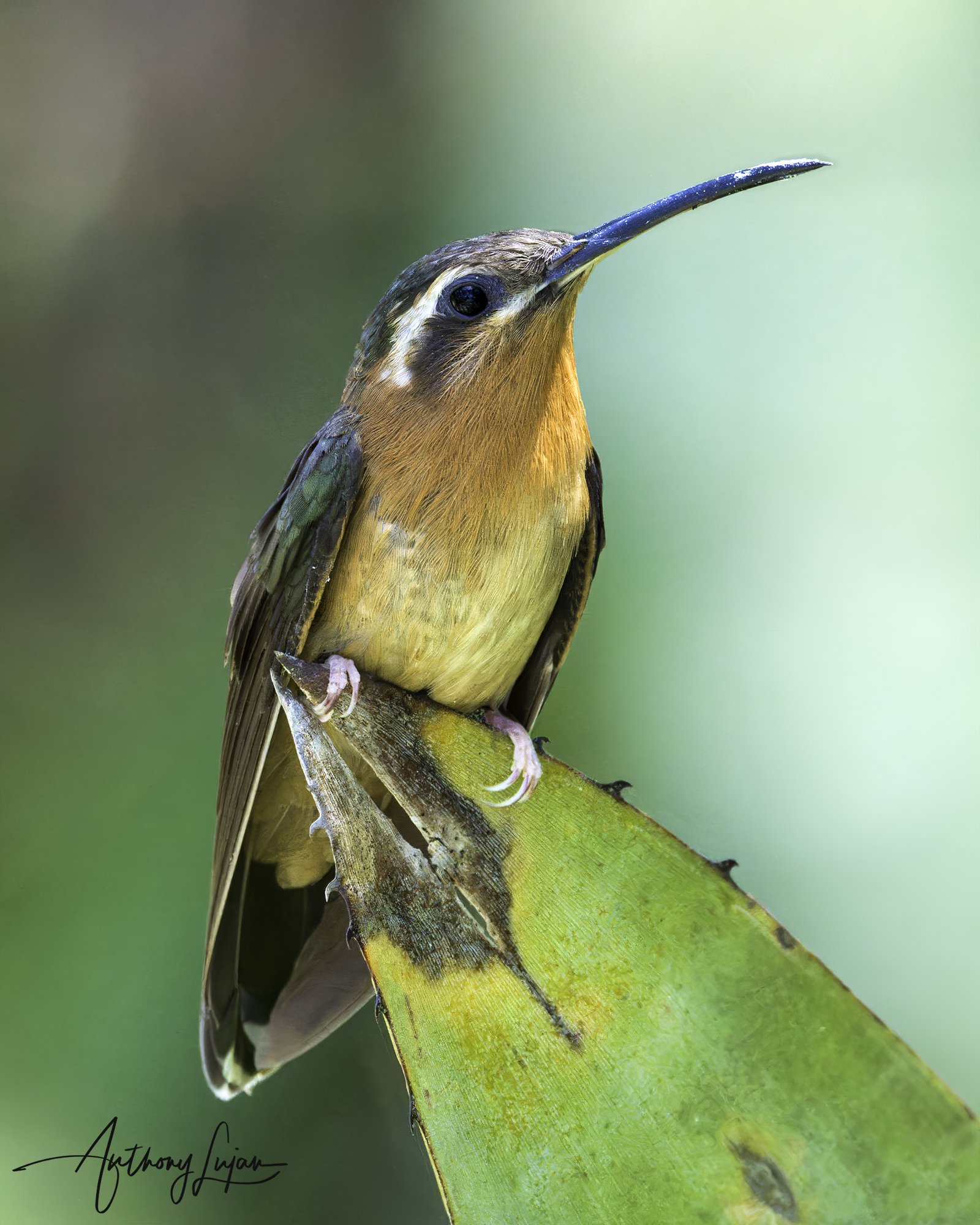
Glaucis dohrnii is a hermit hummingbird in the subfamily Phaethornithinae. It is part of the genus Glaucis, together with the Bronzy Hermit (G. aeneus) and Rufous-breasted (Hairy) Hermit (G. hirsutus).
Subspecies and Distribution
Monotypic — no subspecies recognized.
Distribution:
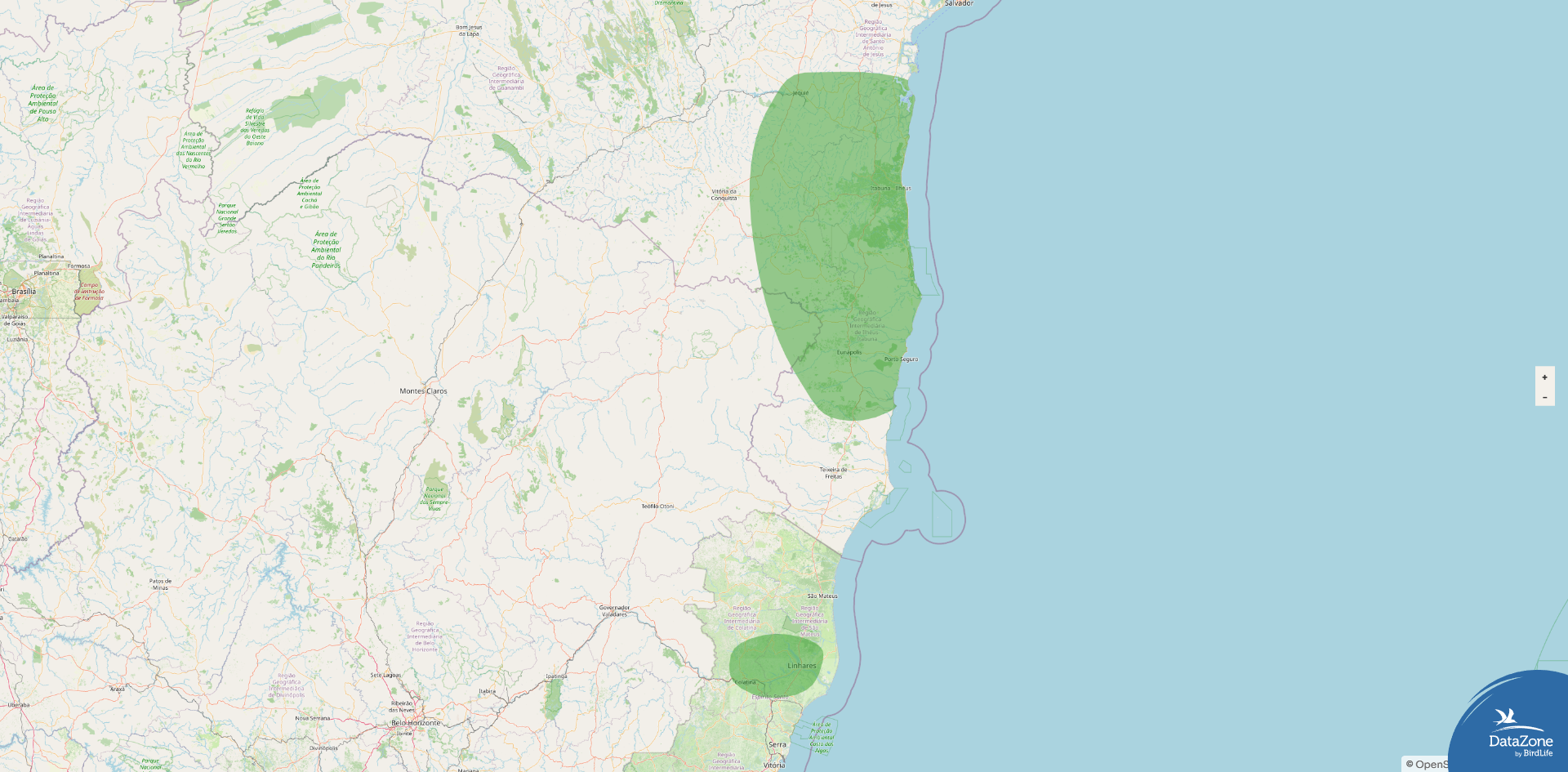
The Hook-billed Hermit is endemic to Brazil and now occurs only at a few scattered sites in the Atlantic Forest of southeastern Bahia and Espírito Santo. It inhabits the understory of inland primary and littoral lowland evergreen forests, usually along streams and in areas with abundant flowering plants such as Heliconia. It formerly occurred more widely, including parts of Minas Gerais and possibly Rio de Janeiro, but is now believed extirpated from much of its historical range.
Legend
Green Resident
Species Overview
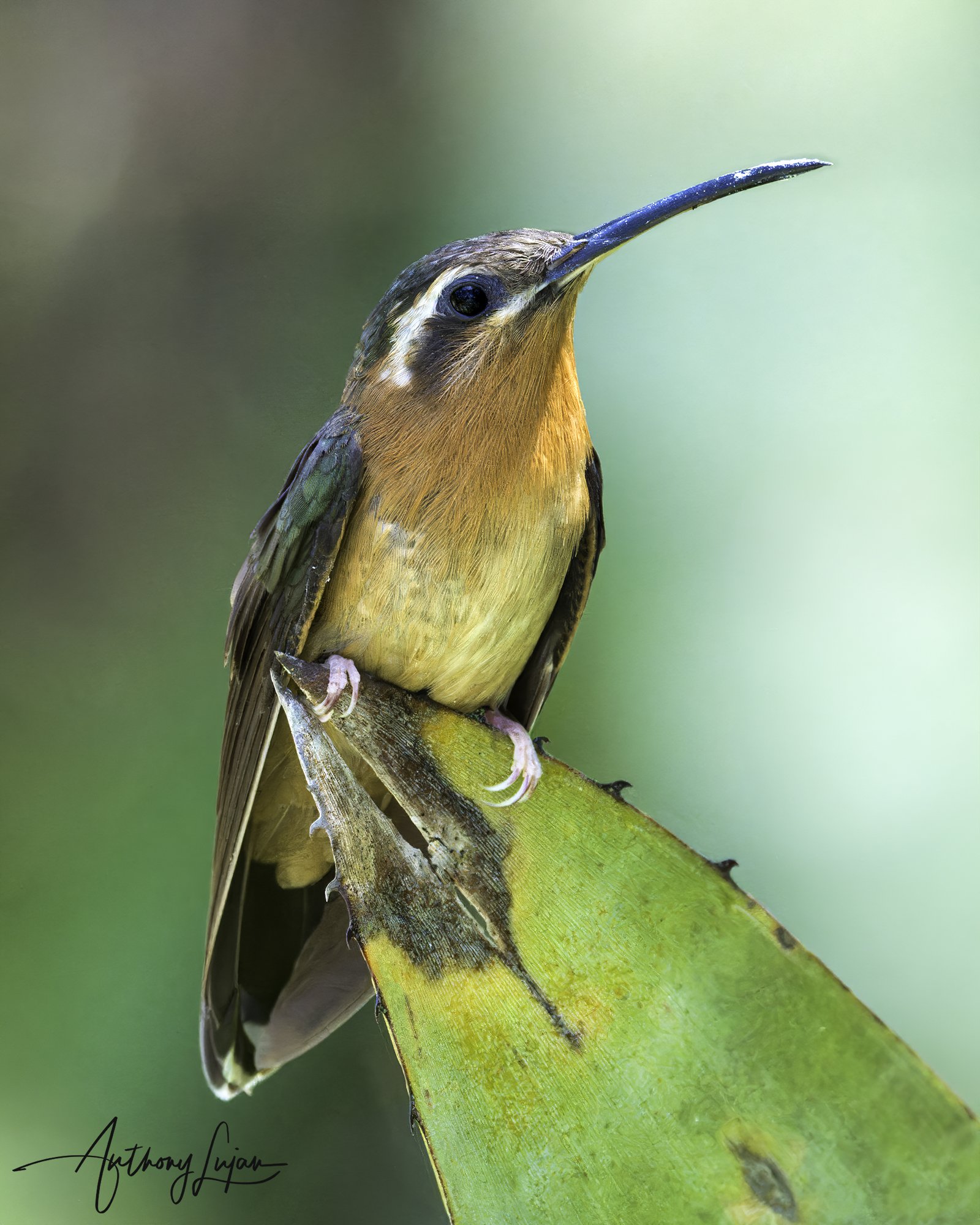
The Hook-billed Hermit is one of the rarest hummingbirds in the Atlantic Forest. It is a medium-sized hermit with greenish‑bronze upperparts, cinnamon underparts, and a distinctive facial pattern featuring a white supercilium and moustache contrasting with a dusky face. The tail is metallic bronze with white-tipped outer feathers, and the bill is nearly straight but with a slight hook at the tip, giving the species its name. It keeps mostly to the forest understory, where it forages quietly and can be difficult to detect.
Male Description
Males are about 12–13 cm long and relatively robust. The upperparts are greenish‑bronze, and the underparts are rich cinnamon, slightly darker on the breast and paler toward the belly. The face shows a dark mask with a clear white line above the eye (supercilium) and a white moustachial stripe, both contrasting strongly with the dusky face. The tail is metallic bronze with white tips to the outer feathers. The bill is nearly straight overall but with a subtle hook at the tip, separating it from many other hermits.
Female Description
Females closely resemble males, with the same greenish‑bronze upperparts, cinnamon underparts, white facial stripes, and metallic bronze tail with white-tipped outer feathers. The underparts in females may be slightly paler on average, but overall sexual dimorphism is minimal. Juveniles resemble adults, though plumage may appear slightly duller or fresher.
Habitat & Behavior
Hook-billed Hermits inhabit humid, lowland evergreen Atlantic Forest, particularly closed‑canopy forest and damp areas along streams. They use the forest interior and understory, often in places where Heliconia and other tubular flowers are abundant. Like other hermits, they feed mainly on nectar, following traplines between a series of flowering plants rather than defending individual patches. They also take small arthropods gleaned from vegetation and spiderwebs.
They tend to be solitary, moving quietly through the understory and can be inconspicuous despite their size. Individuals may occasionally visit ornamental flowers in areas adjacent to forest.
Breeding
The breeding season is believed to extend from roughly September to February. The female builds a small cup or cone-shaped nest of plant fibers and spiderweb, often suspended from the tip of a long, drooping leaf or similar support in the understory. The usual clutch consists of two white eggs. As with other hummingbirds, the female alone incubates the eggs and feeds the chicks; incubation and nestling periods together span several weeks.
Movement
The Hook-billed Hermit is not a migrant. It is resident within its small Brazilian range, remaining in lowland forest throughout the year. Any movements are local within or between nearby forest fragments, rather than true seasonal migrations.
Population
The global population is estimated at 2,500–9,999 mature individuals. Its distribution is small, fragmented, and has contracted substantially due to historical and ongoing deforestation in the Atlantic Forest. The population is believed to be decreasing, and the species is considered one of the most threatened hummingbirds in the region.

Conservation
The Hook-billed Hermit is assessed as Vulnerable, reflecting its small, fragmented range and declining population. Massive deforestation of Atlantic Forest lowlands, habitat fragmentation, fires, and infrastructure development are major threats. Historically, hunting for feathers may also have contributed to declines. The species now likely persists mainly in a few reserves and national parks in Bahia and one in Espírito Santo, and it is legally protected in Brazil. Continued protection and restoration of Atlantic Forest, especially along stream corridors and in lowland evergreen tracts, are crucial for its survival.

Related species in the Glaucis genus (3 species total)


Please note: The content provided in this article reflects Anthony’s personal experience and photographic approach. Results can vary depending on light, weather, location, equipment, subject behavior, and field conditions.