
Scientific name: Ocreatus peruanus
The Peruvian Racket-tail is a tiny, spectacular hummingbird of humid montane and cloud forests along the eastern Andean slope of Ecuador and northeastern Peru. The total number of mature individuals is unknown, the overall population trend is decreasing, it is considered an altitudinal migrant, and it is currently assessed as Least Concern.
At a Glance
Family: Trochilidae (hummingbirds)
Clade: Heliantheini – Brilliants
Genus: Ocreatus — 3 species in total
Range: Eastern slope of the Andes in eastern Ecuador and northeastern Peru (south at least to Huánuco)
Habitat: Humid montane forest and cloud forest, especially forest edges, clearings, and semi‑open secondary forest with flowering shrubs and small trees
Elevation: Mostly from about 1,600 to 2,200 m (5,200–7,200 ft); recorded from roughly 600 to 4,000 m (2,000–13,000 ft)
Length: Males about 11–15 cm (4.3–5.9 in) including the 7–8 cm (2.8–3.1 in) outer tail feathers; females shorter‑tailed
Weight: About 2.5–2.7 g (0.088–0.095 oz)
Number of mature individuals: Unknown
Population trend: Decreasing
Movement: Altitudinal Migrant (seasonal elevational movements after breeding)
IUCN Red List category: Least Concern
Name Origin
The genus name Ocreatus refers to “leggings” or “greaves,” alluding to the conspicuous “boots” of fluffy leg puffs typical of racket‑tails. The species name peruanus means “from Peru,” marking the species’ core distribution along the Peruvian Andes, even though it also occurs in eastern Ecuador. The English name “Peruvian Racket-tail” combines this geographic link with the distinctive racket‑tipped tail of males.
Taxonomy
Ocreatus peruanus belongs to the “brilliants” (tribe Heliantheini) within the subfamily Lesbiinae. The genus Ocreatus currently includes three species: Peruvian Racket-tail (O. peruanus), White-booted Racket-tail (O. underwoodii), and Rufous-booted Racket-tail (O. addae). The Peruvian Racket-tail was formerly treated as part of a widespread “Booted Racket-tail” complex but is now widely recognized as a distinct species based on plumage, structure, and range.
This species is found along the eastern slope of the Andes from eastern Ecuador south into northeastern Peru as far as Huánuco Department. It inhabits temperate and subtropical Andean zones, favoring humid montane forest and cloud forest, especially at edges, in clearings, along roadsides, and in semi‑open secondary growth with abundant flowering plants. Within this elevational band it is often associated with forested ridges, ravines, and the upper edges of river valleys.
Subspecies and Distribution
Monotypic — no subspecies recognized.
Distribution: Peruvian Racket-tails occur on the eastern slope of the Andes in eastern Ecuador and northeastern Peru. In Ecuador they are found in suitable montane habitats from roughly southern Zamora‑Chinchipe northward within the eastern cordillera. In Peru they range south through the eastern Andean slope at least to Huánuco, occupying humid montane forests, forest edges, and nearby secondary growth typically between 1,600 and 2,200 m, but locally from about 600 m up to 4,000 m where conditions are favorable and flowering plants are available.
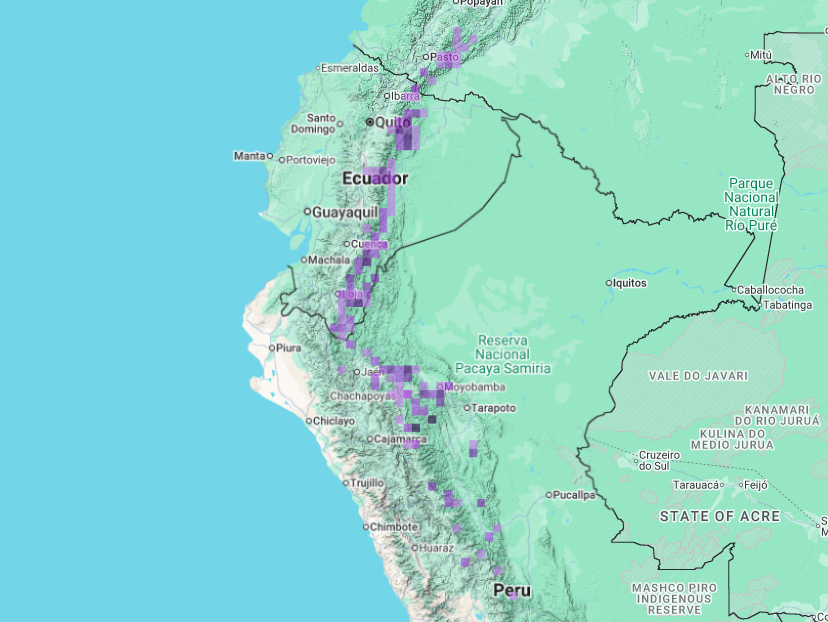
Legend
Purple Resident
Species Overview
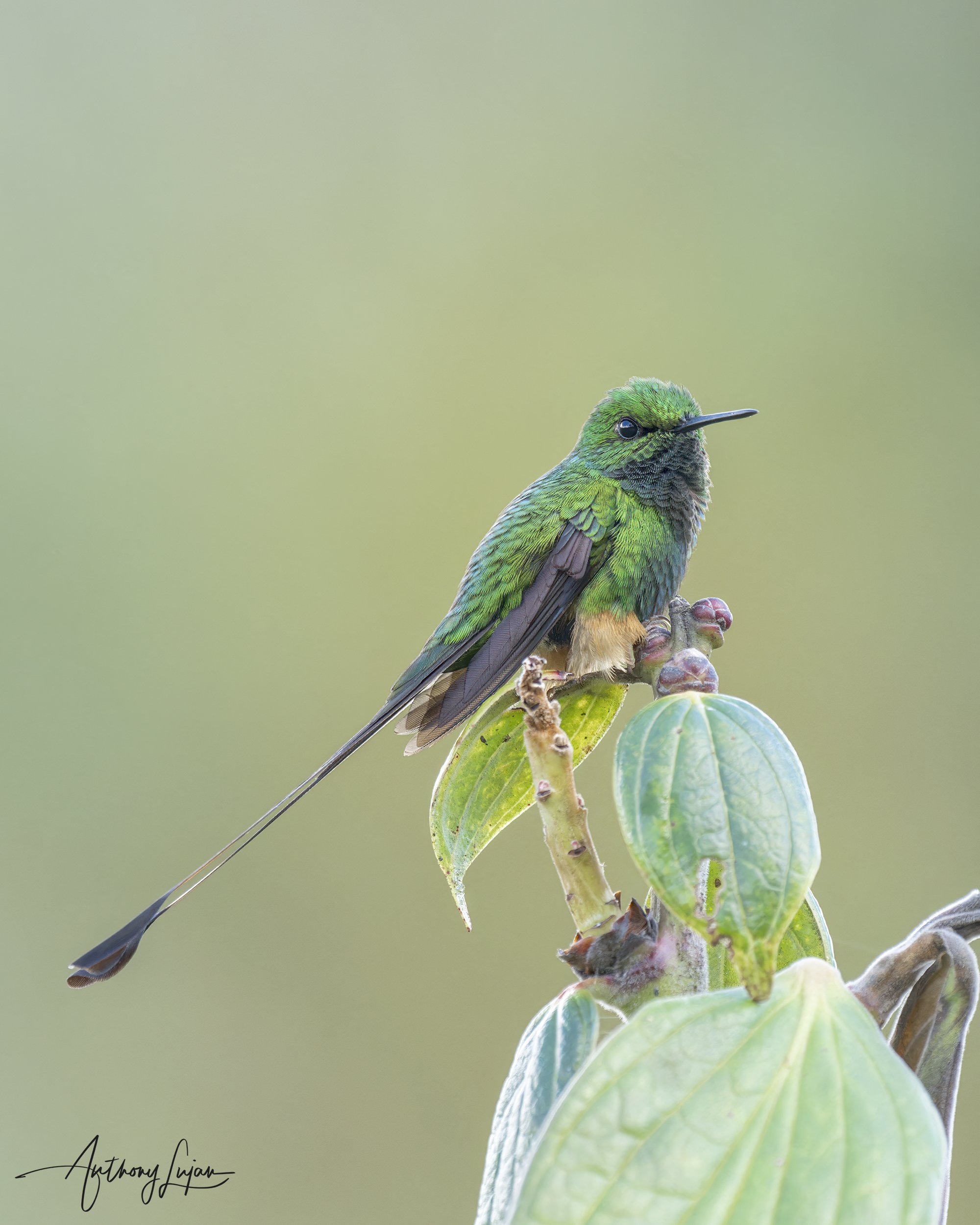
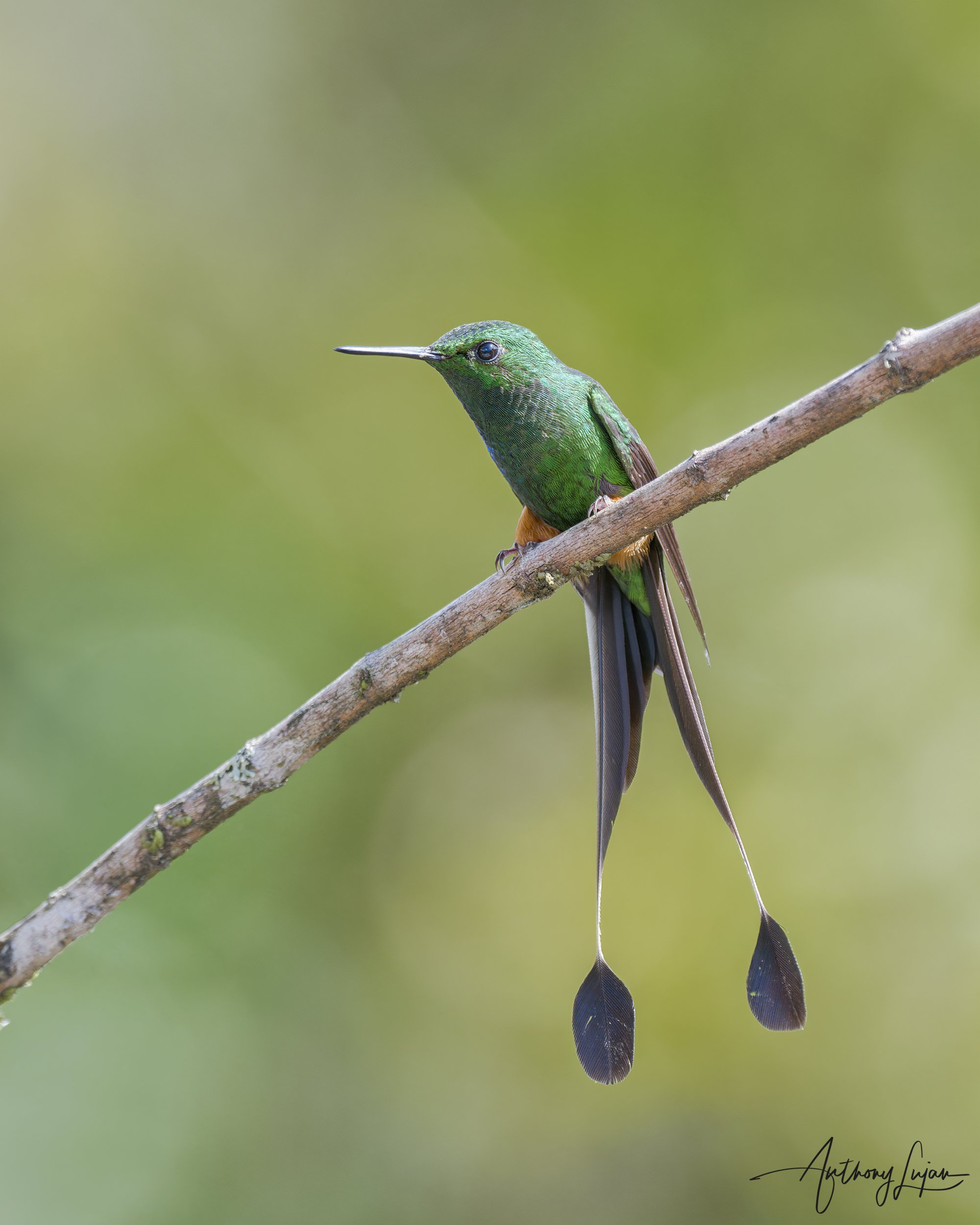
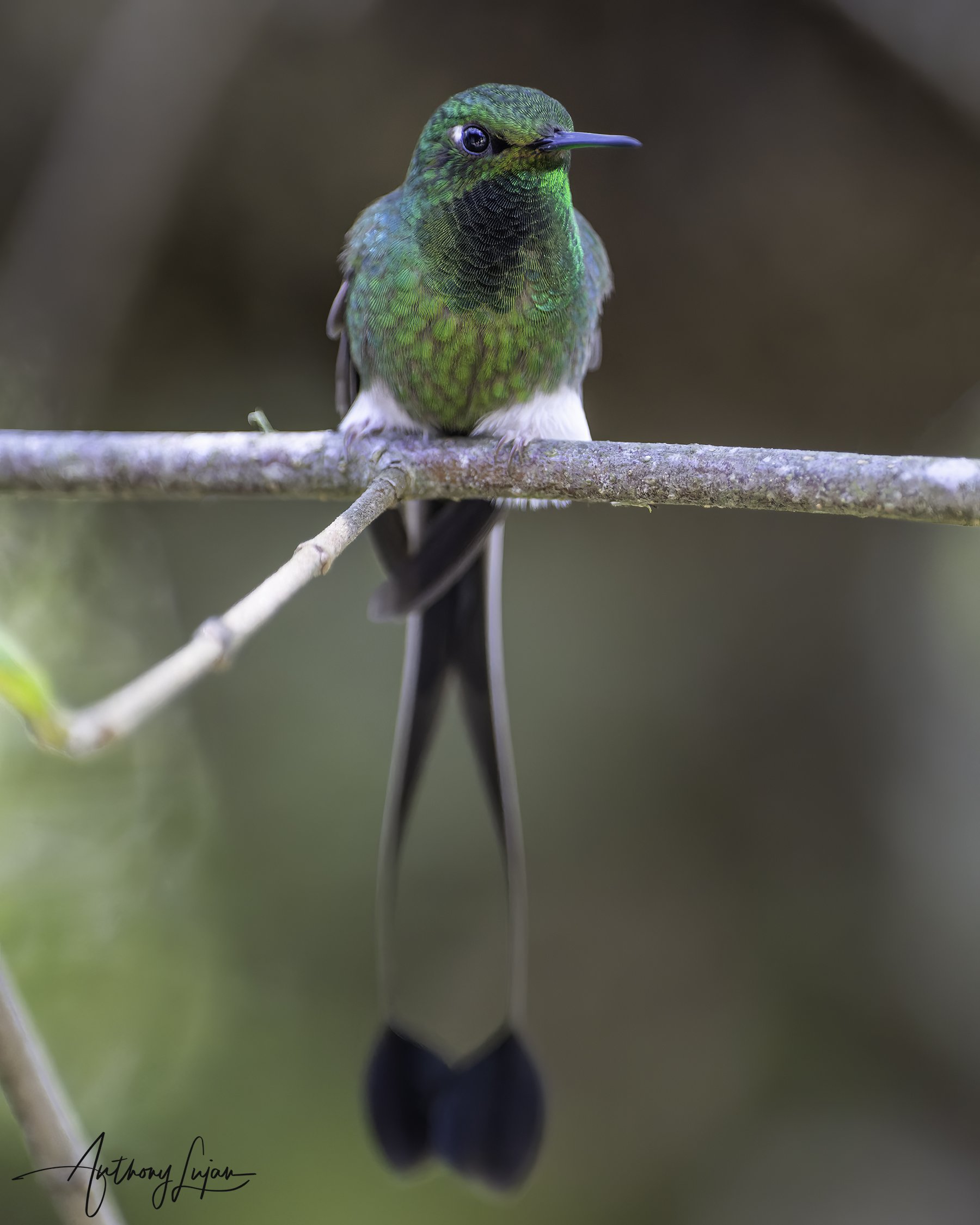
The Peruvian Racket-tail is one of the most charismatic Andean hummingbirds, especially the male with its long, bare‑shafted outer tail feathers ending in narrow oval “rackets” and large white leg puffs. It is active, vocal, and agile, often seen making rapid, hovering forays at flowers along forest edges and clearings. Within its limited range it can be locally common in good habitat but remains patchily distributed and is vulnerable to loss and degradation of montane forests, contributing to a decreasing population trend.
Male Description
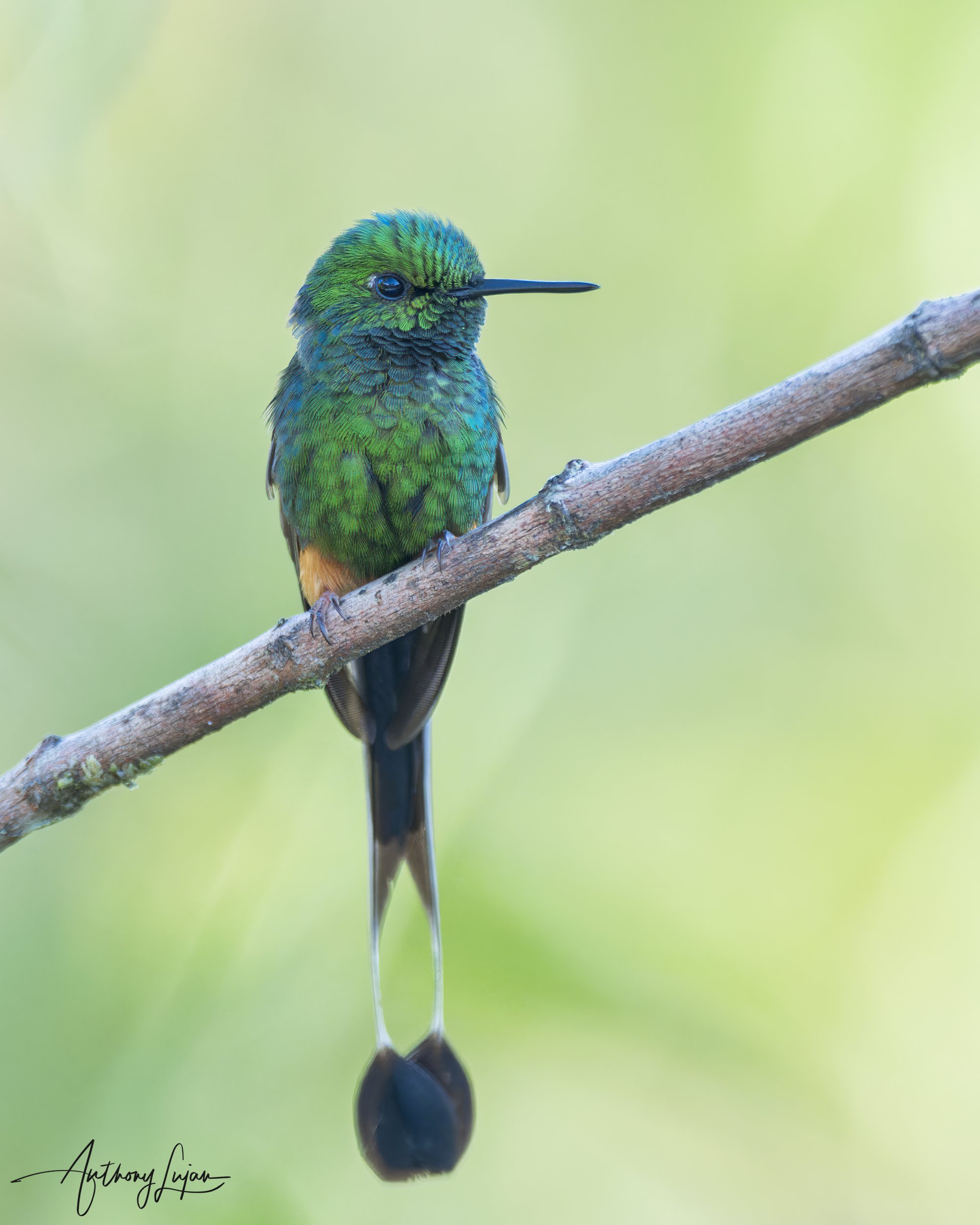
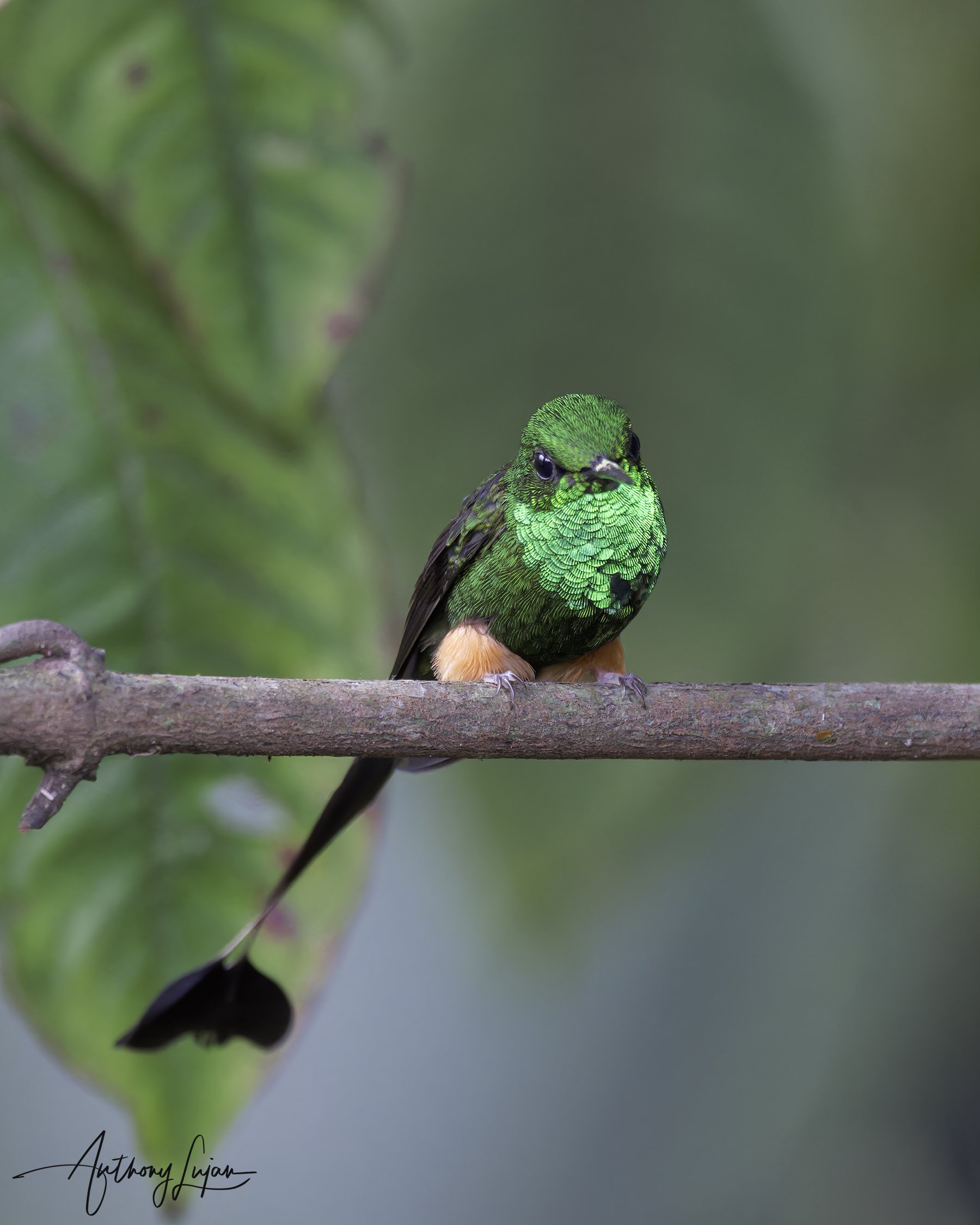
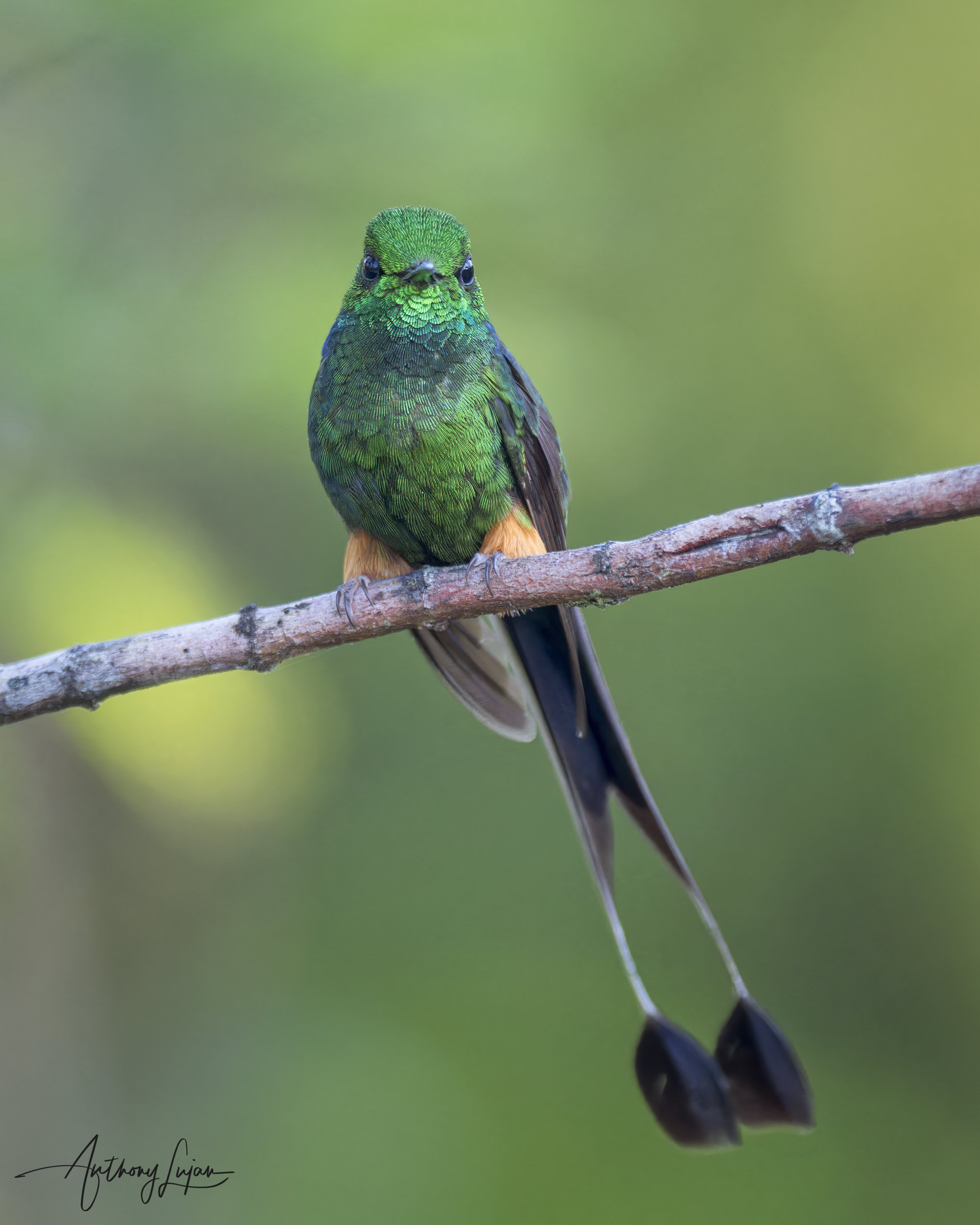
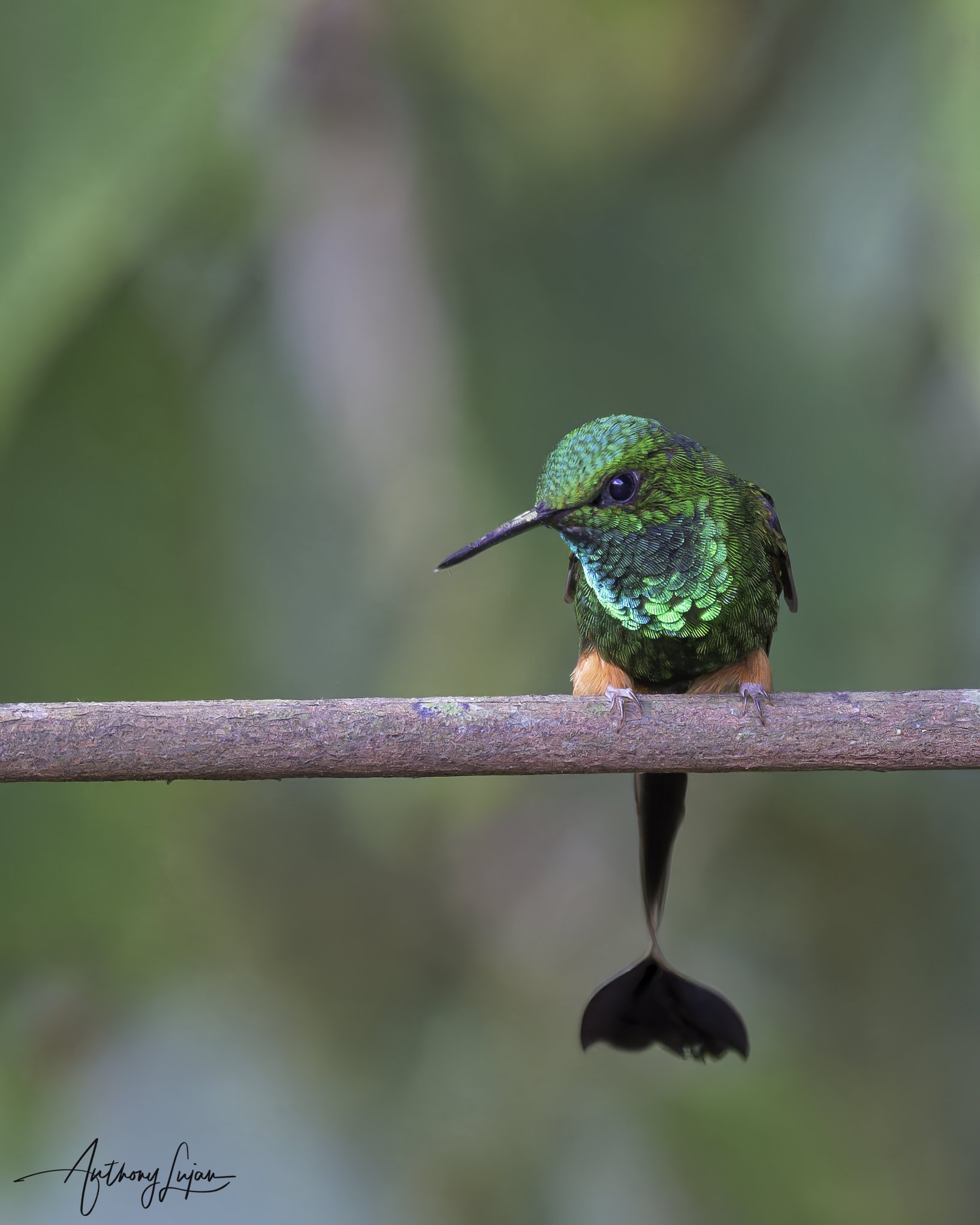
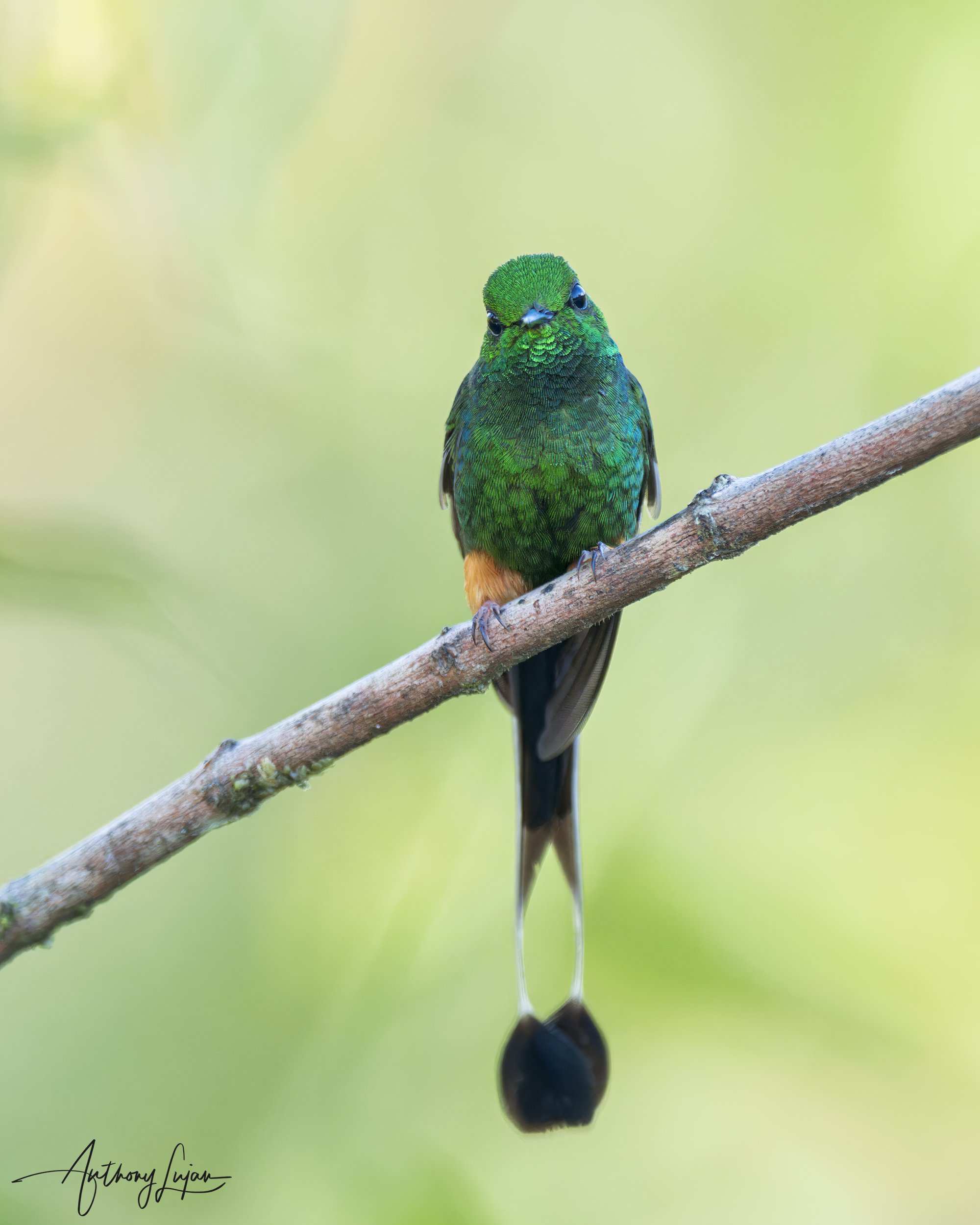
Adult males are very small hummingbirds with a compact body and extremely elongated outer tail feathers. The head and upperparts are mostly iridescent green, with a slightly darker crown and back. The throat and upper breast are glittering green, blending into a whiter or paler belly and undertail region. The most striking features are the long, bare outer tail shafts, which extend well beyond the rest of the tail and end in narrow, oval flags (rackets) that overlap slightly but do not cross; these flags are dark, often bluish or purplish, with an iridescent sheen. The legs bear conspicuous, fluffy white “boots” of feathering that stand out against the darker body. The bill is straight, short, and black. In flight the male’s rackets swing and flick, and the leg puffs can give a “pompom” impression.
Female Description
Females lack the elongated racket‑tipped outer tail feathers and have a more typical, short, slightly forked tail with rounded tips. The upperparts are green like the male, while the underparts are whitish to buffy with green spotting or scaling on the throat and sides, and a buffy or pale gray belly. White leg puffs are present but smaller and less dramatic than in males. The tail feathers are greenish with some whitish or buffy edges on the outer feathers, forming a modestly forked tail. Juveniles resemble females; young males gradually develop longer outer tail feathers and more prominent leg puffs as they mature, with full racket development reached after their first molt.
Habitat & Behavior
Peruvian Racket-tails inhabit humid montane forest, cloud forest, and associated edges, clearings, and secondary growth on the eastern Andes. They are often seen along forest borders, roadside banks, and shrubby gaps where flowering shrubs, vines, and small trees are common. They typically forage at mid‑levels, between about 6 and 18 m above the ground, visiting flowers on trees and tall shrubs, including those of Palicourea, Clusia, Inga, Cavendishia, and other Andean genera.
They feed mainly on nectar, hovering at blossoms or briefly perching, and they also take small insects, hawking from perches or gleaning near flowers. Several individuals may feed close together at rich nectar sources, and males sometimes display by hovering with tail spread and rackets swung outward. Their flight is nimble and acrobatic, with quick darts, sudden stops, and hovering pauses that show off the tail.
Breeding
The breeding season varies with locality and elevation but generally coincides with periods of increased flowering in montane forests, often during the wetter months. As with other hummingbirds, the female alone handles nesting duties. She builds a small cup nest of soft plant fibers, moss, and spiderweb, often placed on a sheltered horizontal branch or in a fork of a shrub or small tree along forest edges or clearings. The nest exterior is usually decorated with bits of moss and lichen to blend with its surroundings.
The clutch normally consists of two white eggs. The female incubates for about two weeks, and the nestling period is around three weeks. Detailed nesting data are limited for this species specifically, but its timing and developmental schedule are thought to be similar to those of closely related brilliants and other racket‑tails.
Movement
The Peruvian Racket-tail is an altitudinal migrant. After breeding, individuals shift seasonally along the elevational gradient, moving either upslope or downslope in response to changes in flowering patterns and local climate. These elevational movements keep birds within the same general Andean regions but redistribute them among different bands of montane forest, forest edges, and secondary growth at various times of year. There is no evidence of long‑distance, latitudinal migration beyond its core range in eastern Ecuador and northeastern Peru.
Population
The total number of mature individuals is unknown. The species has a relatively small global range limited to the eastern Andes of Ecuador and northeastern Peru. Within this range it can be locally fairly common at suitable sites—such as well‑preserved montane forest edges and hummingbird lodges with abundant flowering plants—but is absent from large areas of unsuitable or heavily deforested habitat. Ongoing deforestation and habitat fragmentation in montane forests likely underlie the inferred decreasing population trend.

Conservation
The Peruvian Racket-tail is currently assessed as Least Concern, reflecting its presence at numerous sites and within some protected areas in Ecuador and Peru, despite its limited overall range and decreasing trend. Its reliance on humid montane forest, forest edges, and shrubby secondary growth makes it vulnerable to deforestation, agricultural expansion, road construction, and other land‑use changes along the eastern Andean slope. Conserving continuous montane forest belts, protecting forest edges and regenerating secondary forest with rich flowering plant communities, and maintaining hummingbird‑friendly gardens around rural communities and lodges are all important for sustaining this species.
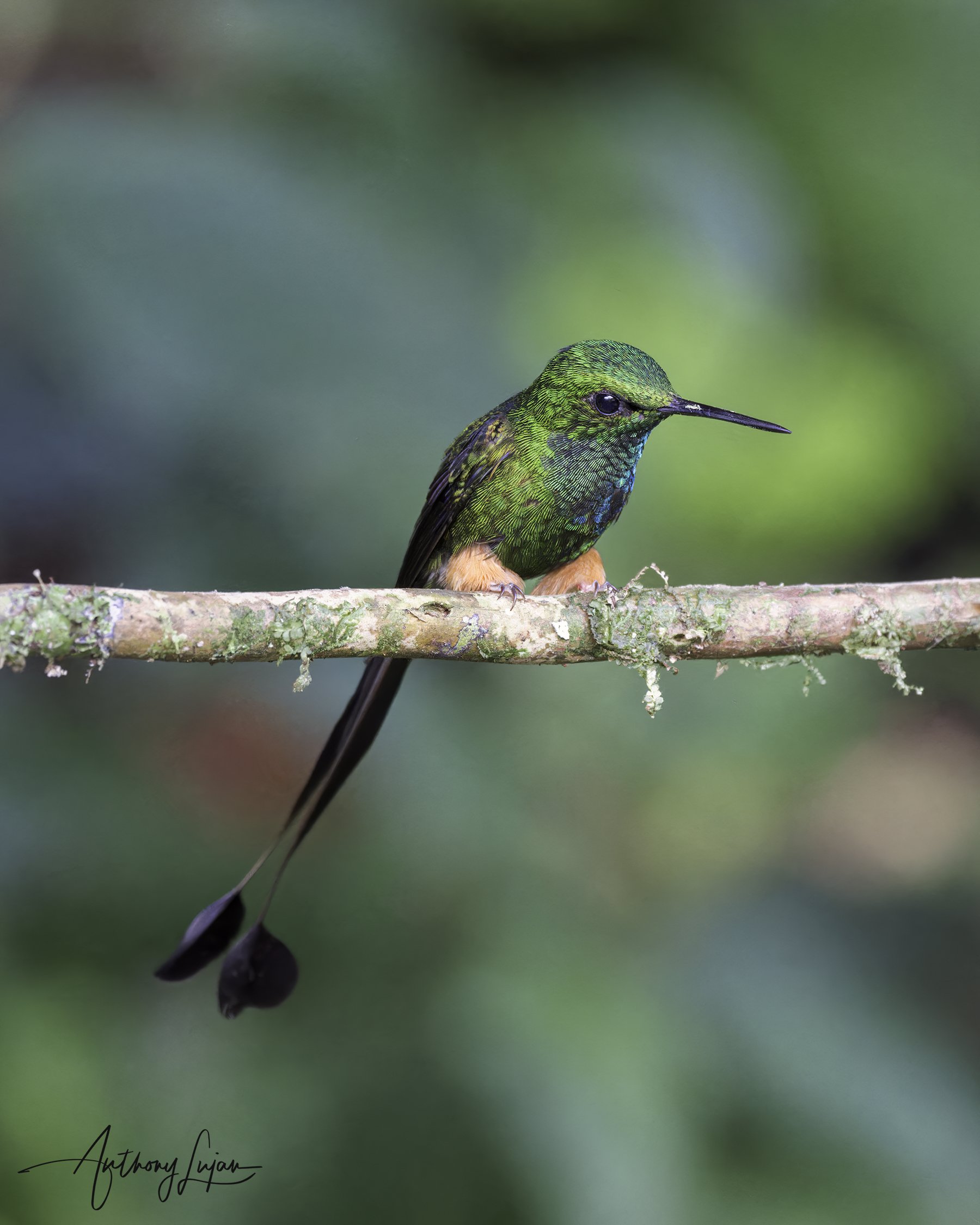
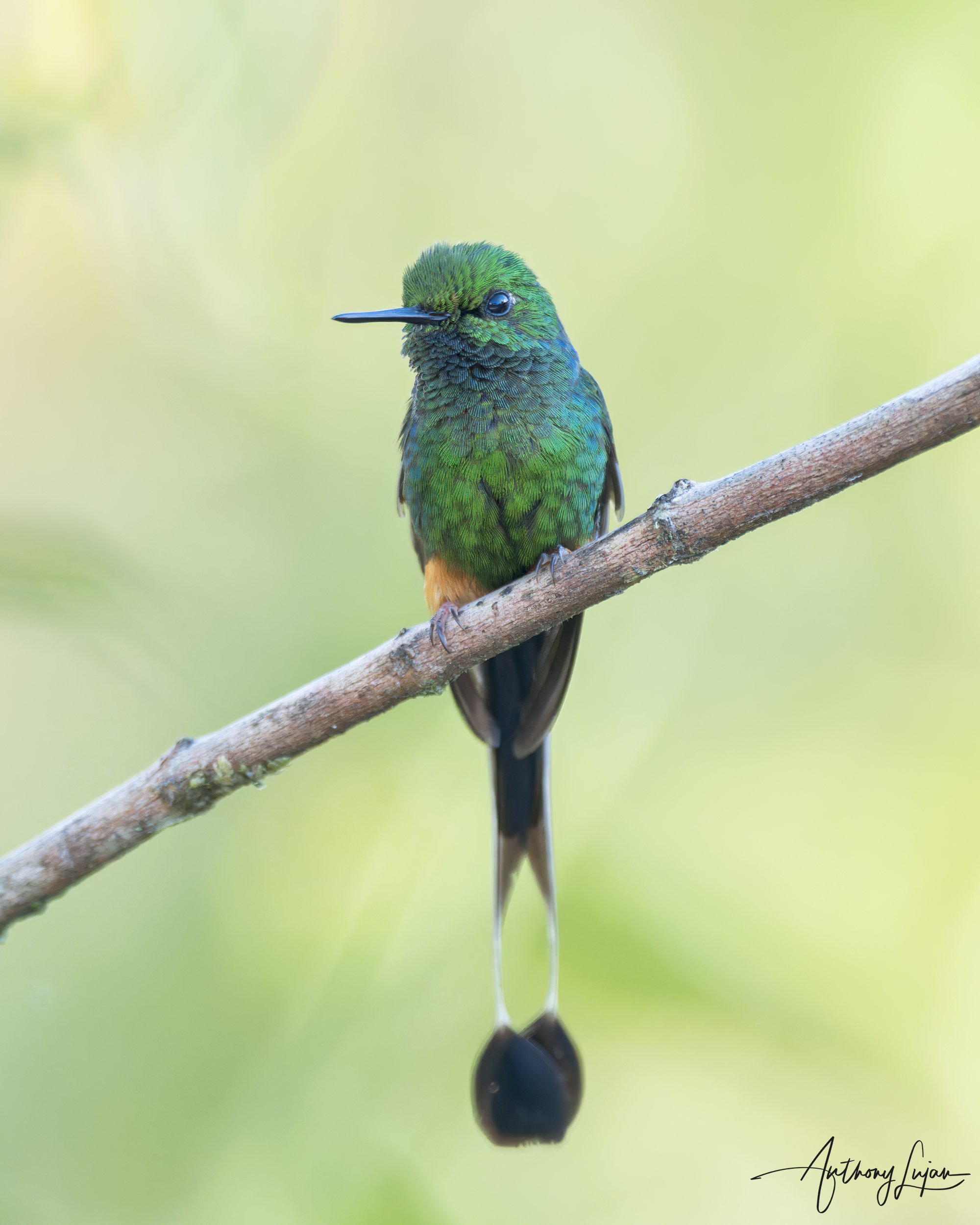
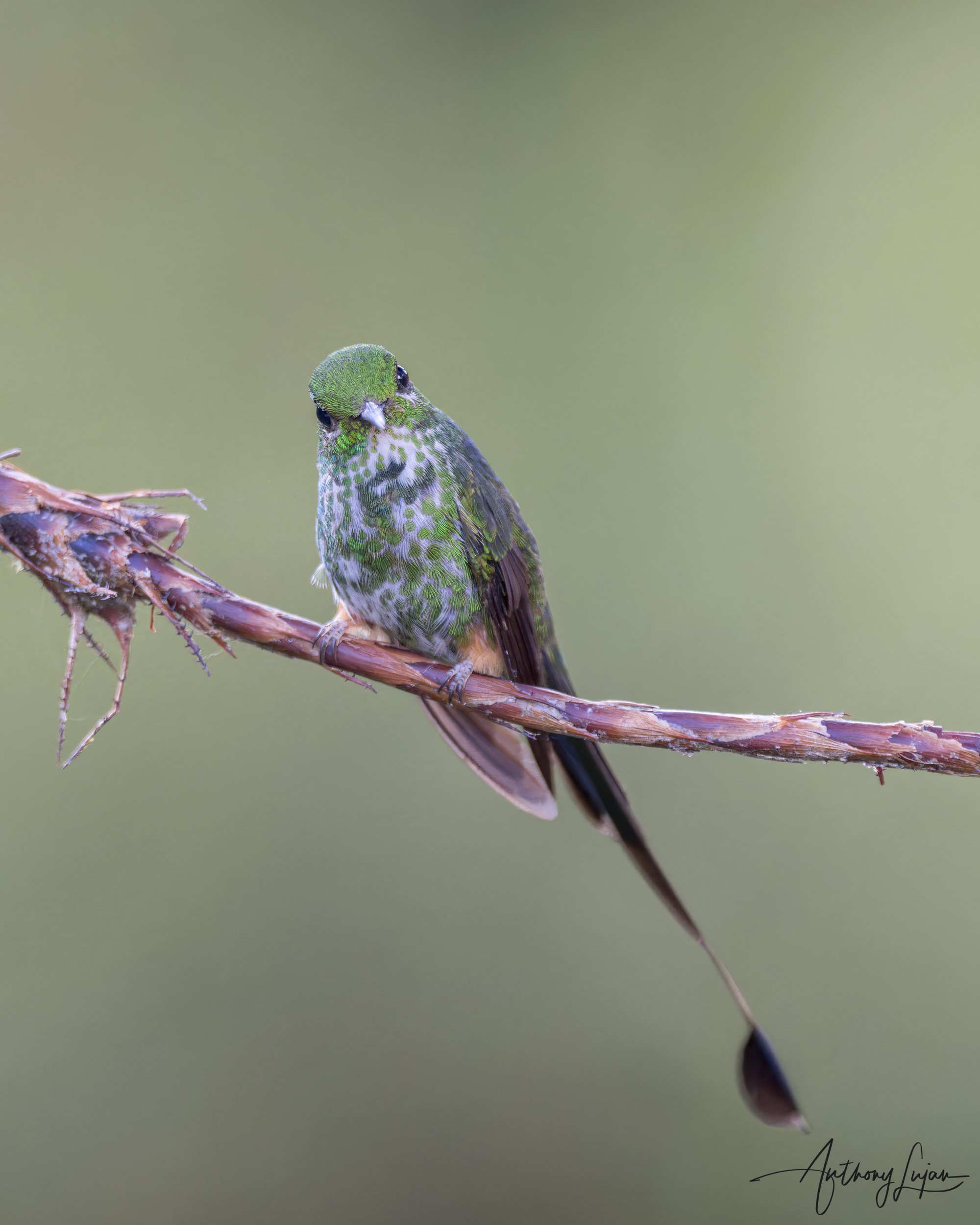
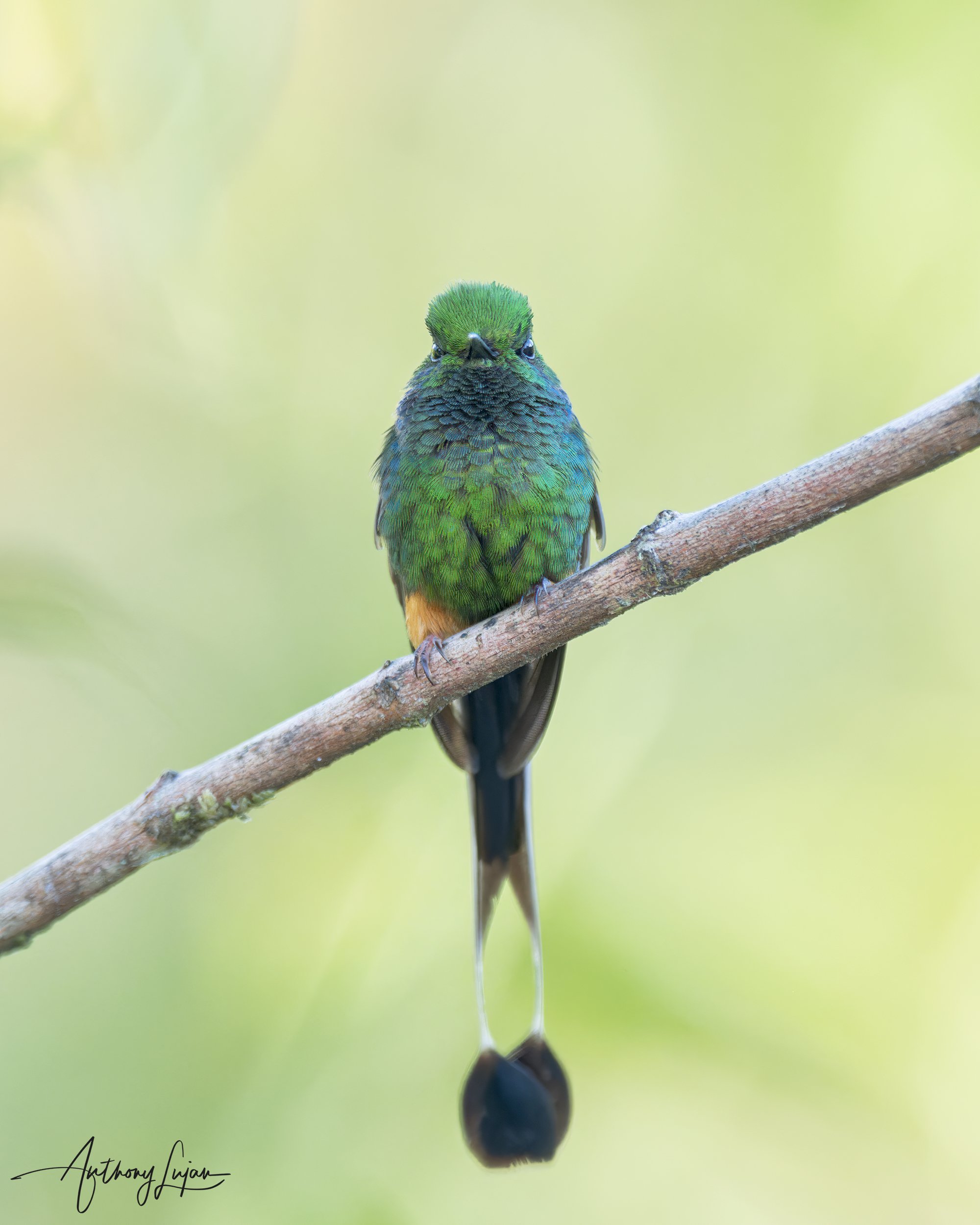
Checkout Anthony’s playlist of this species! Click the top right dropdown to see all the videos.
Related species in the Ocreatus genus (3 species in total):
Please note: The content provided in this article reflects Anthony’s personal experience and photographic approach. Results can vary depending on light, weather, location, equipment, subject behavior, and field conditions.