
Peruvian Sheartail
Scientific name: Thaumastura cora
The Peruvian Sheartail is a tiny, long‑tailed hummingbird of arid and semi‑arid coastal valleys, foothills, and gardens from southwestern Ecuador through western Peru into northern Chile. The total number of mature individuals is not quantified, the overall population trend is considered stable, it is treated as non‑migratory, and it is currently assessed as Least Concern.
At a Glance
Family: Trochilidae (hummingbirds)
Clade: Mellisugini – Bee Hummingbirds
Genus: Thaumastura — monotypic (1 species)
Range: Southwestern Ecuador, western Peru, and northwestern Chile
Habitat: Arid and semi‑arid coastal zones, scrubby foothill valleys, river canyons, farmland, orchards, and gardens with flowering shrubs and trees
Elevation: From sea level up to about 2,800–3,300 m (9,200–10,800 ft), most common near sea level in coastal valleys
Length: Males about 13–15 cm (5.1–5.9 in) including tail; females about 7–7.5 cm (2.8–3.0 in)
Weight: About 2.3–2.6 g (0.08–0.09 oz)
Number of mature individuals: Not estimated
Population trend: Stable
Movement: Not a migrant (resident, with local movements only)
IUCN Red List category: Least Concern
Name Origin
The genus name Thaumastura combines Greek thauma (“wonder” or “marvel”) and oura (“tail”), referring to the male’s extraordinary long, scissor‑like tail. The species epithet cora almost certainly references the Cora people of western Mexico, a name early naturalists applied more broadly in the region. The English name “Peruvian Sheartail” highlights both its main range and the deeply forked tail that recalls a pair of shears.
Taxonomy
Thaumastura cora belongs to the bee hummingbird tribe Mellisugini in subfamily Trochilinae. It is the only extant species in the genus Thaumastura; past “subspecies” have been reinterpreted as individual or geographic variation, and other species formerly placed here have been reassigned to different genera.
The Peruvian Sheartail’s range runs from far southwestern Ecuador (where it arrived and established only in the early 2000s) south through the length of western Peru into northwestern Chile. In Chile it was first reported in 1971, and the species has since expanded southward; in the Azapa Valley, for example, it now numbers in the thousands and also occurs further down the coast. Across this range, the species is strongly associated with arid and semi‑arid coastal valleys and foothills but also occupies irrigated farmland, orchards, towns, and cities where flowering ornamental plants are common.
Subspecies and Distribution
Monotypic — no subspecies recognized.
Distribution:
Southwestern Ecuador: Rare and recently colonized, with only a handful of records since the early 2000s, in arid coastal and foothill habitats near the Peruvian border.
Western Peru: Widespread along the coastal strip and in western Andean foothill valleys from Tumbes south through Lima to Tacna, occupying arid coastal scrub, river canyons, agricultural areas, and gardens.
Northwestern Chile: Occurs in extreme north (e.g., Azapa Valley and other valleys of Arica y Parinacota and Tarapacá) and has expanded south along coastal valleys and irrigated zones, where it can be locally abundant.
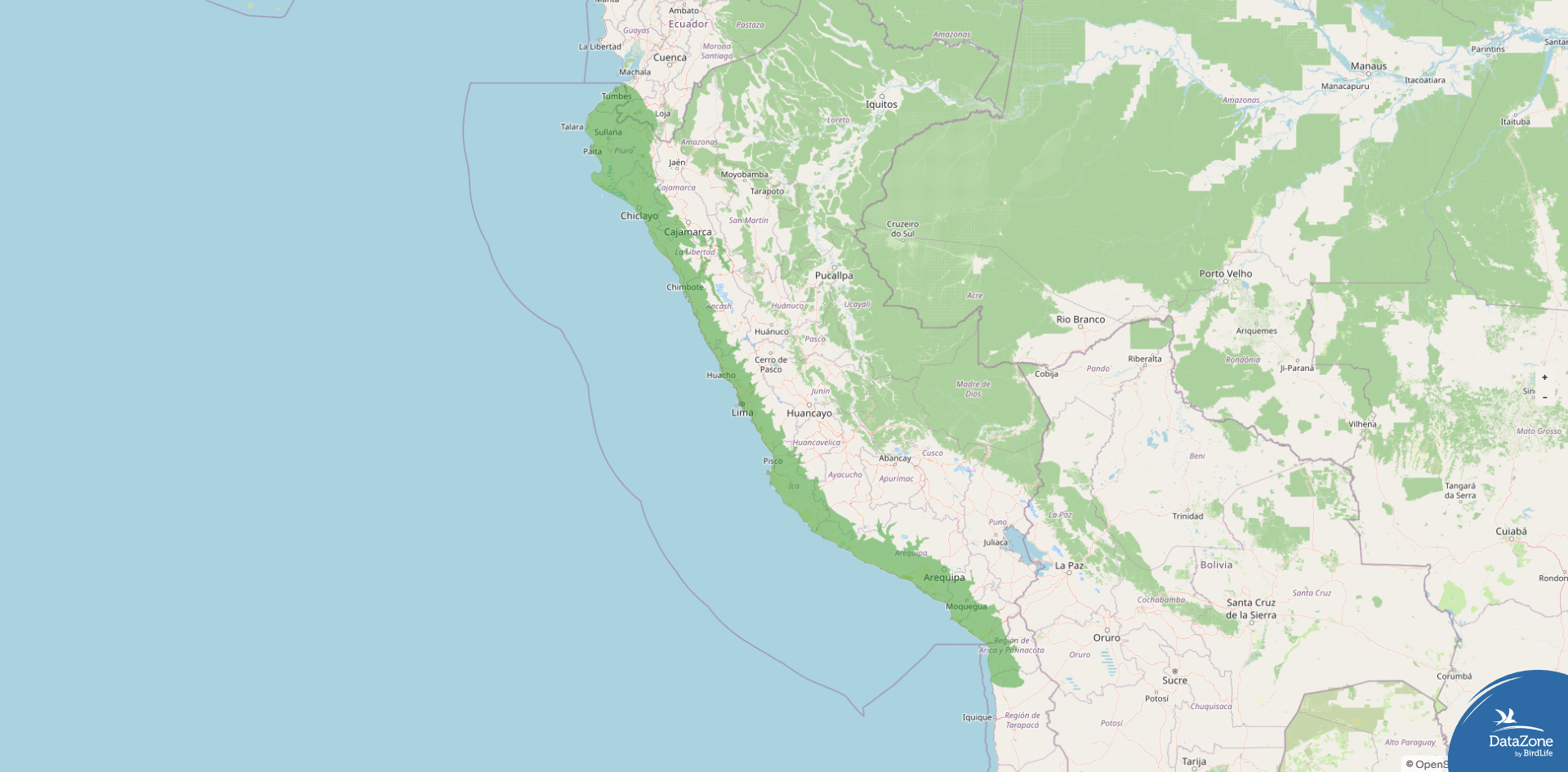
Legend
Green Resident
Species Overview
The Peruvian Sheartail is one of the most striking small hummingbirds of the Pacific slope, with males showing a vivid magenta‑violet gorget and a long, deeply forked tail that curves inward like a pair of shears. It thrives in dry environments unusual for many hummingbirds, frequenting flowering shrubs in desert canyons, farmlands, and urban gardens. Despite its small size, it is often conspicuous and vocal, perching on exposed twigs to sing and launching short display flights. Its adaptability to human‑altered habitats, including city parks and suburban gardens, underlies its stable conservation status and ongoing range expansion in Chile and Ecuador.
Male Description
Adult males are very small in body but appear longer overall due to their tail length (13–15 cm total). The upperparts are bronzy‑green to greenish‑gray, and the underparts are mostly off‑white to pale gray. The most prominent feature is the iridescent throat patch (gorget), which is bright magenta‑violet and can flash pink, purple, or nearly black depending on the light. The head may show a slightly darker cap, and the face has a narrow dark cheek stripe behind the short, straight black bill.
The tail is long, deeply forked, and strongly curved inward: the central tail feathers are short, the next pair are extremely long and narrow, and the remaining outer feathers are intermediate in length. The long feathers show dark outer webs and whitish or pale inner webs, creating a contrasting pattern when the tail is spread. In display the male widely opens and fans this tail, accentuating the shears‑like shape.
Female Description
Females are shorter overall (7–7.5 cm), with no elongated tail feathers. The upperparts are green, and the underparts are buffy‑white to pale gray. The throat is creamy to whitish, often with a darker cheek stripe and light speckling near the sides but lacking the male’s bright gorget. The tail is short and only shallowly forked, mainly dark with white tips on the outer feathers, producing a modest pattern when spread. Juveniles resemble females; young males gradually develop the magenta throat and elongated, curved tail feathers as they mature.
Habitat & Behavior
Peruvian Sheartails inhabit arid and semi‑arid landscapes: coastal desert scrub, rocky and sandy foothill slopes, river canyons with shrubs and small trees, dry farmland, orchards, and ornamental gardens. They are especially common wherever flowering shrubs and trees occur in otherwise dry terrain, such as irrigated fields, hedgerows, roadside plantings, and city parks. Elevationally they occur from sea level up to around 2,800 m, possibly higher, but are most numerous in lowland and foothill valleys.
They feed primarily on nectar from a wide variety of native and introduced plants, including desert shrubs, ornamental flowers, and garden species. Birds forage at low to mid heights, moving rapidly between blossoms with short, hovering visits, and they regularly perch on exposed twigs or wires to rest and sing. Small insects are also taken, either by hawking from perches or gleaning near flowers. Males often defend small territories around rich nectar sources, engaging in chases and noisy display flights with tail spread and gorget flashing.
Breeding
Breeding timing varies across the range but generally follows periods when flowering is sufficient in coastal valleys and foothills, often linked to seasonal rainfall and irrigation. The male performs elaborate courtship displays, including shuttle flights and hovering in front of the female with tail widely spread and gorget fully exposed, sometimes accompanied by persistent, squeaky song.
The female constructs a tiny cup nest from soft plant fibers, spiderweb, and other fine materials, camouflaging the outside with bits of bark, lichen, or dried plant fragments. Nests are typically attached to slender branches, stems, or wires in shrubs, small trees, hedges, or garden plants at low to moderate heights. The clutch is usually two white eggs. The female incubates for about two weeks and cares for the chicks until they fledge roughly three weeks after hatching.
Movement
The Peruvian Sheartail is considered non‑migratory and is treated as a resident species. It does not undertake large‑scale seasonal migrations, though local movements occur as birds track flowering within and between coastal valleys, foothills, and irrigated districts. Its recent appearance in Ecuador and southward expansion in Chile reflect gradual range extension linked to changes in land use, irrigation, and garden plantings rather than regular long‑distance migration.
Population
The number of mature individuals has not been formally estimated, but the species is described as common to abundant in many parts of its range, particularly in western Peru and northern Chile where irrigated agriculture and ornamental plantings are widespread. It adapts well to human‑modified environments, including urban and suburban gardens, and has shown clear expansion into new regions over recent decades. There is no evidence of major declines; overall, the population is considered stable. Local fluctuations may occur with changes in water availability and flowering, but these do not appear to affect the global status.

Conservation
The Peruvian Sheartail is currently assessed as Least Concern due to its broad and expanding range, stable population trend, and adaptability to modified habitats. It readily uses farmland, orchards, and urban gardens, which buffer it against some of the habitat loss affecting more forest‑dependent hummingbirds. Potential local threats include heavy pesticide use, removal of flowering hedges and shrubs, and urban development that reduces nectar resources, but none are currently causing significant global declines. Conservation actions that promote native and nectar‑rich plantings in agricultural, suburban, and urban landscapes will continue to benefit this species.


No other species are currently recognized in the genus Thaumastura; the Peruvian Sheartail is the only member of this genus.
Please note: The content provided in this article reflects Anthony’s personal experience and photographic approach. Results can vary depending on light, weather, location, equipment, subject behavior, and field conditions.