
Scientific name: Urosticte benjamini
The Purple-bibbed Whitetip is a small, forest‑interior hummingbird of humid montane forests on the Pacific slope of the Andes in Colombia and Ecuador. The total number of mature individuals is unknown, the overall population trend is decreasing, it is considered an altitudinal migrant, and it is currently assessed as Least Concern.
At a Glance
Family: Trochilidae (hummingbirds)
Clade: Heliantheini – Brilliants
Genus: Urosticte — 2 species in total
Range: Pacific slope of the western Andes from western Colombia south into western Ecuador (Chocó bioregion)
Habitat: Interior and edges of humid montane forest and cloud forest, mostly on shaded, wet slopes and ravines
Elevation: Generally from about 700 to 1,600 m (2,300–5,200 ft); in Ecuador most numerous around 1,200–1,400 m (3,900–4,600 ft)
Length: About 8–9 cm (3.1–3.5 in)
Weight: About 3.8–4.2 g (0.13–0.15 oz)
Number of mature individuals: Unknown
Population trend: Decreasing
Movement: Altitudinal Migrant (mostly sedentary in Colombia; moves lower after breeding in Ecuador)
IUCN Red List category: Least Concern
Name Origin
The genus name Urosticte combines Greek roots meaning “tail” and “spotted or pricked,” referring to the conspicuous white spots at the tips of the tail feathers. The species name benjamini honors Benjamin Leadbeater, a 19th‑century British natural history dealer. The English name “Purple-bibbed Whitetip” describes the male’s iridescent purple throat patch and the bold white tips on the central tail feathers.
Taxonomy
Urosticte benjamini belongs to the brilliants (tribe Heliantheini) within subfamily Lesbiinae. The genus Urosticte contains two species: Purple-bibbed Whitetip (U. benjamini) and Rufous-vented Whitetip (U. ruficrissa). The Purple-bibbed Whitetip is restricted to the Pacific slope of the Andes in north‑western South America, primarily within the humid Chocó biogeographic region. It occurs from western Colombia’s Chocó Department and adjacent Andean slopes south into western Ecuador, reaching roughly as far as Pichincha and neighboring provinces. Within this range it inhabits humid montane forests and cloud forests, especially on wet, shaded slopes and in ravines.
Subspecies and Distribution
Monotypic — no subspecies recognized.
Distribution: The Purple-bibbed Whitetip is found on the Pacific slope of the western Andes in western Colombia and western Ecuador. In Colombia it occurs mainly in Chocó and adjacent Andean departments, inhabiting humid montane forest between about 700 and 1,600 m. In Ecuador it is found in similar elevational bands on the western Andean slopes, especially in cloud‑forest zones and foothill forests between roughly 1,000 and 1,600 m, with highest densities around 1,200–1,400 m in some areas.
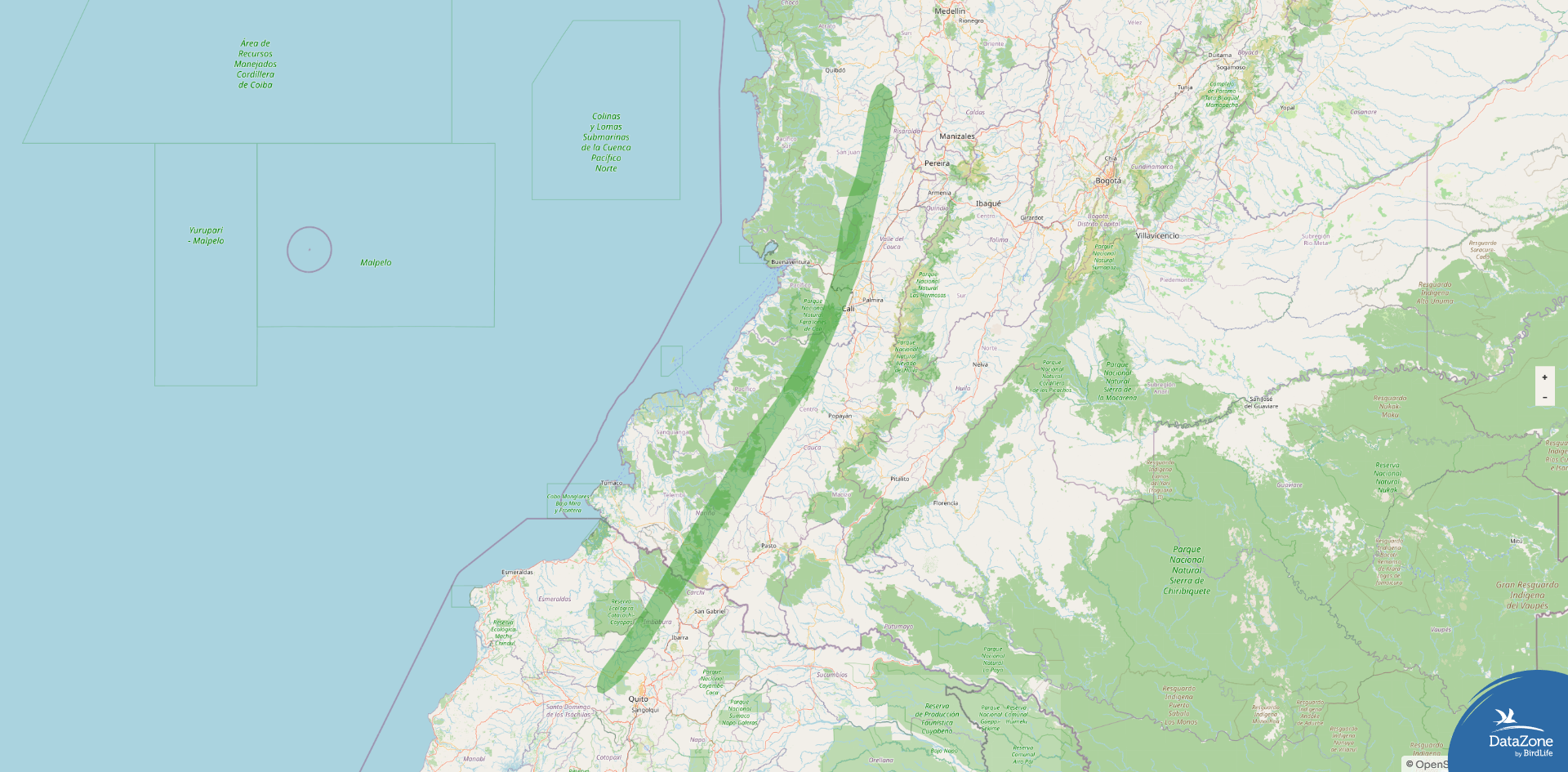
Legend
Green Resident
Species Overview
The Purple-bibbed Whitetip is a subtly colored but distinctive small hummingbird that spends much of its time in the dim undergrowth and mid‑story of Andean cloud forests. Males have a shimmering purple throat patch and bold white tips on the central tail feathers, while both sexes show a clean white stripe behind the eye and glittering green upperparts. It is typically described as uncommon and local but can be fairly common at some Andean lodges and forest edges with feeders in western Colombia and Ecuador. Ongoing habitat loss in the Chocó region and western Andean foothills is believed to be driving a gradual decline.
Male Description
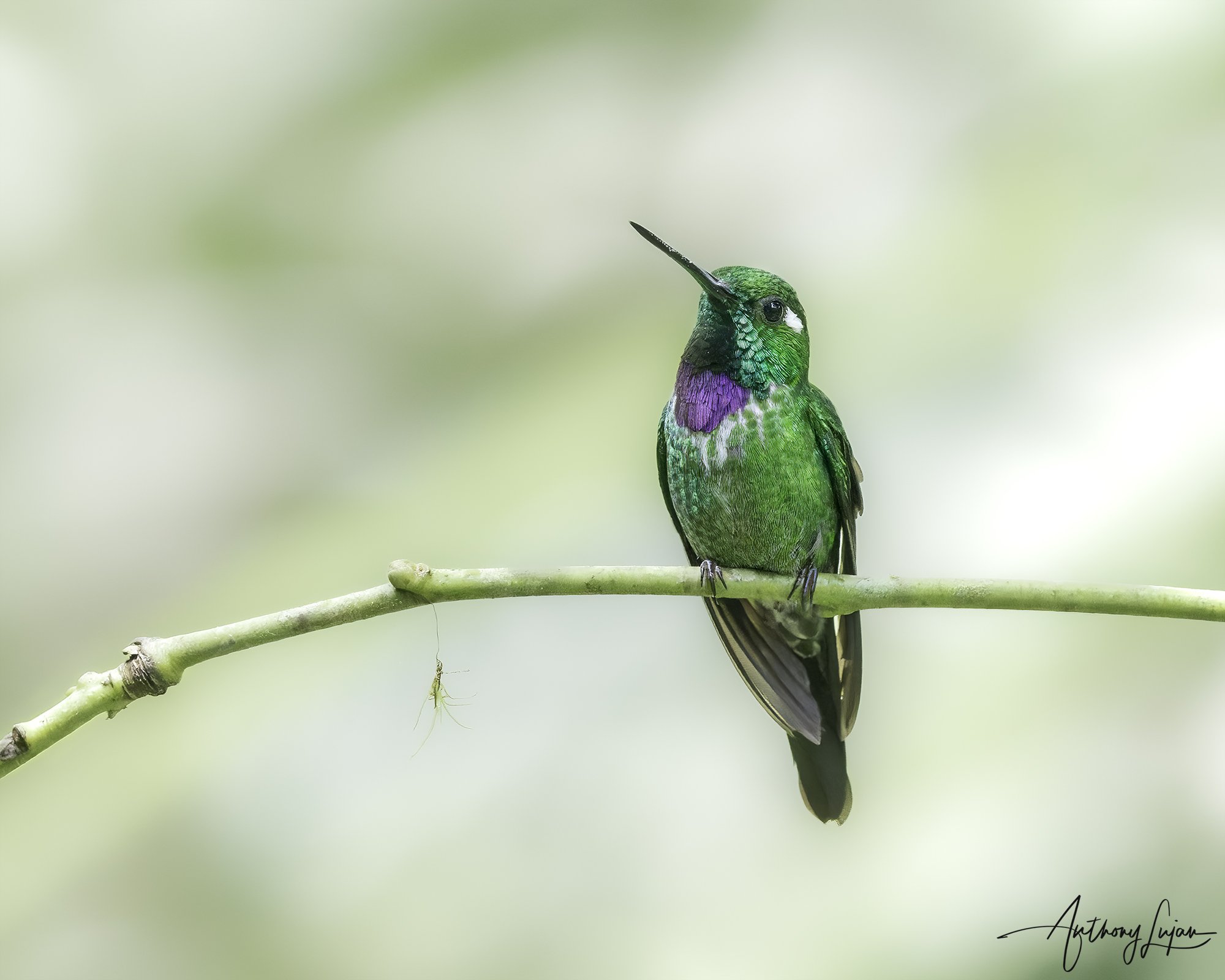
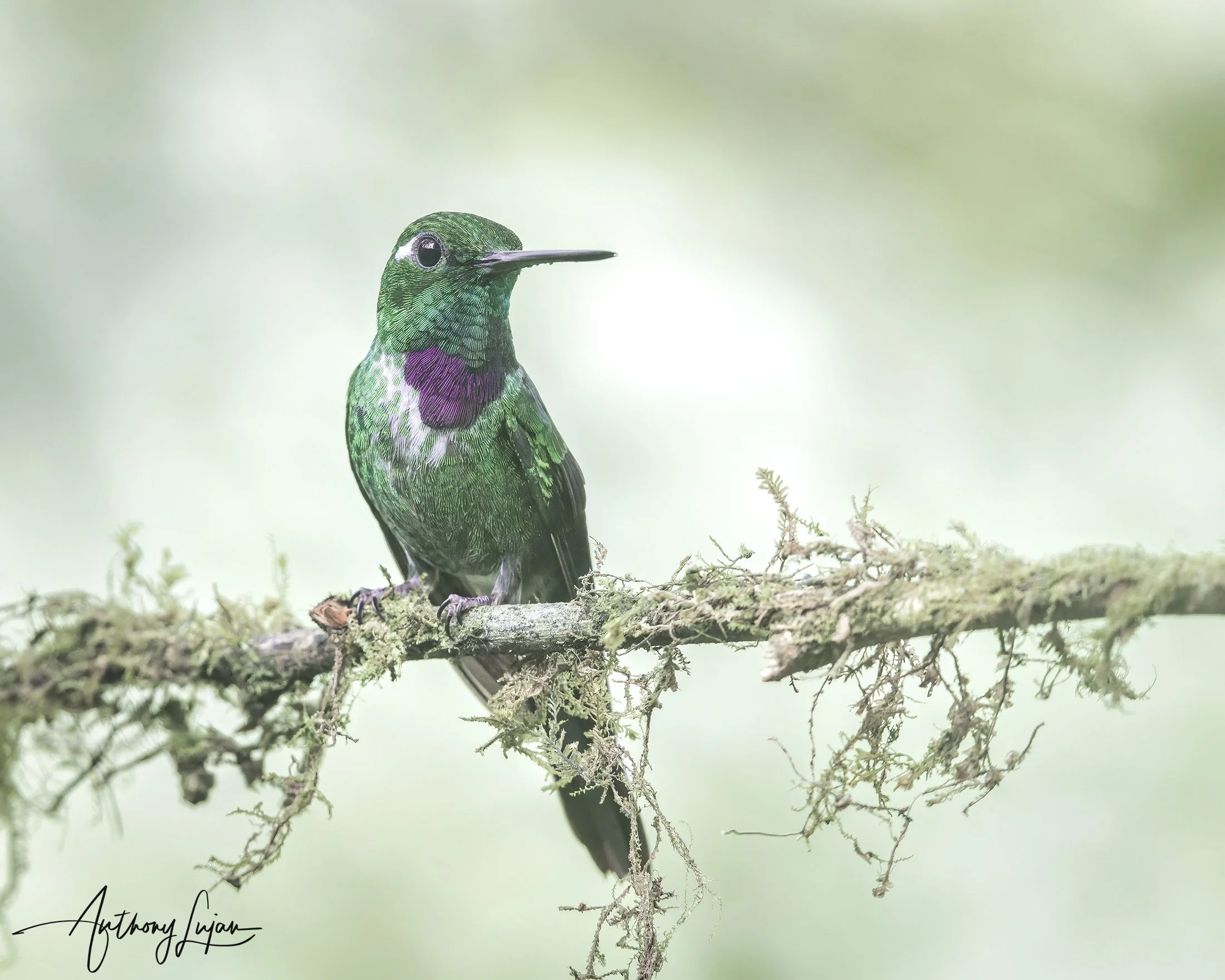
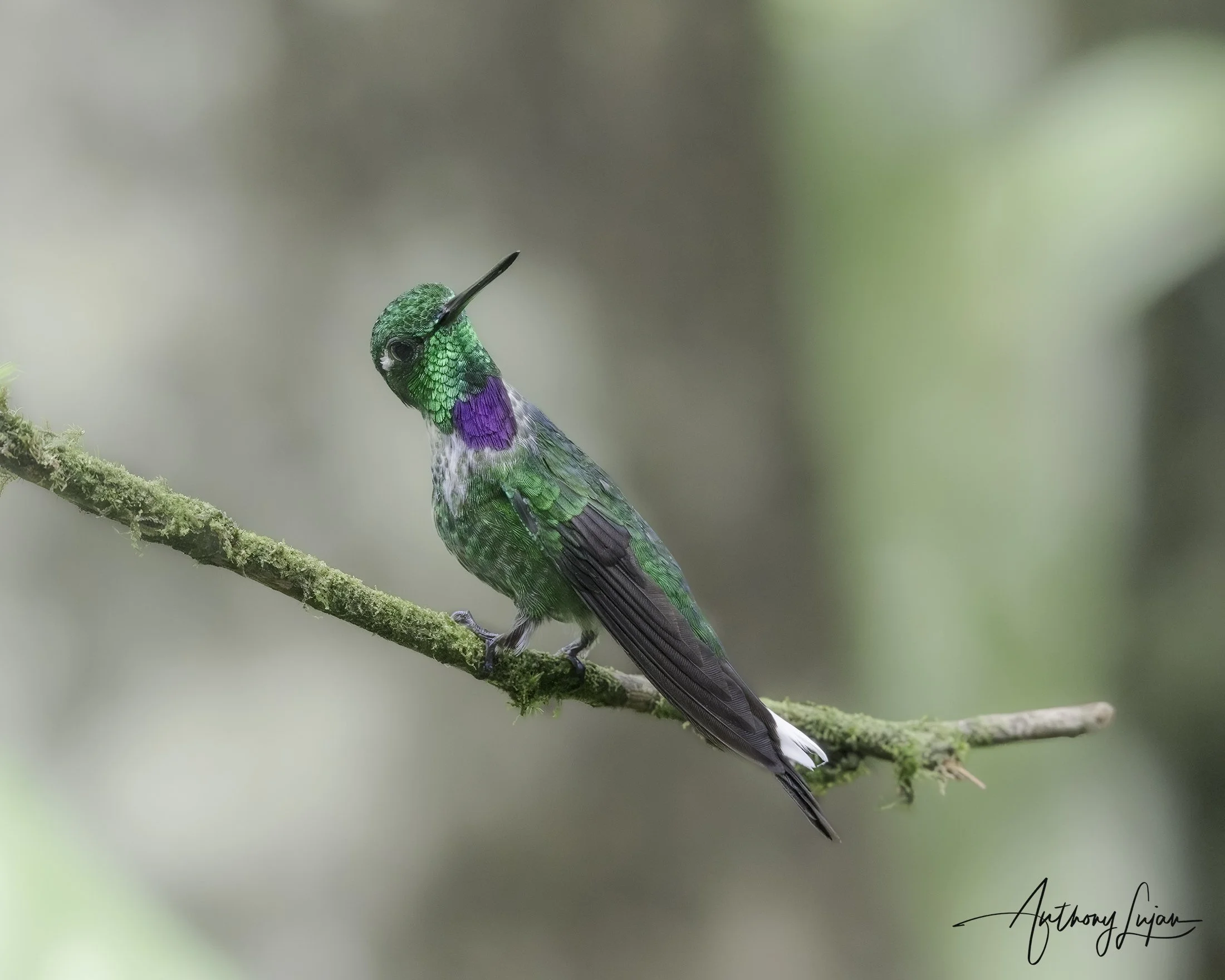
Adult males measure about 8–9 cm in length and weigh 3.8–4.2 g. The bill is straight, of medium length, and black. The upperparts are a bright, glittering green, including crown and back. A clear white post‑ocular stripe runs behind the eye. The throat bears an iridescent violet‑purple “bib,” which can look blackish when not catching the light. Below the bib, the belly is grayish with green spots or scaling, and the flanks are green.
The tail is dark bronze with broad white tips on the central tail feathers, forming conspicuous oval white patches when the tail is closed. The outer tail feathers are bronzy with darker tips and may show a purplish sheen near the end. In flight, the white‑tipped central feathers stand out, giving the bird its “whitetip” name.
Female Description
Females are similar in size and structure but lack the purple throat patch. The upperparts are glittering green with the same white stripe behind the eye. The underparts are whitish with many green spots or scaling across the throat, breast, and flanks, giving a heavily speckled appearance; the center of the belly is paler. The tail is dark bronze with purple near the end and white tips on the outer feathers, forming a patterned tail with less emphasis on the central white ovals compared to the male. Juveniles resemble females and can be recognized by brownish edges on the head feathers and generally duller plumage; young males develop the purple bib as they mature.
Habitat & Behavior
Purple-bibbed Whitetips inhabit the interior and edges of humid montane forests and cloud forests on the western Andean slopes. They are most often seen on steep, wet slopes and in ravines where understory and mid‑story vegetation are dense and flowering plants such as bromeliads and ericads are abundant. They typically forage from near ground level up to just below the canopy, often in rather dark, shaded forest.
They feed primarily on nectar from a variety of flowering plants, including bromeliads and species in the Ericaceae, Fabaceae, and Rubiaceae families. Foraging involves both hovering at flowers and perching while feeding when flowers permit. In addition to nectar, they take small insects, which they capture by gleaning from leaves and twigs or hawking out from a perch in short sallies. Their calls include a mellow, nasal, fast twittering series and various high, thin notes and scratchy call notes given during foraging and interactions.
Breeding
The breeding biology is not completely documented, but available observations show that the Purple-bibbed Whitetip builds a small cup nest constructed from mosses, ferns, and plant fibers, bound together with spiderweb. Nests are typically placed in shrubs or vine tangles in steep ravines or on shaded slopes, about 2–4 m above the ground, where they are sheltered from heavy rain and wind.
The clutch usually consists of two white eggs. The female alone incubates, with an incubation period of about 16–18 days. The fledging period is not well known but is likely around three weeks after hatching, in line with other small brilliants. Males do not participate in nesting, focusing instead on courtship and defending nectar sources.
Movement
The Purple-bibbed Whitetip is considered sedentary in Colombia but behaves as an altitudinal migrant in Ecuador. In Ecuador, birds are most common in mid‑elevation zones during the breeding season and then move to lower elevations afterwards, tracking flowering patterns and possibly more favorable climatic conditions. These movements are vertical shifts along the same Andean slopes rather than long‑distance latitudinal migrations.
Population
The global population size is unknown. The species has a relatively restricted range confined to the Pacific slopes of western Colombia and Ecuador. It is generally described as uncommon and local, although at some protected sites and hummingbird feeders it can be encountered regularly. Despite its restricted distribution, it occurs in several reserves and protected areas. The overall population is believed to be decreasing, primarily due to ongoing deforestation and habitat degradation in the Chocó bioregion and western Andean foothills.

Conservation
The Purple-bibbed Whitetip is assessed as Least Concern, reflecting its occurrence at numerous sites within a still relatively intact belt of Andean forest, and its presence in protected areas. However, its restricted range, forest‑interior habits, and decreasing population trend highlight the importance of preserving humid montane and cloud forests in western Colombia and Ecuador. Continued deforestation for agriculture, logging, and infrastructure development in the Chocó and western Andean regions represents the main threat. Conservation of cloud‑forest reserves, maintenance of forest corridors, and protection of steep, ravine‑rich slopes with abundant flowering understory and mid‑story vegetation are all important for sustaining this species.
The Purple-bibbed Whitetip is a species of hummingbird endemic to the Talamancan montane forests of Costa Rica and western Panama. It is known for its striking plumage, with the male sporting a vibrant purple throat patch, or "bib," contrasting with its mainly green body. The female, on the other hand, has a more subtle coloration with a whitish throat and greenish body.
These hummingbirds primarily feed on nectar from a variety of flowers, using their long, slender bills to extract the sweet liquid. They are an important pollinator in their ecosystem, aiding in the reproduction of flowering plants. In addition to nectar, they also consume small insects and spiders for protein.
The Purple-bibbed Whitip is known for its agile flight, able to hover in place and quickly change direction with precision. Their distinctive buzzing sound is often the first sign of their presence in the area.
Related species in the Urosticte genus (2 species in total):

Please note: The content provided in this article reflects Anthony’s personal experience and photographic approach. Results can vary depending on light, weather, location, equipment, subject behavior, and field conditions.