
Rufous-shafted Woodstar
Scientific name: Chaetocercus jourdanii
The Rufous-shafted Woodstar is a tiny hummingbird of semi-open montane landscapes in Venezuela, Trinidad, and northern Colombia. The number of mature individuals is unknown, the population is considered stable, it is treated as non-migratory, and it is currently listed as Least Concern with three recognized subspecies.
At a Glance
Family: Trochilidae (hummingbirds)
Clade: Mellisugini – Bee Hummingbirds
Genus group: Chaetocercus — 6 species, all tiny “woodstar” hummingbirds of northwestern South America and Trinidad
Range: Northeastern and northern Venezuela, Trinidad, the Sierra de Perijá on the Colombia–Venezuela border, and the eastern Andes of northern Colombia and western Venezuela.
Habitat: Semi-open and open habitats including scrublands, edges of montane forest, coffee plantations, gardens, and sometimes lower slopes of páramo; often where scattered trees and shrubs break up open country.
Elevation: Mostly between about 900 and 3,000 m, though most records are below roughly 2,500 m.
Length: About 6–8 cm (2.4–3.1 in).
Weight: Only a few grams, typical of small woodstars.
Number of mature individuals: Unknown
Population trend: Stable
Status: Least Concern (IUCN)
Name Origin
The genus name Chaetocercus means “bristle tail,” referring to the narrow, filamentous outer tail feathers of males in this group. The species name jourdanii honors French naturalist Pierre-Médard Diard Jourdain (name as used by the original describer) or another Jourdain-linked figure, following a tradition of commemorative scientific names. The English name “Rufous-shafted Woodstar” describes the warm rufous color along the tail shafts and underparts combined with its tiny woodstar build.
Subspecies & Distribution
Chaetocercus jourdanii jourdanii
Distribution: Northeastern Venezuela in the mountains of Sucre and northern Monagas; also present on Trinidad (resident in Venezuela, vagrant or localized on Trinidad depending on authority).Chaetocercus jourdanii rosae
Distribution: Highlands of northern Venezuela from Falcón east to Miranda.Chaetocercus jourdanii andinus
Distribution: Sierra de Perijá along the Colombia–Venezuela border, the Andes of western Venezuela (Lara to Táchira), and the eastern Andes of northern Colombia.
Taken together, these subspecies give the Rufous-shafted Woodstar a discontinuous but relatively compact range spanning northern Venezuela, Trinidad, and the border zone and eastern Andes of northern Colombia.
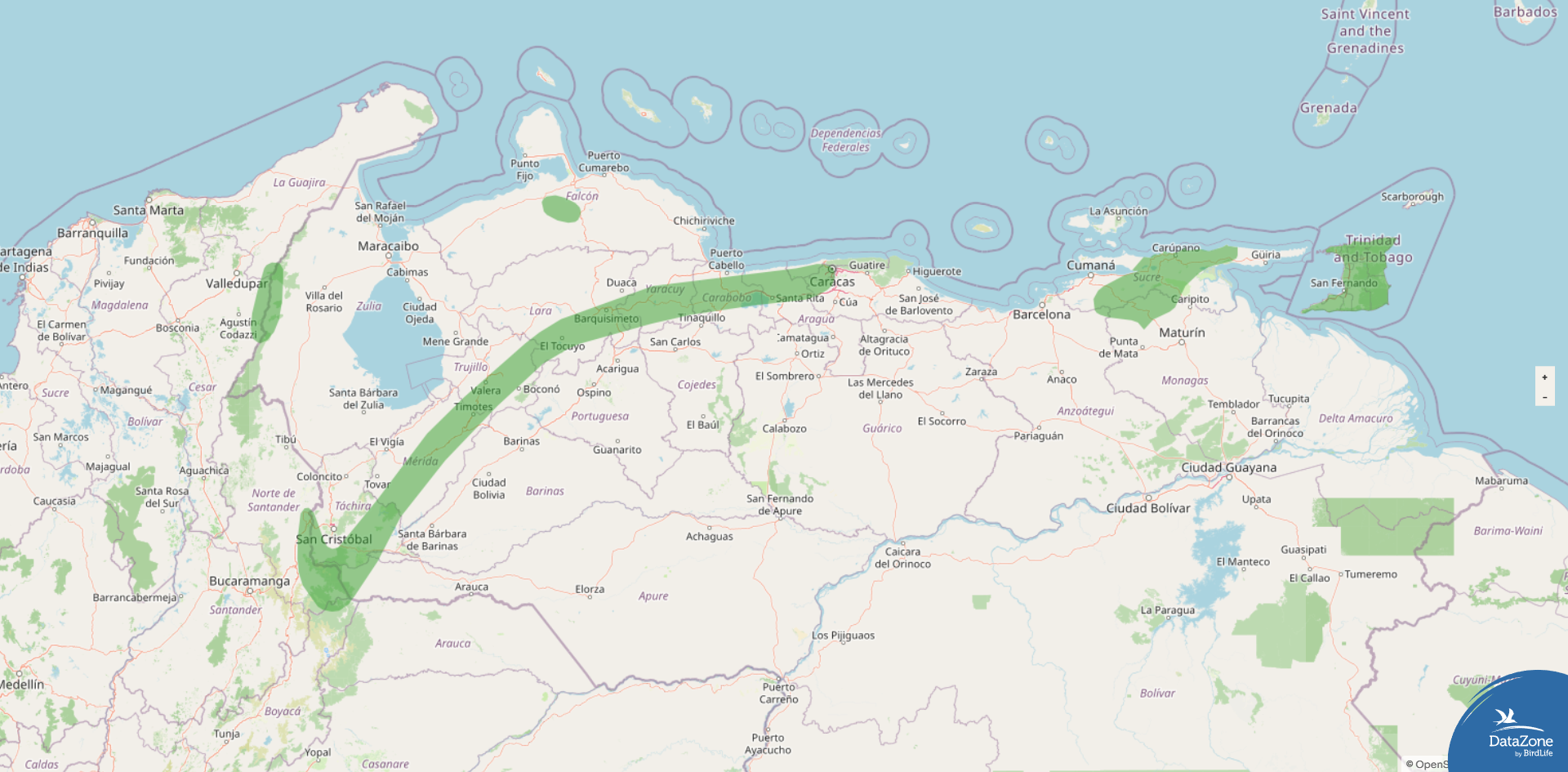
Legend
Green Resident
Species Overview
The Rufous-shafted Woodstar is a classic “bee hummingbird,” often appearing like a large insect as it hovers around flowers in scrubby, montane landscapes. It favors semi-open environments such as scrublands, forest edges, and coffee plantations, where flowering shrubs and small trees are abundant. Its stable population and adaptability to some agricultural mosaics support its current Least Concern status, even though it is small and easy to overlook.
Male Description
Adult males are very small, with a straight black bill and bright bottle-green upperparts. The throat bears a deep reddish-pink to magenta gorget, which can appear violet or rosy crimson depending on subspecies and lighting. Below the throat is a wide white chest band that contrasts sharply with the green breast and flanks and the buffy or greenish belly. The tail is deeply forked, with blackish feathers that have rufous shafts, creating the “rufous-shafted” effect when the tail is spread or back-lit. Overall, males appear as tiny green woodstars with a magenta throat, bold white chest band, and a short, sharply forked dark tail showing warm rufous shafts.
Female Description
Adult females share the straight black bill and green upperparts but lack the male’s bright gorget and bold white band. The underparts are buffy or cinnamon with some pale areas on the throat and chest, often with faint mottling; the flanks can be slightly warmer in tone. The tail is shorter and not as deeply forked as in males, with rufous tones and a darker subterminal band near the tips of the feathers. Both sexes show small white patches on the sides just behind the wings, visible when perched or hovering. In the field, females look like tiny, green-backed hummingbirds with buffy underparts and a short, slightly notched rufous-and-dark tail.
Habitat & Behavior
Rufous-shafted Woodstars inhabit semi-open and open montane habitats, including scrublands, forest edges, coffee plantations, gardens, and occasionally the lower fringes of high-elevation grasslands (páramo). They forage at low to mid-levels, visiting small tubular flowers on shrubs and scattered trees, and likely supplement their diet with tiny insects. Their flight is bee-like, with rapid, hovering movements and short darts between flowers; they may perform brief display flights but are generally unobtrusive and easily overlooked. The species is considered resident, with no large-scale migration, though in Venezuela it may shift seasonally to higher elevations in the dry season and lower elevations in the rainy season.
Population
The total number of mature individuals is unknown, but the Rufous-shafted Woodstar appears locally fairly common in suitable habitats across parts of northern Venezuela and the Andes of Colombia and western Venezuela, and it is recorded irregularly on Trinidad. Its ability to use semi-open mosaics, forest edges, and traditional coffee plantations suggests a degree of resilience, and current assessments consider its overall population trend to be stable.

Conservation
The Rufous-shafted Woodstar is listed as Least Concern due to its relatively broad, though patchy, range and stable population trend. Nonetheless, deforestation, conversion of traditional shade coffee to intensive agriculture, and degradation of montane scrub and forest edges can reduce local habitat quality. Conservation measures that maintain hedgerows, flowering shrubs, and shade trees in agricultural landscapes, alongside protection of montane forest and scrub in Venezuela, Colombia, and Trinidad, will help ensure that this species remains secure.
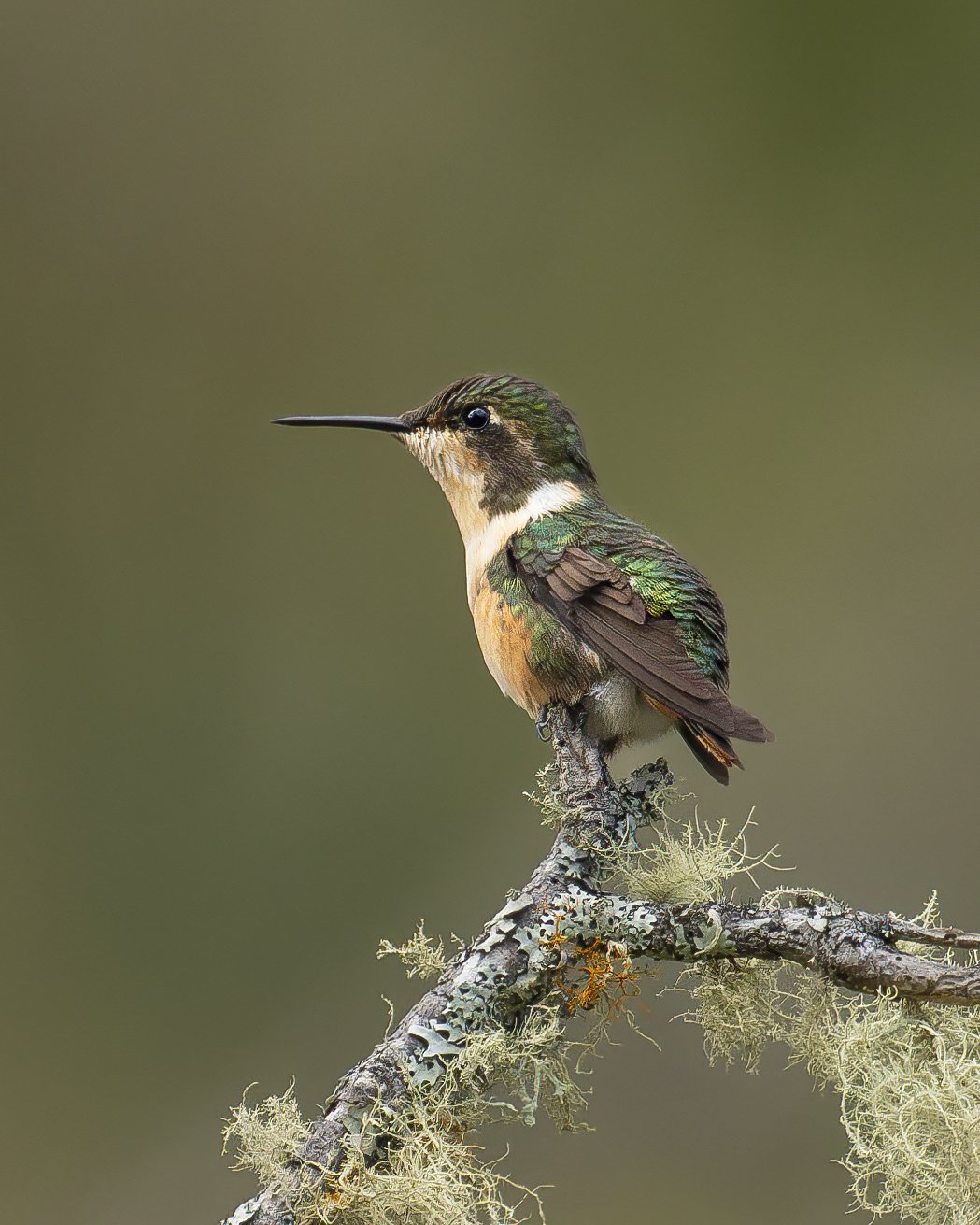
Below is the Rufous-shafted Woodstar (Chaetocercus jourdanii andinus)
Female photographed at Manaure Balcón del Cesar, Serranía del Perijá, Colombia
These individuals belong to the subspecies andinus, which occurs in the Sierra de Perijá and along the eastern Andes of northern Colombia and adjacent western Venezuela. This form is consistent with others in the species but is geographically isolated in montane ridges and cloud forest edge. Males show the characteristic violet throat and rufous wing shafts, while females are pale below with muted spotting.
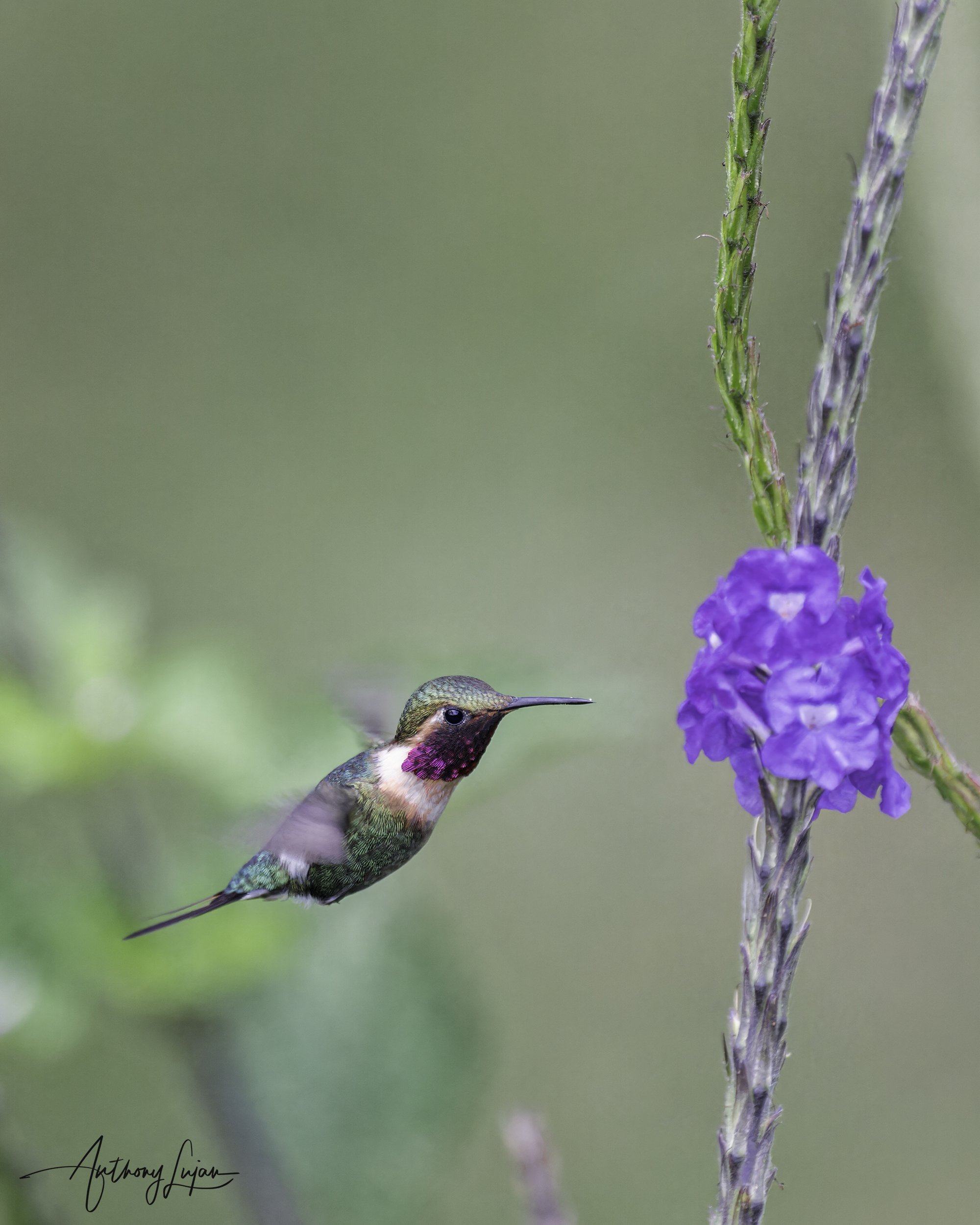
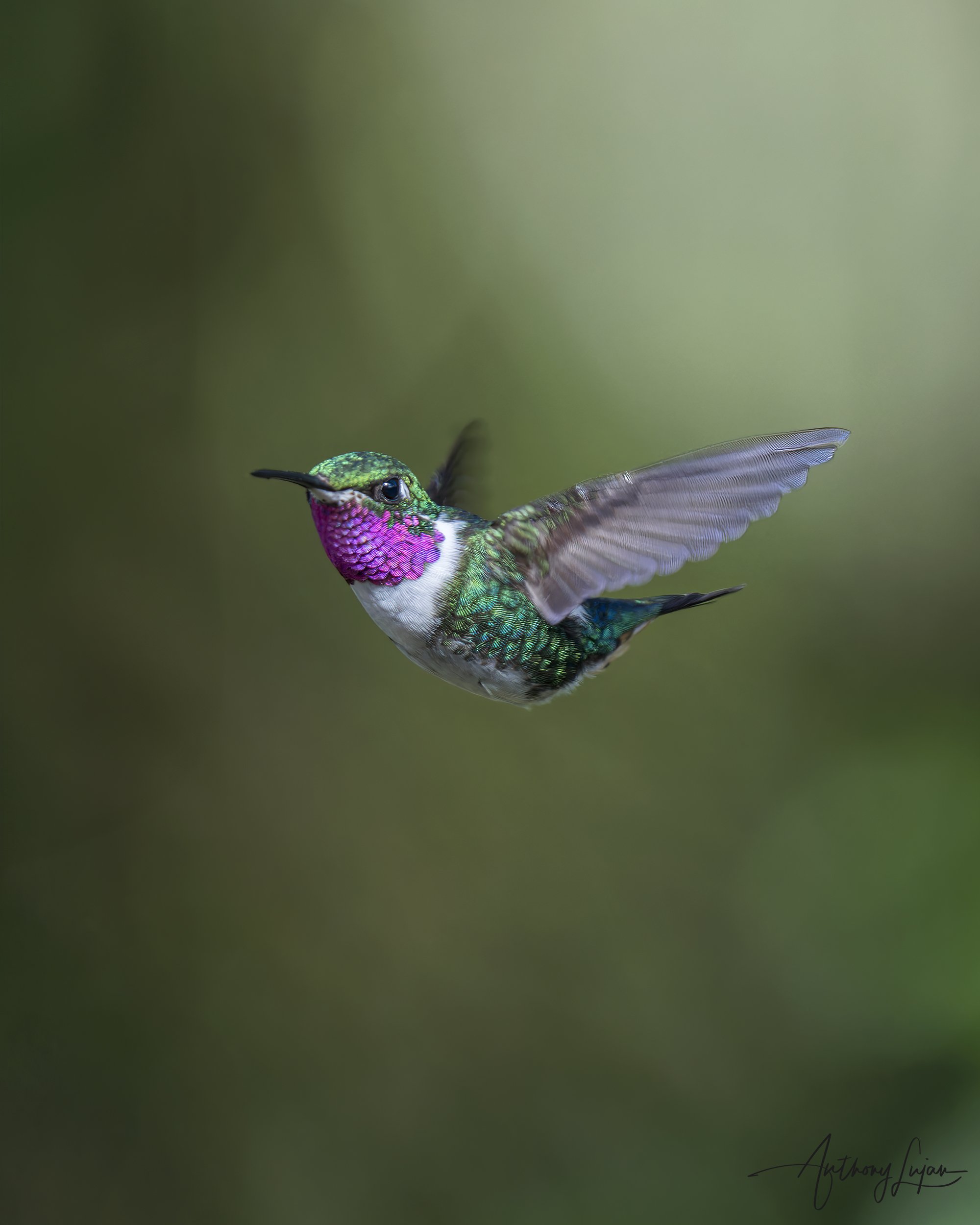
Related species in the Chaetocercus genus (6 species total):



Please note: The content provided in this article reflects Anthony’s personal experience and photographic approach. Results can vary depending on light, weather, location, equipment, subject behavior, and field conditions.