
Talamanca Hummingbird
Scientific name: Eugenes spectabilis
The Talamanca Hummingbird is a large, robust “mountain gem” hummingbird endemic to the highlands of Costa Rica and western Panama. The total number of mature individuals is unknown, the overall population trend is stable, it is considered non‑migratory, and it is currently assessed as Least Concern.
At a Glance
Family: Trochilidae (hummingbirds)
Clade: Lampornithini – Mountain Gems
Genus: Eugenes — 2 species in total
Range: Highlands of Costa Rica and western Panama (Cordillera Central, Cordillera de Talamanca, Volcán Barú massif)
Habitat: Oak‑dominated cloud forest, forest edges and clearings, nearby secondary forest, and high‑elevation gardens
Elevation: Mostly from about 2,000 m up to treeline, most common above 2,500 m; sometimes as low as roughly 1,850 m
Length: About 13 cm (5.1 in)
Weight: Males about 10 g (0.35 oz); females about 8.5 g (0.30 oz)
Number of mature individuals: Unknown
Population trend: Stable
Movement: Not a migrant (year‑round resident with only local shifts)
IUCN Red List category: Least Concern
Name Origin
The genus name Eugenes comes from Greek for “well‑born” or “noble,” a nod to the species’ large size and imposing presence. The species name spectabilis means “notable” or “admirable,” inspiring the alternate English name “Admirable Hummingbird.” The widely used common name “Talamanca Hummingbird” refers to the Cordillera de Talamanca, the high mountain range that forms the core of its range in Costa Rica and western Panama.
Taxonomy
Eugenes spectabilis belongs to the mountain gem tribe Lampornithini within the hummingbird family. It was long treated as the southern subspecies of the Magnificent Hummingbird, but genetic and morphological work led to a split into Rivoli’s Hummingbird (E. fulgens) in Mexico and northern Central America and Talamanca Hummingbird (E. spectabilis) in Costa Rica and western Panama. The genus Eugenes now includes these two species.
The Talamanca Hummingbird is confined to high mountain regions of Costa Rica and western Panama. In Costa Rica it occurs in the Cordillera Central and Cordillera de Talamanca; in Panama it is known primarily from the Volcán Barú massif in Chiriquí Province. It inhabits cool, humid oak forests and cloud forests, especially edges, clearings, and adjacent secondary forest in the upper montane zone.
Subspecies and Distribution
Monotypic — no subspecies recognized.
Distribution: The species ranges from central Costa Rica south through the Cordillera de Talamanca into western Panama. In Costa Rica it typically occurs from about 2,000 m to treeline, most common above 2,500 m, and occasionally down to roughly 1,850 m on some slopes. In Panama it is found mainly between about 2,000 and 2,400 m on Volcán Barú and neighboring high ridges, in oak‑dominated cloud forest and associated habitats.
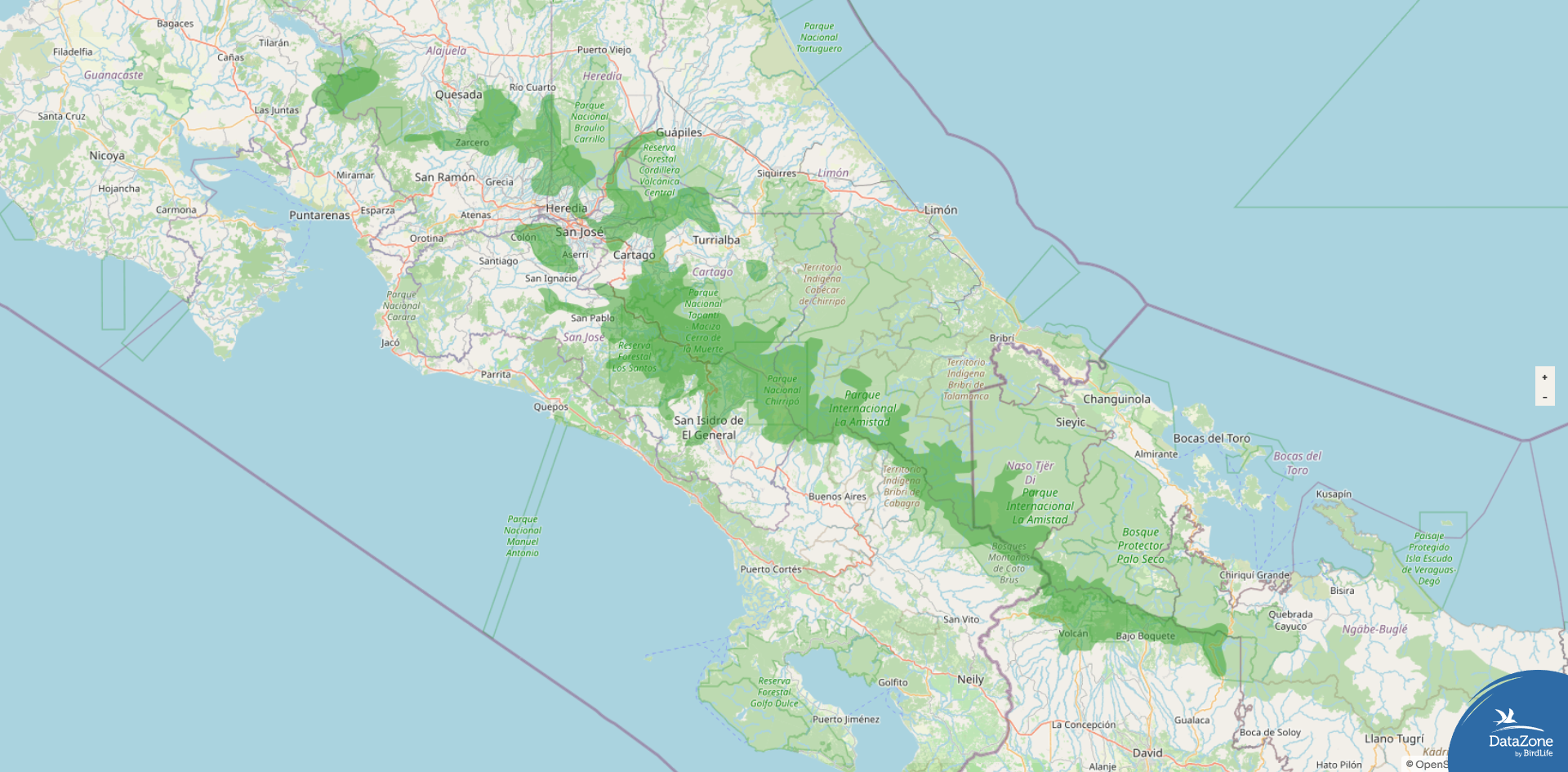
Legend
Green Resident
Species Overview
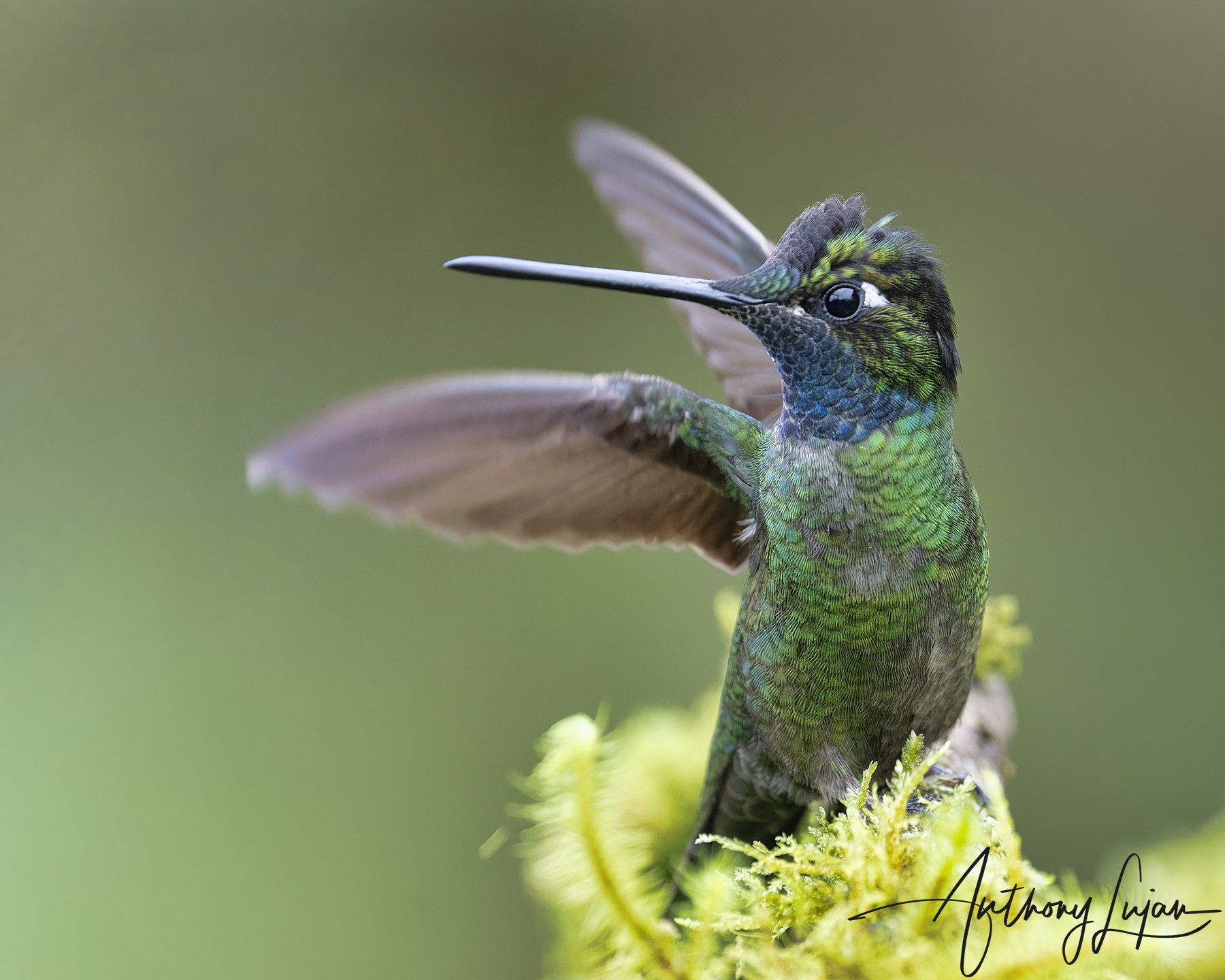
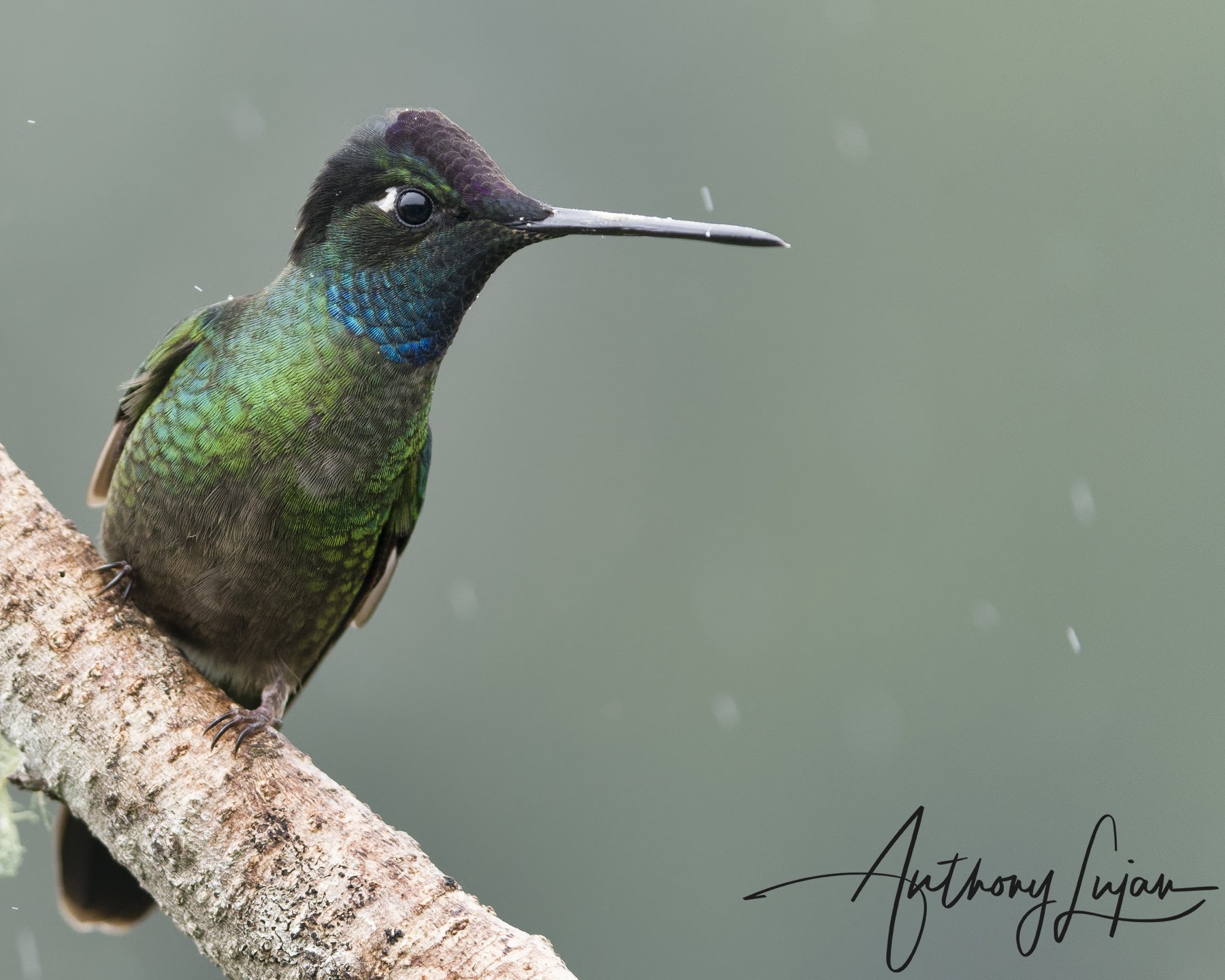
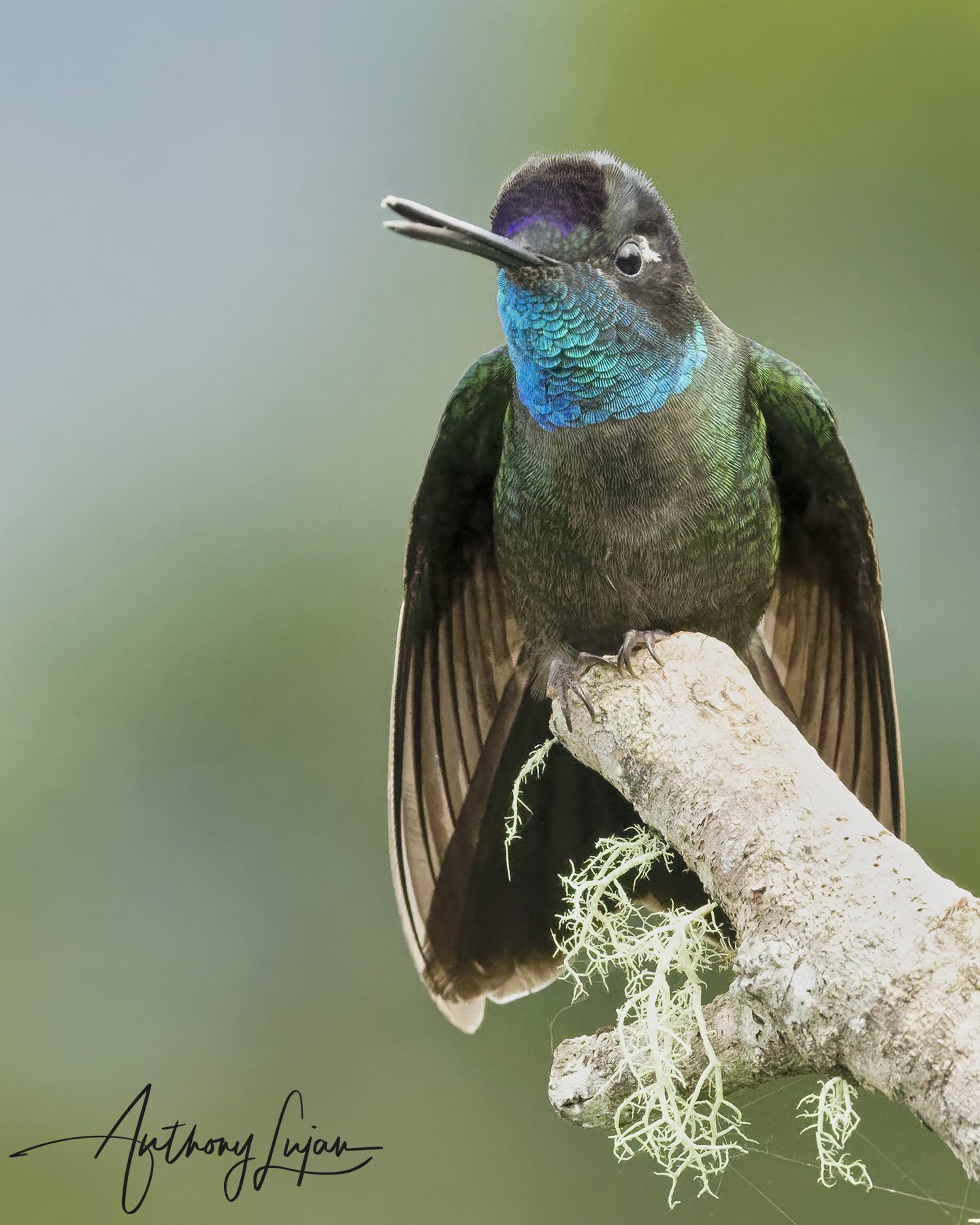
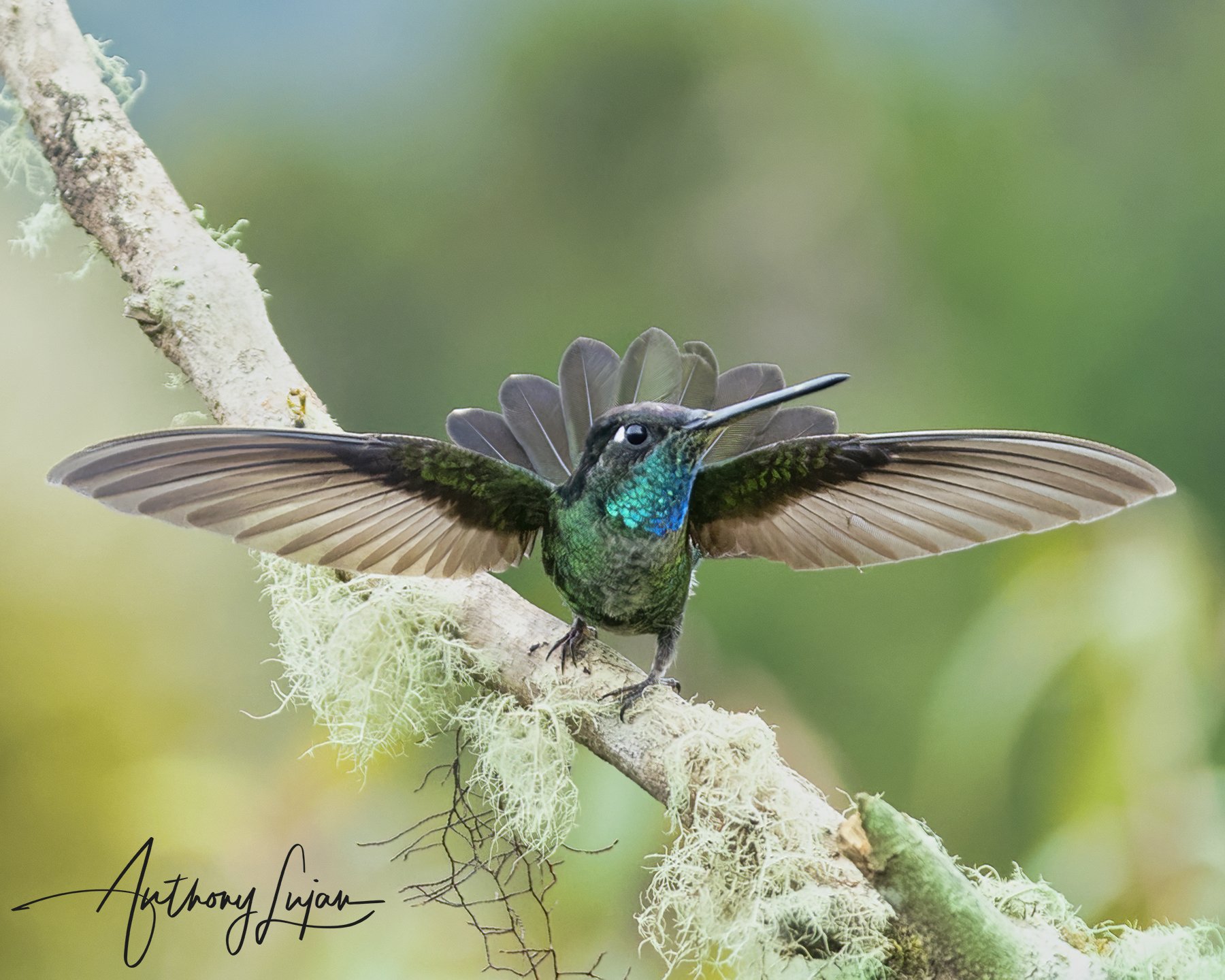
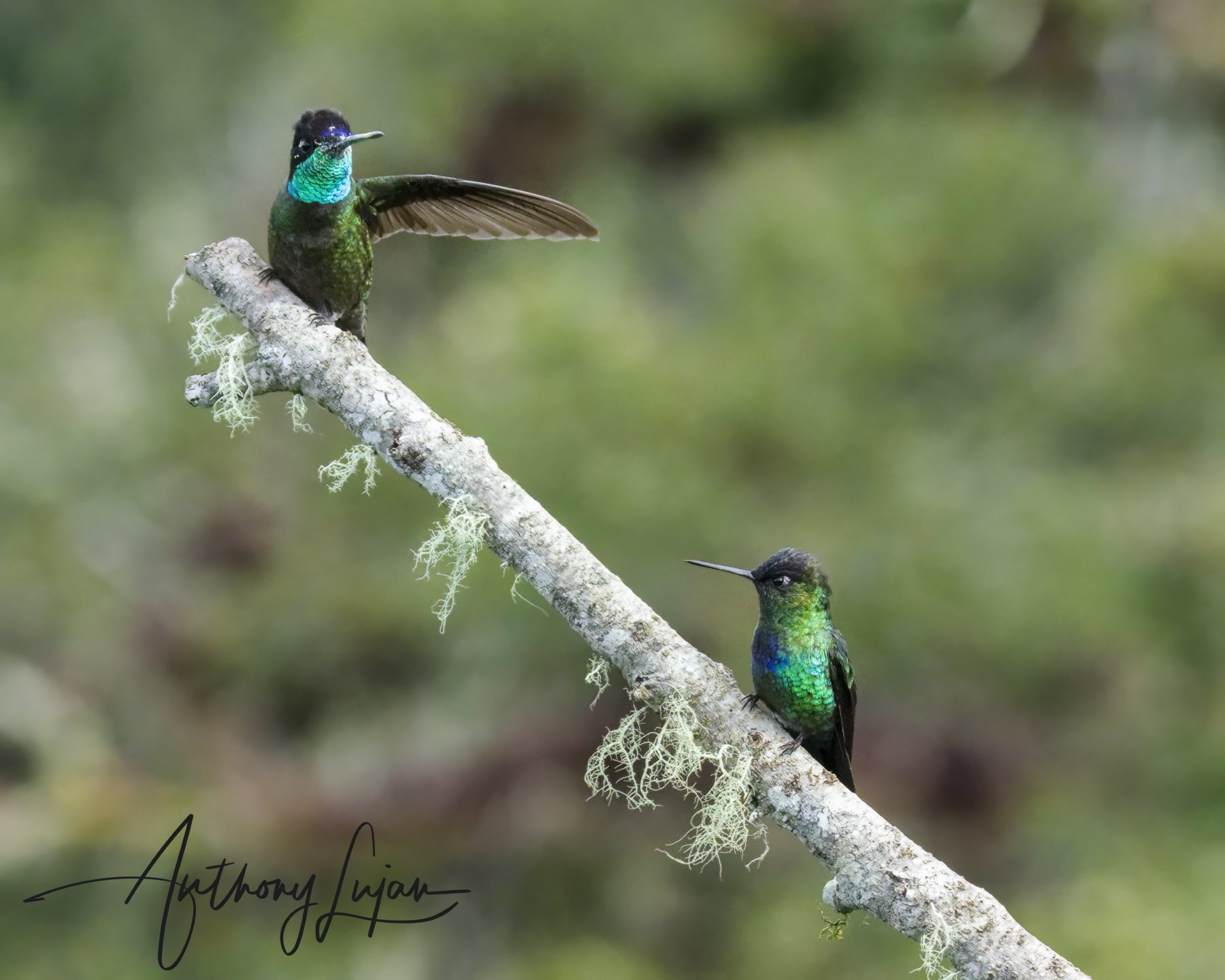
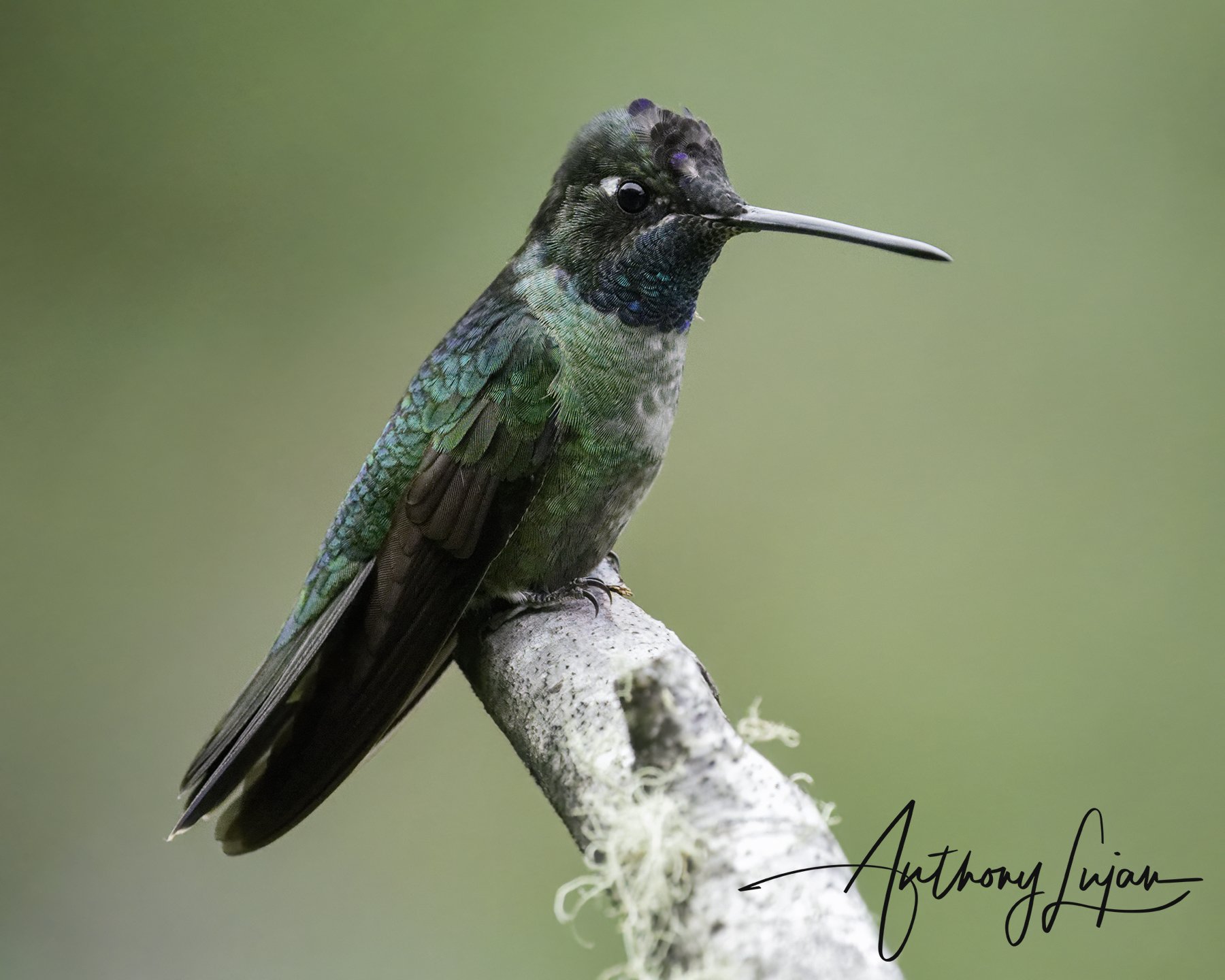
The Talamanca Hummingbird is one of the largest hummingbirds in Central America, a dark, heavy bird that reveals brilliant iridescent colors when viewed in good light. Males have a gleaming green body, a crown that flashes violet‑purple, and a bright metallic green throat, while both sexes show a long, straight black bill and a small white spot behind the eye. It is a characteristic bird of high‑elevation oak forests and a regular visitor at feeders in mountain lodges, where it is often among the dominant species. Despite its restricted range, it is fairly common in suitable habitat and appears to have a stable population.
Male Description
Male Talamanca Hummingbirds are about 13 cm long and weigh around 10 g. Both sexes have a long, straight black bill and a small white post‑ocular spot. Adult males have a dull black forehead with a dark green gloss and a metallic violet‑blue to purple crown that usually appears black until it catches the light. The nape and upper back are dull black washed with dark green, and most of the face is dark green with black lores.
The rest of the upperparts and tail are bronzy to golden green, with tail feathers sometimes showing grayish tips. The chin and gorget are metallic bluish‑green, forming a bright patch on the throat. The breast and belly are dark bronzy green, with the belly often mixed with brownish gray, and the undertail coverts are dull bronzy green edged with pale buff. In poor light the bird can look almost uniformly dark; in good light, the crown and throat ignite with vivid color.
Female Description
Females are slightly smaller, about 8.5 g, and lack the iridescent crown and gorget. Their upperparts are dull dark green, and most of the face is sooty black with the same small white spot behind the eye. The two innermost pairs of tail feathers are dull dark green while the three outer pairs are bronzy green with a black band near the end and brownish gray tips.
The throat is brownish gray with buff tips to the feathers, giving a softly scaled look, the flanks are dark green, and the breast, belly, and undertail coverts are dull brownish gray with a faint dull green wash. Juveniles resemble females; young males gradually acquire the bright throat and crown coloration as they mature.
Habitat & Behavior
Talamanca Hummingbirds live in high‑elevation oak forests and cloud forests, especially forest edges, canopy breaks, and adjacent second growth. They are particularly associated with mature oak stands draped in moss and epiphytes, with a rich understory of flowering shrubs and herbs. They are most common above 2,500 m, up to timberline, but can be found somewhat lower in suitable habitat.
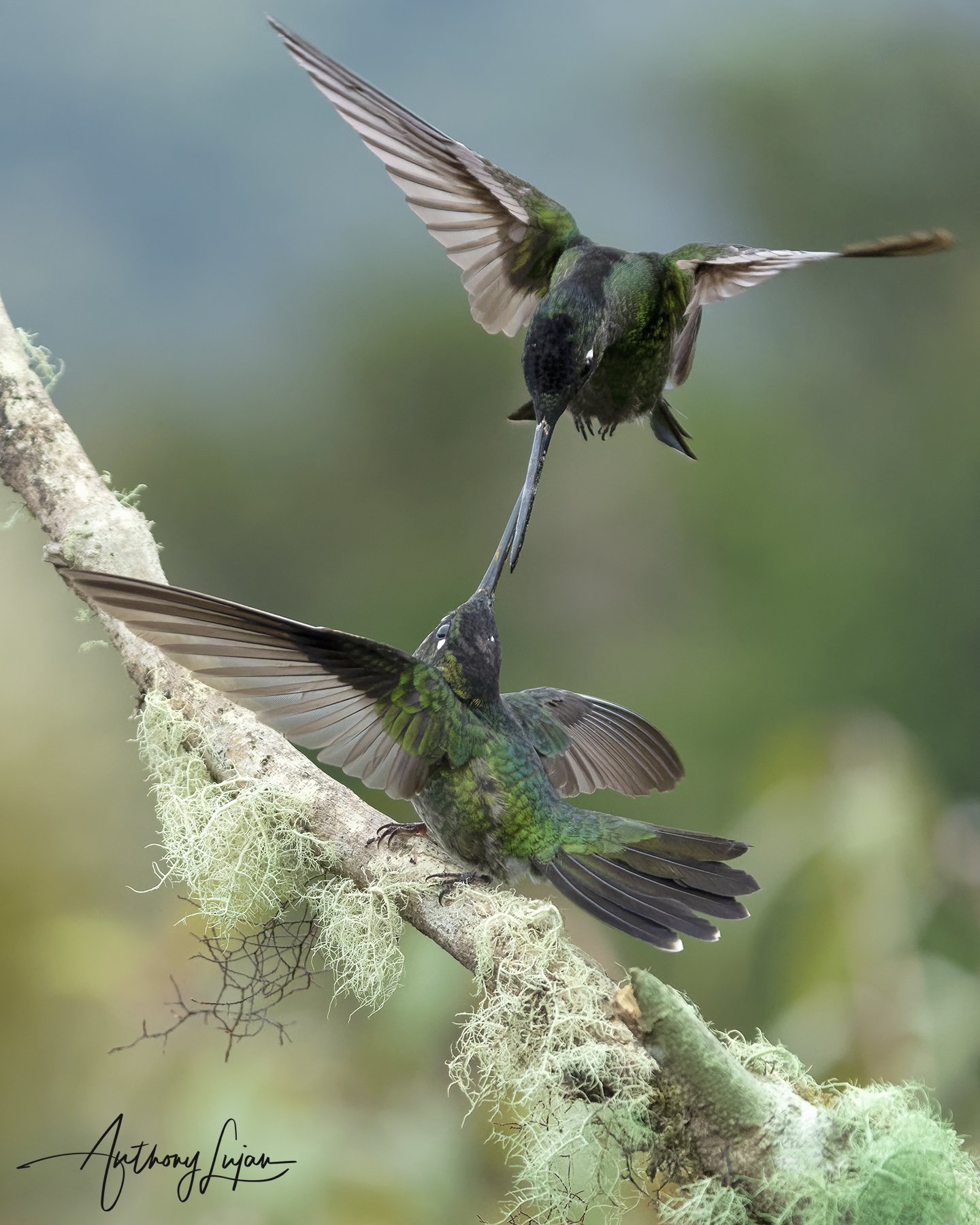
They feed primarily on nectar from a variety of highland flowers, including epiphytes, shrubs, and flowering trees along edges and clearings. Males often defend flower patches in the lower forest levels and at edges, perching conspicuously and chasing intruders, while females tend to forage by trap‑lining, following a circuit of flowers rather than holding a fixed territory. The species also takes small arthropods, probably snatched in flight or gleaned from vegetation while hovering, though details are less well documented than for its northern relative, Rivoli’s Hummingbird. Talamanca Hummingbirds are frequent visitors to hummingbird feeders at highland lodges, where they often dominate smaller species.
Breeding
In Costa Rica, the breeding season runs mainly from November to March, overlapping the drier season and early rains in highland forests. The female builds a cup nest of plant down and other fine fibers, binding it with spiderweb and covering the outside with moss and lichens for camouflage. The nest is typically placed at the tip of a dangling bamboo stem or similar flexible support between about 1.5 and 3 m above the ground, hanging in a way that may reduce predator access and help shed heavy rain.
The clutch consists of two white eggs. The incubation period is not precisely known, but once the eggs hatch, the time from hatch to fledging is at least 25 days, longer than in many smaller hummingbirds. As in most hummingbirds, the female handles all incubation and chick‑rearing, making frequent trips between the nest and nearby nectar and insect sources.
Movement
The Talamanca Hummingbird is considered a resident species and is treated as non‑migratory. It does not undertake regular long‑distance migrations. Some local elevational movements likely occur as birds track flowering within the high‑elevation belt or respond to short‑term weather changes, but these shifts keep birds within the same mountain ranges of Costa Rica and western Panama.
Population
The total number of mature individuals is unknown. Within its relatively small range, the species is typically described as common in suitable highland habitats and is a regular, often abundant visitor at feeders and flowering hedges around mountain lodges and rural communities. There is no evidence of rapid declines, and overall the population is considered stable. Its presence across multiple highland ranges and in protected areas further supports its current status.

Conservation
The Talamanca Hummingbird is assessed as Least Concern. It benefits from extensive protected areas in Costa Rica and Panama, including national parks and reserves that encompass large tracts of high‑elevation oak and cloud forest. However, its dependence on highland habitats makes it potentially vulnerable to climate change, deforestation, and land‑use changes that affect montane forests and treeline ecosystems. Conservation of oak forests, maintenance of forest edges and second growth, and protection of high‑elevation corridors across the Cordillera Central and Cordillera de Talamanca are important for the species’ long‑term security.
Interested in coming along? Visit Travel with Me!
Also visit Costa Rica Hummingbird Expedition | July 2021 | 10 Species | Where It All Started
Also visit Costa Rica Hummingbird Expedition | November 2021 | 22 New Species | Second Chances
Also visit Costa Rica Hummingbird Expedition | July 2025 | 32 Species | 10 New | Closing the Gap
Checkout Anthony’s playlist of this species! Click the top right dropdown to see all the videos.
Related species in the Eugenes genus (2 species in total):

Please note: The content provided in this article reflects Anthony’s personal experience and photographic approach. Results can vary depending on light, weather, location, equipment, subject behavior, and field conditions.