
White-eared Hummingbird

Scientific name: Basilinna leucotis
The White-eared Hummingbird is a medium-sized species of mountain forests and pine-oak woodlands from northern Mexico through Central America. The number of mature individuals is estimated at 2,000,000, the population trend is decreasing, it is not a migrant, and it is currently assessed as Least Concern.
At a Glance
Family: Trochilidae (hummingbirds)
Clade: Trochilini – Emeralds
Genus: Basilinna — 2 species total
Range: Northern Mexico to north-central Nicaragua
Habitat: Mountain forests, pine-oak woodlands, forest edges, canyons
Elevation: 1,200–3,500 m (3,900–11,500 ft)
Length: About 10.5–12 cm (4.1–4.7 in)
Weight: About 4.5–6 g
Number of mature individuals: 2,000,000
Population trend: Decreasing
Movement: Not a migrant
IUCN Red List category: Least Concern
Name Origin
The genus name Basilinna refers to "little queen" from Greek roots. The species name leucotis means "white-eared," describing the bold white stripe behind the eye. The English name highlights this conspicuous facial marking.
Taxonomy
Basilinna leucotis belongs to the emeralds clade (Trochilini) and shares its genus with the Xantus's Hummingbird (B. xantusii).
Subspecies and Distribution
Three subspecies:
Basilinna leucotis borealis
Distribution: Northern Mexico (eastern Sonora, western Chihuahua, and southern Coahuila to southwestern Tamaulipas); rarely into southeastern Arizona, USA.Basilinna leucotis leucotis
Distribution: Central and southern Mexico (from Durango and San Luis Potosí southward) into Guatemala.Basilinna leucotis pygmaea
Distribution: Highlands of El Salvador, Honduras, and north-central Nicaragua.
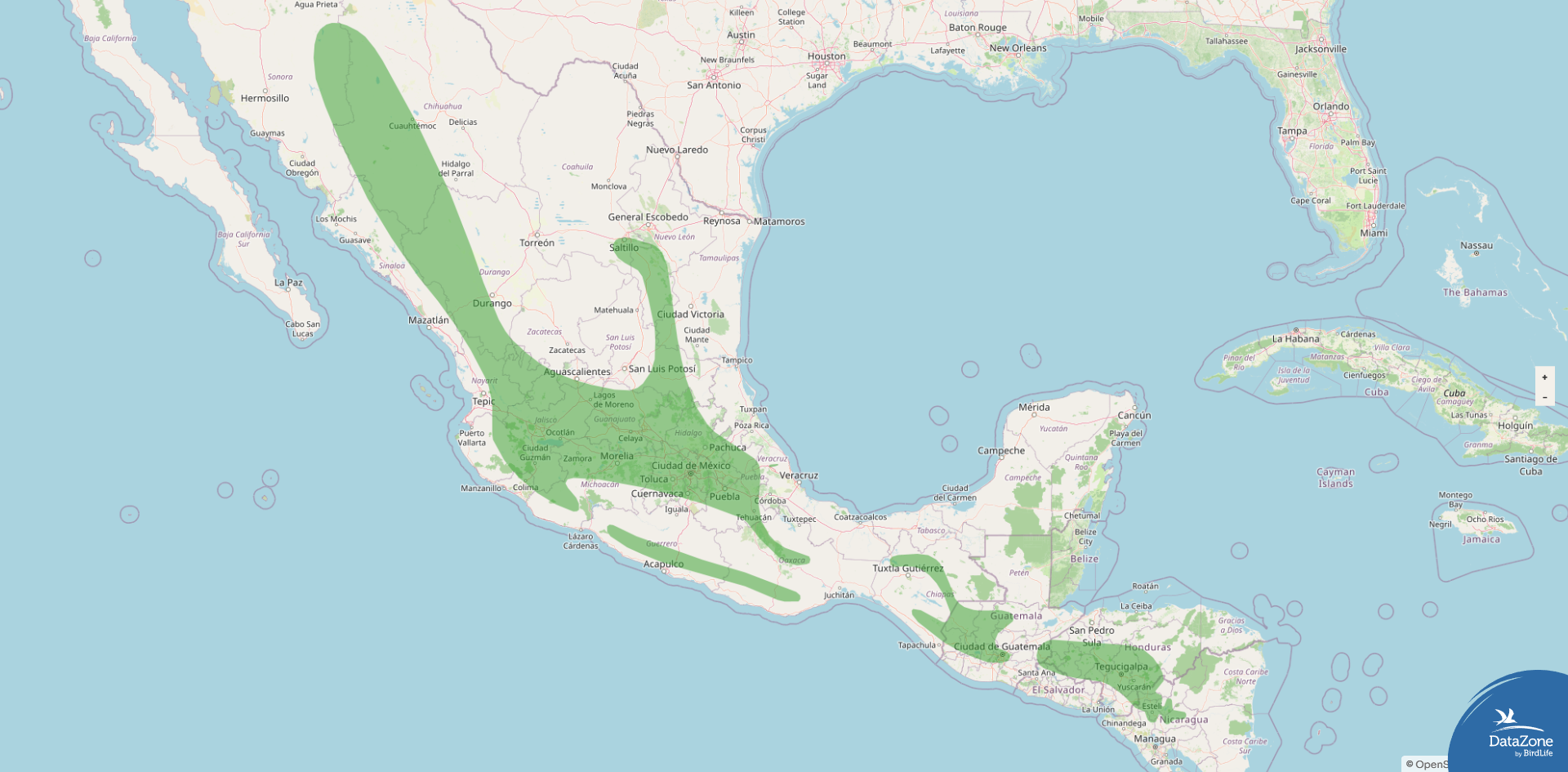
Legend
Green Resident
Species Overview
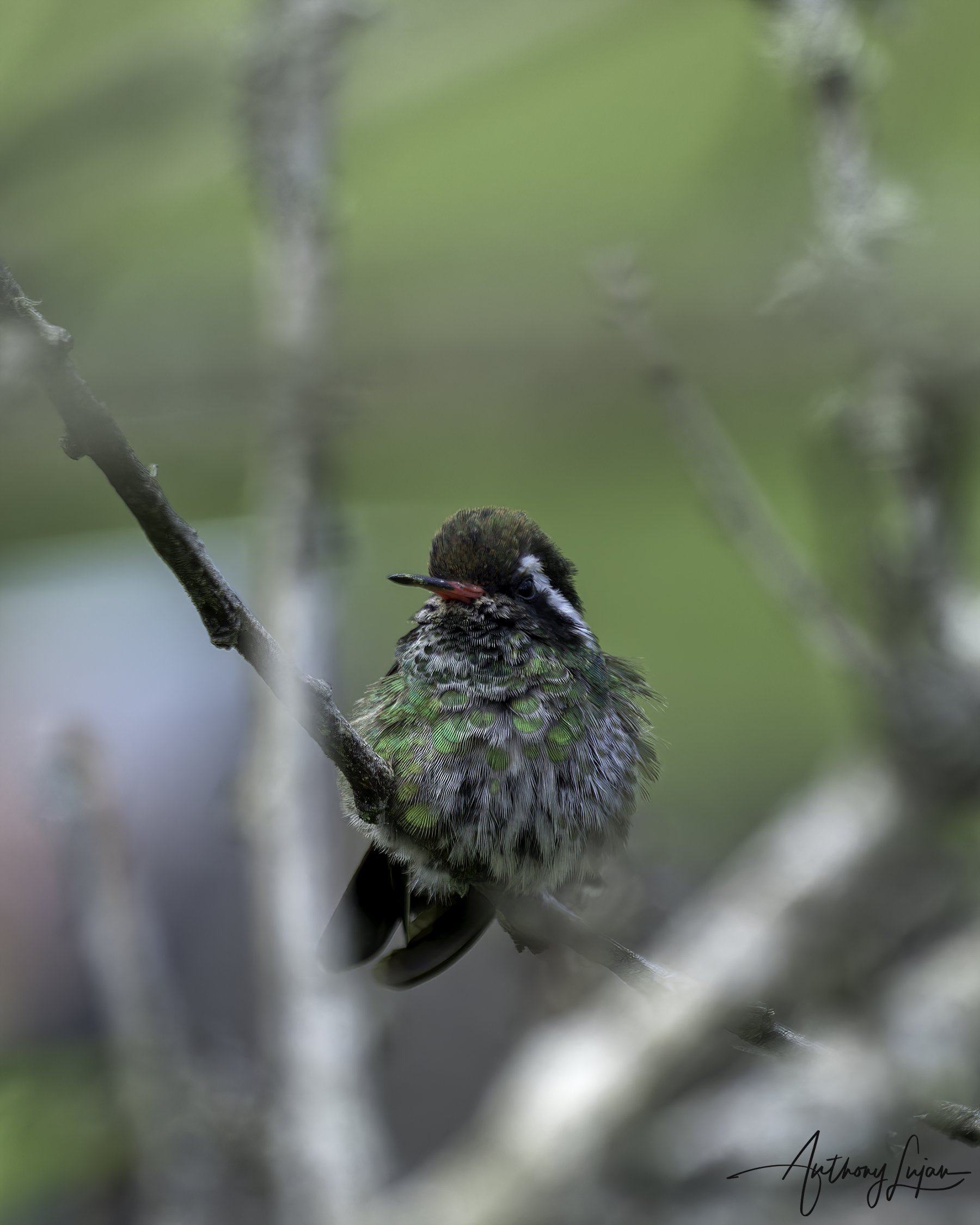
The White-eared Hummingbird stands out with its gleaming white ear stripe contrasting against a dark violet head. Males flash violet face and green throat in sunlight while females show duller green head with same white stripe. Regular vagrant to southeastern Arizona where it visits feeders.
Male Description
Dark violet head with bold white stripe from eye extending rearward. Green upperparts and throat with violet face patches in good light. Underparts green with grayish belly. Tail dark green, slightly forked. Straight black bill medium length. Violet head most striking feature.
Female Description
Duller green head with same prominent white ear stripe. Green upperparts, throat, and breast with paler grayish belly. Tail similar to male but slightly shorter. Less iridescent overall but white ear stripe equally conspicuous. Juveniles resemble females.
Habitat & Behavior
Inhabits mountain oak, pine-oak, and pine-evergreen forests, forest edges, and mountain canyons. Forages low in clearings and midstory on tubular flowers. Aggressive at feeders and nectar sources. Migrates to Arizona feeders in fall where surprisingly bold.
Breeding
Female builds cup nest of plant down, lichens, and moss 1.6–6 m above ground, sometimes reusing old nests. Lays two white eggs. Female incubates 14–16 days; nestlings fledge 23–28 days. Polygynous; 1–2 broods per season.
Movement
Not a migrant though northern populations (borealis) make seasonal movements into southern Arizona. Otherwise resident within highland range year-round.
Population
Estimated 2,000,000 mature individuals across extensive Mexican and Central American range. Locally common in pine-oak zones. Decreasing due to habitat loss in montane forests.

Conservation
Least Concern despite decreasing trend due to large population and range. Regular feeder visitor in Arizona suggests some habitat flexibility. Vulnerable to logging of pine-oak forests and agricultural conversion at middle elevations.
Below are individuals of the White-eared Hummingbird (Basilinna leucotis leucotis)
Photographed at:
Omiltemi, Chilpancingo de los Bravo, Guerrero, Mexico
Puerto del Gallo, General Heliodoro Castillo, Guerrero, Mexico
These birds belong to the subspecies leucotis, which ranges throughout the highlands of central and southern Mexico into Guatemala. It is characterized by its vibrant gorget and distinct white postocular stripe. The Guerrero region hosts suitable pine-oak and humid montane forest habitat where this subspecies is commonly found.
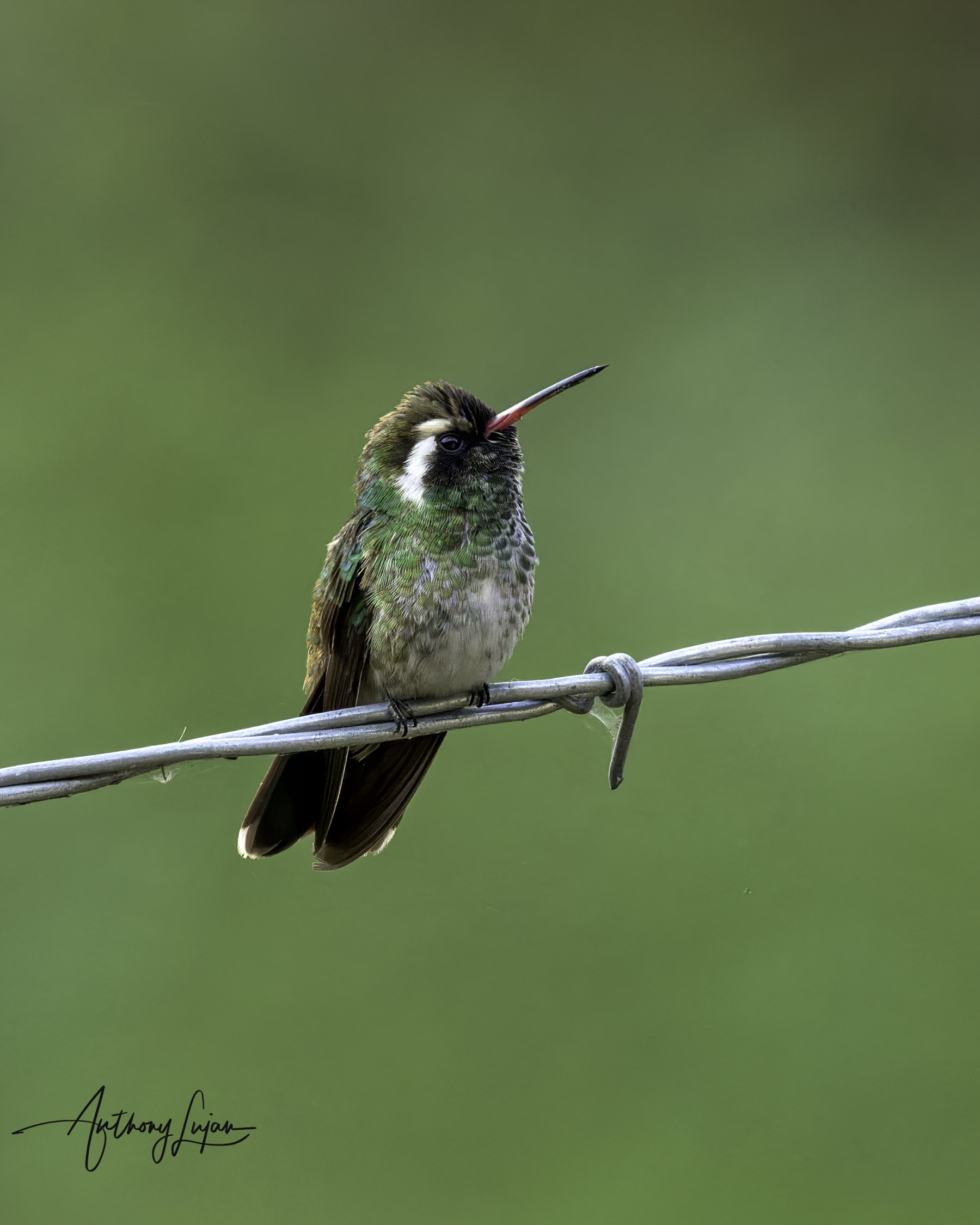
same subspecies as above but photographed in Guatemala.


Related species in the Basilinna genus (2 species total)

Please note: The content provided in this article reflects Anthony’s personal experience and photographic approach. Results can vary depending on light, weather, location, equipment, subject behavior, and field conditions.