
Emerald-chinned Hummingbird
Scientific name: Abeillia abeillei
The Emerald-chinned Hummingbird is a tiny forest hummingbird of humid montane and foothill forests from southern Mexico through parts of Central America. It is listed as Least Concern, with an estimated 20,000–49,999 mature individuals, a decreasing population trend, and it is considered not a migrant.
At a Glance
Family: Trochilidae (hummingbirds)
Clades: Trochilini – Emeralds
Genus group: Abeillia — emerald-chinned hummingbird (1 species in total)
Range: Highlands of southern Mexico (Oaxaca, Chiapas) south through Guatemala and El Salvador to the highlands of Honduras and northern Nicaragua.
Habitat: Humid montane and foothill forests, including cloud forest, evergreen forest, and forest edges, as well as tall second growth and shaded coffee plantations.
Elevation: Generally between about 1,000 and 2,200 m (3,300–7,200 ft), locally lower in some parts of Honduras and Nicaragua.
Length: About 7–8.5 cm (2.8–3.3 in).
Weight: About 2.7–3.5 g (0.095–0.12 oz).
Number of mature individuals: 20,000–49,999.
Population trend: Decreasing.
Status: Least Concern (IUCN Red List category).
Migration: Not a migrant.
Name Origin
The genus name Abeillia honors French naturalist Abeille de Perrin, recognized for his contributions to natural history. The species name abeillei is also derived from his name, emphasizing his association with this bird’s discovery and description. The English name “Emerald-chinned Hummingbird” refers to the male’s brilliant emerald‑green chin and throat, which stand out against darker surrounding plumage.
Taxonomy & Distribution
Abeillia abeillei
Emerald-chinned Hummingbird belongs to the emerald clade (tribe Trochilini) and is the sole species in the genus Abeillia. It occurs in a discontinuous band of montane and foothill forest from southern Mexico through northern Central America. Within this range, it inhabits humid highland forests and edges, with two recognized subspecies that differ mainly in geography and elevation.
Subspecies and Distribution
Emerald-chinned Hummingbird has two recognized subspecies.
Abeillia abeillei abeillei
Distribution: Highlands of southern Mexico (Oaxaca, Chiapas), Guatemala, and El Salvador, with some occurrence in northwestern Honduras. It inhabits humid montane and foothill evergreen forests, cloud forests, and forest edges within this northern part of the range, often in steep, forested ravines, slopes, and tall second growth.Abeillia abeillei aurea
Distribution: Highlands of Honduras and northern Nicaragua, generally at slightly lower elevations than the nominate form. This subspecies occupies humid foothill and lower montane forests, forest edges, and tall second growth in these more southerly highlands, sometimes extending into shaded agricultural habitats such as coffee plantations.
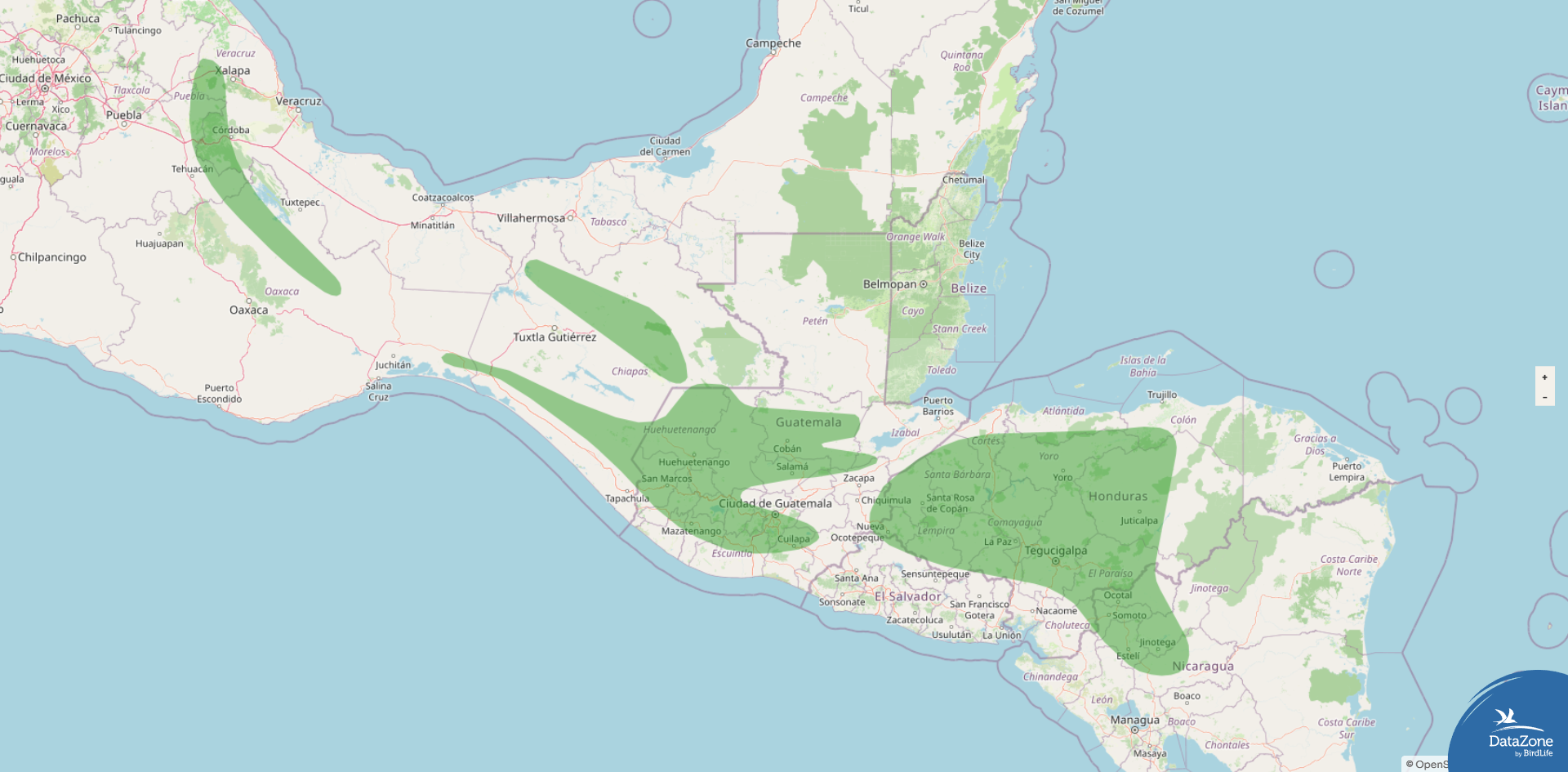
Legend
Green Resident
Species Overview
The Emerald-chinned Hummingbird is one of the smallest highland hummingbirds in its range, easily overlooked unless its glowing green throat catches the light. It favors humid montane and foothill forests and edges, where it feeds quietly at understory and mid‑story flowers. Despite its small global population and decreasing trend, it remains locally fairly common in well‑preserved forest and shade coffee regions, especially in parts of Guatemala and Honduras.
Male Description
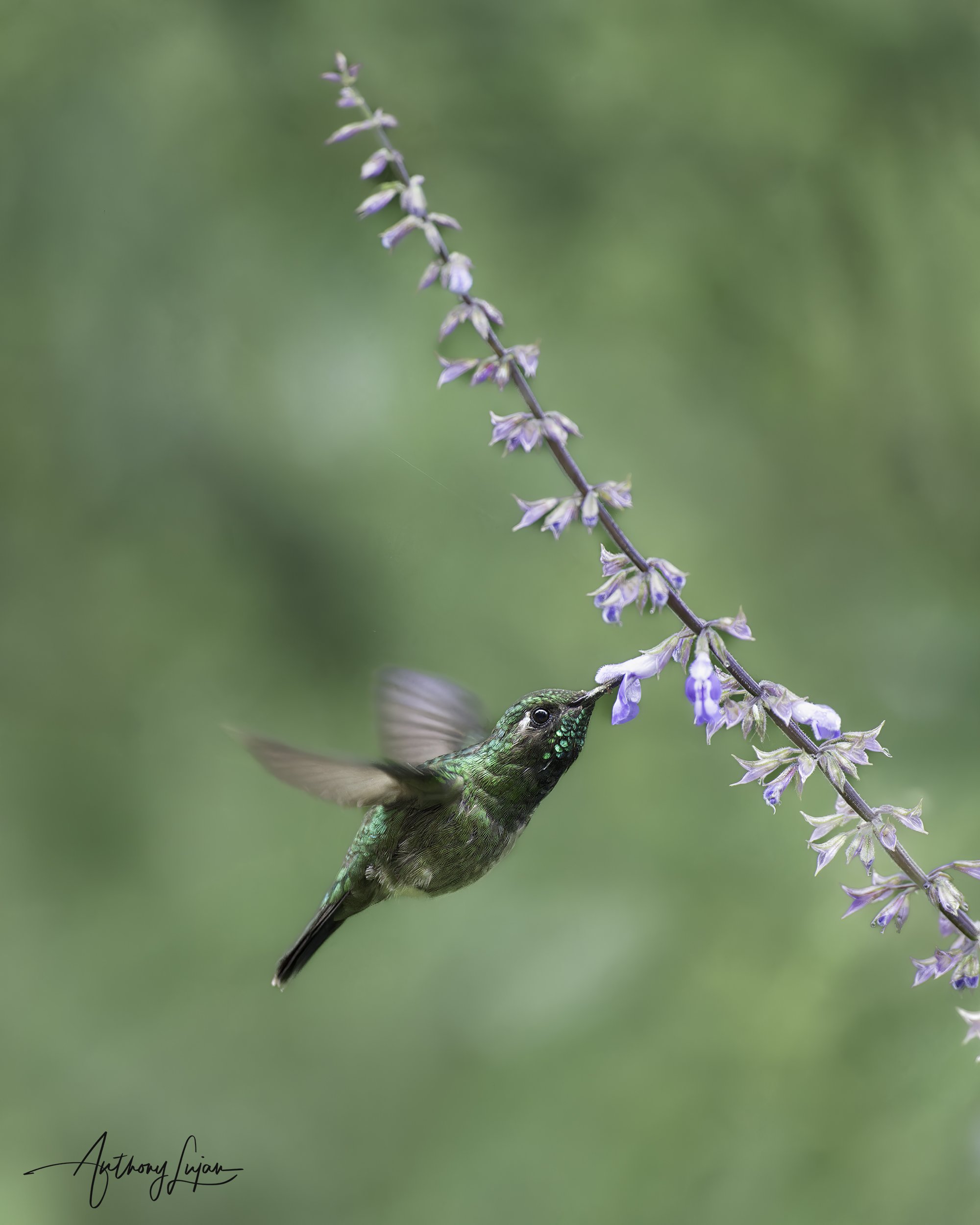
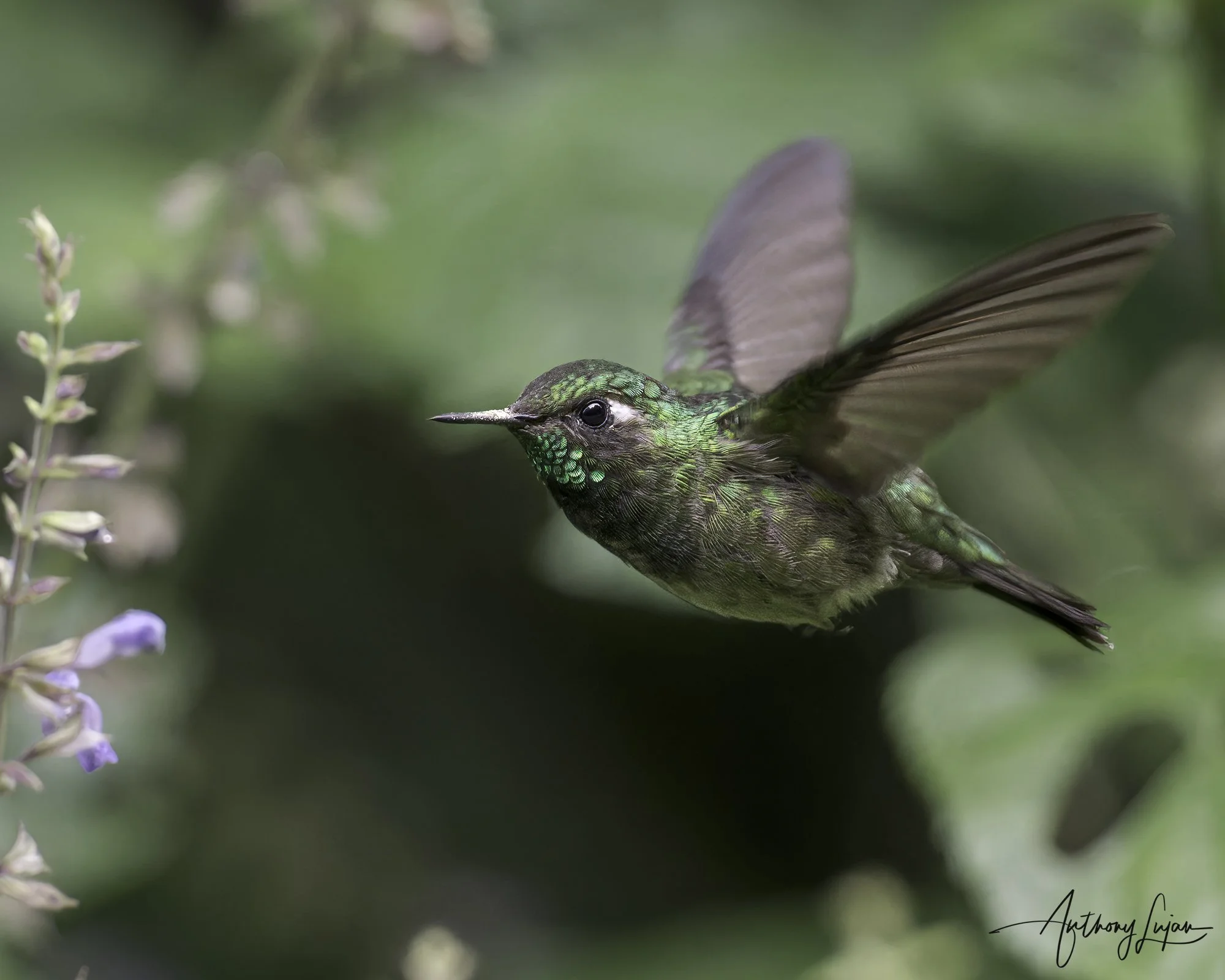
Adult males are tiny, with a short, straight, dull black bill. The upperparts are metallic bronze‑green to greenish‑bronze, including the crown, nape, and back. The face shows a bold white spot behind the eye and darker areas around the eye. The chin and upper throat are brilliant metallic emerald‑green, forming the characteristic “emerald chin,” while the lower throat is velvety black to dusky metallic bronze‑green. The breast and belly are grayish to gray‑olive, sometimes with faint green suffusion on the sides. The tail is fairly short and broad; the central pair of tail feathers are bronze‑green, and the rest are black with a faint bluish or bronzy gloss and brownish‑gray tips. Overall, males appear as small bronze‑green hummingbirds with a bright green chin and dark throat patch, plus a short, somewhat squared tail.
Female Description
Females are duller and less contrasting than males. The upperparts are metallic green, similar to the male, but the chin may show only a faint or limited green area, and the throat is more uniformly grayish or lightly mottled without the distinct black patch. The belly is paler gray and less sharply set off from the throat. The tail is shorter and more rounded, with dark rectrices tipped in whitish or gray. The facial white spot behind the eye is present but can appear less bold. Juveniles resemble females but are duller overall, with less iridescence and more brownish or grayish tones in the plumage; young males gradually develop the full emerald chin and darker lower throat.
Habitat & Behavior
Emerald-chinned Hummingbirds inhabit humid montane and foothill forests, including cloud forests, pine–evergreen mixtures, and evergreen broadleaf forests, as well as forest edges, tall second growth, and shade coffee plantations. They typically forage at low to mid levels, frequently along forest trails, edges, and light gaps, visiting small tubular flowers on shrubs, vines, and understory trees. They also take nectar from epiphytes and occasionally from flowering plants in shaded agricultural plots. Insects and spiders are taken as an important protein source, captured by hawking from perches or gleaning near flowers. They can be somewhat shy and unobtrusive, less aggressive than larger hummingbirds, but may defend small feeding areas when flower resources are concentrated.
Breeding
Breeding seasons vary geographically but generally coincide with periods of high flower availability in the montane wet season. Males may perform short display flights near favored perches, but they do not form pair bonds. The female chooses a nest site, typically on a thin, horizontal branch or fork in the understory or lower mid‑story of forest or tall second growth. She builds a tiny cup nest of plant fibers, moss, and spiderweb, often decorated externally with lichens to blend with the branch. The nest’s elastic walls stretch as the nestlings grow. She lays two white eggs and alone incubates and feeds the chicks, visiting the nest frequently with nectar and small insects until the young fledge.
Population
With an estimated 20,000–49,999 mature individuals and a relatively narrow geographic and elevational range, the Emerald-chinned Hummingbird has a fairly small global population. Within suitable highland forests and shade coffee landscapes it can be locally fairly common, but it is absent from large areas of cleared or heavily degraded land. The overall population is thought to be decreasing due to ongoing deforestation, forest fragmentation, and loss of structurally complex shade coffee systems.

Conservation
Emerald-chinned Hummingbird is assessed as Least Concern, but its decreasing trend and dependence on humid montane and foothill forests make it vulnerable to habitat loss and degradation across southern Mexico and northern Central America. Clearing of forest for agriculture and pasture, conversion of traditional shade coffee to sun coffee or other intensive crops, and logging all reduce suitable habitat. Conservation of highland forest, promotion and maintenance of shade coffee and agroforestry systems, protection of forest corridors, and effective management of protected areas are important for sustaining populations of this species and many other montane hummingbirds.
Below is the Emerald-chinned Hummingbird (Abeillia abeillei abeillei)
Photographed in Tuxtepec and Ixtlán, Oaxaca, Mexico
This individual belongs to the nominate subspecies abeillei, which occurs in the mountains and foothills of southern Mexico (Oaxaca and Chiapas) south into Guatemala and western Honduras. It inhabits humid montane forest, pine-oak forest, and forest edge between 800 and 1,800 meters elevation.
No related species in the Abeillia genus (1 species in total):
Please note: The content provided in this article reflects Anthony’s personal experience and photographic approach. Results can vary depending on light, weather, location, equipment, subject behavior, and field conditions.