
Golden-breasted Puffleg
Scientific name: Eriocnemis mosquera
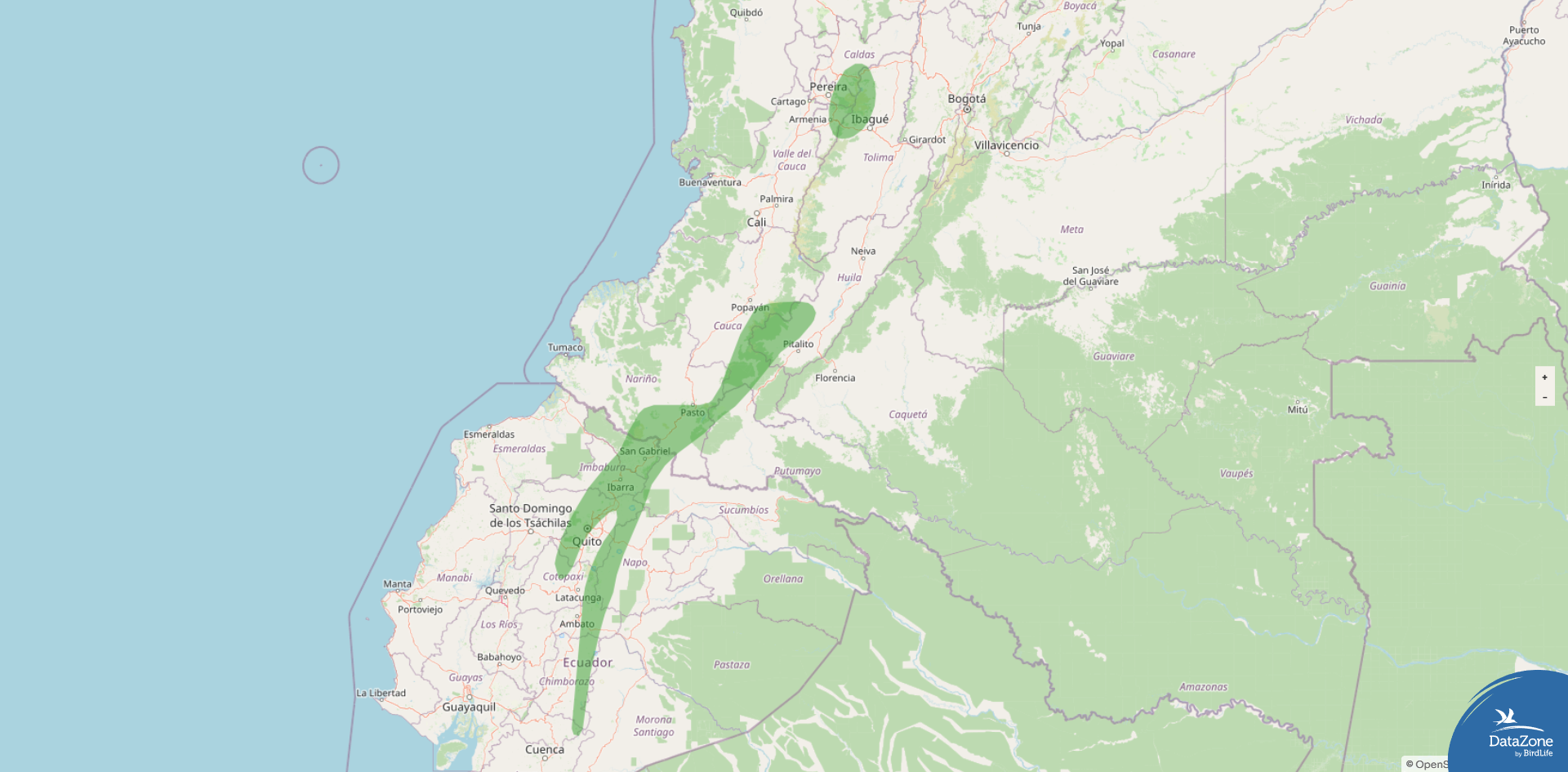
The Golden-breasted Puffleg is a high-Andean hummingbird found in the Central and Western Andes of Colombia and across much of the Andes of Ecuador, where it inhabits stunted montane forest, elfin forest, and shrubby zones near treeline. The number of mature individuals is unknown, its population trend is Decreasing, it is assessed as Least Concern, and it is considered an altitudinal migrant that moves seasonally up and down the slopes.
At a Glance
Family: Trochilidae (hummingbirds)
Clade: Lesbiini – Coquettes
Genus: Eriocnemis — Andean pufflegs with dense feather “puffs” around the legs
Range: Central and Western Andes of Colombia (with a few records in the Eastern Andes) and much of the Andean chain in Ecuador
Habitat: Edges and clearings of stunted montane forest and elfin forest, shrubby zones near treeline, and other high-Andean shrublands and clearings
Elevation: In Colombia from about 1,200–3,600 m, usually above 2,600 m; in Ecuador mostly 3,000–3,600 m
Length: About 11–13 cm (4.3–5.1 in)
Weight: Around 5.3 g (0.19 oz)
Number of mature individuals: Unknown
Population trend: Decreasing
Status: Least Concern (IUCN)
Name Origin
The genus name Eriocnemis comes from Greek roots meaning “wool” and “leg,” referring to the fluffy feather “puffs” around the legs that give pufflegs their name. The species name mosquera honors a member of the Mosquera family of Colombia, recognized in the 19th century for their influence and patronage. The English name “Golden-breasted Puffleg” highlights the species’ rich golden to coppery breast combined with the characteristic white leg puffs.
Subspecies & Distribution
Golden-breasted Puffleg is monotypic, with no recognized subspecies.
It occurs in the Central and Western Andes of Colombia, with a few records from the Eastern Andes, and continues south through much of the Andean chain in Ecuador. Within this range it inhabits the edges and clearings of stunted montane forest, elfin forest, and shrubby zones near treeline, often in a mosaic of forest edge, shrubland, and high-altitude clearings.
Ledged
Green Resident
Species Overview
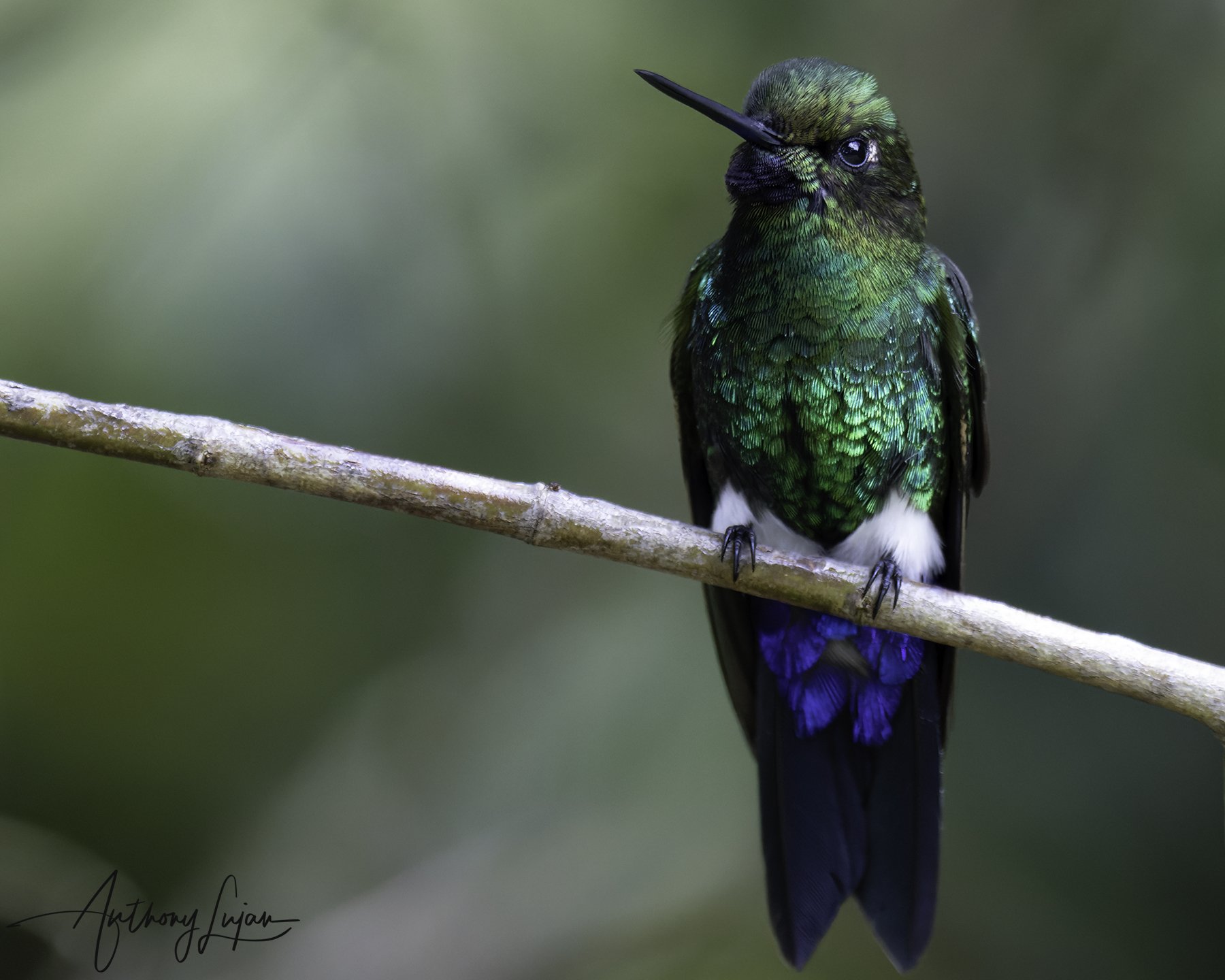
The Golden-breasted Puffleg is a characteristic hummingbird of high-Andean cloud forest margins and shrubby slopes close to treeline. Its glowing golden or coppery breast and bright white leg puffs make it one of the more distinctive pufflegs in Colombia and Ecuador. It favors semi-open high-elevation habitats where low trees, shrubs, and tall herbs provide nectar, and it moves seasonally along the altitudinal gradient to track flowering. Although it has a relatively narrow geographic range confined to the northern Andes, its presence in a variety of high-Andean habitats supports a Least Concern status despite a Decreasing trend.
Male Description
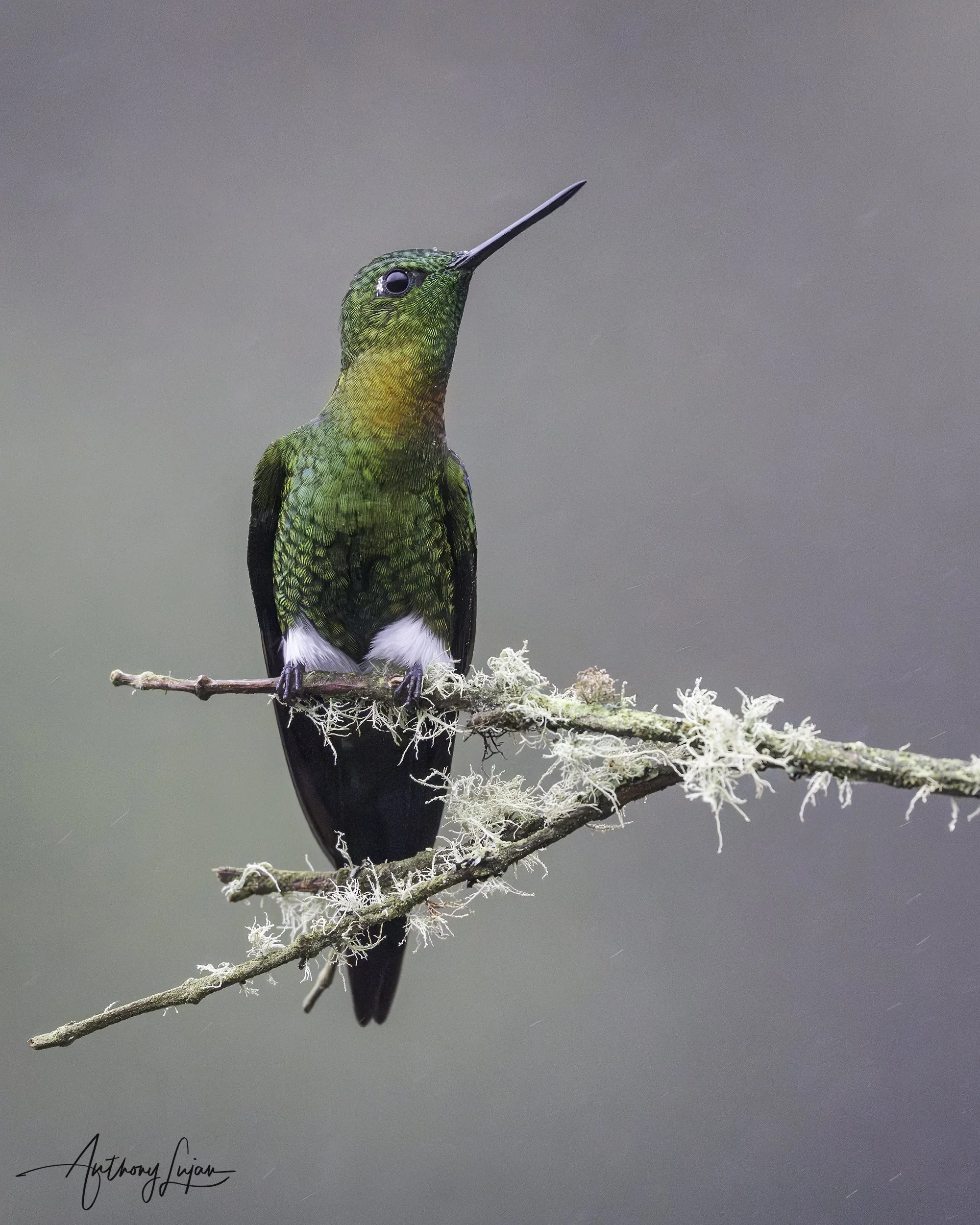
Adult males have shining green upperparts with a bronzier green nape and rump, and a rich golden to coppery breast that contrasts with the surrounding green plumage. They have bright white “cotton ball” leg puffs above a dark, usually blue-black forked tail, giving the classic puffleg silhouette. The throat and upper chest are green, blending into the golden breast and paler belly, and the bill is straight and black. In good light the golden breast glows strongly against the darker tail and white leg puffs, creating the “golden-breasted” effect.
Female Description
Golden-breasted Pufflegs show little sexual dimorphism; females are very similar to males and also have green upperparts, golden-tinged underparts, and white leg puffs. They may be slightly duller, with less intense golden coloring on the breast and more greenish or buff tones mixed in, but in the field the sexes are difficult to separate. Overall, both sexes appear as medium-sized, bright green hummingbirds with golden breasts, white leg puffs, and dark forked tails in the high-Andean shrublands.
Habitat & Behavior
Golden-breasted Pufflegs inhabit the edges and clearings of stunted montane forest and elfin forest, as well as shrubby zones near treeline and other high-Andean shrublands. They are typically found at elevations between about 2,600 and 3,600 meters, depending on locality, using a mix of forest edge, scrub, and open areas with scattered shrubs. They feed on nectar from a wide variety of high-elevation flowers, including shrubs and herbs along forest borders and in shrubby clearings, and they also take small insects and spiders for protein. The species is considered an altitudinal migrant, moving seasonally up and down the slopes to follow blooms and suitable conditions, although detailed movement patterns are still being studied.
Population
The total number of mature individuals is unknown, but the Golden-breasted Puffleg is described as uncommon to locally fairly common in suitable high-Andean habitats in Colombia and Ecuador. Its range is relatively limited to specific Andean cordilleras, and it is tied to high-elevation forest-edge and shrub habitats that are sensitive to land-use change. The overall population trend is Decreasing, driven by deforestation, burning, and agricultural expansion in montane and high-Andean zones, which reduce the extent and quality of elfin forest and shrubby slopes.

Conservation
Golden-breasted Puffleg is listed as Least Concern because it remains fairly widespread in high-Andean areas of Colombia and Ecuador and occurs in several protected areas. However, its Decreasing trend reflects ongoing threats from habitat loss and degradation, including deforestation, conversion of high-Andean habitats to pasture and crops, and burning of shrublands and páramo-like areas. Conservation measures that safeguard montane and elfin forest edges, maintain native shrub cover near treeline, and limit destructive land-use practices at high elevations will benefit this species. Monitoring its altitudinal movements and population trends is important to ensure this glowing puffleg remains a regular member of northern Andean bird communities.

Checkout Anthony’s playlist of this species! Click the top right dropdown to see all the videos.
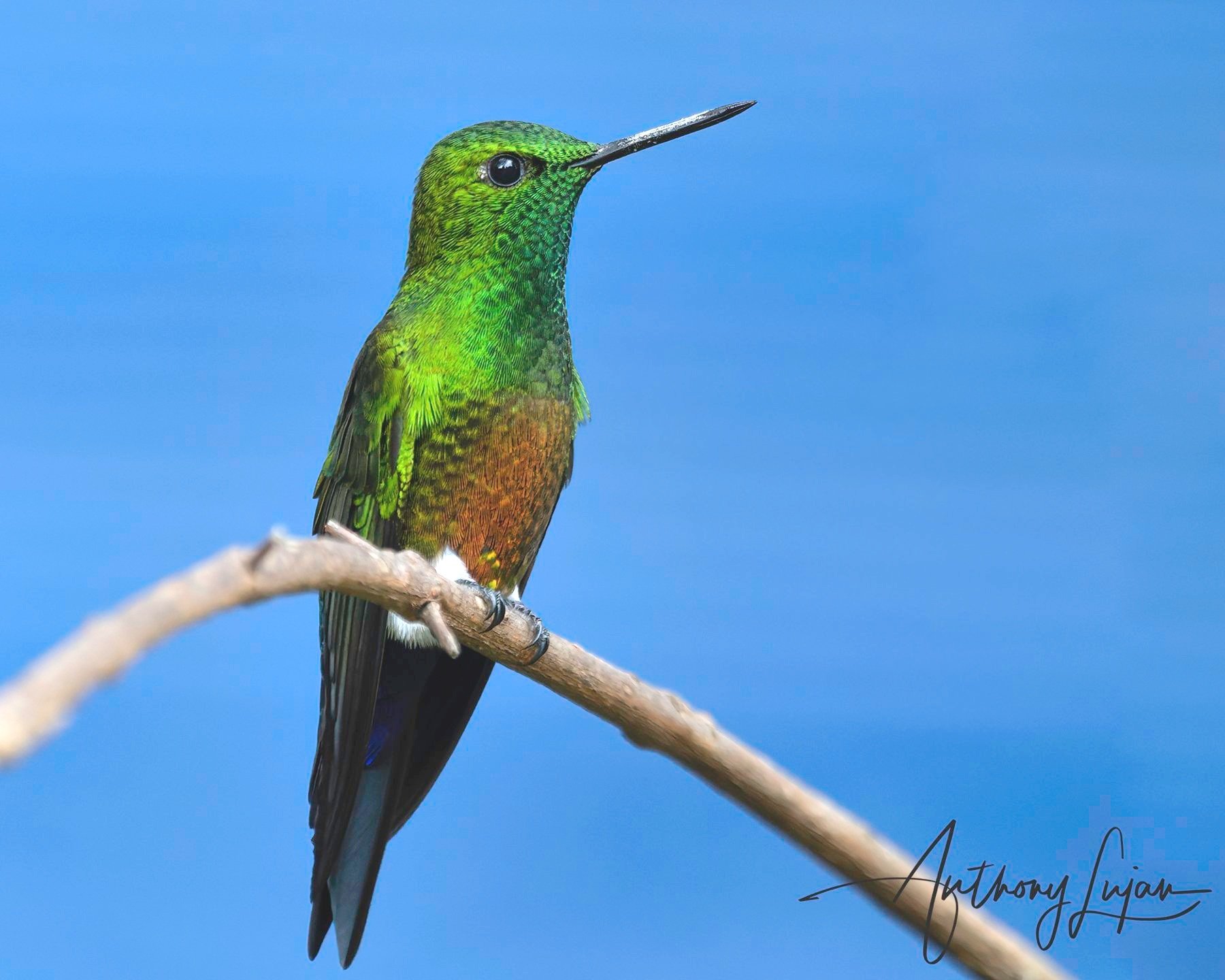
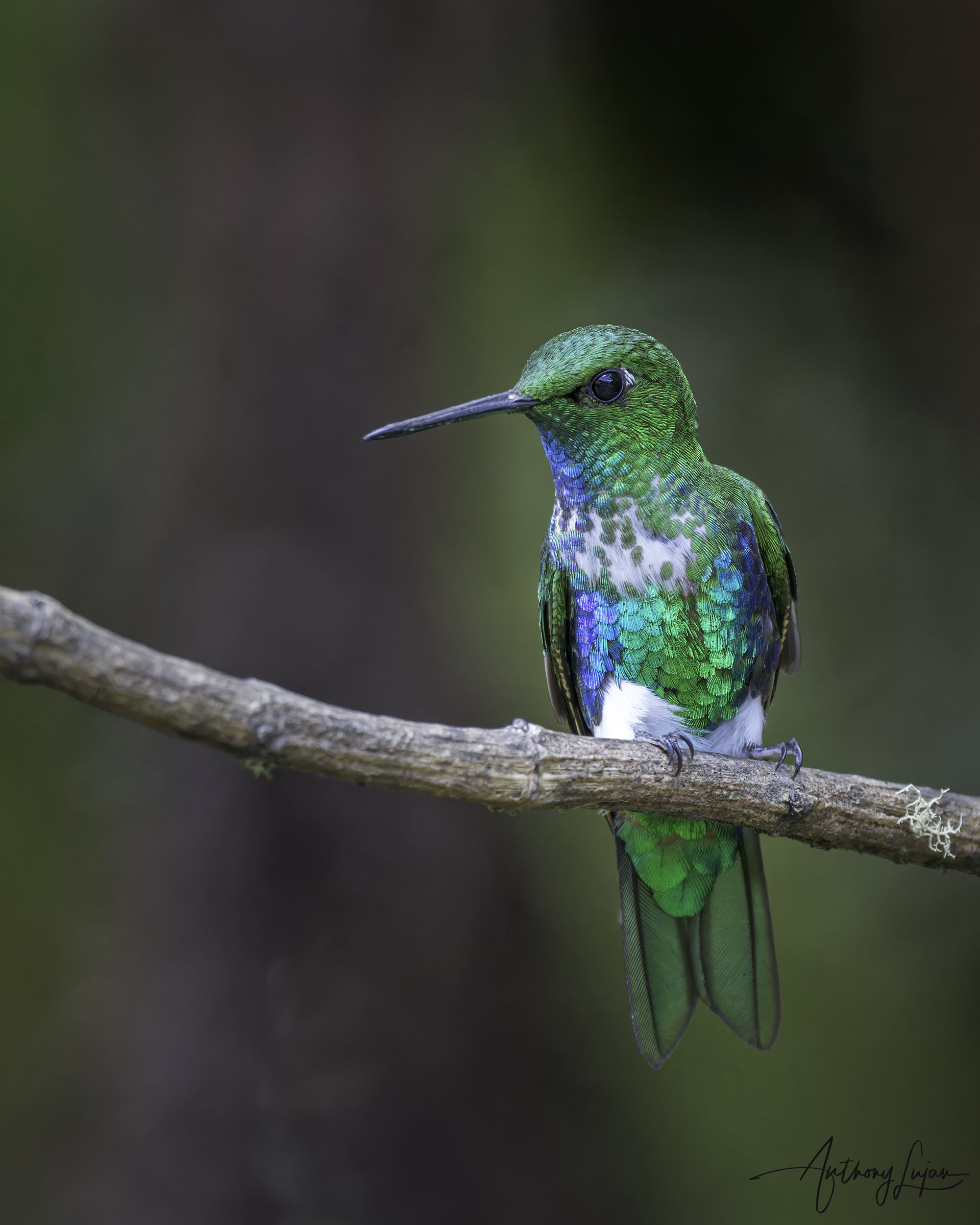
Related species in the Eriocnemis genus (11 species total):



Please note: The content provided in this article reflects Anthony’s personal experience and photographic approach. Results can vary depending on light, weather, location, equipment, subject behavior, and field conditions.