
Scientific name: Thalurania glaucopis
The Violet-capped Woodnymph is a medium-sized, striking hummingbird of Atlantic Forest, forest edges, secondary growth, and urban green spaces in southeastern South America. It is listed as Least Concern, with an unknown number of mature individuals, a decreasing population trend, and it is considered not a migrant (though some short-distance seasonal movements occur).
At a Glance
Family: Trochilidae (hummingbirds)]
Clades: Trochilini – Emeralds
Genus group: Thalurania — woodnymphs (4 species in total: Crowned, Green-crowned, Violet-capped, Fork-tailed)
Range: Eastern and southeastern Brazil (Bahia and Minas Gerais south to Rio Grande do Sul and southern Mato Grosso do Sul), eastern Paraguay, northern Uruguay, and far northeastern Argentina (primarily Misiones).
Habitat: Humid and semi‑humid forest, Atlantic Forest and its fragments, secondary forests, forest edges, scrub, and urban and suburban parks and gardens with flowering trees and shrubs.
Elevation: From sea level up to about 1,200 m (3,900 ft).
Length: About 9.5–11 cm (3.7–4.3 in).
Weight: About 4.0–5.0 g (0.14–0.18 oz).
Number of mature individuals: Unknown.
Population trend: Decreasing.
Status: Least Concern (IUCN Red List category).
Migration: Not a migrant (short-distance local movements).
Name Origin
The genus name Thalurania combines Greek roots suggesting a “sea‑green queen,” evoking the shimmering greens and blues typical of woodnymphs. The species name glaucopis means “blue‑eyed” or “blue‑faced,” referring to the bluish or violet tones on the crown and head. The English name “Violet-capped Woodnymph” highlights the male’s vivid violet crown and its membership in the forest‑dwelling woodnymph group.
Taxonomy & Distribution
Monotypic — no recognized subspecies.
Violet-capped Woodnymph is part of the emerald clade (tribe Trochilini) and one of four species in the genus Thalurania. It is native to southeastern South America, primarily within the Atlantic Forest biome and adjacent regions of Brazil, Paraguay, Uruguay, and Argentina. Within this range, it occupies a broad array of wooded and semi‑open habitats, from interior forest to city parks, and is one of the most frequently encountered hummingbirds in many parts of southeastern Brazil.
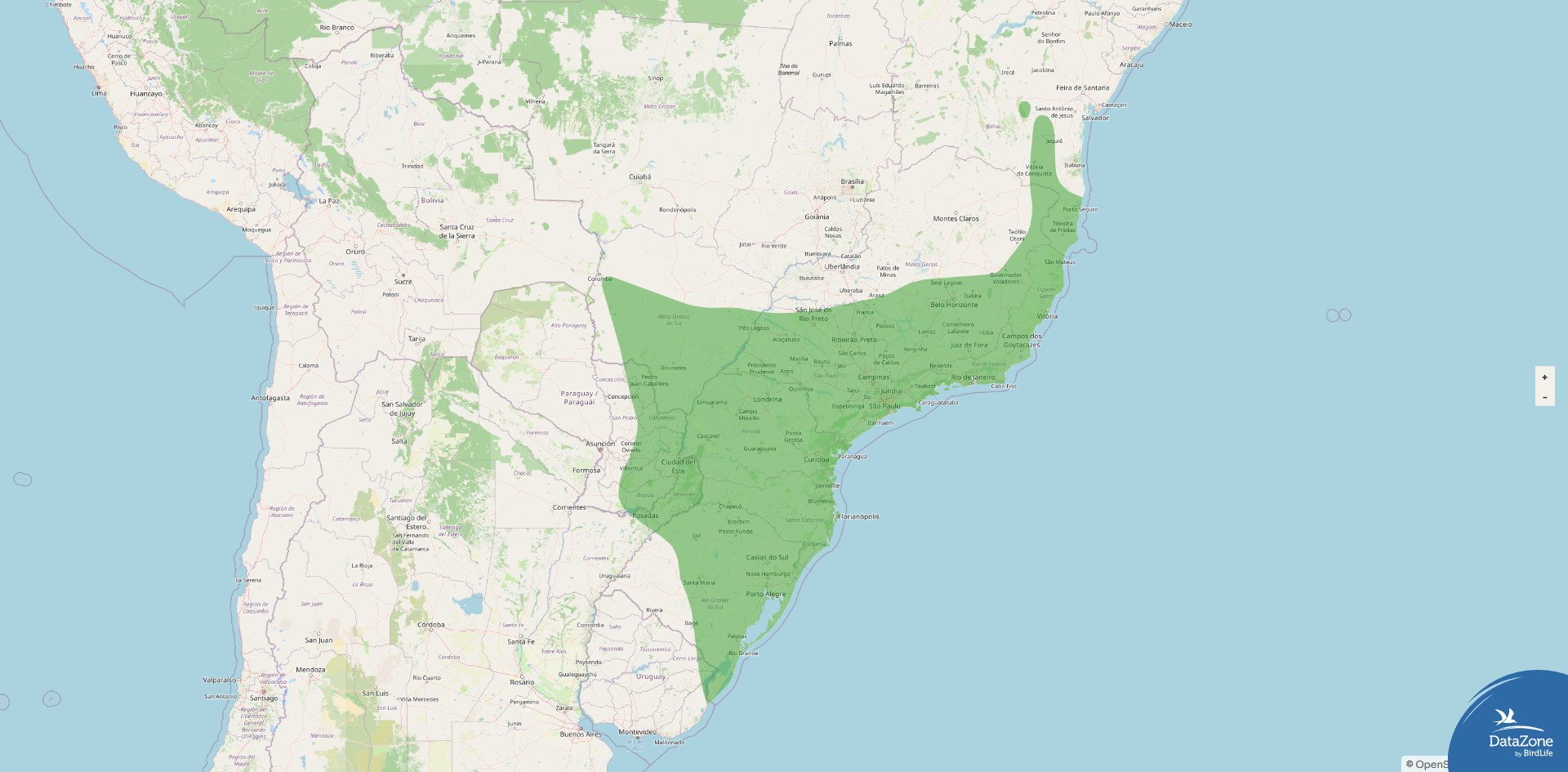
Legend
Green Resident
Species Overview
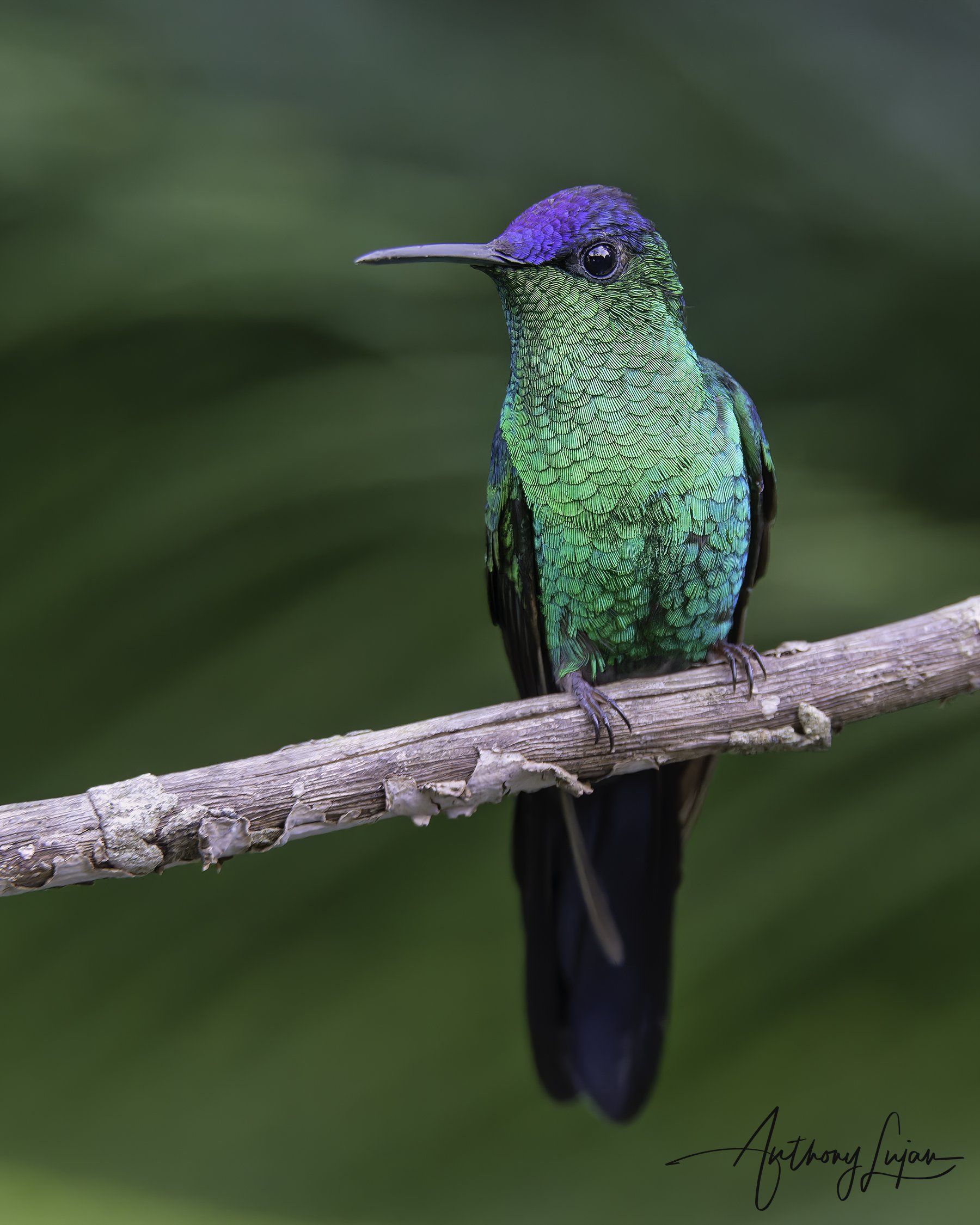
The Violet-capped Woodnymph is a widespread, adaptable hummingbird and a characteristic species of the Atlantic Forest and its urban fringes. Males show a brilliant violet crown and glittering green body, while females are green above and pale below with a contrasting darker cap and white‑tipped tail. The species thrives in both natural and human‑modified environments, often dominating flowering trees and feeders in parks and gardens, though ongoing habitat loss and fragmentation in the Atlantic Forest contribute to a gradual population decline.
Male Description
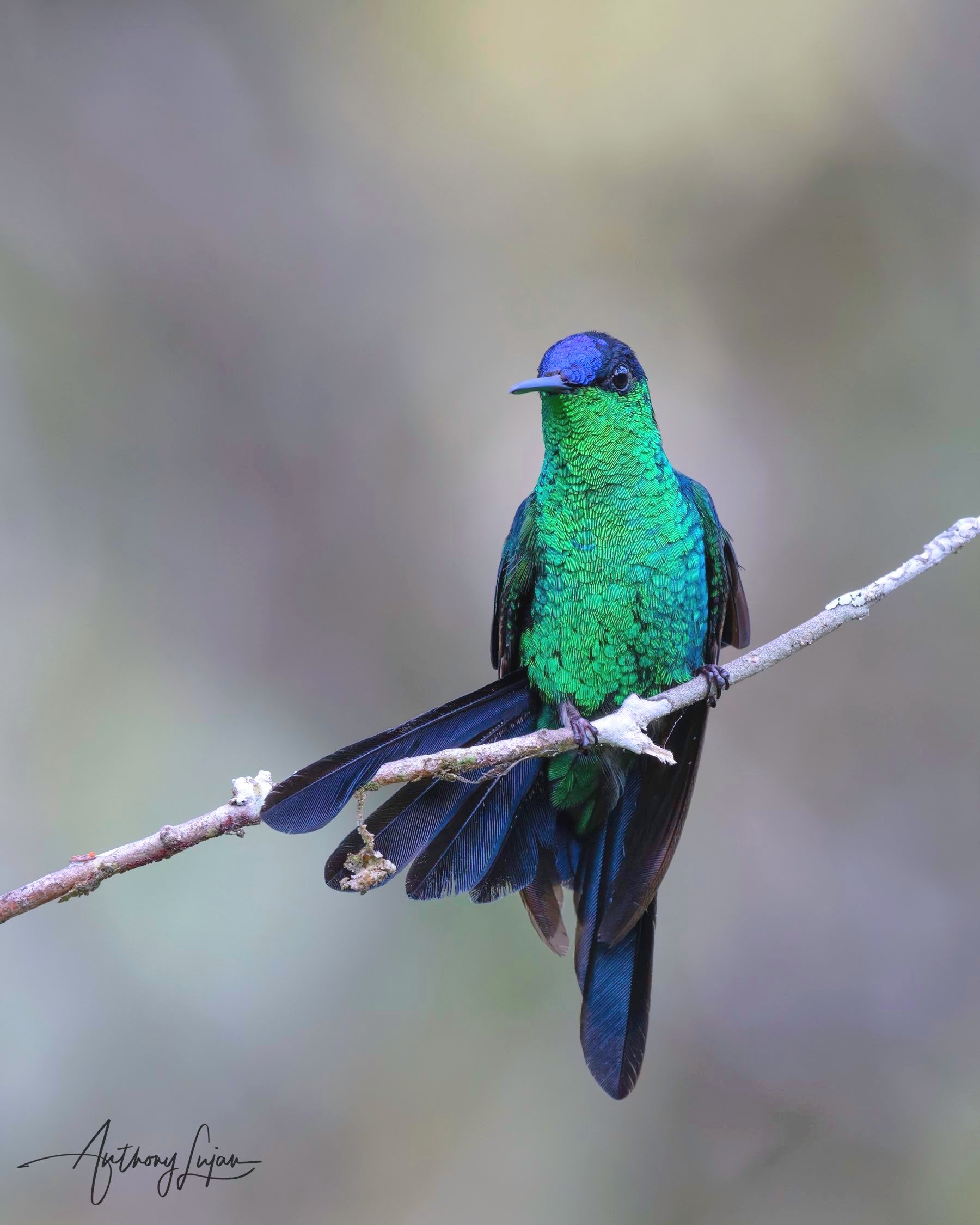
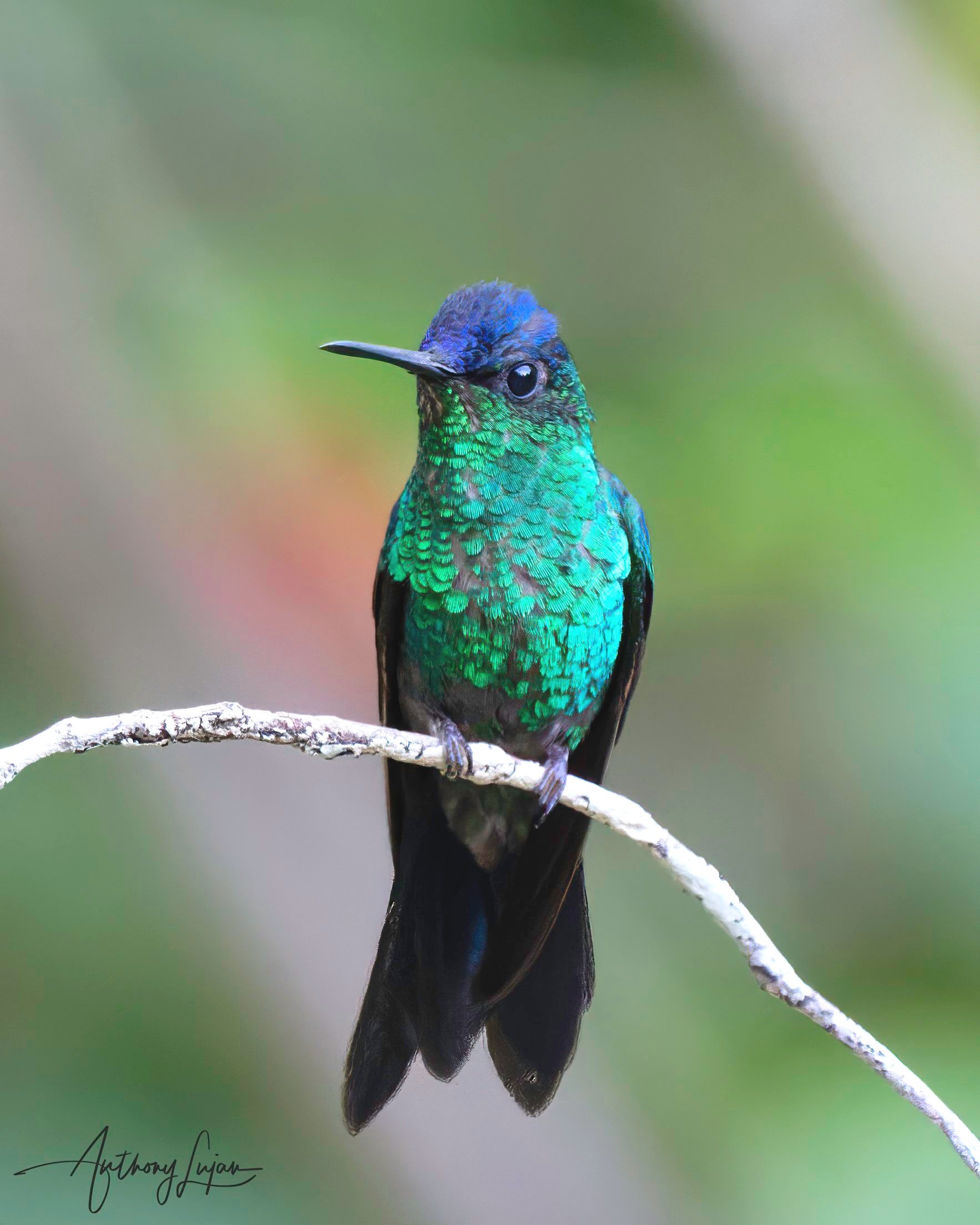
Adult males are medium‑sized with a straight, medium‑length black bill. The crown is a deep, brilliant violet, sharply contrasting with the metallic green back, nape, and upperparts. The throat, breast, and belly are glittering green to bluish‑green, sometimes appearing darker on the lower belly. The wings are dusky, and the tail is slightly forked and deep blue to bluish‑black, often showing a metallic sheen. In good light, males are striking, with a vivid violet cap, bright green body, and dark blue tail.
Female Description
Females are smaller and less intensely colored. The upperparts are metallic green, and the crown is darker but lacks the strong violet of the male. The underparts are dirty white to pale gray, with greenish flanks and sometimes faint green mottling on the throat. The tail is bluish with distinct white tips on the outer feathers and is only slightly notched. The bill is similar to the male’s, straight and black, sometimes with a slightly paler base. Juveniles resemble females but are duller overall, with less contrast between upperparts and underparts and less clearly defined tail patterning; young males gradually develop the violet crown and more saturated green body.
Habitat & Behavior
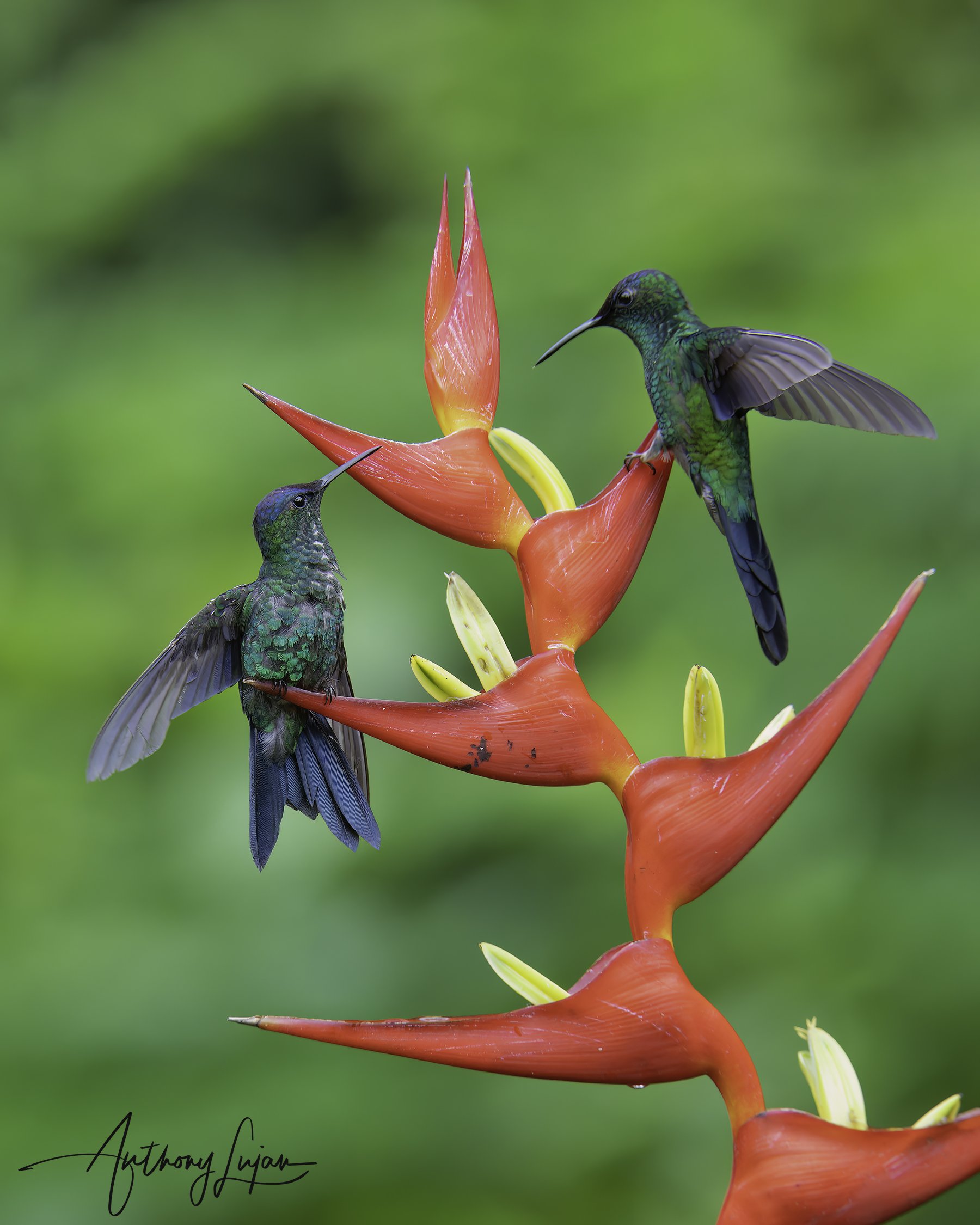
Violet-capped Woodnymphs inhabit forest interiors, forest edges, secondary forests, scrub, and a wide variety of human‑modified habitats, including parks, gardens, and shaded plantations. They forage at all levels, from understory to canopy, but are especially active at mid‑levels and in flowering trees and shrubs along edges and in open woodlands. They feed on nectar from a wide range of flowering plants, shrubs, and trees and regularly visit hummingbird feeders. The species also takes small insects by hawking from perches and gleaning from foliage. Males can be aggressive and territorial, often defending rich flower patches or feeders against other hummingbirds.
Breeding
The breeding season extends mainly from about September to February, varying somewhat with latitude and local climate. The female builds a small bowl nest of soft plant down and fibers, often decorated externally with fern scales and lichens, and typically places it on a horizontal branch or in a fork between about 1.5 and 3 m (5–10 ft) above the ground in forest, secondary growth, or large gardens. She lays two white eggs and alone incubates them for around two weeks; the young fledge about three weeks after hatching. Multiple broods may occur in favorable years and habitats.
Population
The total number of mature individuals is not known, but the Violet-capped Woodnymph is considered widespread and generally common throughout much of its range. It is one of the commonest hummingbirds in southeastern Brazil and occurs in many protected areas. However, continuing loss and fragmentation of Atlantic Forest and adjacent habitats, along with urban expansion and agricultural intensification, are thought to be causing a slowly decreasing population trend.

Conservation
Violet-capped Woodnymph is assessed as Least Concern because of its broad range and overall abundance, and because it adapts well to secondary forests and urban green spaces. Nevertheless, the ongoing destruction and fragmentation of Atlantic Forest remain a concern for the long‑term health of its populations and those of many associated species. Conservation of remaining Atlantic Forest fragments, restoration of forest corridors, protection of riparian woodlands, and creation and maintenance of green spaces with native flowering plants in urban and rural areas all support this species.
Checkout Anthony’s playlist of this species! Click the top right dropdown to see all the videos.
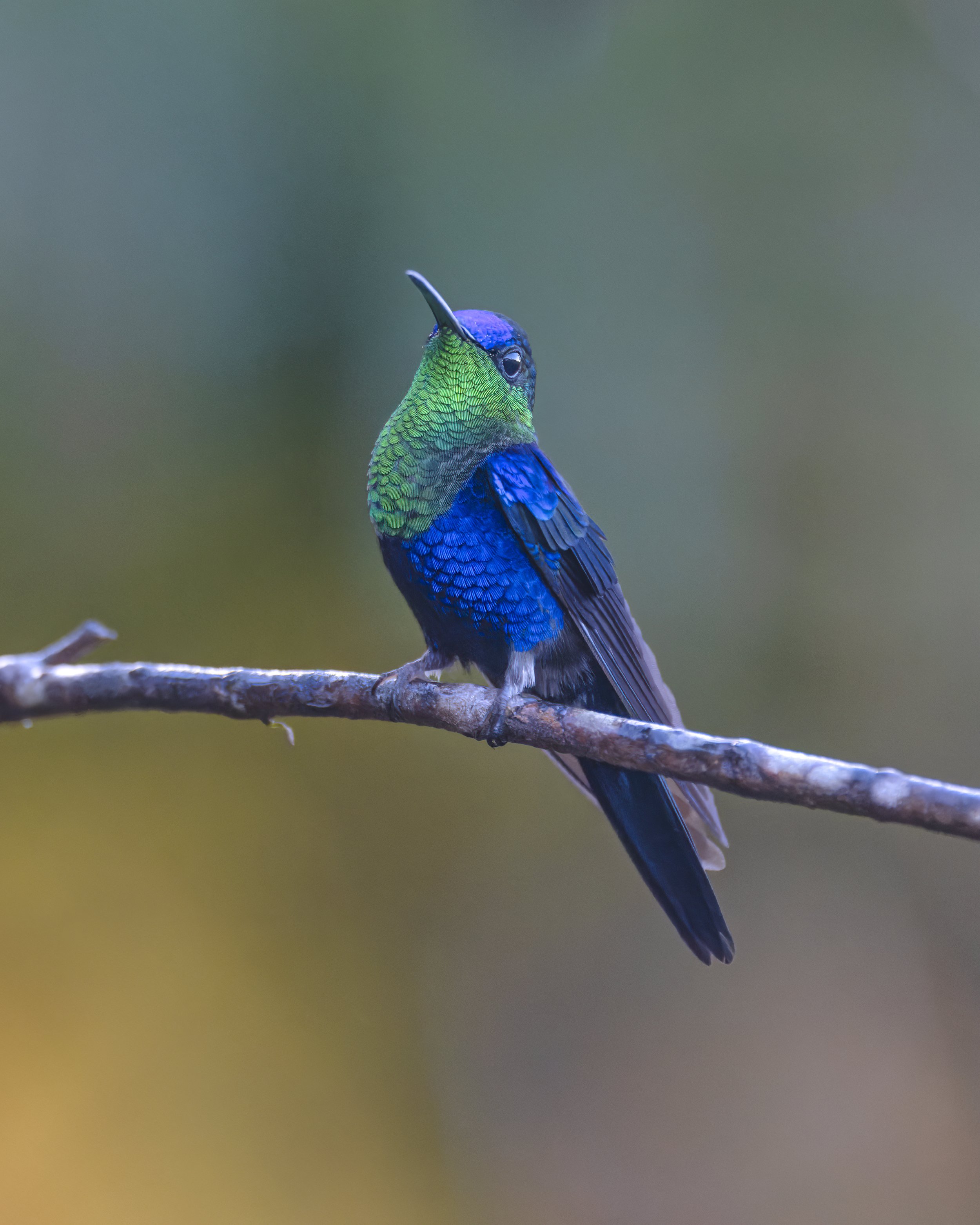
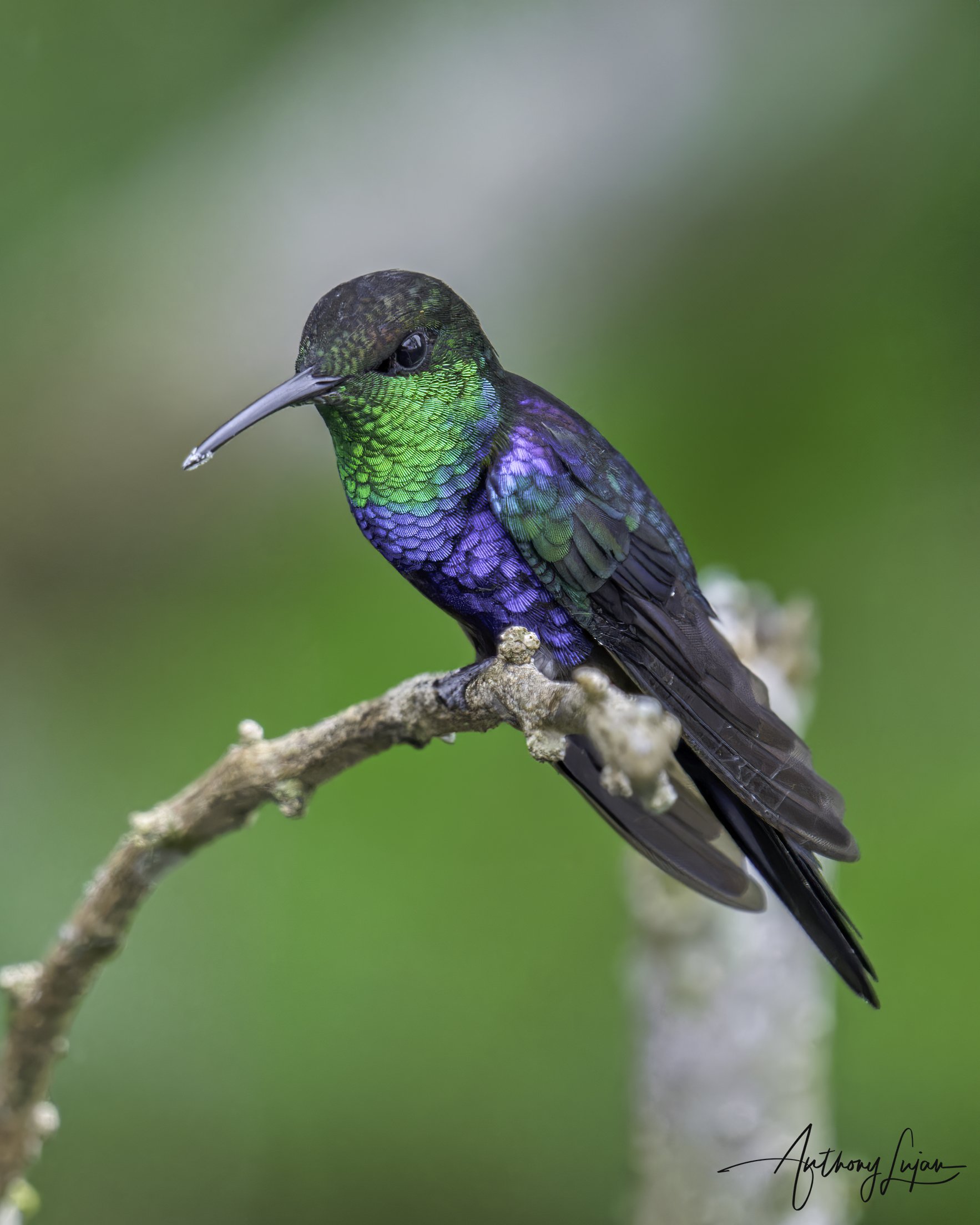
Related species in the Thalurania genus (4 species in total):

Please note: The content provided in this article reflects Anthony’s personal experience and photographic approach. Results can vary depending on light, weather, location, equipment, subject behavior, and field conditions.