
Scientific name: Metallura williami
The Viridian Metaltail is a high-Andean hummingbird found in Colombia and Ecuador. The number of mature individuals is unknown, the population is believed to be decreasing, it is considered non-migratory, and it is currently listed as Least Concern, with four recognized subspecies.
At a Glance
Family: Trochilidae (hummingbirds)
Clade: Lesbiini – “coquettes” of the Andean highlands
Genus group: Metallura — high-elevation “metaltails” of the northern and central Andes
Range: Discontinuous along upper slopes of the Andes in Colombia and northern to southern Ecuador, mostly near and above treeline.
Habitat: Páramo grasslands with scattered shrubs, shrubby edges of humid montane forest, and elfin forest; favors areas with dense, flowering shrubs.
Elevation: Typically around 2,700–3,800 m, locally from about 2,100 m up to roughly 4,000 m.
Length: About 11–12 cm (4.3–4.7 in).
Weight: Approximately 4.1–5.3 g.
Number of mature individuals: Unknown
Population trend: Decreasing
Status: Least Concern (IUCN)
Name Origin
The genus name Metallura refers to the metallic sheen and colorful tails characteristic of metaltails. The species name williami honors a person named William (or Willliam), a common practice in mid-19th century ornithology to commemorate colleagues or patrons. The English name “Viridian Metaltail” emphasizes the bird’s rich green body color and its shimmering metallic tail.
Subspecies & Distribution
Four subspecies:
Metallura williami recisa
Distribution: Western Andes of Colombia (Antioquia to Cauca), inhabiting upper montane forest edges, shrubby elfin forest, and páramo margins.Metallura williami williami
Distribution: Central Andes of Colombia (from Caldas and Tolima south into Huila), mainly on humid slopes near treeline, using shrubby páramo and forest–páramo ecotone.Metallura williami primolina
Distribution: Eastern Andes of Colombia south into northern Ecuador (e.g., Nariño into N Ecuador provinces such as Napo and Pichincha), occurring in elfin forest, shrubby edges, and high-montane scrub.Metallura williami atrigularis
Distribution: Southeastern Ecuador (e.g., Loja, Zamora-Chinchipe and adjacent highlands), often along slightly drier páramo margins and shrubby slopes.
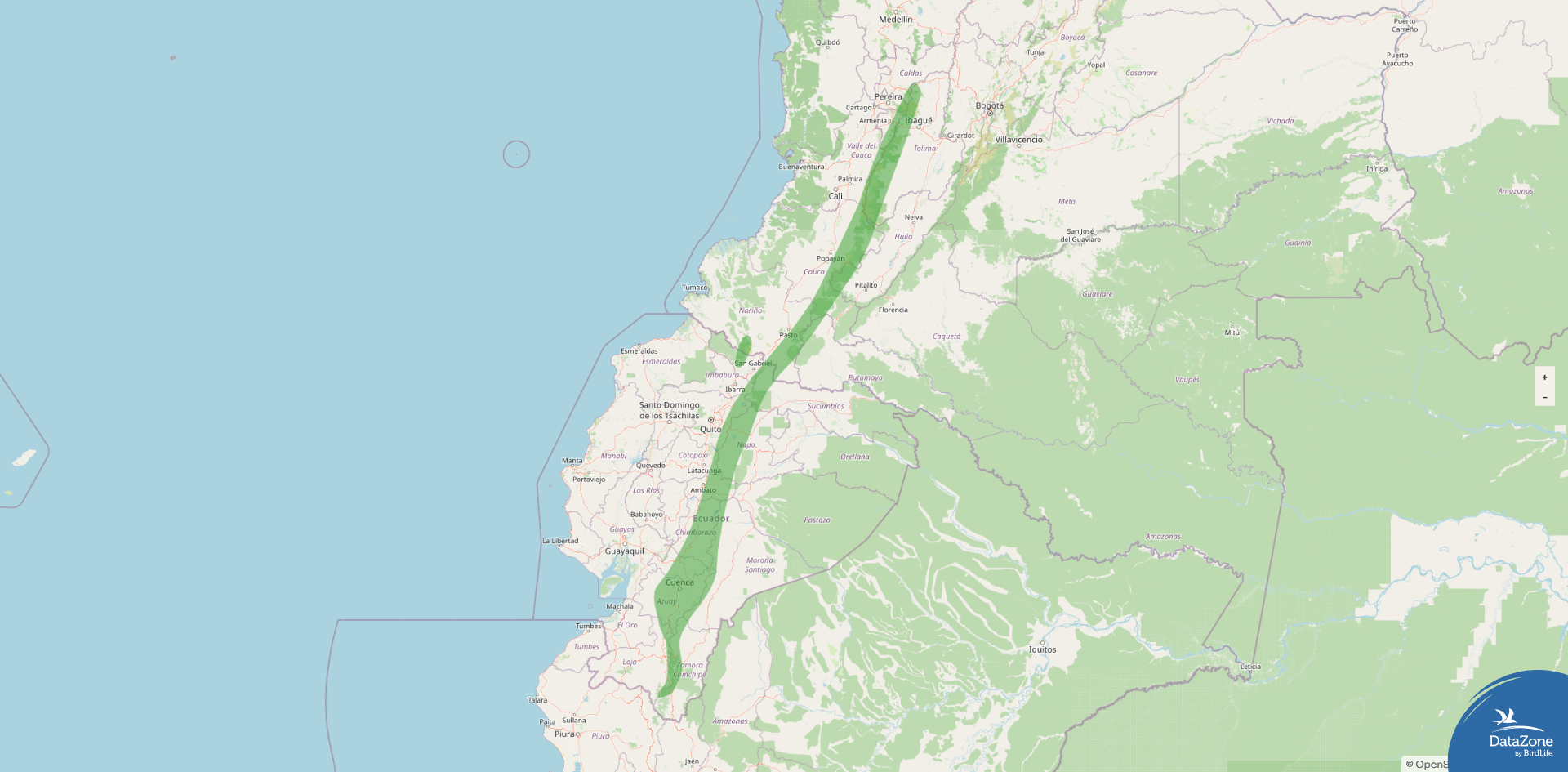
Legend
Green Resident
Species Overview
The Viridian Metaltail is a compact Andean hummingbird adapted to cold, windswept grasslands and shrub-dotted slopes close to treeline. It is typically seen flitting among low shrubs, bushes, and páramo flowers, often perching on exposed twigs to scan its surroundings. Though widespread along the Andes, it occurs patchily in suitable habitat and is believed to be undergoing a slow decline as páramo and high-montane habitats are altered.
Male Description
Adult males have a medium-length, straight black bill. The head, upperparts, and underparts are rich, bottle-green to viridian, often with a velvety appearance on the breast. The gorget is not strongly set off from the rest of the underparts in the nominate, but shines intensely green in good light; in some subspecies (such as atrigularis), a darker or blackish patch in the center of the throat is present. The tail is metallic and relatively long, varying by subspecies: in the nominate it may show bluish or greenish tones; in others it can be reddish-black above with shining green below, and fork depth differs slightly between forms. In the field, males appear as small, mostly green metaltails with a glowing throat and a bright, metallic tail that flashes as they sally from low perches.
Female Description
Adult females resemble males but are generally duller and may show more grayish or buff tones on the underparts. The upperparts are green, while the throat and breast can be lightly mottled or washed with gray or buff, sometimes with faint spotting. The tail is metallic but often slightly less vivid than in males, with pale or buffy edging on the outer feathers more evident in worn plumage. Females lack the more intense throat coloration and sharper contrast of males, appearing as small green hummingbirds with subtler underparts and a bright but somewhat less showy tail.
Habitat & Behavior
Viridian Metaltails inhabit páramo grasslands with scattered shrubs, shrubby edges of humid montane forest, elfin forest borders, and rocky slopes near treeline. They forage at all levels of the low vegetation, visiting flowers of shrubs, herbs, and small trees, especially in plant families such as Ericaceae and Melastomataceae. They hover to take nectar and also capture small insects, either gleaned from foliage or hawked in short flights. The species is considered largely sedentary, present year-round within its Andean range, though males may disperse slightly higher outside the breeding season following flowering peaks.
Population
The total number of mature individuals is unknown, but the Viridian Metaltail has a relatively broad Andean distribution across multiple cordilleras. It is usually described as fairly common to locally common in suitable habitat, yet much of its páramo and high-montane scrub has been burned or converted to pasture. These pressures, coupled with ongoing habitat modification, suggest a decreasing population trend, even though the species is not yet severely fragmented or rapidly declining at a global scale.

Conservation
The Viridian Metaltail is listed as Least Concern because of its extensive range in Colombia and Ecuador, but its reliance on páramo and high-montane scrub makes it vulnerable to land-use change. Burning for cattle pasture, expansion of agriculture, and infrastructure development reduce and fragment its habitats near treeline. Conservation actions that protect páramo mosaics, maintain natural shrub cover, and limit burning will benefit this species, as will the inclusion of high-Andean zones in protected areas and reserves.
Below is the Viridian Metaltail (Metallura williami williami)
Photographed at Hotel Termales del Ruíz, Caldas, Colombia
These individuals belong to the subspecies williami, which occurs along the Central Andes of Colombia, including Caldas, Tolima, and Huila. It inhabits humid upper montane forest and páramo margins at elevations of 3,000–4,000 meters, often near treeline in misty, windswept slopes.


Related species in the Metallura genus (examples from 9 species total):


Please note: The content provided in this article reflects Anthony’s personal experience and photographic approach. Results can vary depending on light, weather, location, equipment, subject behavior, and field conditions.