
Blue-tufted Starthroat
Scientific name: Heliomaster furcifer
The Blue-tufted Starthroat is a large, striking hummingbird of semi-open habitats across southern and central South America. The number of mature individuals is unknown, the population is decreasing, it is considered a full migrant with broad seasonal movements, and it is currently listed as Least Concern and monotypic, with no recognized subspecies.
At a Glance
Family: Trochilidae (hummingbirds)
Clades: Lampornithini – Mountain Gems (starthroats and allies within Trochilinae)
Genus group: Heliomaster — long-billed “starthroats” with bold gorgets and white tail spotting (4 species total)
Range: Eastern Bolivia, southern and central Brazil, Paraguay, northern Argentina, and northern Uruguay, with scattered records north to Colombia and Peru and at least one report from Ecuador.
Habitat: Semi-open landscapes including savannas, cerrado, open and gallery woodlands, forest edges, second growth, grasslands with trees, and sometimes scrubby agricultural areas.
Elevation: Mostly lowlands and foothills, from near sea level up to around 1,500–1,800 m (4,900–5,900 ft), locally higher on interior plateaus.
Length: About 12.6–13 cm (5.0–5.1 in).
Weight: About 5–6.5 g (0.18–0.23 oz).
Number of mature individuals: Unknown
Population trend: Decreasing
Status: Least Concern (IUCN)
Name Origin
The genus name Heliomaster combines Greek roots for “sun” and “master,” referring to the brilliant, sun-catching gorgets and crown patches of starthroats. The species name furcifer means “forked,” likely referencing the forked tail. The English name “Blue-tufted Starthroat” highlights both the bluish, star-like throat patch and its membership in the starthroat group.
Taxonomy & Genus
Heliomaster furcifer is currently treated as a monotypic species with no recognized subspecies. It belongs to Heliomaster, a small genus of four starthroats: Plain-capped Starthroat (H. constantii), Long-billed Starthroat (H. longirostris), Blue-tufted Starthroat (H. furcifer), and one additional Central American/Mexican taxon depending on taxonomic treatment.
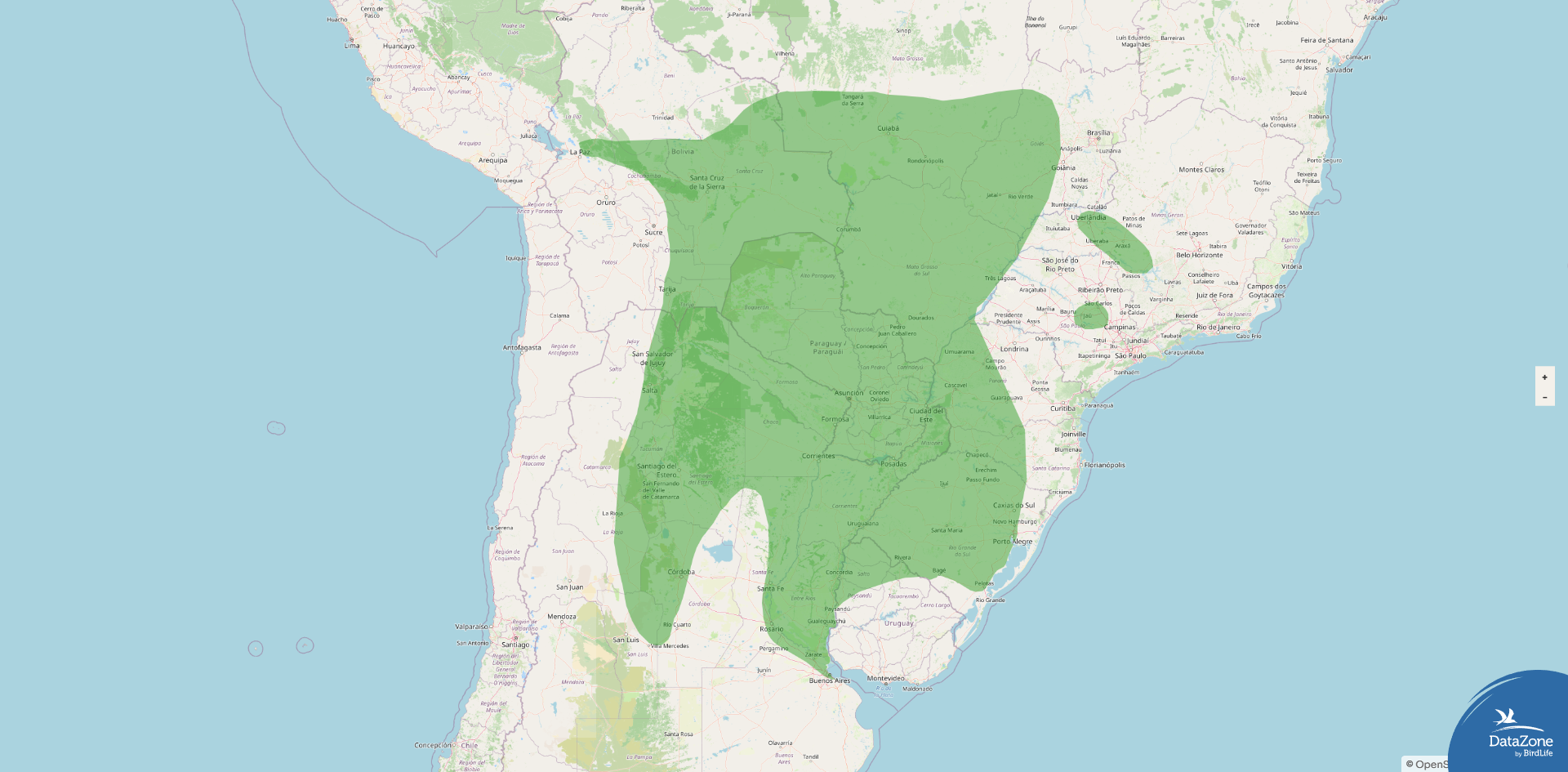
Legend
Green Resident
Species Overview
The Blue-tufted Starthroat is a robust, long-billed hummingbird that favors sunny, semi-open habitats such as savannas, cerrado, and open woodlands, often near forest edges and along gallery forests. It uses its long, slightly decurved bill to reach deep into large, tubular flowers and is an important pollinator for some vines and shrubs. Although still locally fairly common in parts of its range, habitat conversion and changes in savanna and cerrado systems are believed to be driving a slow decline.
Male Description
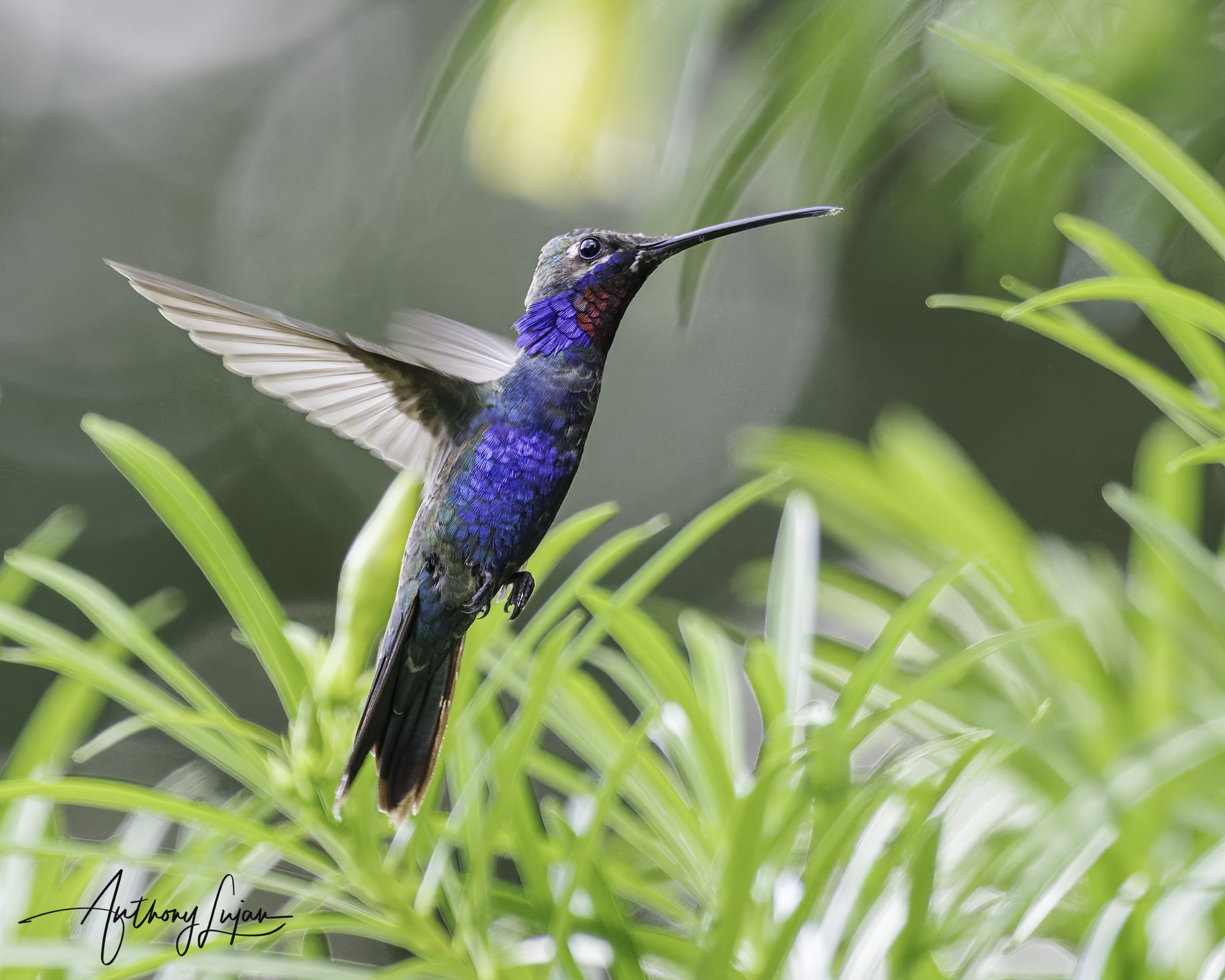
Adult males are large for a hummingbird, with a long, slightly decurved black bill and a small white spot behind the eye. The crown and upperparts are bronzy to dark green. The throat and upper chest bear the characteristic “starthroat” gorget: an iridescent patch that can appear purplish, bluish, or violet depending on the angle of the light, framed by darker plumage. The underparts are mostly gray, with a darker chest band and paler belly; the flanks can show some greenish spotting. The tail is forked and dark green above, shining blue-green below. In the field, males look like big, long-billed hummingbirds whose throats flare into bright blue-violet when they turn toward the sun.
Female Description
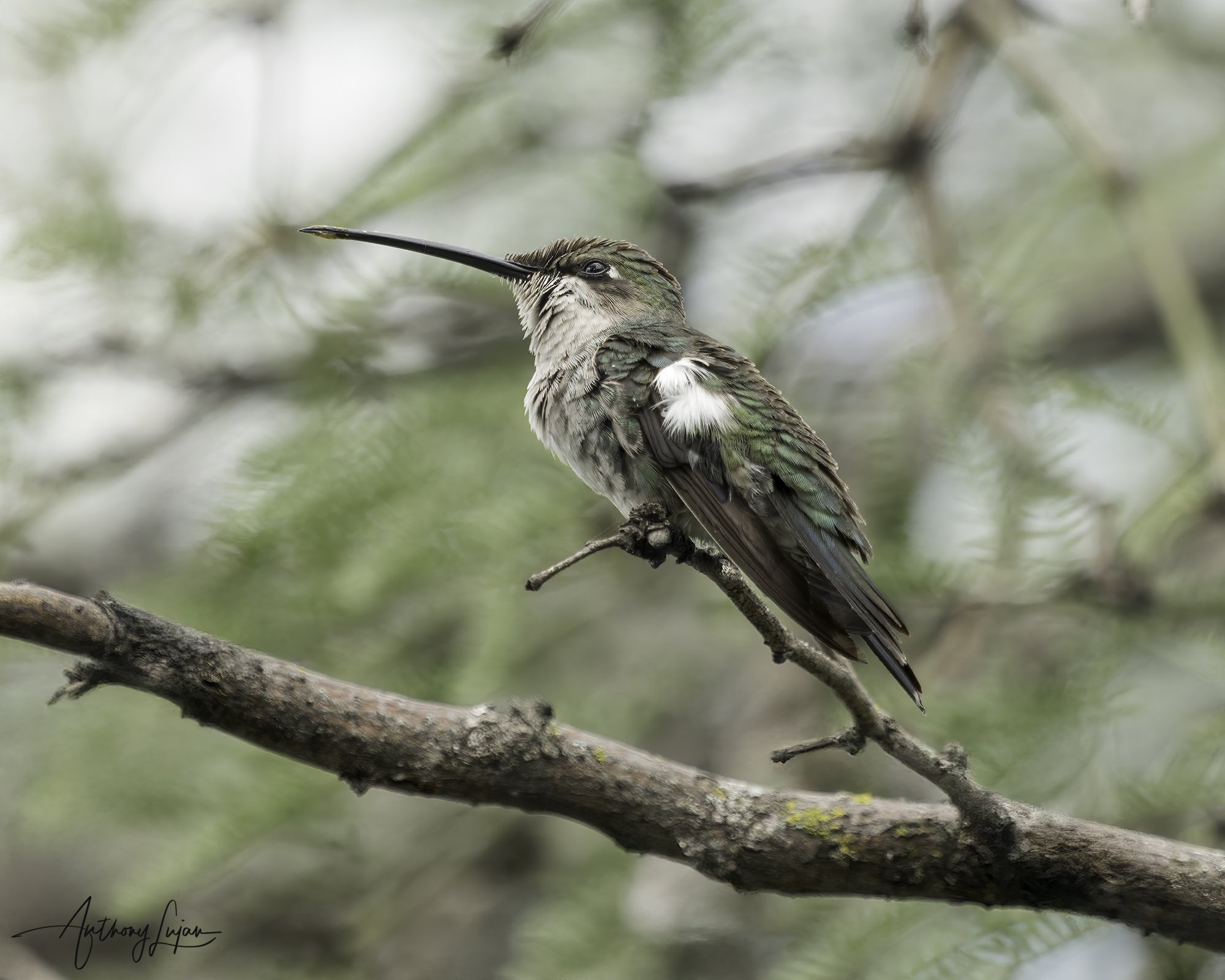
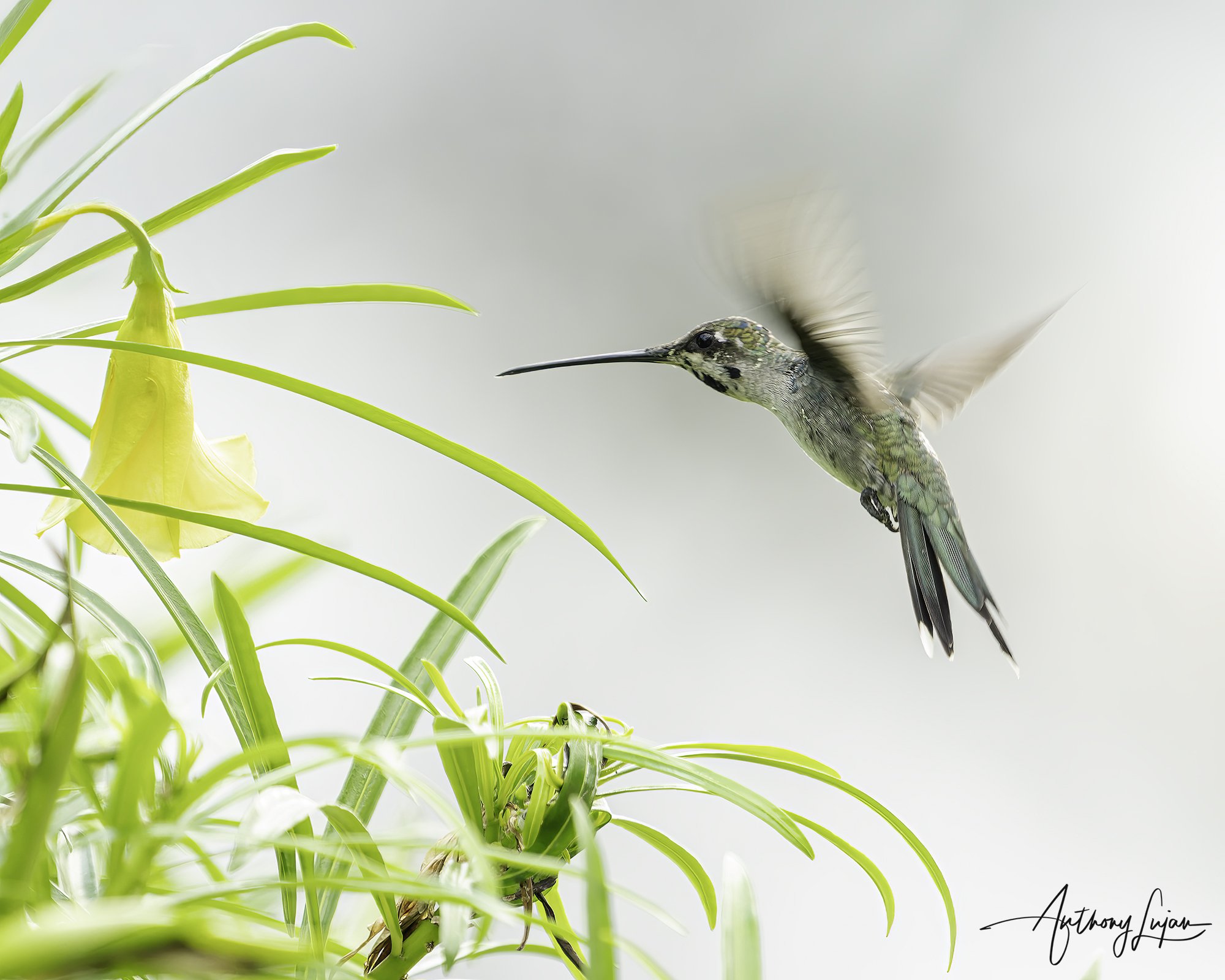
Adult females share the long, decurved black bill and white post-ocular spot. The upperparts are coppery or bronzy green. The throat and underparts are gray with a white midline down the belly and green spotting or mottling along the flanks. The tail is bronze-green above with darker tips on the central feathers, and shining blue-green below with distinct white tips on the outer feathers—these white tips are a key field mark. Non-breeding males resemble females, with duller underparts and a reduced, less colorful gorget.
Habitat & Behavior
Blue-tufted Starthroats primarily occupy semi-open habitats including cerrado, savannas, open woodland, forest edges, second growth, and sometimes shrubby grasslands and agricultural mosaics with trees. They typically forage between about 2 and 8 m above the ground, visiting a wide variety of flowering shrubs, trees, and vines, and are important pollinators of certain deep, tubular flowers. They also take small insects captured by hawking from exposed perches. Males may aggressively defend rich flower patches, chasing away other hummingbirds.
Movement
The species shows at least partial austral migration or broad-scale seasonal dispersal. It is present year-round in some core areas but appears mainly seasonally in others, and occasional records outside the core range likely reflect post-breeding dispersal or nomadic responses to flowering. Treating the species as a full migrant on your site aligns with this pattern of extensive seasonal movements across southern South America.
Breeding
The breeding season runs roughly from November to March in much of its range. The female builds a cup-shaped nest of plant fibers and spiderweb, often camouflaged with lichens, placed several meters above the ground on a horizontal branch or in a fork. She incubates two eggs; the chicks remain in the nest for several weeks before fledging.
Population
The global number of mature individuals is unknown, but the Blue-tufted Starthroat has a broad range across southern and central South America and can be locally fairly common where suitable semi-open habitats remain. Ongoing conversion and intensive management of cerrado, savannas, and open woodlands likely reduce habitat quality and availability, leading to a gentle but ongoing decline even though the species remains widespread.

Conservation
The Blue-tufted Starthroat is listed as Least Concern because of its wide distribution and continued presence in many regions, including some protected areas. However, large-scale agricultural expansion, degradation and loss of cerrado and savanna habitats, and altered fire regimes pose threats to its preferred environments. Protecting cerrado patches, savanna–forest mosaics, and tree-lined gallery forests, and maintaining flowering shrubs and trees within agricultural landscapes, will help conserve this species and other semi-open country hummingbirds.
Related species in the Heliomaster genus (4 species total):


Please note: The content provided in this article reflects Anthony’s personal experience and photographic approach. Results can vary depending on light, weather, location, equipment, subject behavior, and field conditions.