
Garnet-throated Hummingbird

Scientific name: Lamprolaima rhami
The Garnet-throated Hummingbird is a striking highland hummingbird of humid montane and cloud forests from southern Mexico to western Honduras. It is listed as Least Concern, with an estimated 20,000–49,999 mature individuals, a stable population trend, and it is considered an altitudinal migrant.
At a Glance
Family: Trochilidae (hummingbirds)
Clades: Lampornithini – Mountain Gems
Genus group: Lamprolaima — garnet-throated hummingbird (1 species in total)
Range: Highlands of southern Mexico (Guerrero, Puebla, Veracruz, Oaxaca, Chiapas) through Guatemala and El Salvador to western Honduras.
Habitat: Interior and edges of humid montane forest, cloud forest, and pine–oak forest, as well as forested ravines, ridges, and tall second growth.
Elevation: Mostly 1,200–3,000 m (3,900–9,800 ft), most numerous between about 1,500 and 2,300 m; in Honduras generally above 1,600 m.
Length: About 12–12.5 cm (4.7–4.9 in).
Weight: About 5.6–7.5 g (0.20–0.26 oz).
Number of mature individuals: 20,000–49,999.
Population trend: Stable.
Status: Least Concern (IUCN Red List category).
Migration: Altitudinal migrant.
Name Origin
The genus name Lamprolaima derives from Greek lampros (“bright” or “shining”) and laimos (“throat”), referring to the species’ dazzling iridescent gorget. The species name rhami honors Dr. Rham, a 19th‑century naturalist associated with early collections from Mexico. The English name “Garnet-throated Hummingbird” describes the male’s fiery garnet-red throat that flashes like a gemstone when struck by light.
Taxonomy & Distribution
Monotypic species — no recognized subspecies.
Garnet-throated Hummingbird is a member of the mountain gem tribe Lampornithini and is the only species in the genus Lamprolaima. It is found discontinuously along highland regions from southern Mexico (notably in the Sierra Madre Oriental and Sierra Madre de Chiapas) through Guatemala and El Salvador to western Honduras. Within this range it occupies humid montane and cloud forests, pine–oak forests, and associated forest edges and ravines at mid to high elevations.
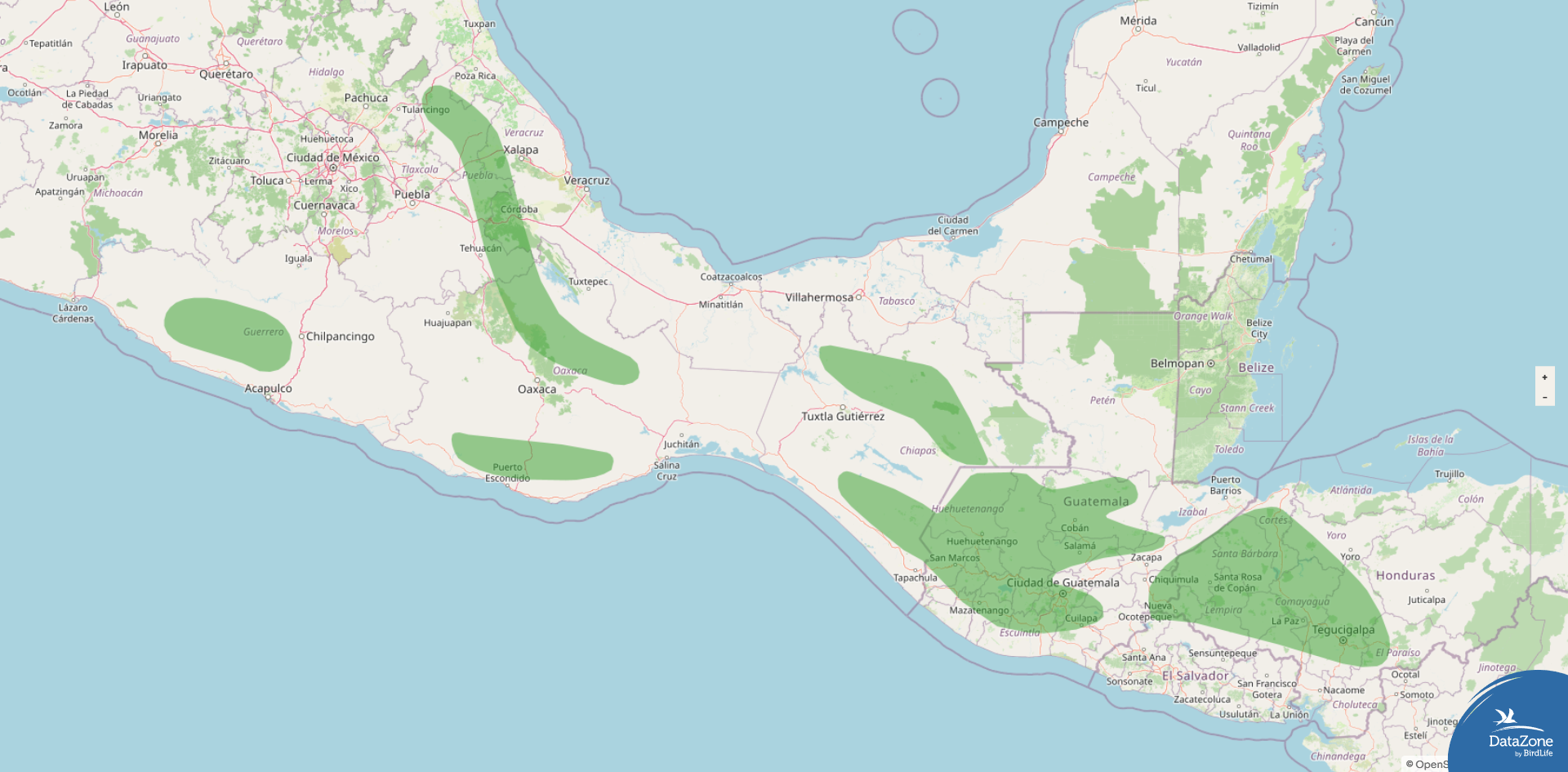
Legend
Green Resident
Species Overview
The Garnet-throated Hummingbird is among the most resplendent Central American highland hummingbirds, displaying a rich garnet-red throat and glowing violet‑blue breast set against dark underparts and green upperparts. Typically solitary and territorial, it frequents the mid‑canopy and edges of cool, humid forests, where it feeds at flowering trees and shrubs. Its deliberate flight, relatively large size, and tendency to perch prominently between feeding bouts make it stand out from smaller, faster emerald-type hummingbirds.
Male Description
Adult males have metallic green upperparts, including crown, nape, back, and rump, with bronzy tones in some lights. Much of the face is black with a small white spot behind the eye. The gorget (throat) is a shining rosy pink to deep garnet red, often appearing fiery copper or blood red depending on the angle of light. The upper breast is iridescent violet‑blue, blending into blackish underparts with mottled green flanks. The wings are rufous with dark brown tips to the feathers, giving a warm tone in flight. The tail is dark purple with gray tips on the outer feathers. In good light the male’s combination of emerald back, garnet throat, violet‑blue breast, and dark purple tail is spectacular.
Female Description
Females are somewhat smaller and duller than males. The upperparts are metallic green similar to the male, but the throat is less intensely colored, often with a more diffuse reddish or pinkish area or a greenish‑spangled or grayish throat instead of a solid garnet patch. The underparts are darker grayish to blackish with green mottling on the flanks but generally less saturated than in males. The wings and tail are similar, with rufous in the wings and a dark tail with paler tips, though the overall contrast is reduced. Juveniles resemble females but are duller and browner overall, with less iridescence and more mottled, less sharply defined colors; young males gradually acquire the full garnet throat and deeper violet‑blue breast as they mature.
Habitat & Behavior
Garnet-throated Hummingbirds inhabit humid montane forest, cloud forest, and pine–oak woodlands, especially along ridges, ravines, and mossy forest edges. They often forage in the mid‑story and canopy, visiting flowers of shrubs and trees such as Fuchsia, Inga, Erythrina, and other nectar‑rich genera. They feed by both hovering and perching, sometimes defending a rich patch of flowers with short aerial chases and aggressive posturing. Males frequently display from exposed branches, flaring their gorget to show off its iridescence in sunlight. They also consume small insects and spiders, hawking them from perches or gleaning near flowers to obtain protein.
Breeding
Breeding timing varies with slope and region: on the Atlantic slope breeding peaks roughly in April and May, while on the Pacific slope it occurs mainly between about December and March. The female builds a bulky cup nest of moss, leaf parts, and pine needles, lined with softer plant fibers, often attached to exposed roots on earth banks such as stream or road cuts or to mossy branches. The nest is typically placed a short distance above the ground or above a bank’s surface, in cool, humid forest conditions. She lays two white eggs and alone incubates and raises the chicks; the exact incubation and fledging periods are not well documented but are likely within the typical hummingbird range of roughly two to three weeks each.
Movement
Garnet-throated Hummingbirds are altitudinal migrants. They tend to move to higher elevations during the breeding season, making use of upper montane and cloud forests when conditions and flower availability are optimal, and then shift downslope to somewhat lower elevations outside the breeding period. These movements follow seasonal changes in flower abundance and local climate, keeping the species within montane zones but redistributing birds along the elevational gradient through the year.
Population
With an estimated 20,000–49,999 mature individuals and a patchy distribution across highlands in four countries, Garnet-throated Hummingbird has a relatively small global population for a hummingbird. Within suitable high-elevation cloud forests and pine–oak woodlands it can be locally fairly common, particularly in protected or remote areas. The population is considered stable, with no strong evidence of rapid decline, although local habitat loss and fragmentation likely affect some subpopulations.

Conservation
Garnet-throated Hummingbird is assessed as Least Concern, but its reliance on high-elevation cloud and montane forests means it is sensitive to deforestation, forest degradation, and potential climate-driven shifts in montane vegetation zones. Logging, agricultural expansion, and human settlement in montane regions can degrade or fragment its habitat. The species benefits from several protected areas, such as El Triunfo Biosphere Reserve in Mexico and Montaña de Celaque National Park in Honduras. Long‑term conservation requires maintaining extensive tracts of highland forest, preserving elevational corridors between breeding and non‑breeding zones, and managing montane landscapes in ways that retain forest structure and flowering resources.


View all the videos by clicking the three lines in the top right corner for the playlist.
No related species in the Lamprolaima genus (1 species in total):
Please note: The content provided in this article reflects Anthony’s personal experience and photographic approach. Results can vary depending on light, weather, location, equipment, subject behavior, and field conditions.