
Giant Hummingbird
Scientific name: Patagona gigas
The Giant Hummingbird is the largest living hummingbird, a long‑winged Andean species of arid scrub, montane valleys, and high‑elevation shrublands from Ecuador to Argentina and Chile. It is listed as Least Concern, with an unknown number of mature individuals, a stable population trend, and it is considered a full migrant, with some populations making very long elevational and latitudinal movements along the Andes.
At a Glance
Family: Trochilidae (hummingbirds)
Clades: Patagonini – Giant Hummingbirds
Genus group: Patagona — giant hummingbird (1 species traditionally treated here)
Range: Along the Andes from southern Ecuador and Peru south through Bolivia and Chile to northwestern Argentina (south to Mendoza), from near sea level in some coastal zones up to high Andean valleys and slopes.
Habitat: Arid and semi‑arid scrub, open montane and inter‑Andean valleys, dry Polylepis and other high‑elevation woodlands, rocky slopes, agricultural areas with hedgerows, and shrubby habitats along canyons and ravines.
Elevation: Common from roughly 2,000 to over 3,500 m in many areas, but can range from near sea level in parts of Chile up to more than 4,000 m in the high Andes.
Length: About 21–23 cm (8.3–9.1 in).
Weight: Roughly 18–24 g (0.63–0.85 oz), making it several times heavier than most hummingbirds.
Number of mature individuals: Unknown.
Population trend: Stable.
Status: Least Concern (IUCN Red List category).
Migration: Full migrant (southern populations strongly migratory, northern populations more resident).
Name Origin
The genus name Patagona refers to Patagonia and the southern portion of the bird’s range in South America, reflecting its occurrence in southern Andean and Patagonian regions. The species name gigas means “giant,” directly referencing its very large size compared with other hummingbirds. The English name “Giant Hummingbird” highlights both its exceptional size and its placement within the otherwise tiny hummingbird family.
Taxonomy & Distribution
Patagona gigas
Giant Hummingbird is placed in its own tribe (Patagonini) within the hummingbird family and has long been considered the only species in the genus Patagona in this traditional treatment. It occurs along the Andes from southern Ecuador and Peru through Bolivia and Chile to northwestern Argentina, following arid and semi‑arid slopes and valleys and, in places, reaching down to the Pacific coast of Chile. Within this broad linear range, two subspecies are commonly recognized, which differ mainly in geography and elevational distribution.
Subspecies and Distribution
Giant Hummingbird has two recognized subspecies in this framework.
Patagona gigas peruviana
Distribution: Andes of Ecuador, Peru, and extreme northern Chile, generally at higher elevations, mostly above about 2,000 m. Birds of this subspecies are characteristic of arid and semi‑arid inter‑Andean valleys, high‑elevation shrublands, and dry montane slopes, often associated with columnar cacti, Puya bromeliads, and scattered shrubs along steep Andean ravines.Patagona gigas gigas
Distribution: Andes of Bolivia, northern to central Chile, and northwestern Argentina (south to Mendoza). This subspecies ranges from coastal and low foothill zones in parts of Chile up into high Andean valleys and slopes, occupying arid scrub, rocky hillsides, river canyons, and open agricultural areas with hedges and scattered shrubs. Southern populations in Chile and Argentina are particularly migratory, moving long distances along and across elevational gradients.
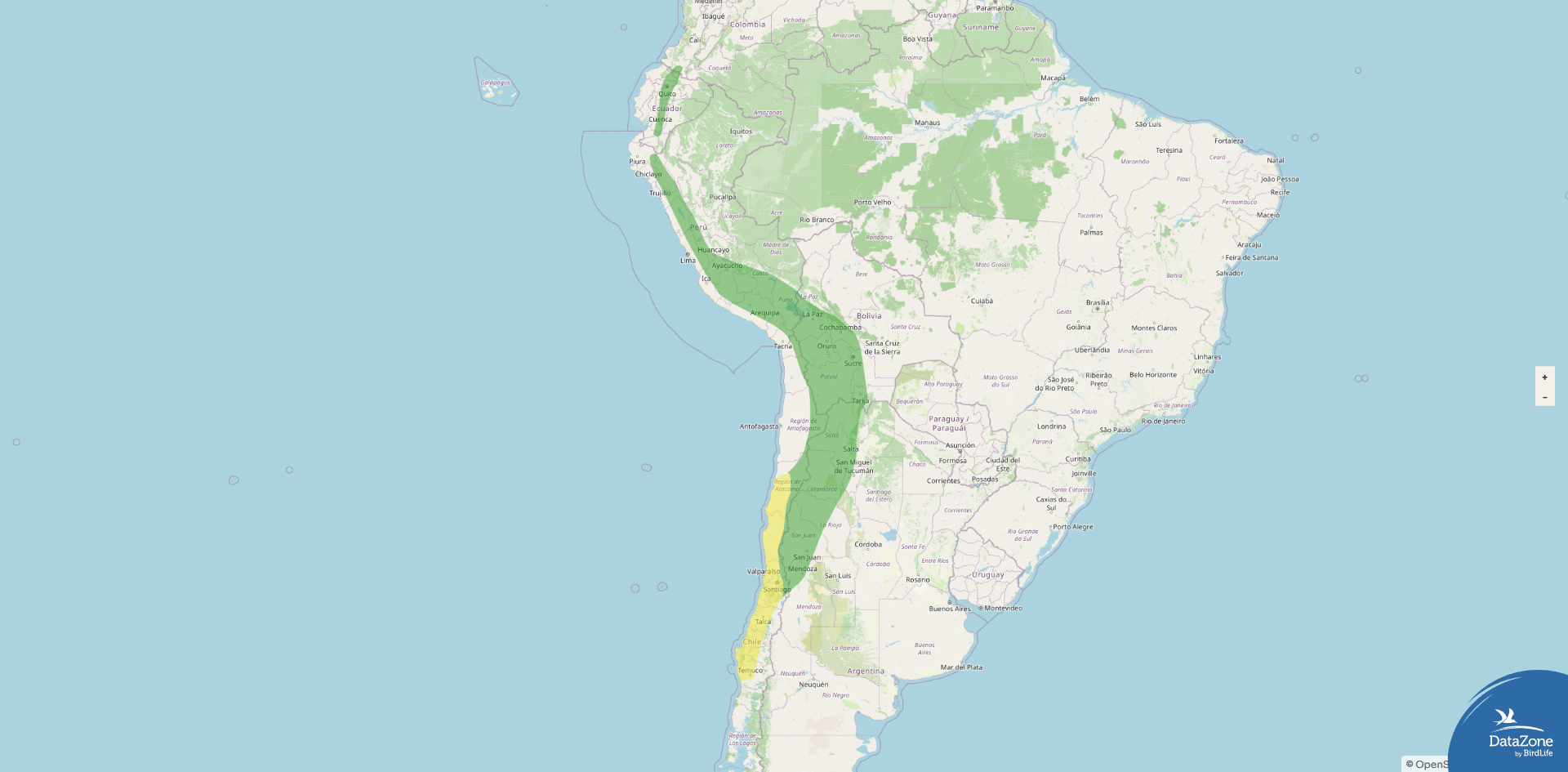
Legend
Green Resident
Yellow Breeding
Species Overview
The Giant Hummingbird is remarkable not only for its size, comparable in length to a small swallow, but also for its relatively slow, powerful wingbeats and long, narrow wings and tail. Unlike many sparkling, jewel‑toned hummingbirds, it is mostly brownish and rufous, blending well with rocky Andean landscapes. It feeds at large tubular flowers of shrubs, cacti, and bromeliads and can often be seen steadily hovering at blooms or making direct, purposeful flights between foraging areas far above Andean valleys and slopes.
Adult Description
Sexes are similar in plumage. The head and upperparts are brownish‑olive to dull bronzy, sometimes with a faint greenish sheen. The underparts are buffy to cinnamon, often somewhat paler on the belly and darker on the breast, with subtle mottling or scaling in some individuals. The throat lacks a distinct iridescent gorget, appearing plain buffy or grayish. The tail is long and slightly forked, with reddish‑brown or rufous tones and paler tips to the outer feathers. The bill is straight, long, and dark, well suited for probing deep tubular flowers. In flight, the very long wings and relatively slow wingbeats distinguish it from smaller, rapidly fluttering hummingbirds. Juveniles resemble adults but can be slightly duller, with more mottled or scaled underparts.
Habitat & Behavior
Giant Hummingbirds inhabit open, often arid or semi‑arid Andean landscapes: scrubby slopes, rocky ravines, high‑elevation shrublands, and inter‑Andean valleys with scattered shrubs, trees, cacti, and bromeliads. They frequently feed at large tubular flowers such as those of agaves, Puya, and columnar cacti, hovering steadily while probing for nectar. They also consume small insects for protein, catching them in flight or gleaning near flowers. Their flight is powerful and more reminiscent of a small swift or swallow than a typical hummingbird, with deliberate, direct movements across ravines and along slopes. Although they may defend rich nectar sources, their territories can be large, and they often travel considerable distances between foraging patches.
Breeding
Breeding occurs in appropriate seasons in Andean regions, timed with local flower peaks and climate, and varies with latitude and elevation. The female builds a relatively large cup or deep cup nest compared with other hummingbirds, constructed of plant fibers, down, and spiderweb and often placed on a ledge, cliff face, bank, or sheltered branch on steep slopes or in ravines. She lays two white eggs and alone incubates and raises the chicks, as is typical for hummingbirds. Nest placement often takes advantage of rock faces, banks, or overhangs that provide protection from wind and weather in exposed Andean environments.
Movement
Giant Hummingbirds are full migrants in much of their southern range. Birds breeding in central Chile and adjacent Argentina move northward and upslope after breeding, making long‑distance migrations along the Andes into higher Andean zones of Peru and adjacent countries for the nonbreeding season. These movements can span thousands of kilometers and involve large elevational shifts, as birds travel from near sea level coastal areas and low foothills up to high Andean valleys at 3,500–4,000 m or more. In contrast, many populations in northern parts of the range (e.g., in Peru and Ecuador) are more resident or only locally dispersive, remaining in the Andean highlands year‑round.
Population
The total number of mature individuals is unknown, but the Giant Hummingbird has a broad though linear distribution along the Andes and is locally fairly common in suitable habitats. Its adaptability to a range of arid and semi‑arid Andean environments, including some lightly modified agricultural landscapes, supports a stable population trend overall. While local pressures such as habitat conversion, intensive agriculture, and urban expansion can affect some sites, there is no current evidence of rapid or widespread declines across its range.

Conservation
Giant Hummingbird is assessed as Least Concern, reflecting its wide Andean distribution and overall population stability. Nevertheless, its dependence on Andean shrublands, cacti and bromeliad communities, and montane scrub makes it vulnerable to large‑scale habitat changes such as overgrazing, land clearing, mining, and infrastructure development. Conservation of Andean shrublands, protection of key flowering plant communities, and maintenance of elevational corridors used during migration are important for sustaining this species. Climate change, which may alter the distribution and flowering phenology of Andean plants, is a growing concern for long‑distance elevational migrants like the Giant Hummingbird.
Below is the Giant Hummingbird (Patagona gigas gigas)
Photographed at Viña del Mar National Botanical Garden, Valparaíso, and Parque Nacional Lauca, Putre, Arica y Parinacota, Chile
These individuals belong to the subspecies gigas, which occurs throughout the central and southern Andes from southern Peru through Chile and Argentina. It is the largest living hummingbird species, inhabiting open montane scrub, high Andean valleys, and arid slopes between 2,000 and 4,500 meters.


Checkout Anthony’s playlist of this species! Click the top right dropdown to see all the videos.
No related species in the Patagona genus (treated here as 1 traditional species):
Please note: The content provided in this article reflects Anthony’s personal experience and photographic approach. Results can vary depending on light, weather, location, equipment, subject behavior, and field conditions.