
Scientific name: Sephanoides sephaniodes
The Green-backed Firecrown is a widespread South American hummingbird found from central to southern Chile and adjacent Argentina, with an additional population on the Juan Fernández Islands. The number of mature individuals is unknown, but the population is believed to be decreasing overall; it is currently assessed as Least Concern, monotypic, and a full migrant on the mainland, with island birds largely sedentary.
At a Glance
Family: Trochilidae (hummingbirds)
Clade: Lesbiini – Coquettes
Genus group: Sephanoides — 2 species, 2 subspecies
Range: Mainland Chile from south of the Atacama Region south to Tierra del Fuego, in adjacent southern and central Argentina east to the Atlantic coast, and on Robinson Crusoe and Alejandro Selkirk Islands in the Juan Fernández archipelago.
Elevation: From sea level up to above 2,000 m, breeding especially in higher-elevation forests and woodlands and wintering more commonly in lowlands and central valleys.
Length: About 10–11 cm (3.9–4.3 in).
Weight: Males about 5.5 g; females about 5–6.8 g.
Number of mature individuals: Unknown
Population trend: Decreasing
Status: Least Concern (IUCN)
Name Origin
The genus name Sephanoides derives from Greek roots meaning “crowned,” referring to the brilliant iridescent crowns of the firecrown hummingbirds. The species name sephaniodes echoes the generic name and emphasizes its membership in this distinctive crowned group. The English name “Green-backed Firecrown” highlights the bird’s green upperparts and the glowing, fiery crown of adult males.
Subspecies & Distribution
The Green-backed Firecrown is monotypic, with no recognized subspecies.
Across its range, it occurs in two main settings:
Mainland South America, where it is found throughout much of Chile from south of the Atacama Region all the way to the southern tip of South America, and in adjacent Argentina from the Andes east across central regions to the Atlantic coast. It breeds widely in temperate and montane forests and shrublands and moves seasonally into lower-elevation and more northerly areas in the non-breeding season.
The Juan Fernández Islands, where an isolated population inhabits Robinson Crusoe and Alejandro Selkirk Islands. Birds on these islands are considered sedentary and do not undertake the long-distance migrations seen in many mainland populations.
It has also been recorded as a vagrant on the Falkland Islands.
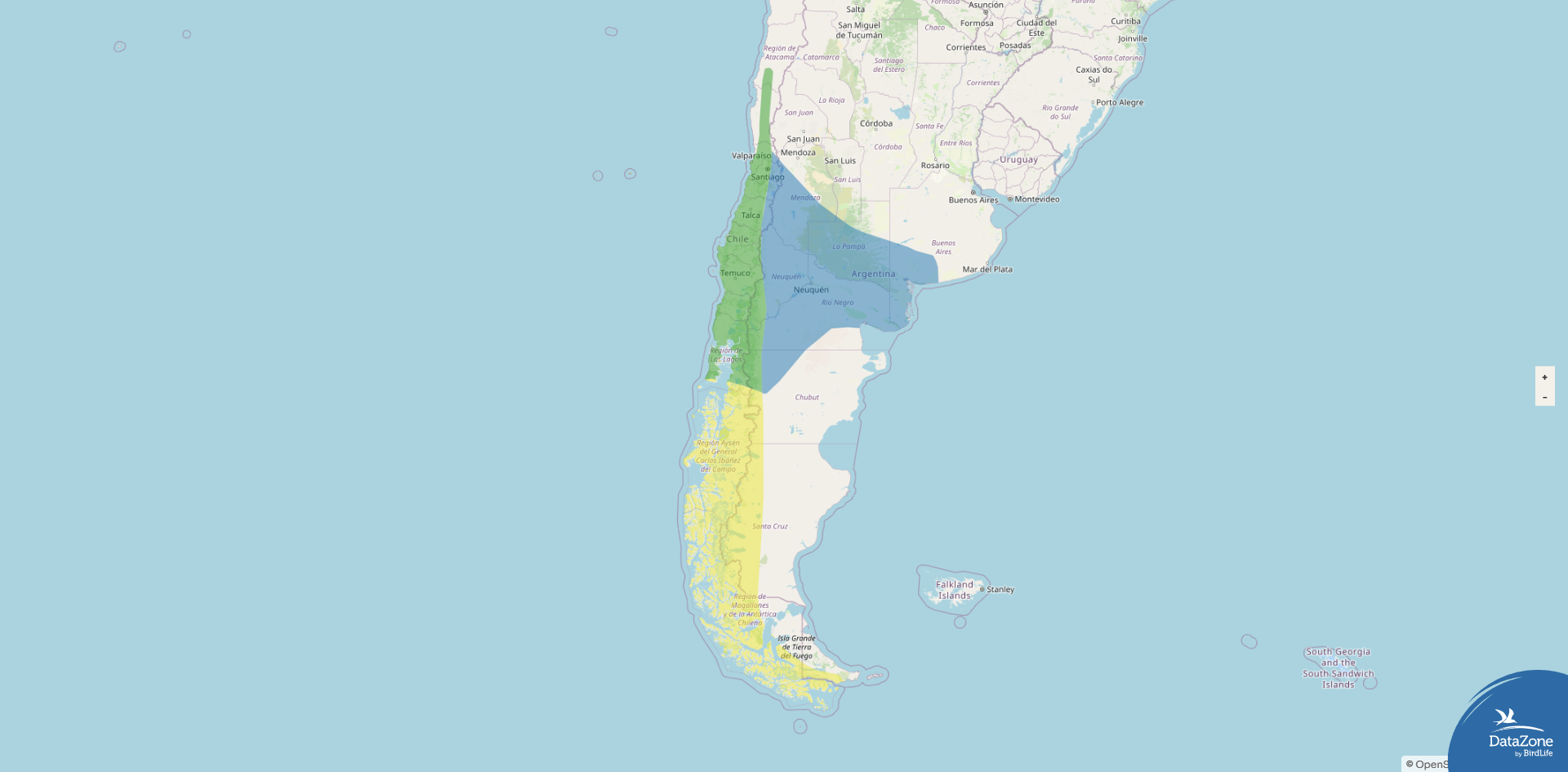
Ledged
Green Resident
Yellow Breeding
Blue Non-breeding
Species Overview
The Green-backed Firecrown is one of the most important pollinators in the temperate rainforests and woodlands of southern South America, visiting a wide variety of native and introduced flowers. It is relatively adaptable and uses human-modified habitats such as plantations, city parks, and gardens, which helps maintain its numbers over a broad geographic range. Despite this adaptability, its population is believed to be decreasing, and local trends may be influenced by habitat change, climate shifts, and interactions with other species, even though it still qualifies as Least Concern at the global scale.
Male Description
Adult males are compact, short-billed hummingbirds with bright green upperparts and a distinctive, iridescent crown patch that can flash from golden to fiery red depending on the angle of light. The underparts are whitish to grayish, often washed with green on the flanks, and the tail is relatively short and slightly notched, usually dark with some greenish tones. The bill is straight and black, and the head can appear fairly large relative to the body, emphasizing the crown when erected. In good light, the glowing “firecrown” is the male’s most striking feature and a key field mark.
Female Description
Females are similar in size but slightly longer-billed and lack the male’s fully developed fiery crown. They have green upperparts and whitish to pale gray underparts marked with dusky or greenish spots or streaks on the throat and chest, giving a mottled appearance. The crown shows only limited iridescence, much less extensive than in males, and the tail is dark with greenish gloss and paler tips on the outer feathers. Overall, females appear as green-backed, pale-bellied hummingbirds with subtle throat markings and only a hint of the male’s crown brilliance.
Habitat & Behavior
Green-backed Firecrowns use a wide range of wooded and semi-open habitats, including temperate rainforests, sclerophyll scrub and woodland (matorral), forest edges, clearings, plantations, orchards, and gardens. They feed primarily on nectar from native flowers and introduced ornamentals and trees (including Eucalyptus), often acting as key pollinators for several shrub and tree species. They also take small arthropods for protein, catching them on the wing or gleaning from vegetation. Mainland populations are strongly migratory: many birds breed in southern and higher-elevation forests, then move northward and downslope into central Chile and lowland Argentina in the non-breeding season; in contrast, the Juan Fernández Islands population is largely sedentary year-round.
Population
The total number of mature Green-backed Firecrowns is unknown, but the species is generally described as locally common over much of its range and does well in human-altered landscapes such as city parks and gardens. In the Juan Fernández Islands, the population is estimated at several thousand individuals, indicating a strong presence there despite the islands’ small size. Overall, however, the global population is considered to be decreasing, likely in response to ongoing habitat modification, climate-related changes in flowering patterns, and other environmental pressures, even though the declines are not yet severe enough to elevate its IUCN category above Least Concern.

Conservation
Green-backed Firecrown is listed as Least Concern due to its broad geographic range, use of a variety of habitats, and continued local abundance in many areas. Nonetheless, its decreasing trend warrants attention, particularly in regions where native forests are being converted to other land uses or where climate change may alter flowering phenology and nectar availability. On the Juan Fernández Islands, this species may compete with the Critically Endangered Juan Fernández Firecrown, potentially affecting that endemic’s recovery. Conservation efforts that protect and restore native forests, maintain flowering shrubs and trees in managed landscapes, and monitor population trends across Chile, Argentina, and the islands will help ensure this important pollinator remains secure.


Related species in the Sephanoides genus (2 species total):


Please note: The content provided in this article reflects Anthony’s personal experience and photographic approach. Results can vary depending on light, weather, location, equipment, subject behavior, and field conditions.