
Green-crowned Brilliant
Scientific name: Heliodoxa jacula
The Green-crowned Brilliant is a large, robust hummingbird of humid sub-montane and montane forests from Costa Rica and Panama south along the Andes of Colombia and Ecuador. The global number of mature individuals is estimated at 500,000–4,999,999, the population trend is Stable, and it is assessed as Least Concern and considered an altitudinal migrant.
At a Glance
Family: Trochilidae (hummingbirds)
Clade: Heliantheini – Brilliants
Genus:Heliodoxa
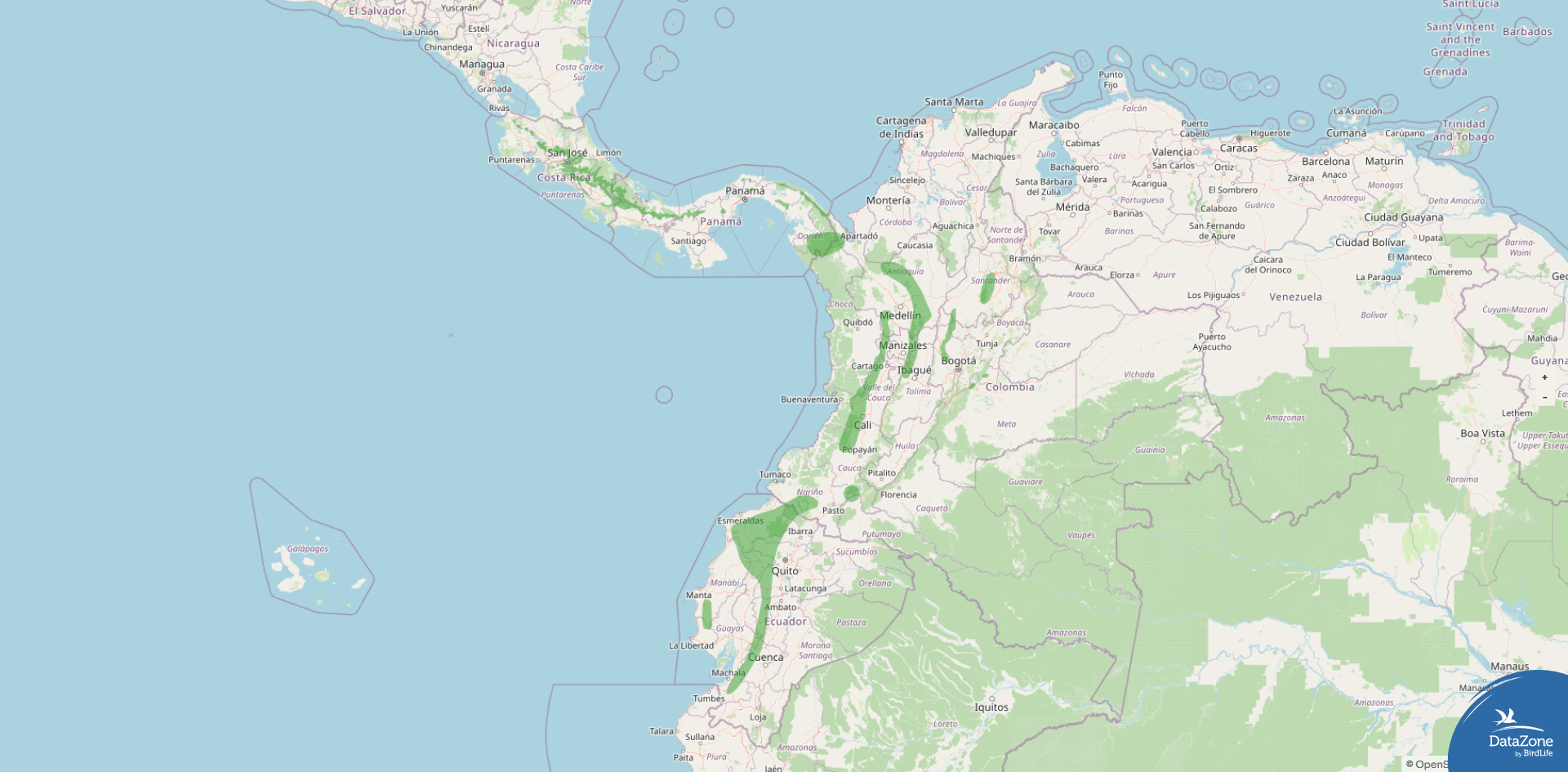
Range: Costa Rica and western Panama south into Colombia (all three Andean ranges) and along the western Andean slope of Ecuador at least to El Oro Province
Habitat: Interior, edges, and clearings of humid sub-montane and montane forest, mature secondary forest, and gardens near forest
Elevation: About 700–2,200 m in Costa Rica (sometimes as low as 100 m), around 500–2,100 m in Panama, 300–1,700 m in Colombia, and 500–1,550 m in Ecuador
Length: Males about 12–13 cm; females about 10.5–12 cm
Weight: Roughly 9–10 g
Number of mature individuals: 500,000–4,999,999
Population trend: Stable
Status: Least Concern (IUCN)
Name Origin
The genus name Heliodoxa combines words meaning “sun” and “glory,” referring to the bright, shining iridescence typical of brilliants. The species name jacula comes from Latin for “dart” or “javelin,” likely alluding to its swift, direct flight through the forest. The English name “Green-crowned Brilliant” highlights the male’s striking green crown and its place within the brilliant group of hummingbirds.
Subspecies & Distribution
Three subspecies are recognized:
Heliodoxa jacula henryi
Occurs from Costa Rica south and east into Panama as far as Coclé Province.Heliodoxa jacula jacula
Found from Panamá Province in eastern Panama into Colombia, where it inhabits all three Andean cordilleras.Heliodoxa jacula jamersoni
Ranges from Colombia’s Nariño Department (possibly north into Cauca) south along the western slope of the Andes of Ecuador at least to El Oro Province.
Across this combined range, Green-crowned Brilliants occupy humid sub-montane and montane forests, forest edges, clearings, mature secondary forest, and forested gardens along middle elevations.
Ledged
Green Resident
Species Overview
The Green-crowned Brilliant is one of the most conspicuous large hummingbirds of middle-elevation cloud forests in Costa Rica, Panama, and the northern Andes. It thrives in structurally complex habitats—forest interior, edges, older secondary growth, and gardens near forest—where flowering trees and shrubs provide abundant nectar. Its broad distribution and use of both natural and human-modified habitats support a Least Concern status, and current evidence indicates a Stable population despite localized habitat changes.
Male Description
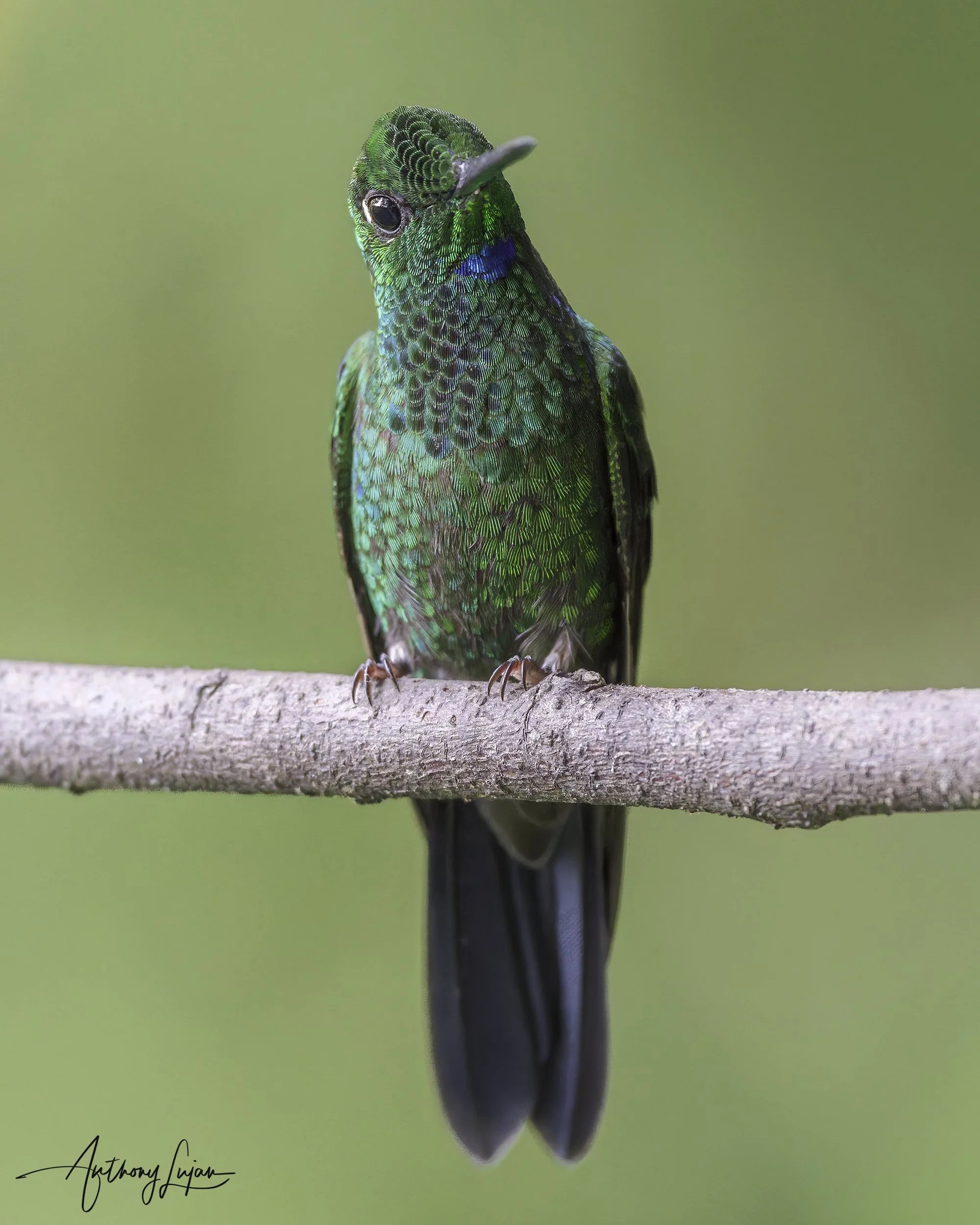
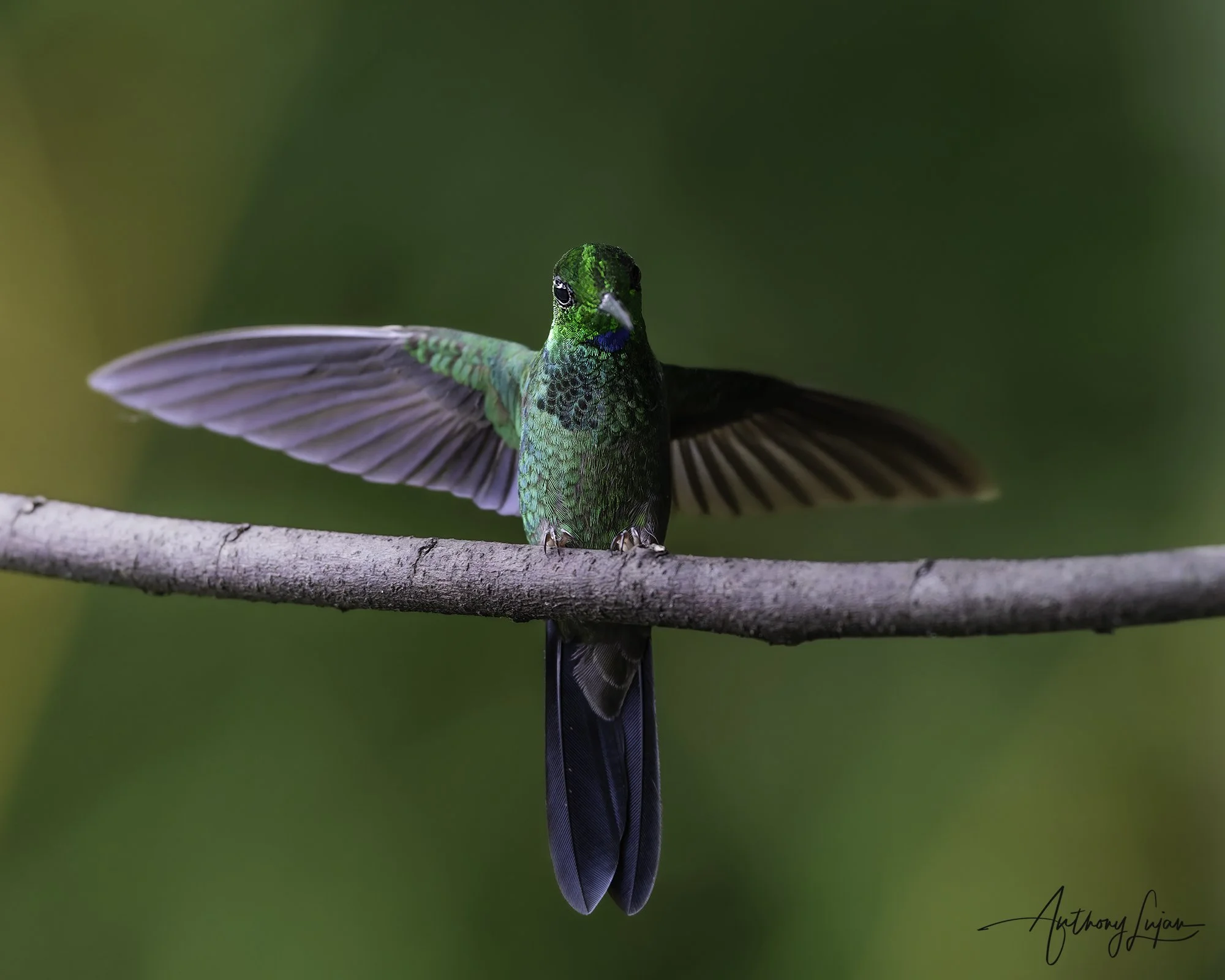
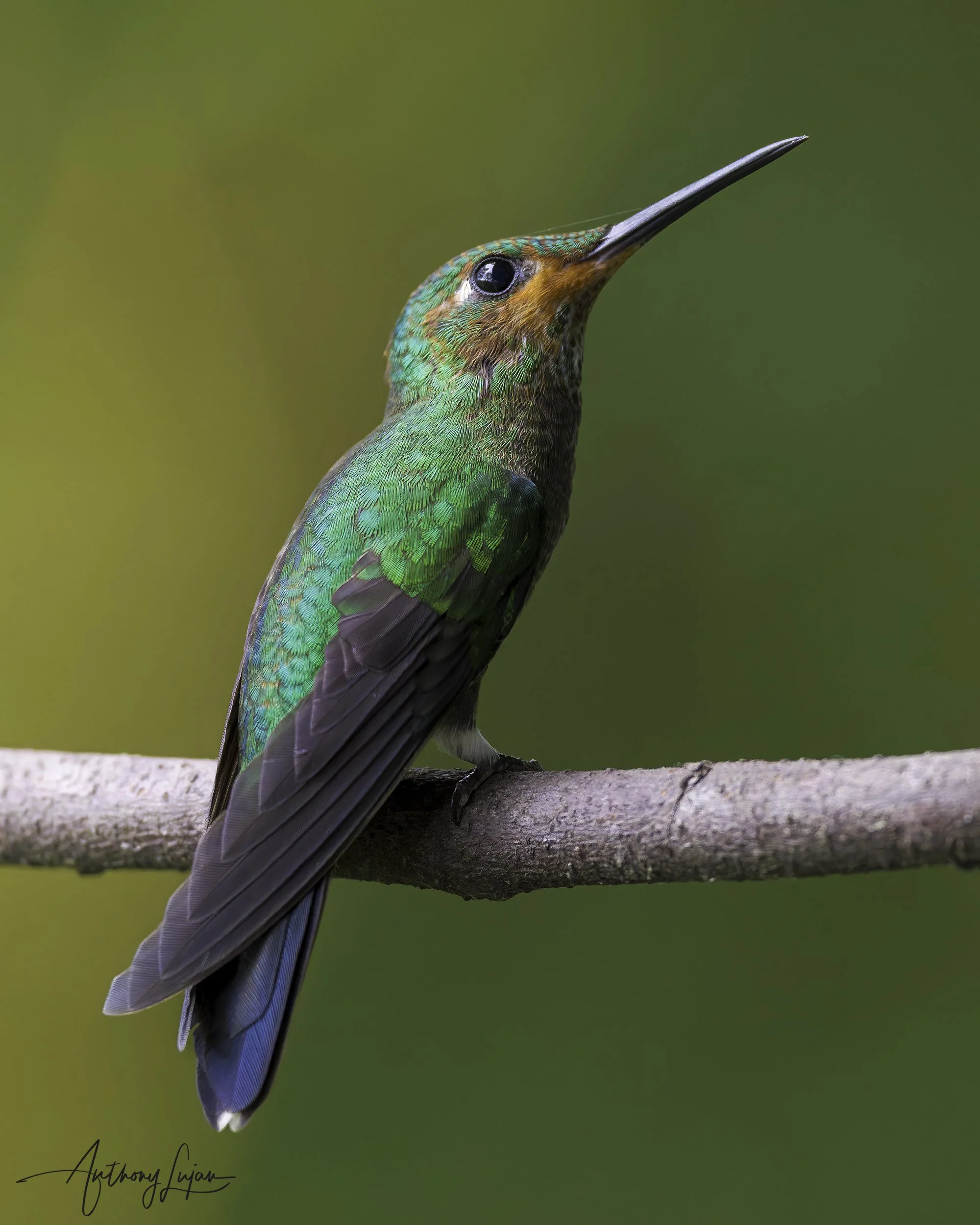
Adult males are large, predominantly green hummingbirds with a bright green crown and forehead. The throat is glittering blue-green, often slightly more intense on the upper chest, while the rest of the underparts are medium gray with green spotting on the sides. The tail is long and slightly forked, dark with a bronze or blue gloss, and the bill is straight, medium-length, and black. At feeders and flowering trees, males are easily recognized by their size, green crown, shining blue-green throat, and long, dark tail.
Female Description
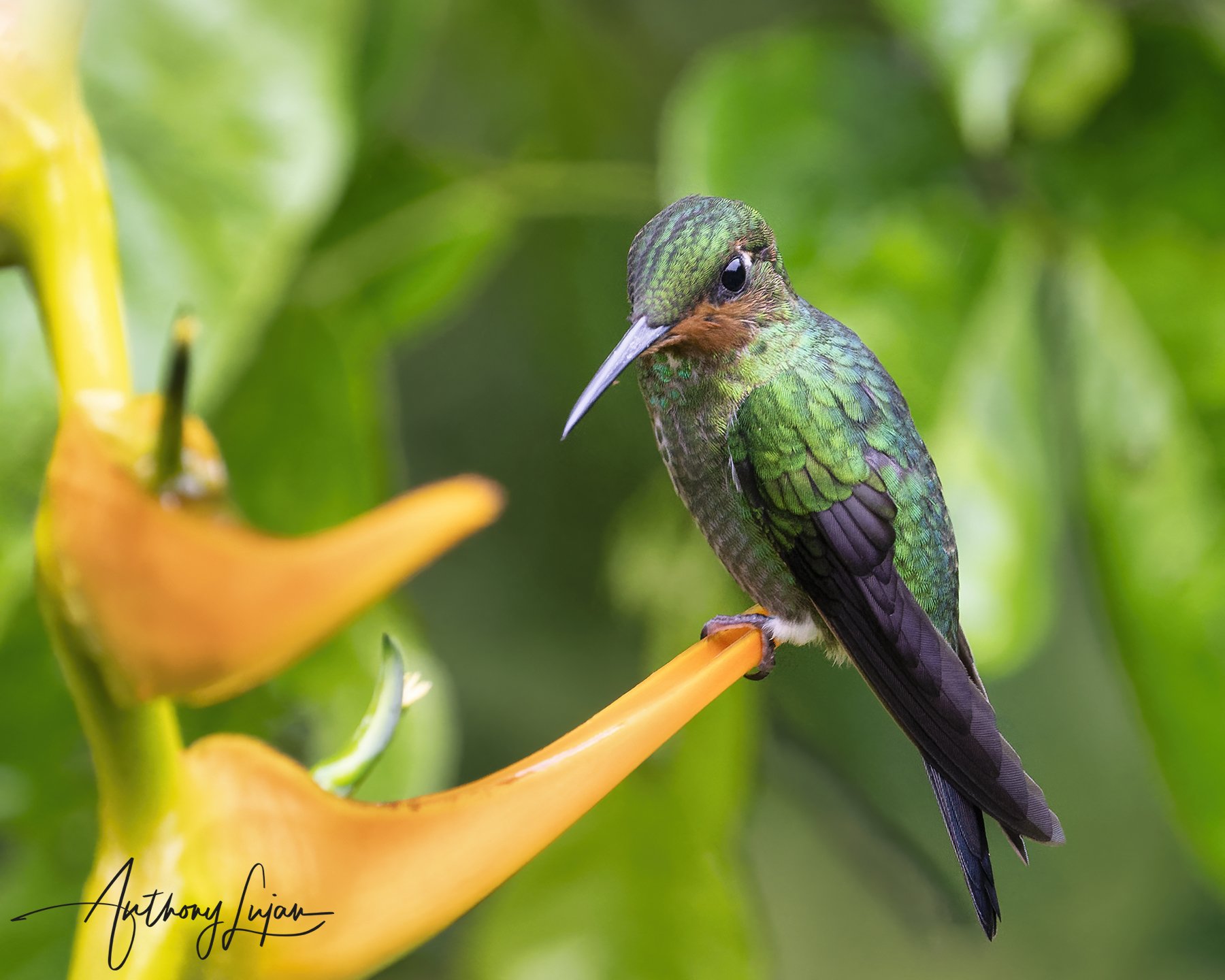
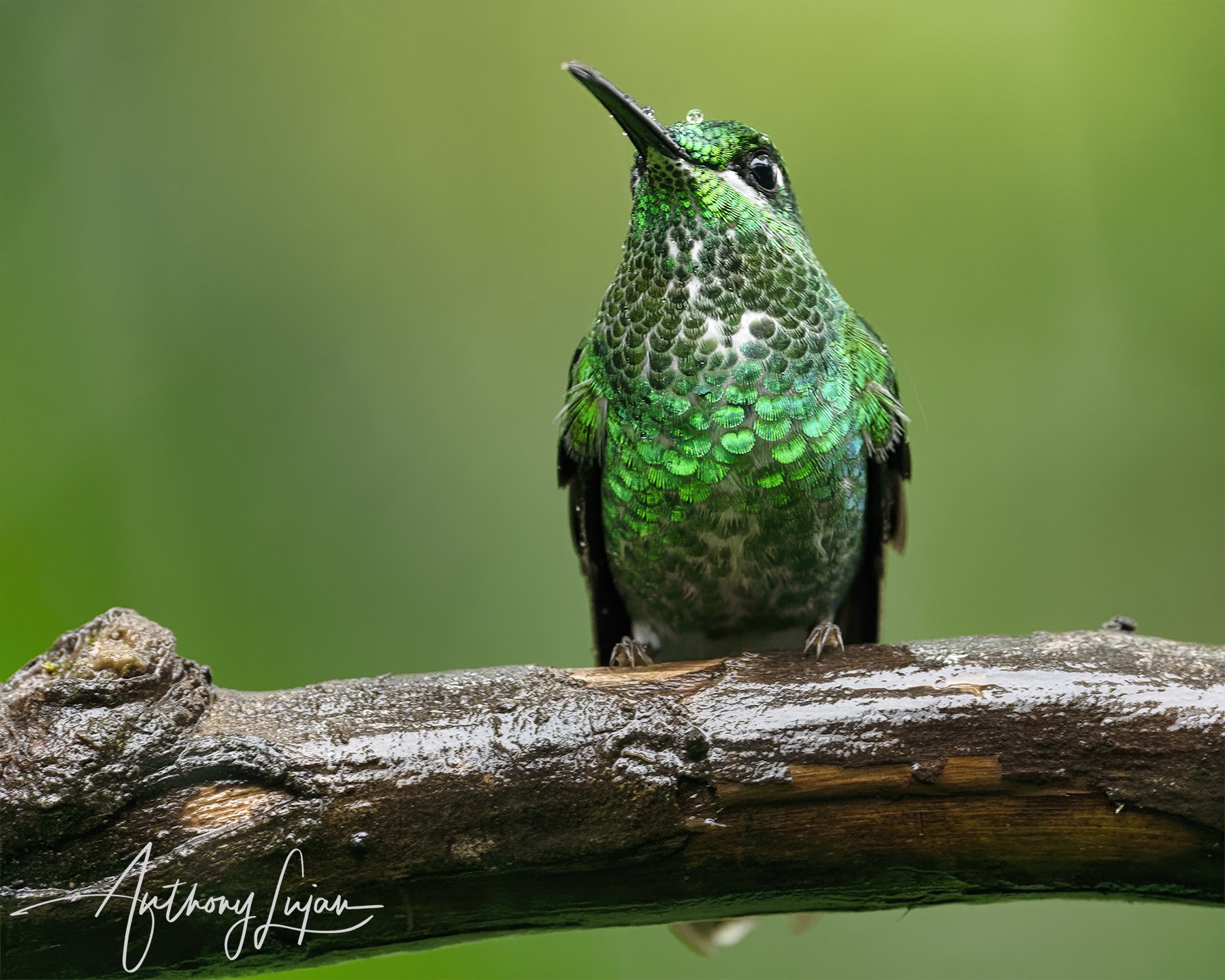
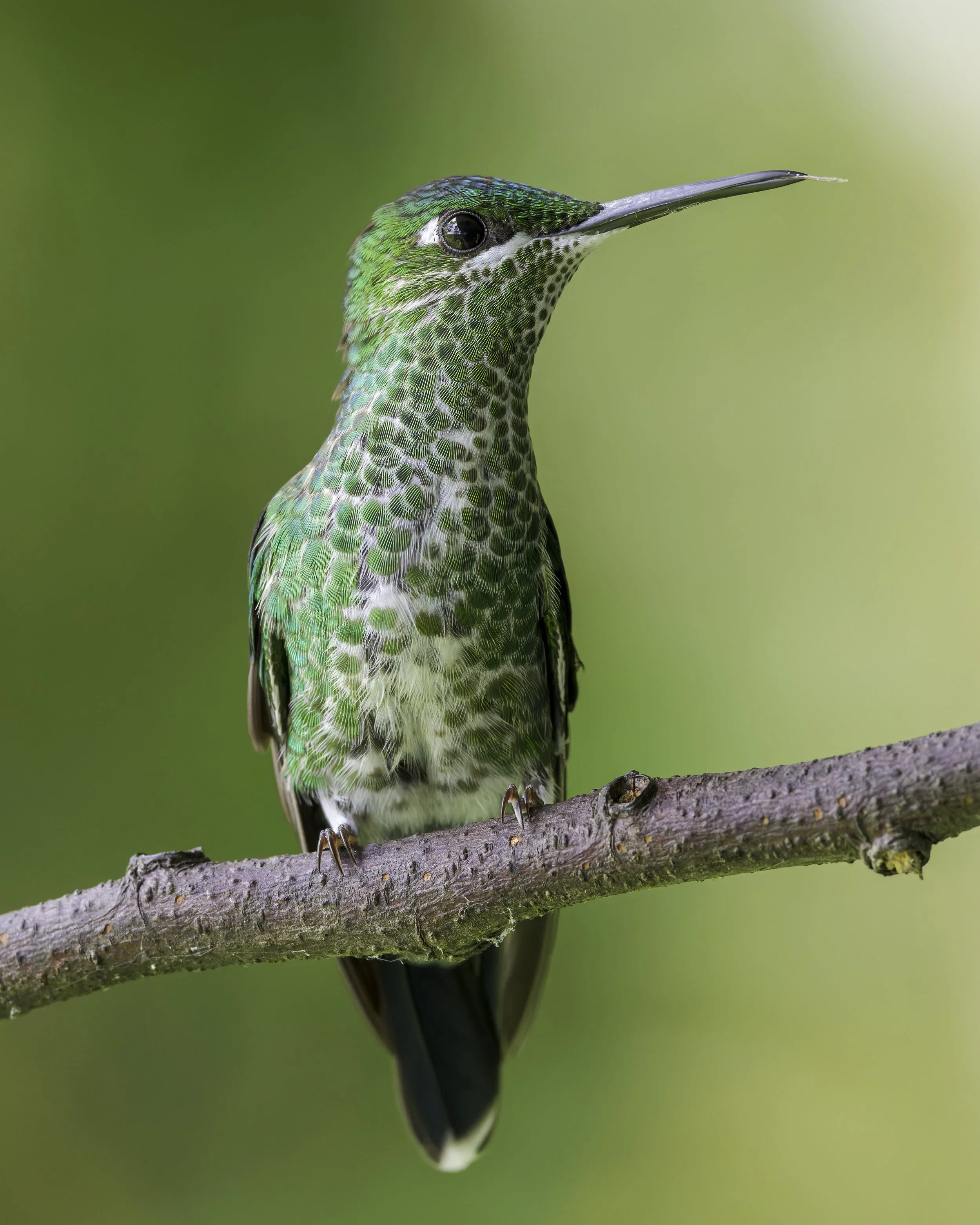
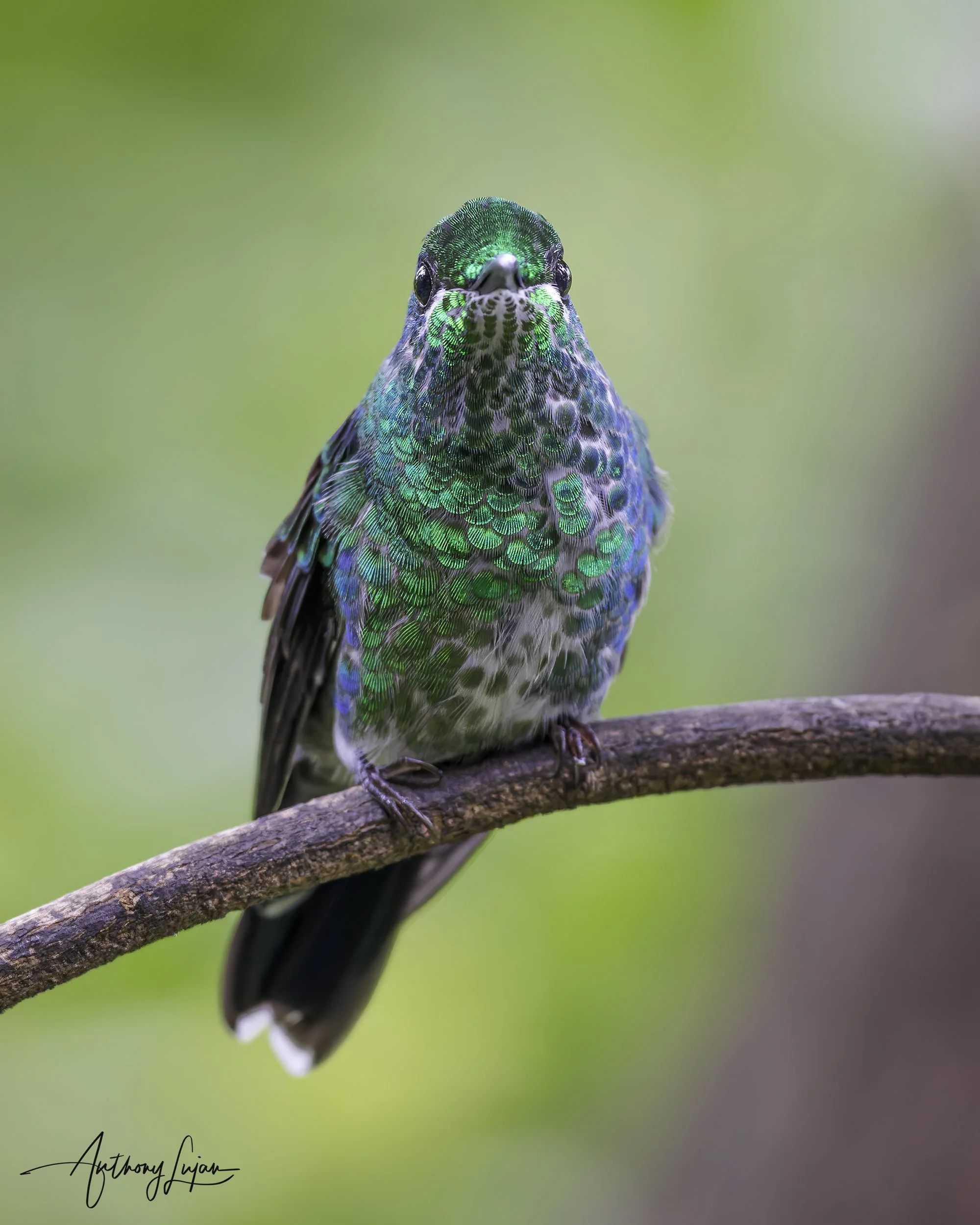
Females are somewhat smaller and more heavily patterned below than males. They share the green crown and upperparts, but the throat and breast are white to pale gray densely marked with large green spots, giving a bold, scaly appearance. The belly is gray and usually less spotted, and the tail is similar in shape but often shows more obvious pale or white tips on the outer feathers. Overall, females appear as big, green-capped hummingbirds with strikingly spotted white underparts.
Habitat & Behavior
Green-crowned Brilliants inhabit the interior, edges, and clearings of humid sub-montane and montane forests, as well as mature secondary forests and gardens close to forest. They typically occur between about 700 and 2,200 meters in Costa Rica, 500–2,100 meters in Panama, 300–1,700 meters in Colombia, and 500–1,550 meters in Ecuador, with occasional records at lower elevations that likely reflect altitudinal movements. They feed on nectar from a wide variety of flowers in both forest and gardens and are frequent, often dominant visitors at hummingbird feeders. Their diet is supplemented by small arthropods, which they catch in flight or glean from foliage. The species is an altitudinal migrant, moving seasonally up and down slopes in response to flowering patterns and climatic conditions.
Population
The global population is estimated at 500,000–4,999,999 mature individuals. Within this range, Green-crowned Brilliants are often locally common in suitable forest and edge habitats, especially where flowering trees, shrubs, and feeders are abundant. Long-term observations suggest a Stable population trend, with no evidence of rapid declines, though local abundance can fluctuate with habitat quality and nectar availability.

Conservation
Green-crowned Brilliant is listed as Least Concern due to its broad distribution from Costa Rica to Ecuador, relatively high population size, and ability to use both natural forests and human-modified habitats. Nonetheless, deforestation, fragmentation, and degradation of sub-montane and montane forests pose regional threats, especially where cloud forests are replaced by agriculture or urban development. Conservation measures that protect cloud forests, maintain mature secondary growth and forested gardens, and preserve elevational corridors will support its altitudinal movements and long-term stability. Monitoring along elevational gradients is particularly important as climate and land-use change continue to reshape Andean and Central American montane habitats.
Below is the Green-crowned Brilliant (Heliodoxa jacula henryi)
Photographed at Catarata del Toro, La Paz Waterfall Gardens, Galería de Colibrí y Soda Cinchona – Mirador San Fernando (Alajuela), and Hotel Quelitales (Cartago), Costa Rica
This individual belongs to the subspecies henryi, found in the highlands of Costa Rica and western Panama east to Coclé Province. It inhabits humid montane forest, clearings, and edges between 900 and 2,000 meters elevation.

Interested in coming along? Visit Travel with Me!
Also visit Costa Rica Hummingbird Expedition | July 2021 | 10 Species | Where It All Started
Also visit Costa Rica Hummingbird Expedition | November 2021 | 22 New Species | Second Chances
Also visit Costa Rica Hummingbird Expedition | July 2025 | 32 Species | 10 New | Closing the Gap
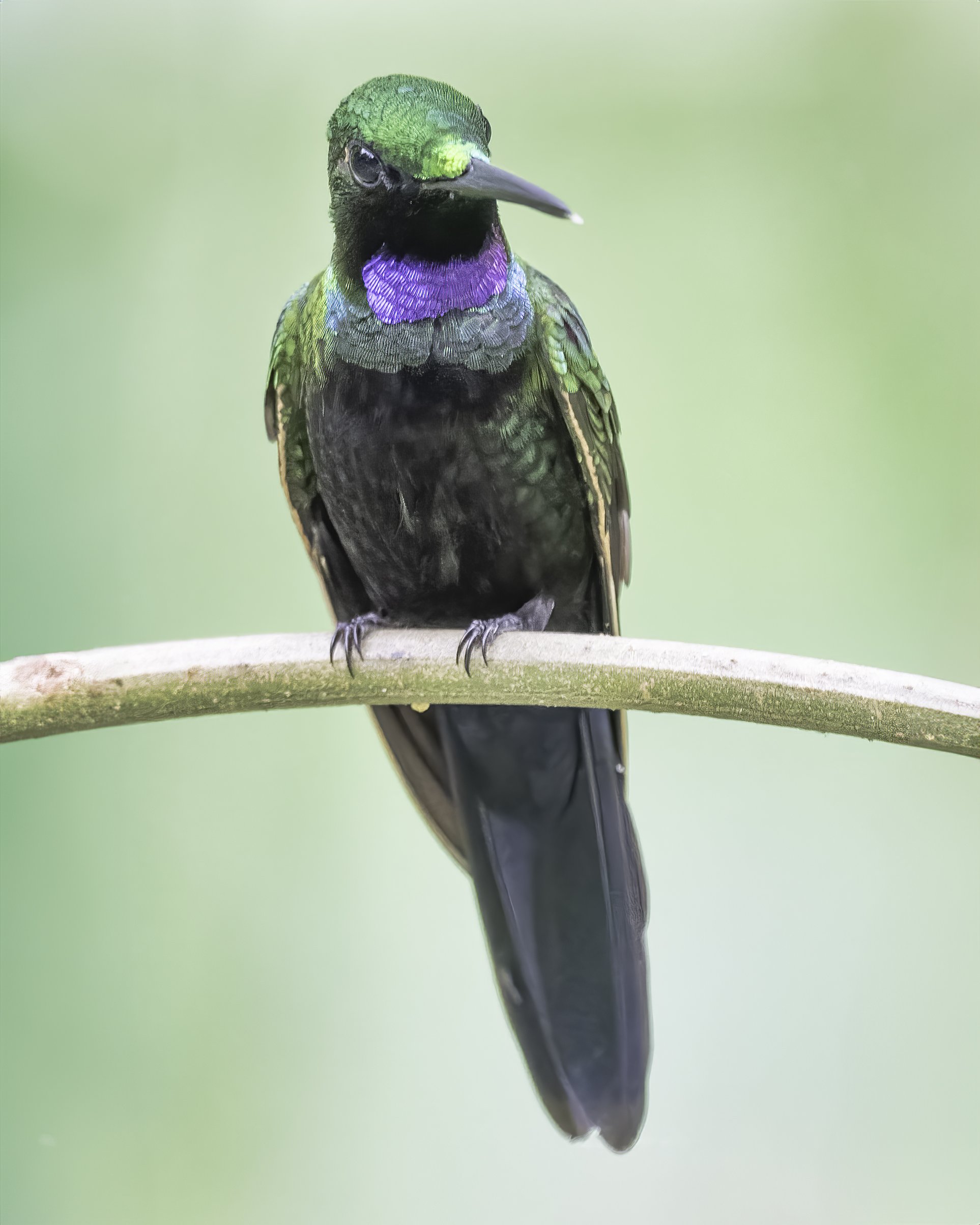
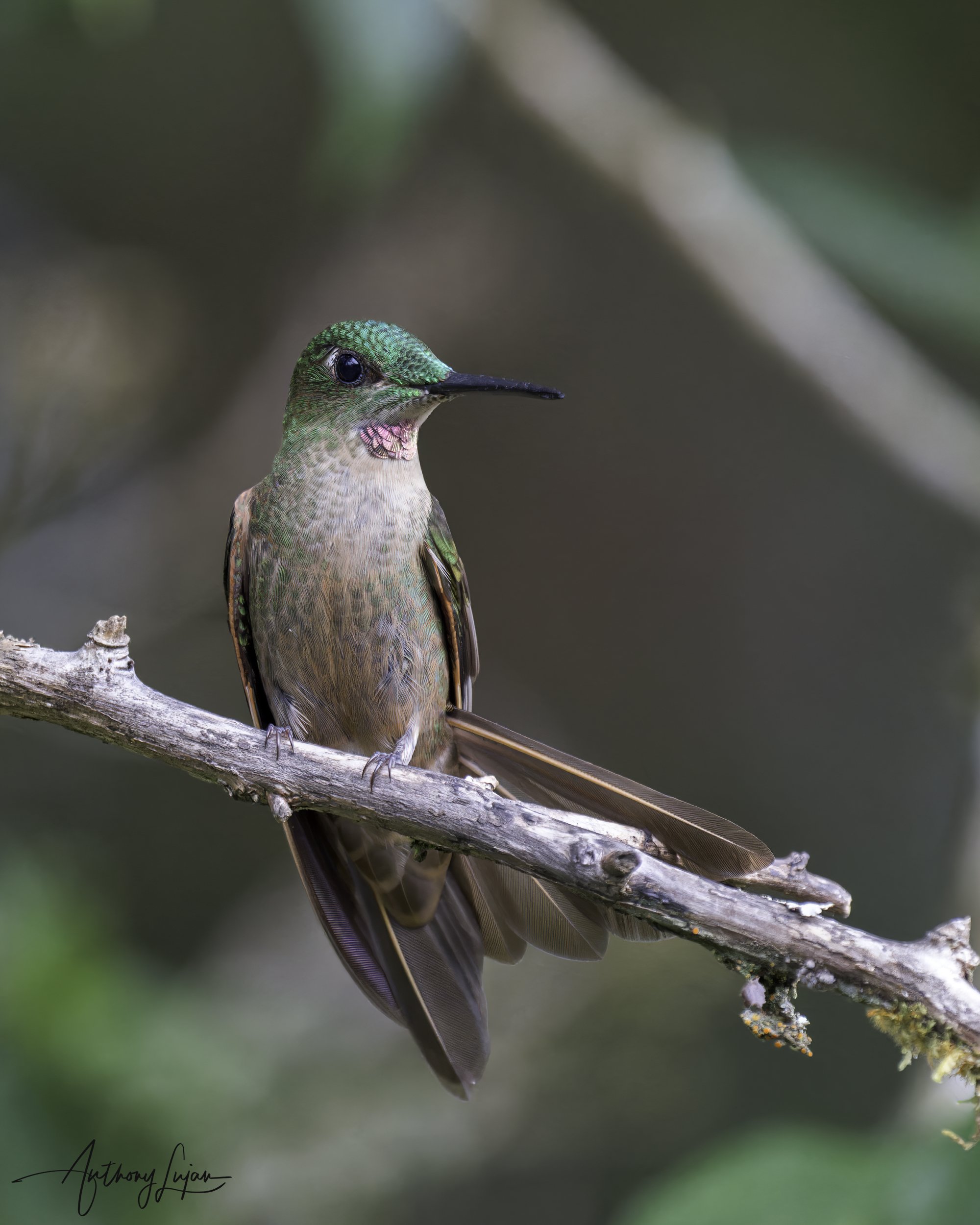
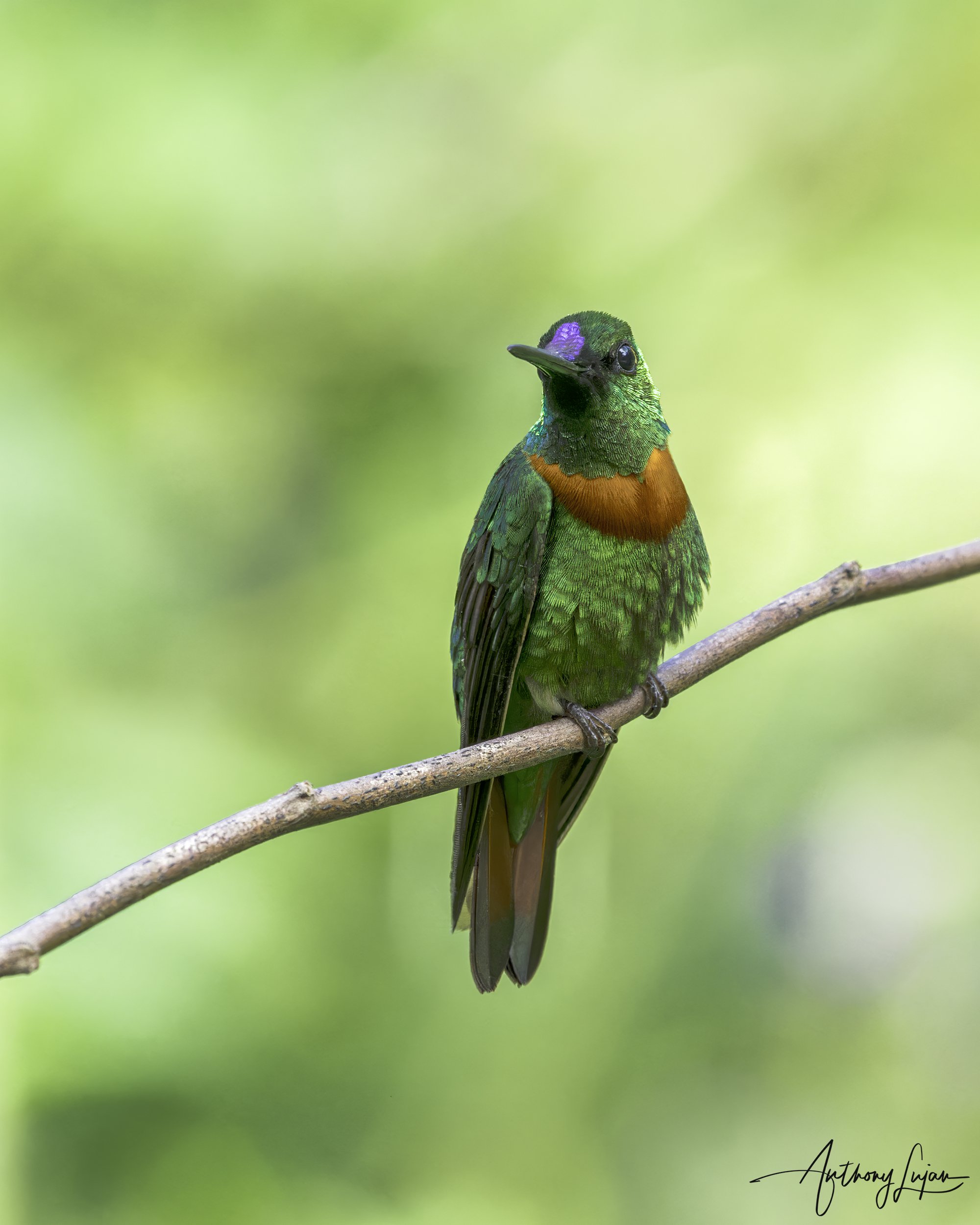
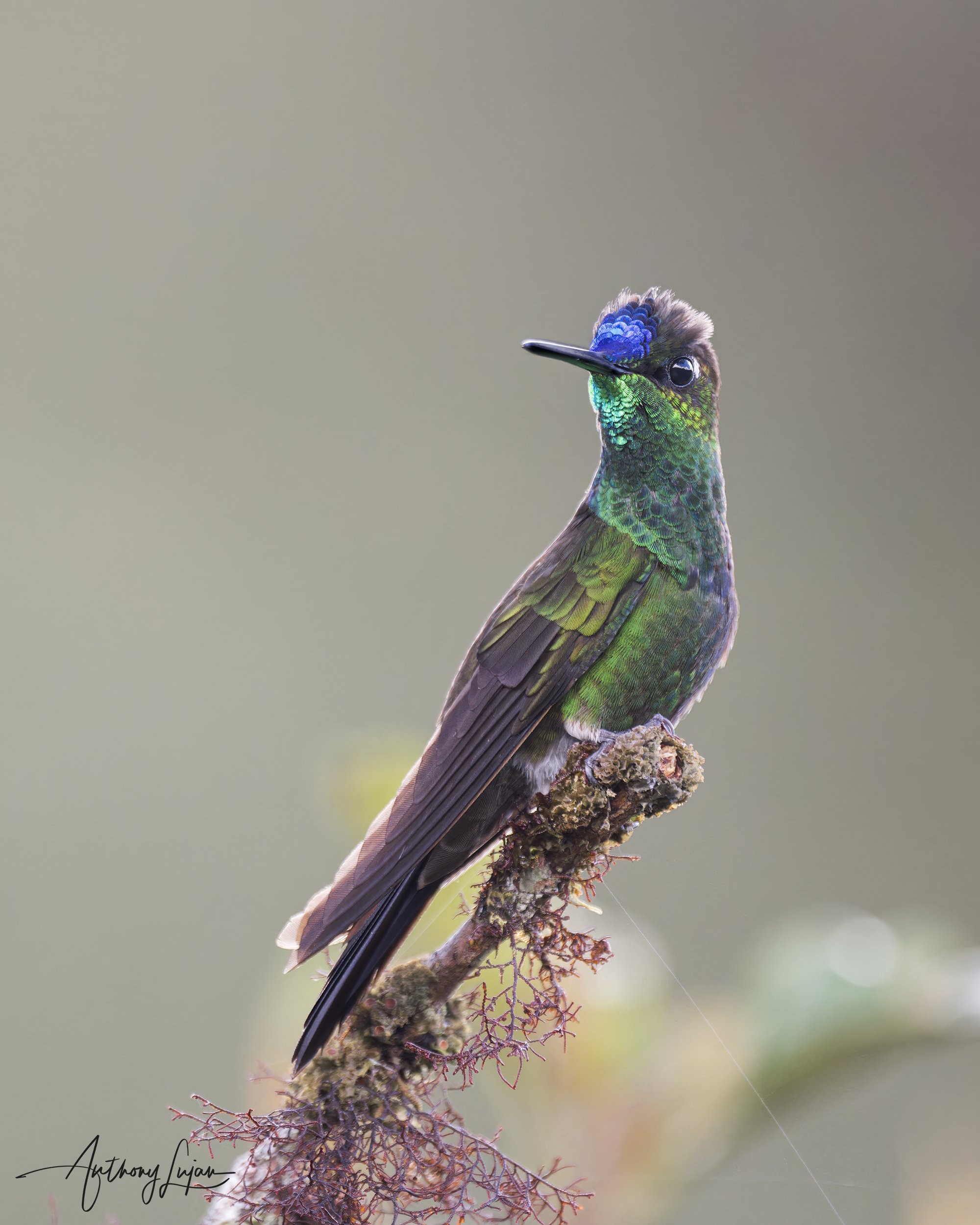
Related species in the Heliodoxa genus (10 species total):



Please note: The content provided in this article reflects Anthony’s personal experience and photographic approach. Results can vary depending on light, weather, location, equipment, subject behavior, and field conditions.