
Scientific name: Sappho sparganurus
The Red-tailed Comet is a medium-sized, extraordinarily long‑tailed hummingbird of arid and semi‑arid montane scrub and open woodland along the eastern slopes of the central Andes in Bolivia and Argentina. The total number of mature individuals is unknown, the overall population trend is considered stable, it is treated as non‑migratory, and it is currently assessed as Least Concern.
At a Glance
Family: Trochilidae (hummingbirds)
Clade: Lesbiini – Coquettes
Genus: Sappho — monotypic (1 species)
Range: Eastern slope of the Andes in Bolivia and northwestern to western Argentina; possibly also extreme southern Peru and northern Chile
Habitat: Arid and semi‑arid montane scrub, dry inter‑Andean valleys, open woodland with scattered trees and bushes, Polylepis woodland, and shrubby slopes; often near human habitation in agricultural areas, towns, and cities
Elevation: Mostly 1,500–4,200 m (4,900–13,800 ft), occasionally as low as about 400 m (1,300 ft)
Length: Males about 19–20 cm (7.5–7.9 in); females 12–14 cm (4.7–5.5 in)
Weight: About 4–6.5 g (0.14–0.23 oz)
Number of mature individuals: Unknown
Population trend: Stable
Movement: Not a migrant (resident, with local elevational shifts)
IUCN Red List category: Least Concern
Name Origin
The genus name Sappho honors the ancient Greek poet Sappho of Lesbos. The species name sparganurus combines Greek roots meaning “wrapped/banded tail,” referring to the tail’s banded, iridescent appearance. The English name “Red-tailed Comet” reflects the male’s spectacular long, glowing red‑orange tail, which trails behind the bird like a comet.
Taxonomy
Sappho sparganurus belongs to the coquette tribe Lesbiini within the hummingbird family Trochilidae. It is the only recognized species in the genus Sappho; no other species are currently placed in this genus within your “family” framework. Historically it was at times placed in Trochilus or Lesbia, but modern classifications treat Sappho as distinct.
The Red-tailed Comet is native to the central Andes, with its core range in Bolivia and northwestern to western Argentina. It inhabits arid montane scrublands and open woodlands on the eastern Andean slope and in inter‑Andean valleys, often in landscapes with scattered trees, cacti, and bushy undergrowth, as well as Polylepis forests and shrubby transition zones toward puna or cloud forest. It frequently occurs around human habitation, including agricultural areas, orchards, gardens, towns, and cities, where flowering trees and shrubs are present.
Subspecies and Distribution
Two subspecies:
Sappho sparganurus sparganurus (nominate)
Distribution: Eastern slope of the Andes in northern Bolivia; possibly also extreme southern Peru. This form occupies arid and semi‑arid scrub and open woodland on the eastern Andean flank in northern Bolivia and may extend into adjacent southern Peru where suitable habitats occur.Sappho sparganurus sapho
Distribution: Eastern slope of the Andes from central Bolivia (Cochabamba) south to northwestern and western Argentina (Jujuy and Salta to Neuquén). This subspecies continues the range southwards through central and southern Bolivia and into Argentina, where it inhabits similar montane scrub and open woodland, including dry valleys and Polylepis woodlands, sometimes reaching into western and northwestern provinces such as Jujuy, Salta, and Neuquén.
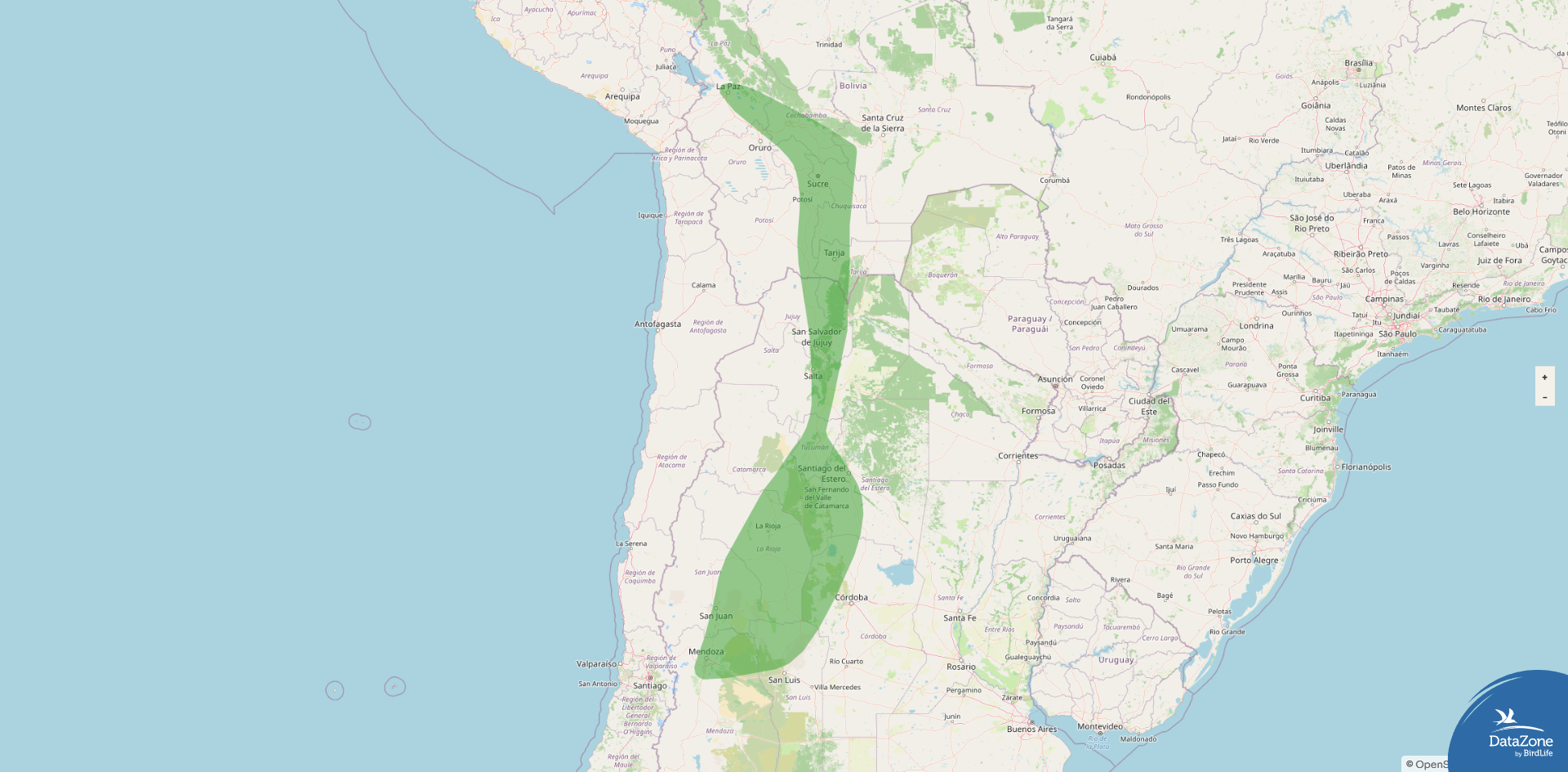
Legend
Green Resident
Species Overview
The Red-tailed Comet is one of the most striking hummingbirds of the Andes, especially the male, whose shimmering green body and fiery red‑orange, deeply forked tail can exceed the length of the body. It is well adapted to dry Andean environments and often frequents flowering shrubs in arid canyons, scrub, and open woodland, as well as gardens and urban green spaces. Despite its dramatic appearance, it is broadly distributed and fairly common in many areas, with no evidence of major declines, which supports its current Least Concern status.
Male Description
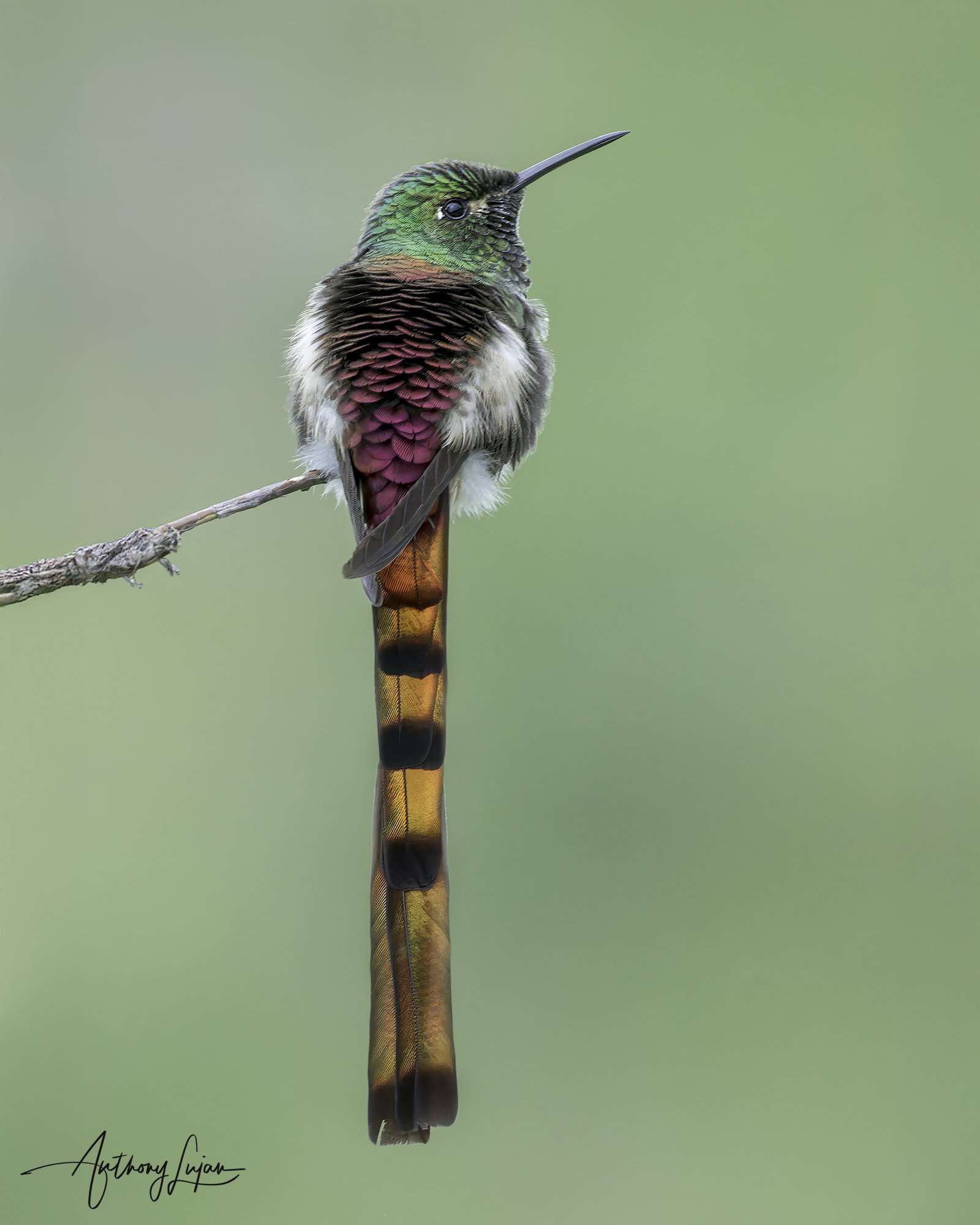
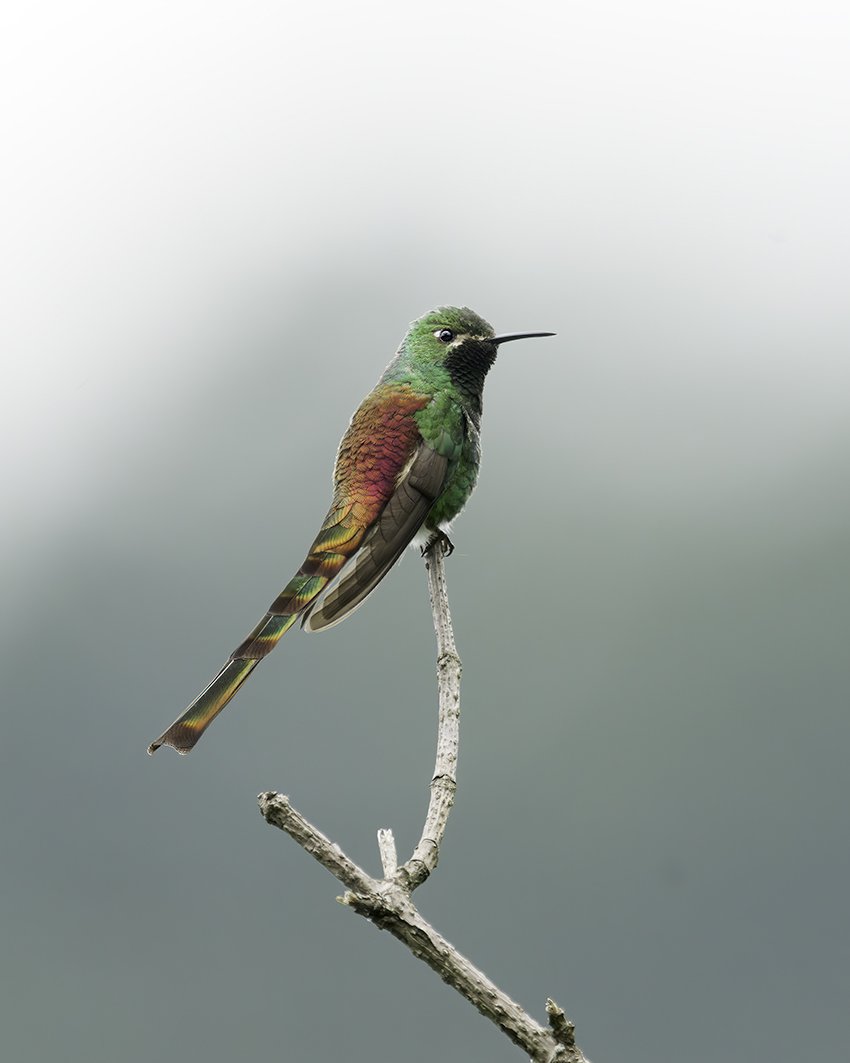
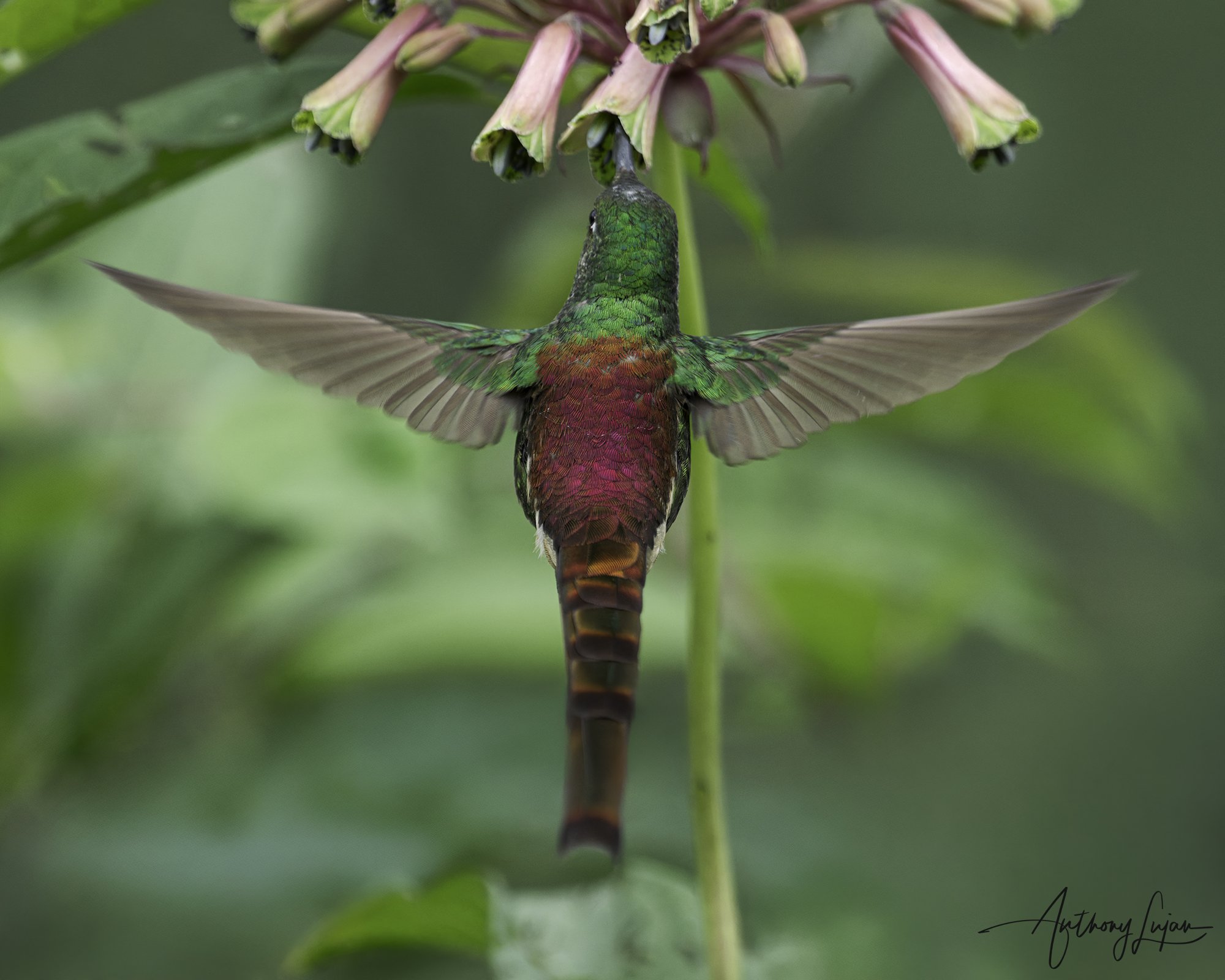
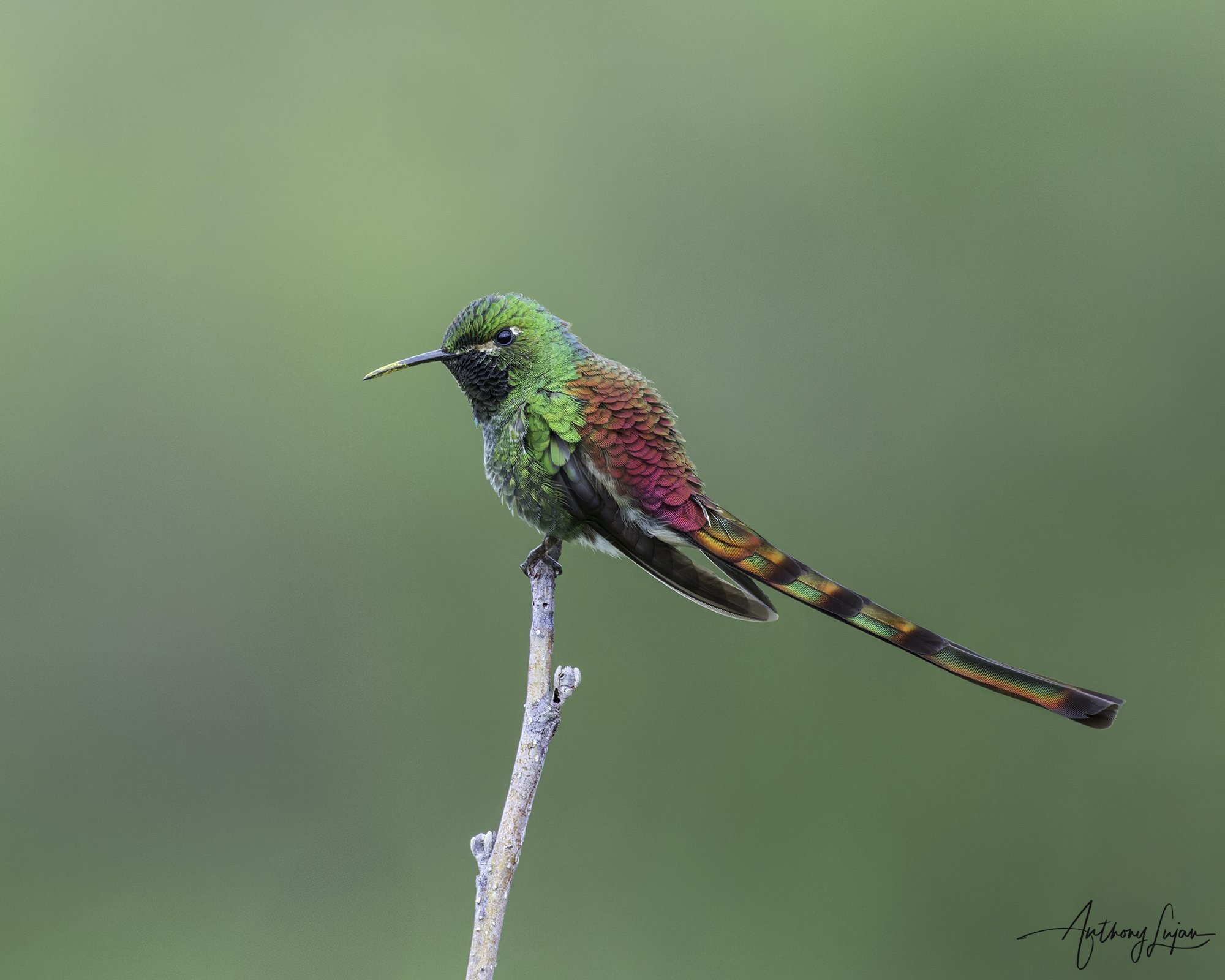
Adult males are among the largest hummingbirds by length due to their elongated tails, measuring about 19–20 cm overall. The head and upperparts are bright metallic green, and the throat bears a glittering golden green or emerald gorget. The rest of the underparts are green, with buffy or pale undertail coverts. The back and rump are a rich reddish purple that can shift in hue depending on the light.
The tail is long and deeply forked, with outer feathers that are narrow, iridescent, and golden‑reddish to reddish purple, sometimes appearing coppery or greenish at different angles. Each tail feather ends in a broad, velvety black or dusky purple tip, giving a banded look. In flight and display, the tail fans out and blazes with red‑orange light, making the bird highly conspicuous. The bill is straight, slender, and black, well suited to accessing nectar from tubular flowers.
Female Description
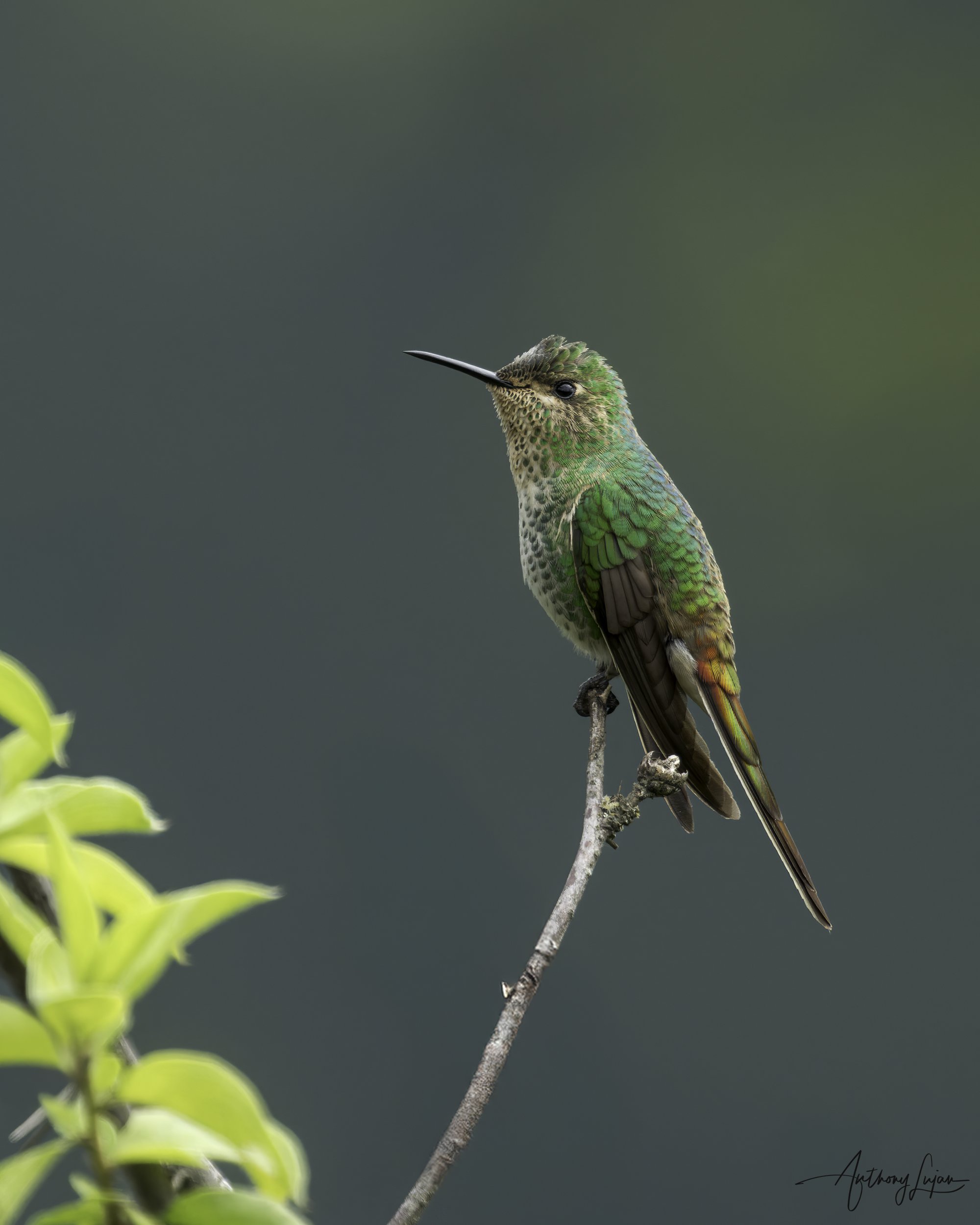
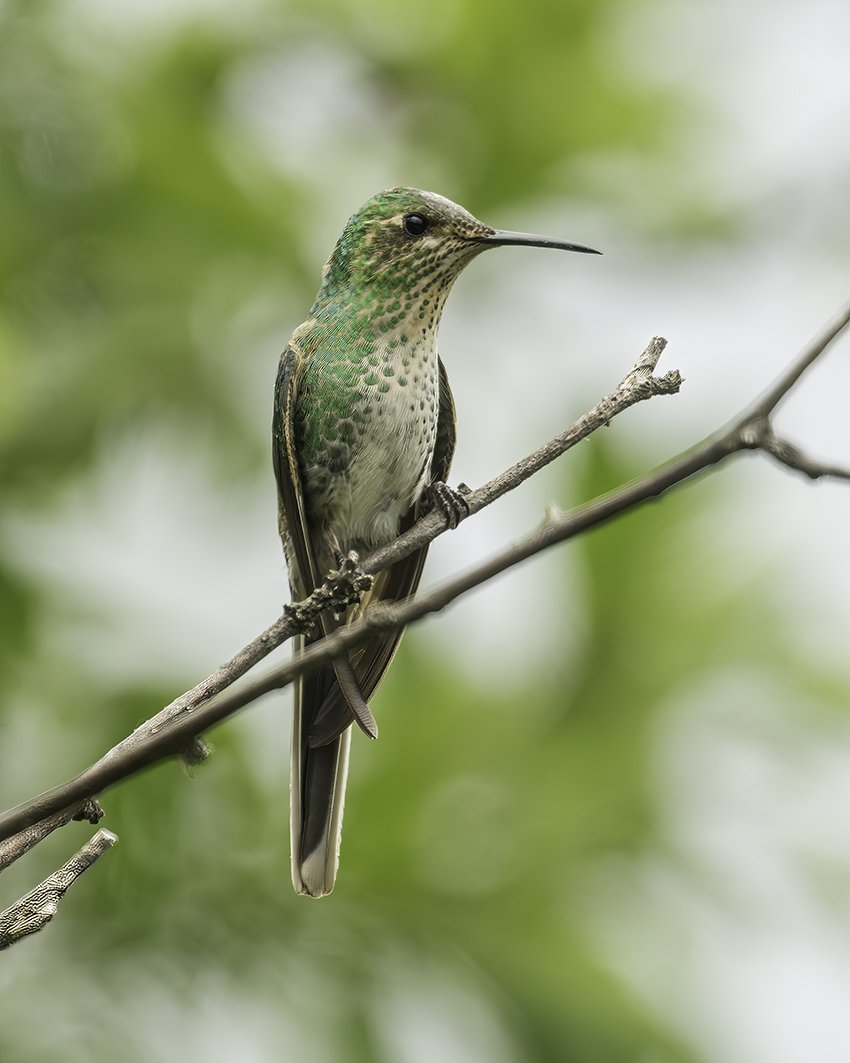
Females are smaller and lack the extremely long tail. They measure about 12–14 cm in total length. The head and back are shining green, and the rump is reddish violet, though duller than in males. The underparts are pale grayish to whitish, often with dark spotting or streaking on the throat and chest. The tail is shorter, less deeply forked, and reddish‑bronze, with dark tips, typically about 7 cm shorter than the male’s tail. Juveniles resemble females, with young males gradually developing longer tail feathers and more intense coloration as they mature.
Habitat & Behavior
Red-tailed Comets inhabit arid and semi‑arid montane scrub, dry valleys, and open woodlands with scattered trees and bushes, including cacti, Prosopis, Alnus, Podocarpus, and Polylepis. They also occupy shrubby transition zones leading toward high‑elevation puna grasslands or moister cloud forests. They commonly occur in and around human settlements, including farms, orchards, gardens, and urban parks, particularly where flowering plants are abundant.
They feed mainly on nectar from a wide array of brightly colored, tubular flowers of trees, shrubs, herbs, and epiphytes, favoring those with high sugar content. They typically hover while feeding, holding the tail cocked upward, and use their long, extendible tongues to lap nectar. Birds may also hang from flowers when convenient. In addition to nectar, they catch small insects for protein, often by hawking from perches. Males are often aggressive and territorial, defending rich nectar patches and chasing away other hummingbirds.
Breeding
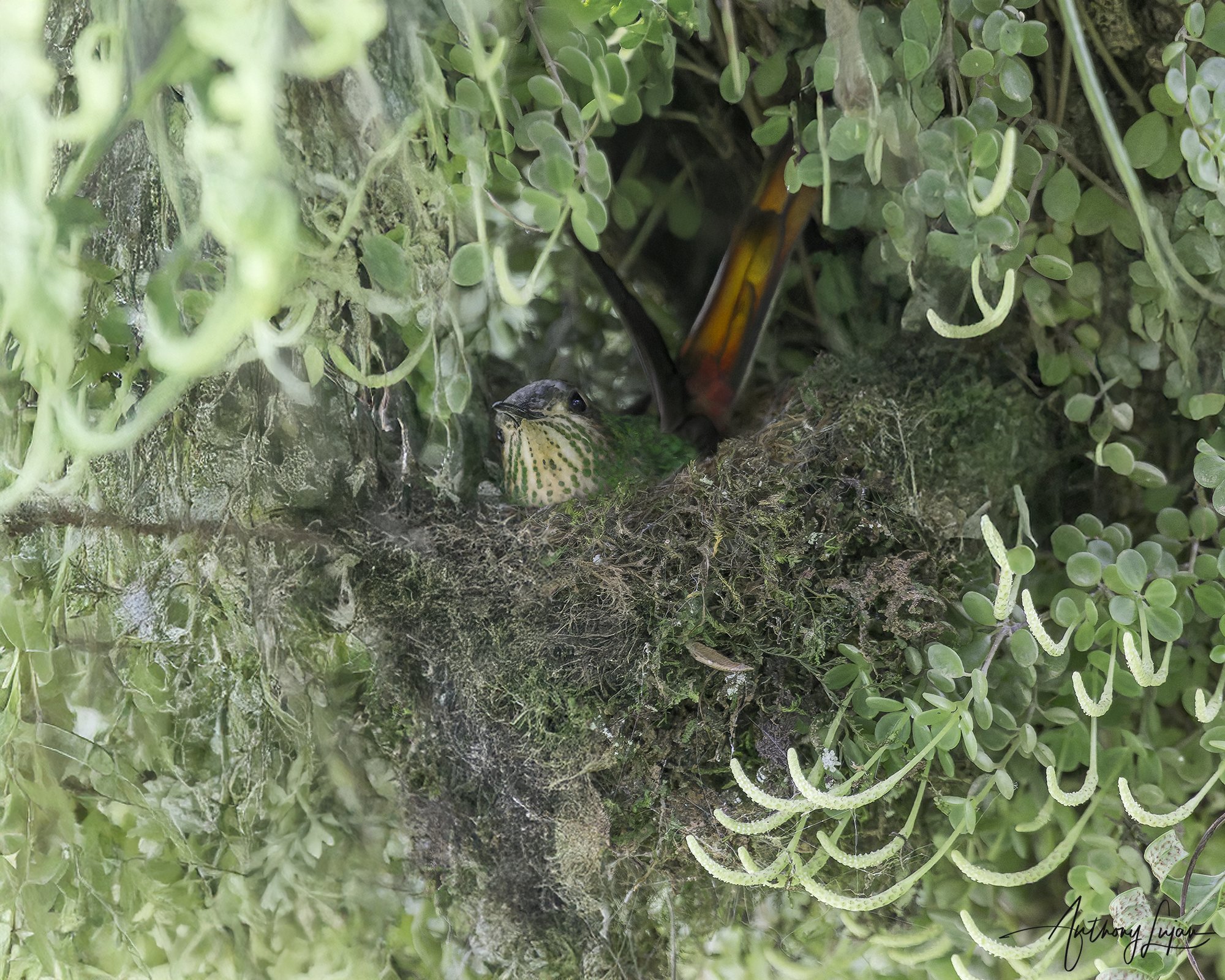
The breeding season varies with locality and elevation but is generally associated with peaks in flowering and favorable weather conditions in montane scrub and woodland. The female builds a compact cup nest of fine plant fibers woven together and covered with green moss on the outside for camouflage. She lines the nest with soft plant fibers, animal hair, and feather down and reinforces the structure with spiderweb, making it elastic enough to stretch as the chicks grow.
Nests are typically placed on a low, thin horizontal branch in a shrub, bush, or small tree, in a sheltered location protected from wind and direct sun. The clutch consists of two white eggs. The female alone incubates and cares for the chicks; incubation lasts about two weeks, and fledging usually occurs around three weeks after hatching, in line with other medium‑sized hummingbirds.
Movement
The Red-tailed Comet is largely resident across its range and is therefore considered non‑migratory. However, local elevational movements occur, particularly in Bolivia, where birds may move downslope outside the breeding season or shift between different altitude bands as flowering patterns change. These movements are local and vertical rather than long‑distance migrations, and individuals remain within the same general regions of the central Andes.
Population
The global number of mature individuals has not been estimated, but the species has a large range and is described as fairly common throughout much of its distribution. Its ability to use arid scrub, open woodland, agricultural land, and urban environments makes it more resilient than many forest‑dependent hummingbirds. There is no evidence of rapid overall decline, and habitat changes have not yet caused significant range‑wide reductions.

Conservation
The Red-tailed Comet is assessed as Least Concern due to its wide range, stable population trend, and tolerance of human‑modified landscapes. It commonly frequents agricultural areas, gardens, and towns where flowering plants are present, which buffers it against some forms of habitat loss. Local threats may include removal of native scrub and woodland, intensive agricultural practices, and urban development that reduces nectar resources, but these have not been shown to cause major global declines. Conservation actions that maintain or create flowering shrublands, hedgerows, and gardens in Andean communities will continue to support this species.
Below is the Red-tailed Comet (Sappho sparganurus sapho)
Photographed at Provincial Potrero De Yala Park, Capital, Jujuy, Argentina
These individuals belong to the subspecies sapho, which ranges from central Bolivia (Cochabamba) south through northwestern and western Argentina, including Jujuy and Salta. This form is nearly indistinguishable in plumage from sparganurus, but differs slightly in measurements and tail length on average. It inhabits dry Andean valleys and montane scrub, where males display their vivid crimson tails in open flight corridors.
Checkout Anthony’s playlist of this species! Click the top right dropdown to see all the videos.
No other species is currently recognized in the genus Sappho; the Red-tailed Comet is the only member of this genus.
Please note: The content provided in this article reflects Anthony’s personal experience and photographic approach. Results can vary depending on light, weather, location, equipment, subject behavior, and field conditions.