
Scientific name: Heliangelus exortis
The Tourmaline Sunangel is a dark, high-Andean hummingbird found in Colombia and Ecuador. The number of mature individuals is unknown, the population is decreasing, it is considered non-migratory, and it is currently listed as Least Concern and monotypic, with no recognized subspecies.
At a Glance
Family: Trochilidae (hummingbirds)
Clade: Lesbiini – “brilliants” of the Andean highlands
Genus group: Heliangelus — “sunangels,” small montane hummingbirds with intense iridescence
Range: All three Andean ranges of Colombia, south along the eastern slope to at least Morona-Santiago in Ecuador.
Habitat: Interior and edges of humid to wet premontane and montane forest, especially cloudforest and elfin forest, plus bushy clearings and shrubby pastures.
Elevation: Mainly 2,300–3,400 m, occasionally from about 1,500 m upwards.
Length: About 11 cm (4.3 in).
Weight: Small, a few grams; typical of a medium-sized sunangel.
Number of mature individuals: Unknown
Population trend: Decreasing
Status: Least Concern (IUCN)
Name Origin
The genus name Heliangelus combines “sun” and “angel,” referring to the brilliant, sunlit iridescence in this group of hummingbirds. The species name exortis likely derives from Latin roots suggesting “standing out” or “projecting,” perhaps referencing its vibrant throat patch or distinctive appearance. The English name “Tourmaline Sunangel” evokes the gemstone-like colors of its iridescent plumage.
Subspecies & Distribution
Monotypic – no recognized subspecies.
Distribution: The Tourmaline Sunangel occurs in all three Andean cordilleras of Colombia and continues south along the eastern Andean slope into Ecuador, reaching at least Morona-Santiago. It occupies a band of humid montane forest, cloudforest, and elfin forest, with birds moving within this elevational zone but not undertaking long-distance migrations.
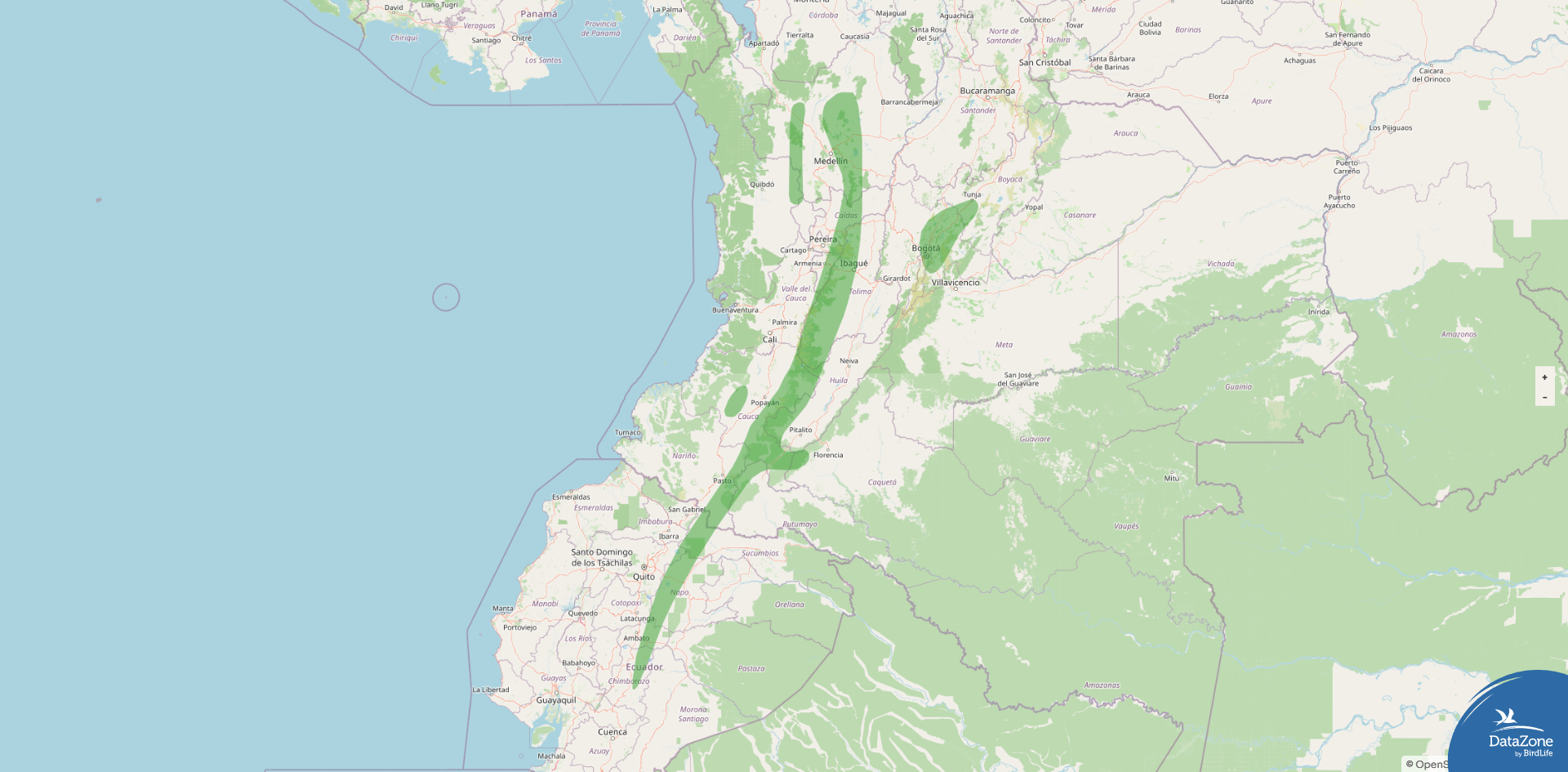
Legend
Green Resident
Species Overview
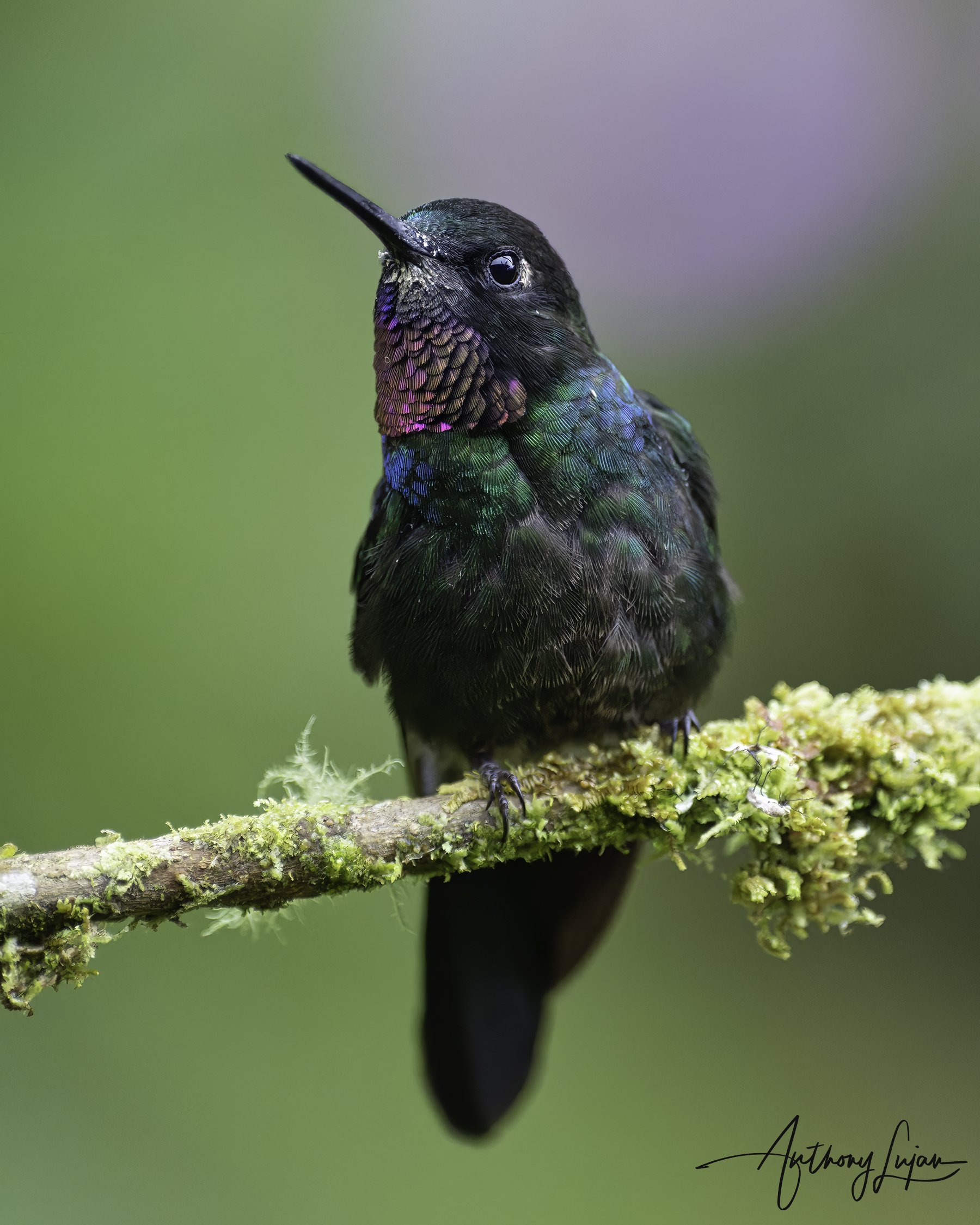
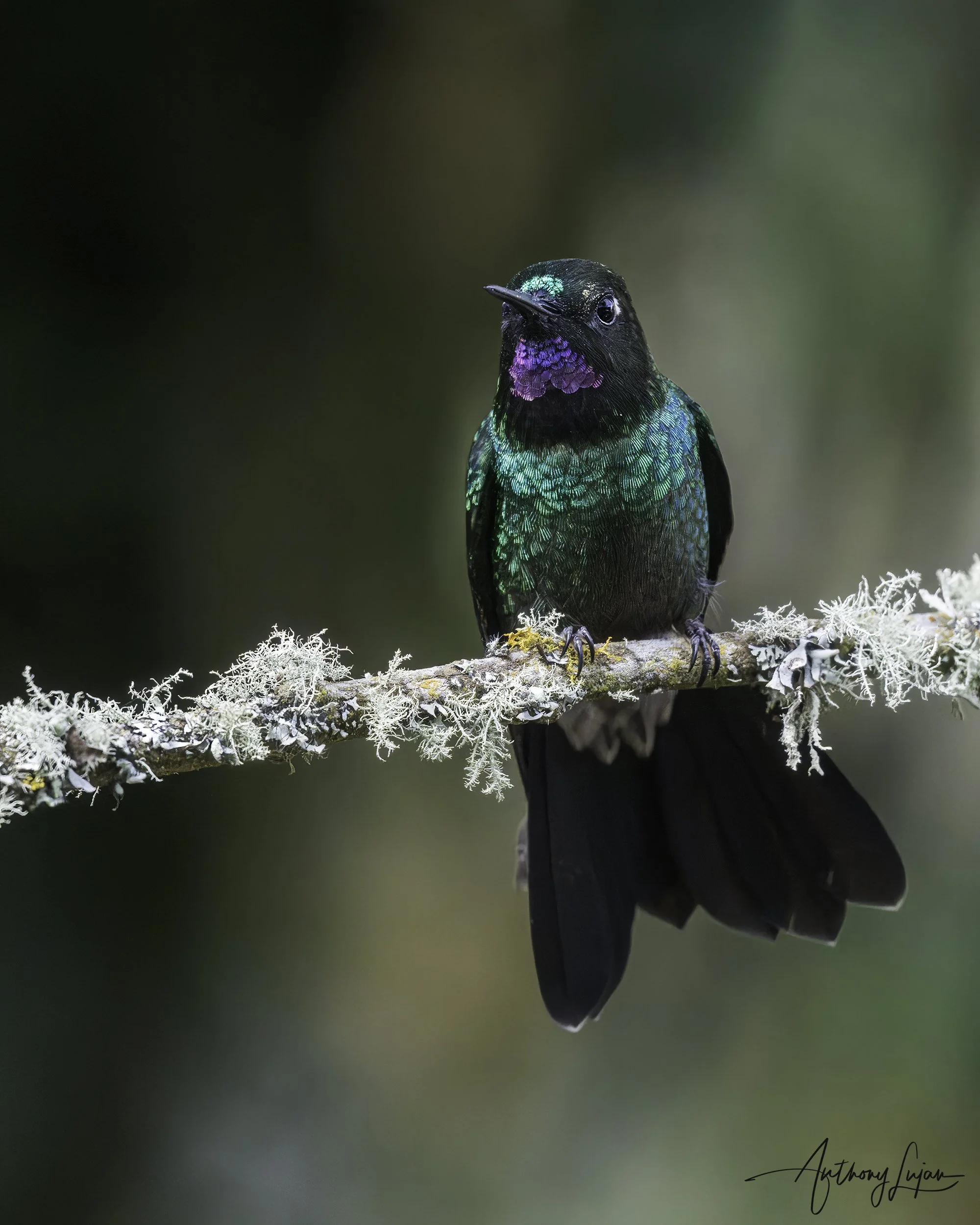
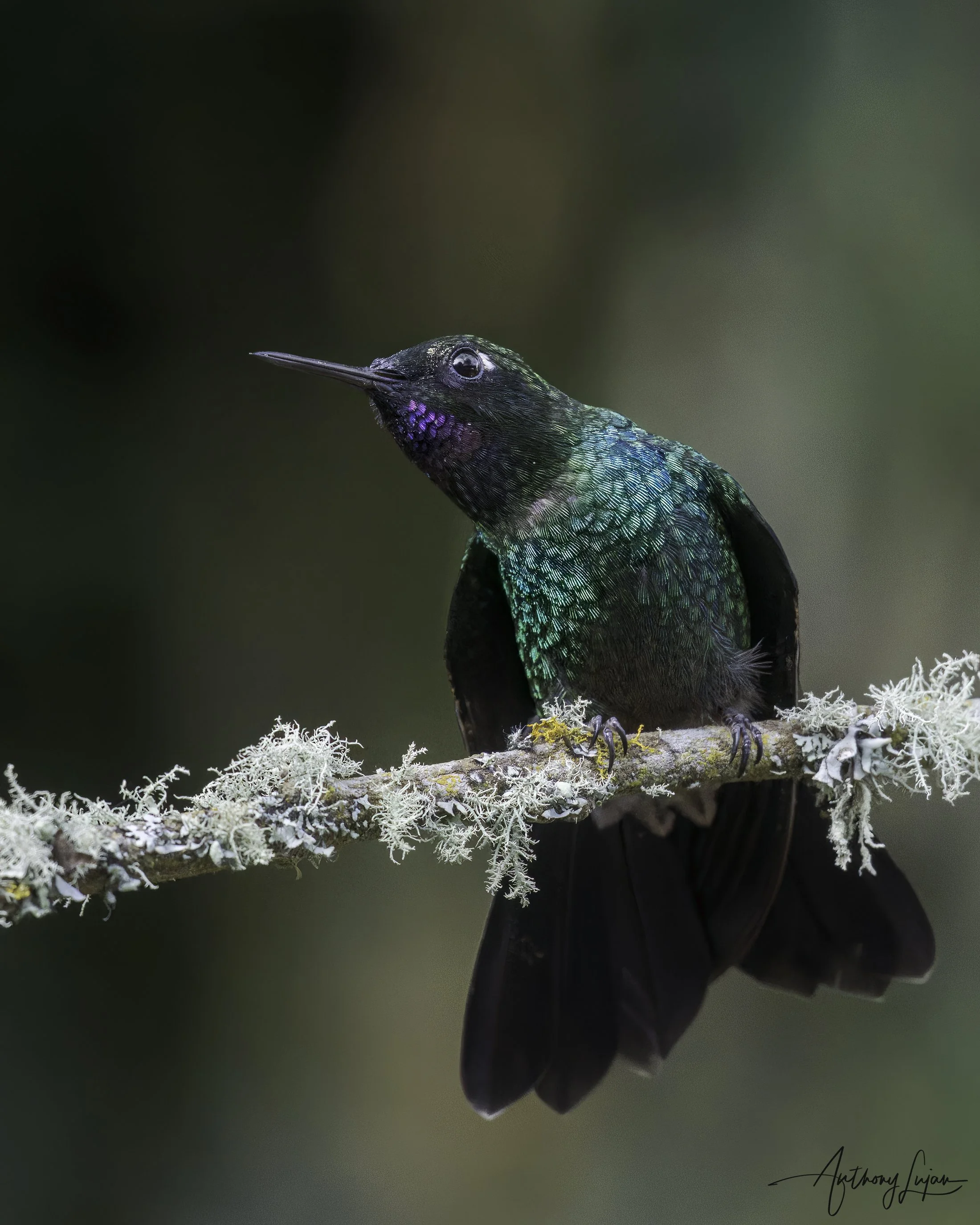
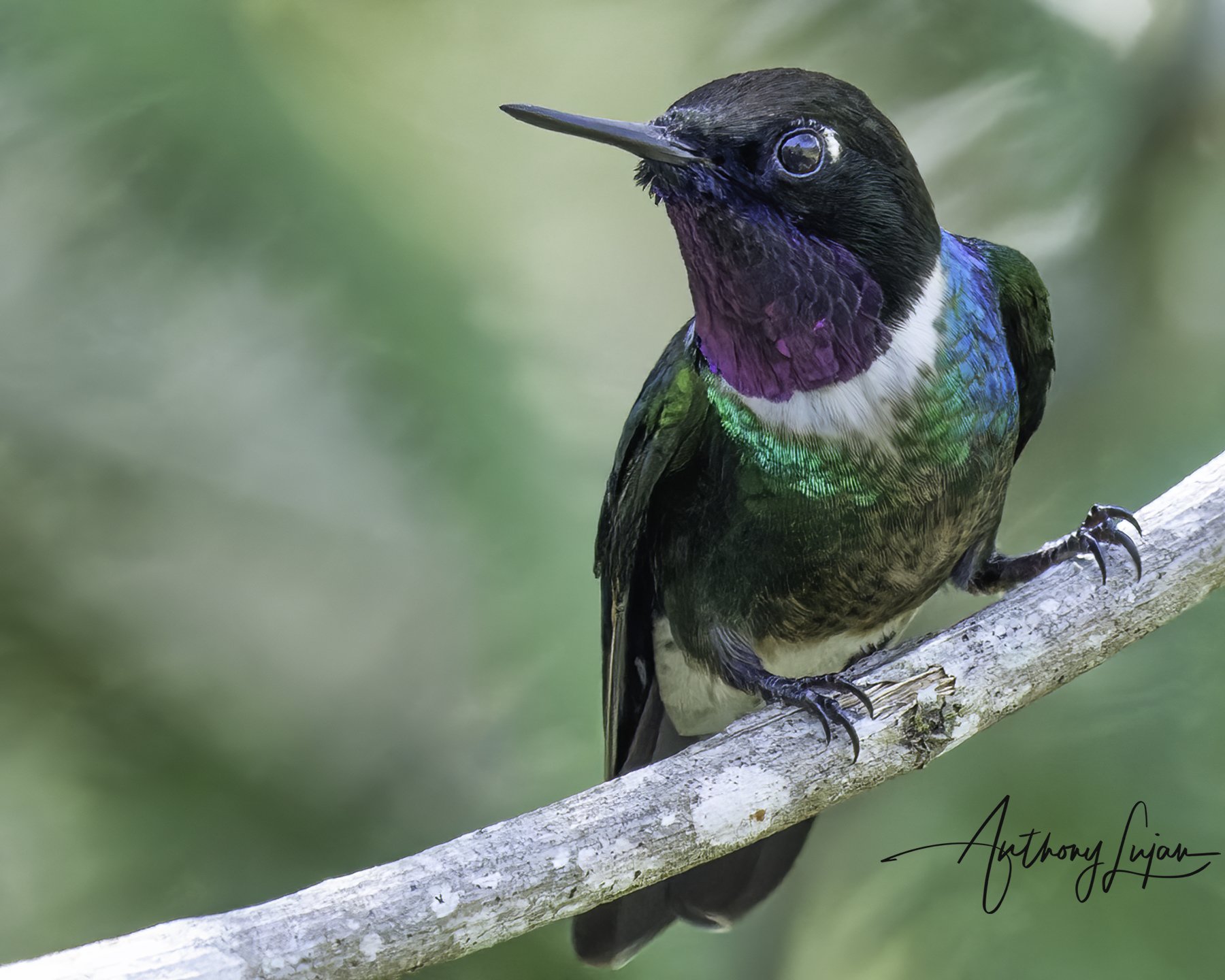
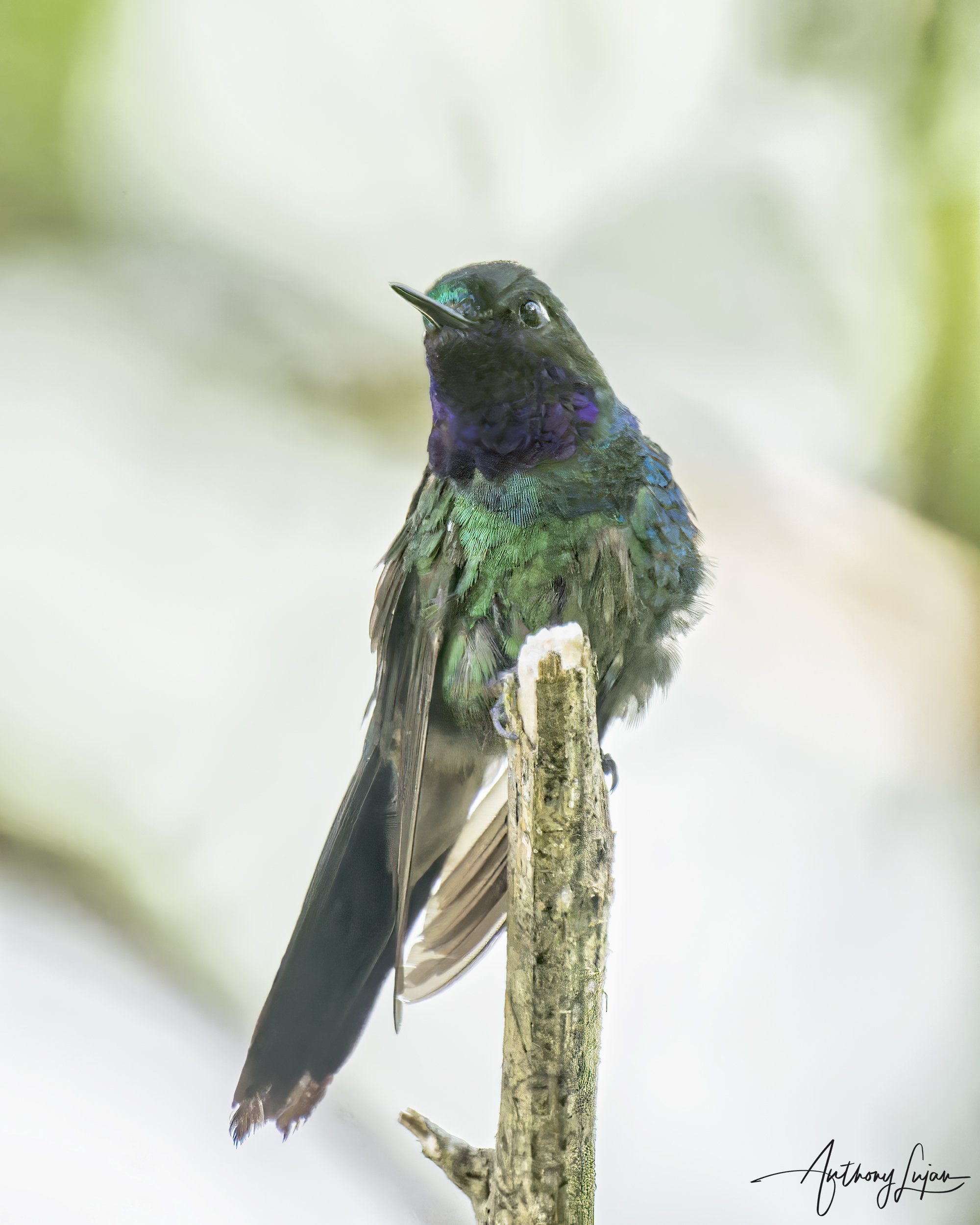
The Tourmaline Sunangel is a compact, dark hummingbird with a brilliant purple throat and blue-green forecrown, typical of moist, mossy Andean forests. It is usually encountered at forest edges, along trails, in bushy clearings, and in shrubby pastures near intact cloudforest. Although still fairly common in some areas, its dependence on humid montane forest and edges makes it vulnerable to ongoing habitat loss and degradation.
Male Description
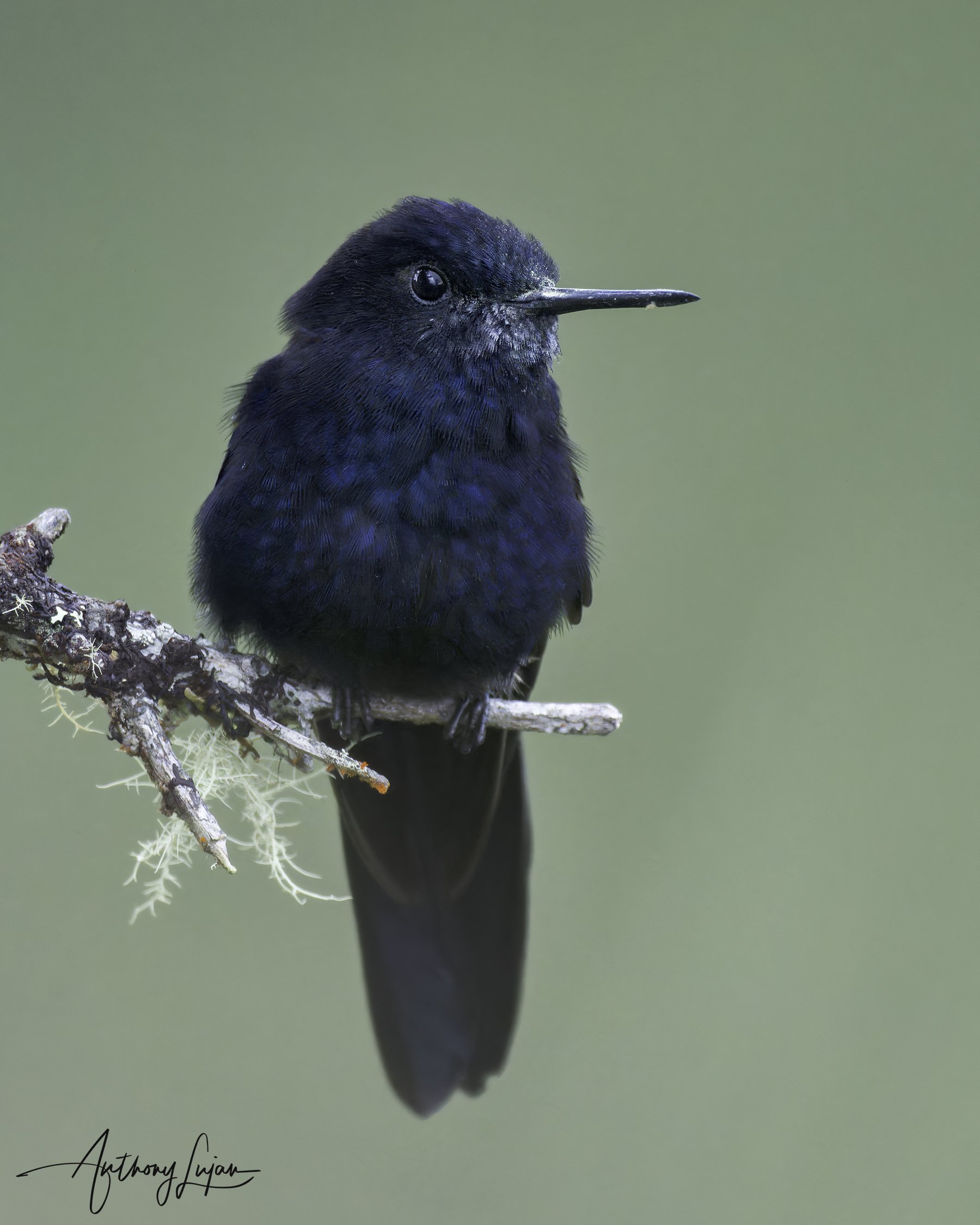
Adult males are small and dark with a fairly short, straight black bill. The head and upperparts are dusky green, with a blue-green forecrown that can flash brightly in good light. The throat bears a vivid, iridescent purple patch that contrasts sharply with the darker chest and belly. The rest of the underparts are dusky greenish to grayish, often looking nearly black in shade. The tail is fairly long and slightly notched, dark with a subtle metallic sheen. In the field, males appear as dark hummingbirds that suddenly blaze purple and blue-green when they turn toward the sun.
Female Description
Adult females are plainer, with green upperparts and a white to pale gray throat. The throat and upper breast may show light mottling or fine speckling, with the lower underparts pale grayish or buffy, sometimes with faint greenish or brownish shading on the sides. The tail is similar in shape to the male’s but lacks strong iridescence, appearing mostly dark with paler tips on the outer feathers. Females thus resemble small green-backed hummingbirds with a clean white throat and modest dark tail.
Habitat & Behavior
Tourmaline Sunangels inhabit the interior and edges of humid premontane and montane forest, especially cloudforest and elfin forest rich in mosses and epiphytes. They also use bushy clearings, shrubby pastures, and other semi-open habitats near forest, often feeding low to the ground at flowering shrubs and herbs. They usually cling to flowers to feed rather than hovering, and they also take small insects by hawking from perches and gleaning from vegetation. The species is considered largely sedentary, with only local elevational movements in parts of Colombia.
Population
The total number of mature individuals is unknown, but the species has a moderately broad range across multiple Colombian cordilleras and into Ecuador. It can be fairly common in suitable forest and edge habitats, yet deforestation, fragmentation, and conversion of montane forest to agriculture and pasture continue across much of its range. These pressures are believed to be causing a slow, ongoing decline, even though the species remains widespread enough to qualify as Least Concern.

Conservation
The Tourmaline Sunangel is listed as Least Concern due to its broad distribution and persistence in many montane forest regions, including some protected areas. However, continued loss and degradation of cloudforest and elfin forest through logging, agriculture, pasture expansion, and development reduce available habitat. Conservation actions that maintain humid montane forest, protect forest edges and ravines, and limit further clearing at mid to high elevations will support this species and other Andean sunangels.
Checkout Anthony’s playlist of this species! Click the top right dropdown to see all the videos.
Related species in the Heliangelus genus (9 species total):
Please note: The content provided in this article reflects Anthony’s personal experience and photographic approach. Results can vary depending on light, weather, location, equipment, subject behavior, and field conditions.