
Wedge-tailed Sabrewing
Scientific name: Pampa curvipennis
The Wedge-tailed Sabrewing is a large hummingbird of humid evergreen and semi‑deciduous forests and second growth from eastern and southern Mexico south into northern Guatemala, Belize, and Honduras. The total number of mature individuals is unknown, the overall population trend is decreasing, it is considered non‑migratory, and it is currently assessed as Least Concern.
At a Glance
Family: Trochilidae (hummingbirds)
Clade: Trochilini – Emeralds
Genus: Pampa — 2 species in total
Range: Eastern and southern Mexico, Yucatán Peninsula, northern Guatemala, Belize, and at least parts of Honduras
Habitat: Interior and edges of humid evergreen and semi‑deciduous forest and rainforest, tall second growth, and dense vegetation along forest edges and steep slopes
Elevation: From near sea level up to about 1,300–1,400 m (4,300–4,600 ft); more common at lower elevations
Length: About 11.5–13.5 cm (4.5–5.3 in)
Weight: Males about 6.5 g (0.23 oz); females about 5 g (0.18 oz)
Number of mature individuals: Unknown
Population trend: Decreasing
Movement: Not a migrant (resident; some may move slightly downslope after breeding)
IUCN Red List category: Least Concern
Name Origin
The genus name Pampa is a historical geographical term that has been retained in modern taxonomy even though this species is a bird of humid forests rather than open pampas. The species name curvipennis means “curved‑winged,” referring to the long, slightly curved (“sabre‑like”) wings typical of sabrewings. The English name “Wedge-tailed Sabrewing” highlights both the wedge‑shaped tail and the sabre‑like wing shape.
Taxonomy
Pampa curvipennis belongs to the emerald clade (tribe Trochilini) within subfamily Trochilinae. Historically, all large sabrewings in this group were placed in Campylopterus curvipennis with several subspecies. Recent taxonomic revisions split that complex into three species: Curve-winged Sabrewing (Pampa curvipennis in a narrow sense), Long-tailed Sabrewing (P. excellens), and Wedge-tailed Sabrewing (P. pampa). Under the taxonomy you are following here, Wedge-tailed Sabrewing is treated as Pampa curvipennis with three subspecies, matching your template, and Pampa as a genus contains two species overall.
The Wedge-tailed Sabrewing in this treatment is a large sabrewing of eastern and southern Mexico, the Yucatán Peninsula, northern Guatemala, Belize, and at least parts of Honduras. It inhabits humid evergreen and semi‑deciduous forests, tall second growth, and dense forest‑edge vegetation from the lowlands into foothills.
Subspecies and Distribution
Three subspecies:
Pampa curvipennis curvipennis (“Curve-winged”)
Distribution: Eastern and southern Mexico from southwestern Tamaulipas through southeastern San Luis Potosí, Veracruz, and northeastern Puebla to northern Oaxaca. This subspecies occupies humid and semi‑deciduous forests and their edges along the Gulf slope and eastern Sierra Madre Oriental into northern Oaxaca.Pampa curvipennis excellens (“Long-tailed”)
Distribution: Endemic to southeastern Mexico, centered around the Sierra de los Tuxtlas, Jesús Carranza, and Uxpanapa in southern Veracruz and eastern Oaxaca. This long‑tailed form is restricted to this Gulf‑slope region, inhabiting humid evergreen and semi‑deciduous forest and tall second growth.Pampa curvipennis pampa (“Wedge-tailed”)
Distribution: Yucatán Peninsula south into northern Guatemala and Belize, extending east into Honduras. This wedge‑tailed subspecies occupies humid lowland and foothill forests, semi‑deciduous forest, and tall second growth across the Yucatán and neighboring parts of northern Central America.
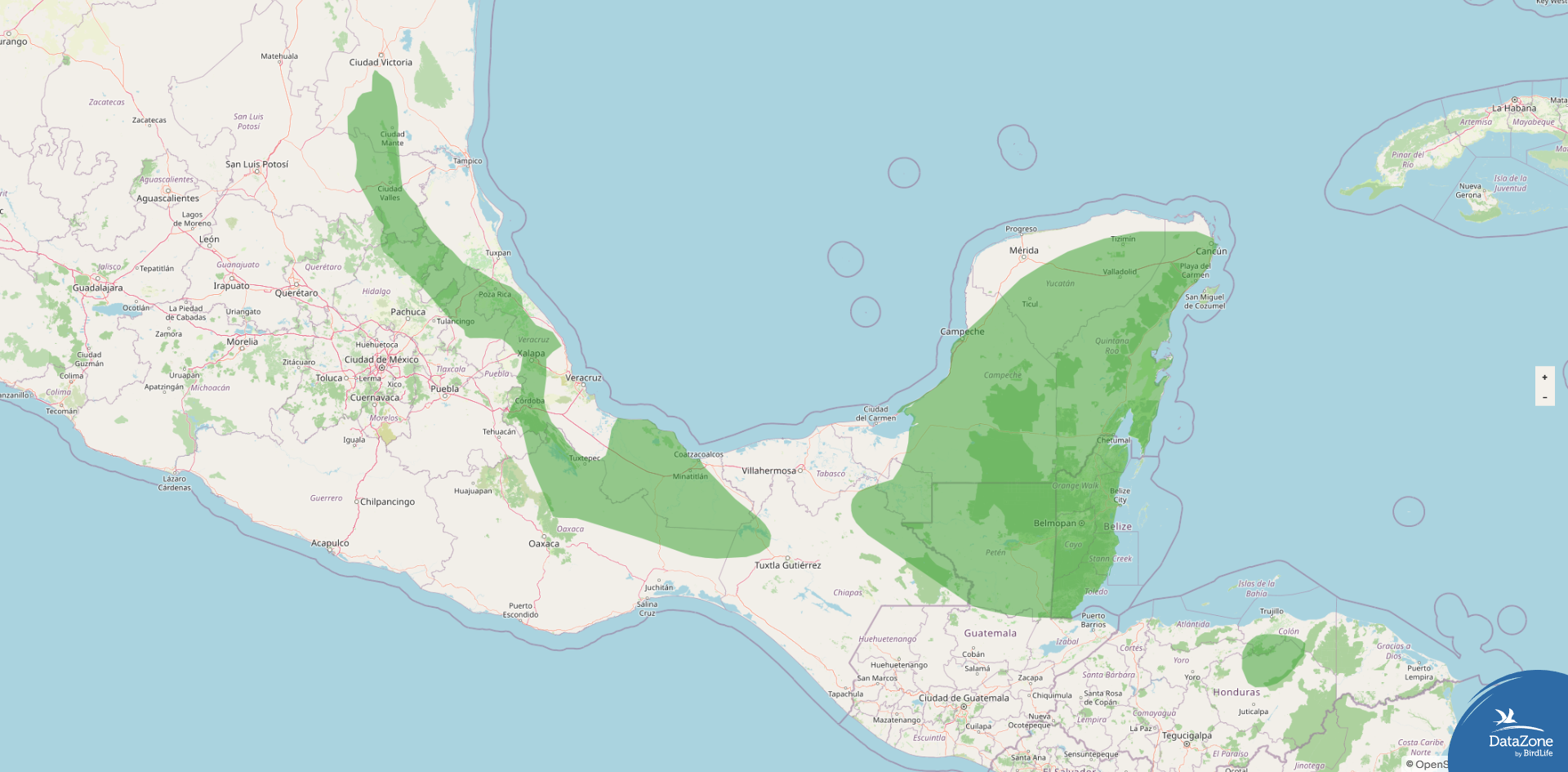
Legend
Green Resident
Species Overview
The Wedge-tailed Sabrewing is one of the largest hummingbirds in Mesoamerica, with a metallic green body, pale gray underparts, and a long, wedge‑shaped tail. It favors humid evergreen and semi‑deciduous forests and dense second growth, often along forest edges, ravines, and steep slopes. Within suitable habitat it can be fairly common locally, but forest loss, fragmentation, and degradation throughout its range are believed to be causing a slow but persistent population decline.
Male Description
Adult males are large hummingbirds, 11.5–13.5 cm long, with a longish, straight, stout black bill. The upperparts, including crown and back, are metallic green to golden‑green, sometimes with bronzy tones. The face is darker with a pale post‑ocular spot behind the eye. The throat and upper breast are dark, often bluish‑green or greenish with a dusky wash, merging into pale gray to grayish‑white lower underparts.
The tail is long and wedge‑shaped: the central feathers are shorter and the outer feathers progressively longer, creating a broad wedge when spread. Tail feathers are bronzy‑green to dark with paler or grayish tips, and in some subspecies the tail and uppertail coverts show more elongated or pointed feathers. The overall impression is of a large, heavy hummingbird with a bright green back, pale gray underside, and a long, wedge‑shaped tail.
Female Description
Females are slightly smaller and slimmer but otherwise similar in plumage. The upperparts are metallic green, and the underparts are pale gray to off‑white, often with some dusky mottling or faint spotting on the breast. The tail is wedge‑shaped and slightly shorter than the male’s, with similar coloration. Juveniles resemble females, with slightly duller greens and fresher feather edges; young males gradually develop a more robust build and more fully wedge‑shaped tail with age.
Habitat & Behavior
Wedge-tailed Sabrewings inhabit the interior and edges of humid evergreen forest, semi‑deciduous forest, tall second growth, and dense vegetation on steep hillsides and ravines. They are often encountered in shady, leafy undergrowth, at forest edges, and along forested streams and gullies. They range from near sea level up to about 1,300–1,400 m and are more common at lower elevations, particularly in lowland and foothill forests.
They feed mainly on nectar from a broad range of forest flowers, including shrubs, understory plants, vines, and flowering trees. Foraging is typically at low to mid‑levels; birds often work “walls” of vegetation along forest edges and steep slopes, probing one flower after another. They also take small insects and spiders, hawking them from perches or gleaning within dense foliage. Wedge-tailed Sabrewings can be quite bold and curious around humans, and their flight ranges from typical rapid hummingbird wingbeats to slower, more powerful wingbeats reminiscent of swifts.
Breeding
The breeding season generally runs from about March to July in much of the range, varying locally with rainfall and flowering. Males are polygynous and gather at leks—traditional display sites—where several males sing persistently from hidden perches in dense vegetation. Their songs are complex, variable series of insect‑like chips, squeaks, squeals, and gurgling or warbled notes, delivered with occasional wing or tail movements.
Females alone build the nest, a well‑camouflaged cup of plant fibers, moss, and spiderweb, often attached to a horizontal branch in the forest interior or edge. The nest is usually placed a few meters above the ground and disguised with mosses and lichens. The typical clutch is two white eggs. The female incubates and cares for the chicks; incubation lasts about two weeks, and fledging occurs roughly three weeks after hatching, similar to other large sabrewings.
Movement
The Wedge-tailed Sabrewing is considered a resident species and is treated as not a migrant. It remains in its range year‑round, though some individuals may move to slightly lower elevations after breeding or shift locally in response to flowering and weather patterns. These movements are short‑range and do not constitute true seasonal migration.
Population
The global number of mature individuals is unknown. The species has a relatively broad range across eastern and southern Mexico, the Yucatán Peninsula, and parts of northern Central America, and it can be fairly common locally in suitable forest and tall second growth. However, ongoing deforestation, forest degradation, and fragmentation throughout this region are likely causing a slow decline, and the species is increasingly restricted to remaining forest tracts and semi‑natural habitats.

Conservation
The Wedge-tailed Sabrewing is currently assessed as Least Concern, reflecting its fairly wide distribution and continued presence in many areas. Nevertheless, its decreasing trend, dependence on humid and semi‑deciduous forest, and sensitivity to forest loss make habitat conservation critical. Protecting lowland and foothill forests, maintaining tall second growth and dense forest edges, and conserving ravines and steep‑slope vegetation are all important for sustaining populations. Shade‑grown agroforestry systems that retain forest‑like structure can also provide valuable habitat.
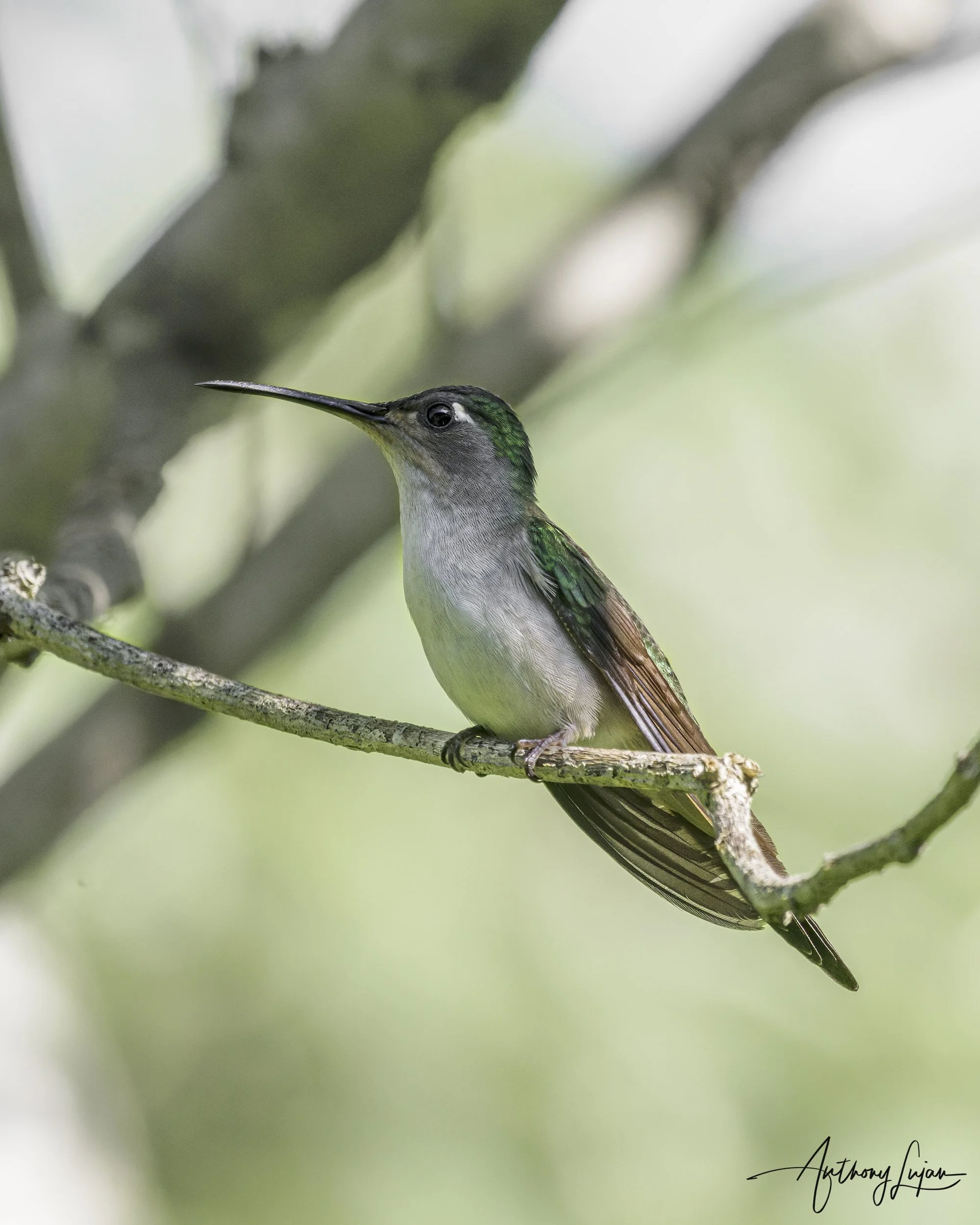
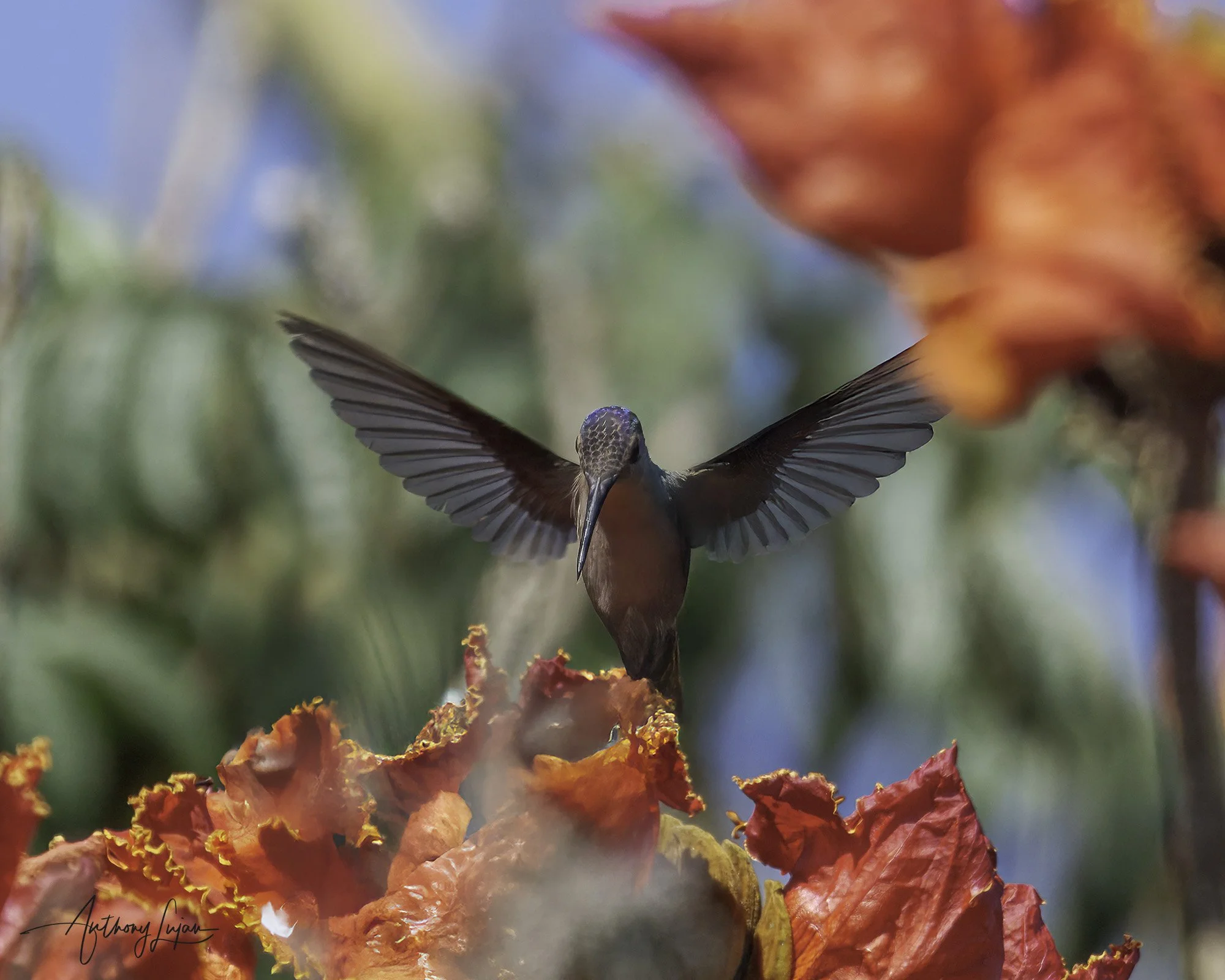
Below is the Wedge-tailed Sabrewing (Pampa curvipennis curvipennis)
Photographed at Chavarrillo, Veracruz, Mexico, Emiliano Zapata, Veracruz
These individuals belong to the subspecies curvipennis (Curve-winged), which is found across eastern and southern Mexico, including southwestern Tamaulipas, southeastern San Luis Potosí, and south through Veracruz and northeastern Puebla to northern Oaxaca. It inhabits humid tropical and subtropical forest edges, second-growth, and plantations, usually at low to mid elevations. This form is large and vocal, with broad rounded wings and a deeply notched tail, showing a shimmering green body, pale underside, and a violet-purple gorget that flares when displaying.
Checkout Anthony’s playlist of this species! Click the top right dropdown to see all the videos.
Related species in the Pampa genus (2 species in total):


Please note: The content provided in this article reflects Anthony’s personal experience and photographic approach. Results can vary depending on light, weather, location, equipment, subject behavior, and field conditions.