
Scientific name: Ocreatus underwoodii
The White-booted Racket-tail is a tiny, long‑tailed hummingbird of humid montane and cloud forests from northern Venezuela through Colombia to southwestern Ecuador. The total number of mature individuals is unknown, the overall population trend is decreasing, it is considered an altitudinal migrant, and it is currently assessed as Least Concern.
At a Glance
Family: Trochilidae (hummingbirds)
Clade: Heliantheini – Brilliants
Genus: Ocreatus — 3 species in total
Range: Coastal and Andean mountains of northern Venezuela, the Andes of Colombia, and the Pacific slope to southwestern Ecuador
Habitat: Humid montane and cloud forests, especially forest edges, clearings, roadsides, and semi‑open secondary growth with flowering shrubs and small trees
Elevation: Mostly 1,600–2,200 m (5,200–7,200 ft), recorded from about 600 to 4,000 m (2,000–13,000 ft)
Length: Males about 11–15 cm (4.3–5.9 in) including the long outer tail feathers; females much shorter‑tailed
Weight: About 2.5–3 g (0.09–0.11 oz)
Number of mature individuals: Unknown
Population trend: Decreasing
Movement: Altitudinal Migrant (seasonal elevational movements)
IUCN Red List category: Least Concern
Name Origin
The genus name Ocreatus refers to “greaves” or “leggings,” alluding to the conspicuous fluffy leg “boots” found in racket‑tails. The species name underwoodii honors British naturalist C. F. Underwood, an early collector in Central and South America. The English name “White-booted Racket-tail” describes the males’ white leg puffs and the elongated outer tail feathers that end in small racket‑like discs.
Taxonomy
Ocreatus underwoodii is part of the “brilliants” (tribe Heliantheini) within subfamily Lesbiinae. The genus Ocreatus contains three species recognized by most current authorities: White-booted Racket-tail (O. underwoodii), Peruvian Racket-tail (O. peruanus), and Rufous-booted Racket-tail (O. addae). The White-booted Racket-tail occupies the northern portion of the group’s range, from the Venezuelan Coastal Range through the Andes of Colombia to the western slope in southwestern Ecuador.
It inhabits temperate and subtropical Andean zones, favoring humid montane and cloud‑forest edges, clearings, and semi‑open secondary forests. Birds occur both on coastal ranges in northern Venezuela and throughout the three Andean cordilleras of Colombia, then south along the Pacific slope into southwestern Ecuador.
Subspecies and Distribution
Five subspecies:
Ocreatus underwoodii polystictus
Distribution: Coastal mountains of northern Venezuela (Carabobo to Miranda). This subspecies occurs in the Venezuelan Coastal Range between Carabobo and Miranda states, inhabiting humid montane forest and edges at mid elevations.Ocreatus underwoodii discifer
Distribution: Northwestern Venezuela (Zulia and Falcón to Táchira and western Barinas) and northern Colombia (Norte de Santander). Found in the Andes and foothills of northwestern Venezuela, then west into adjoining northern Colombia.Ocreatus underwoodii underwoodii (nominate)
Distribution: Eastern Andes of Colombia. Occurs along the Eastern Cordillera from northern to central Colombia, typically in humid montane forest and cloud‑forest edges.Ocreatus underwoodii incommodus
Distribution: Western and Central Andes of Colombia. Found in Colombia’s Western and Central Andes, occupying similar elevational zones in humid forest and second growth.Ocreatus underwoodii melanantherus
Distribution: Western slope from southwestern Colombia (Nariño) to southwestern Ecuador. Occurs on the Pacific slope from Colombia’s Nariño Department south into southwestern Ecuador, where it inhabits cloud‑forest edges and semi‑open montane habitats.
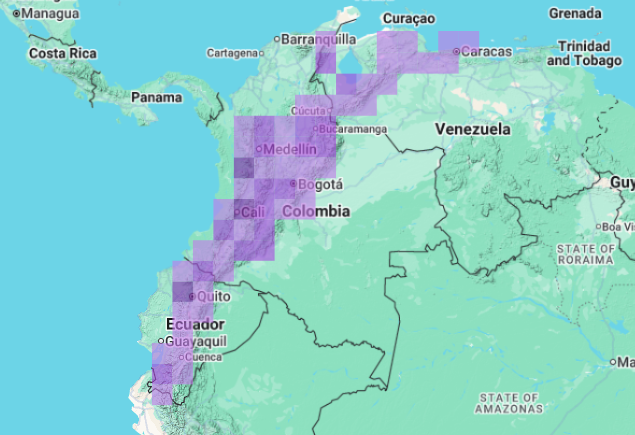
Legend
Purple Resident
Species Overview
The White-booted Racket-tail is an iconic Andean hummingbird, especially the male, with its bright green body, large white leg puffs, and long outer tail feathers ending in small, dark rackets. It is energetic and agile, darting among flowers at forest edges, along roadsides, and in gardens near cloud forests. Across much of its range it is a familiar visitor to feeders at Andean lodges and rural homes, though overall the species is considered to be declining slowly as montane forests are degraded and fragmented.
Male Description
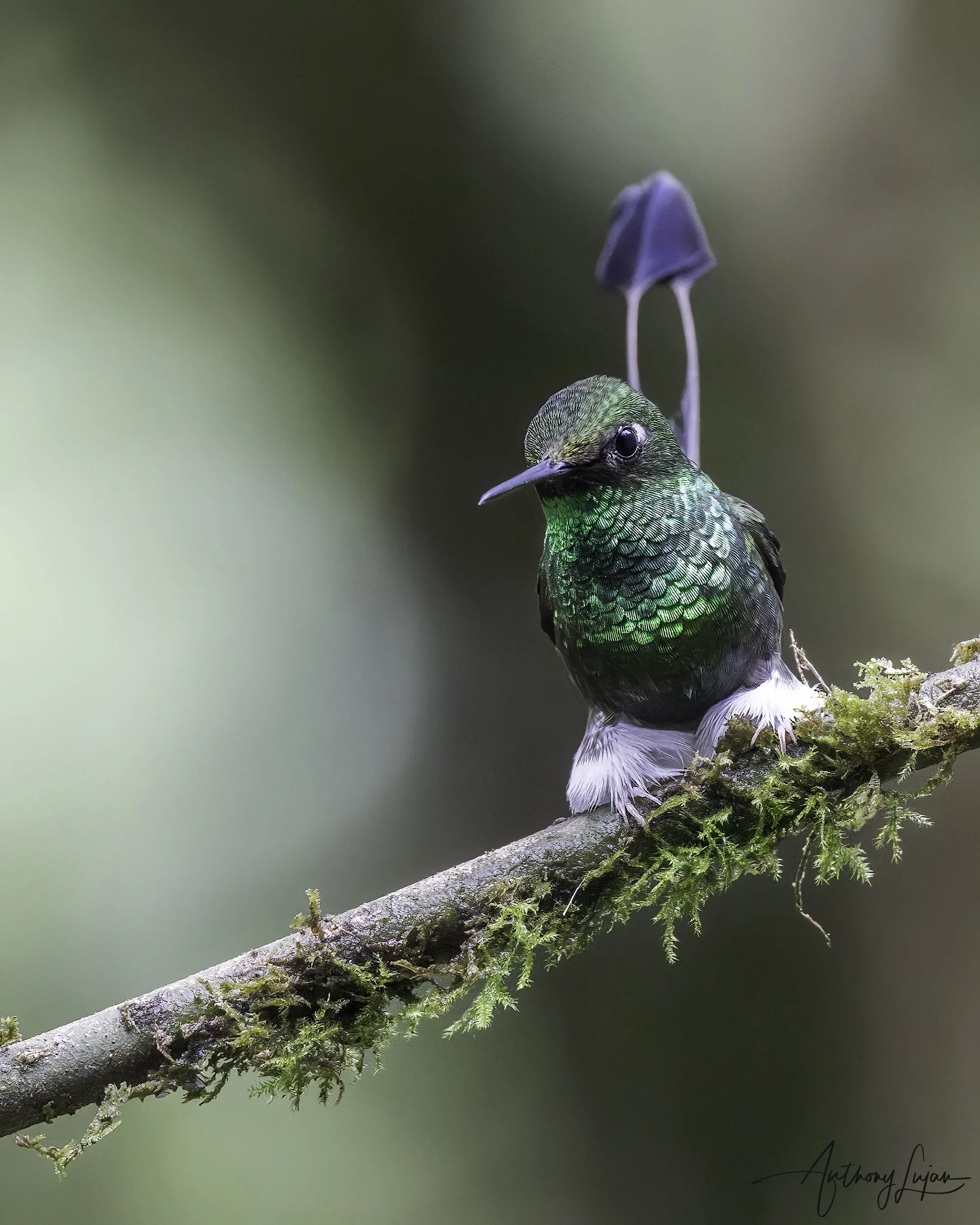
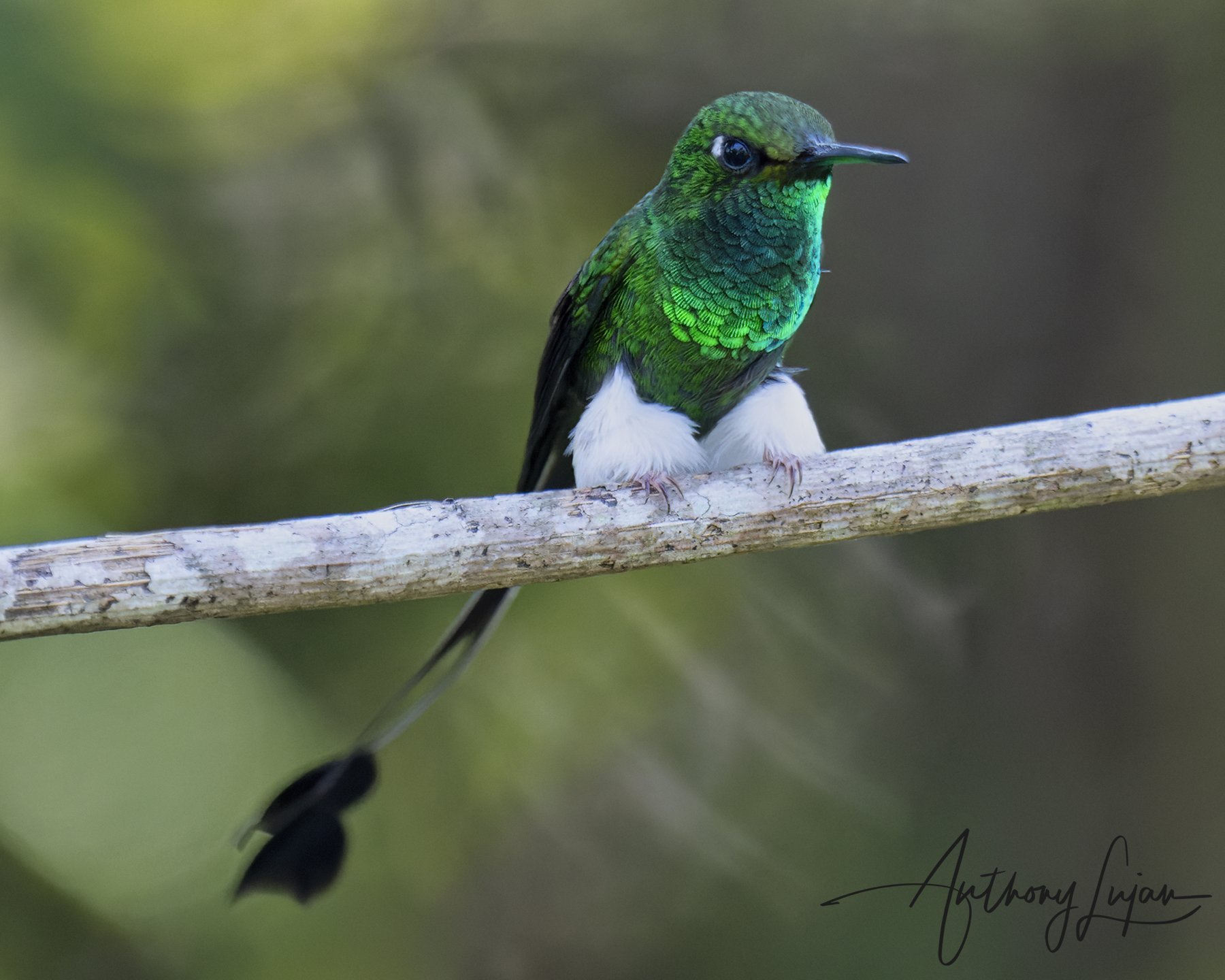
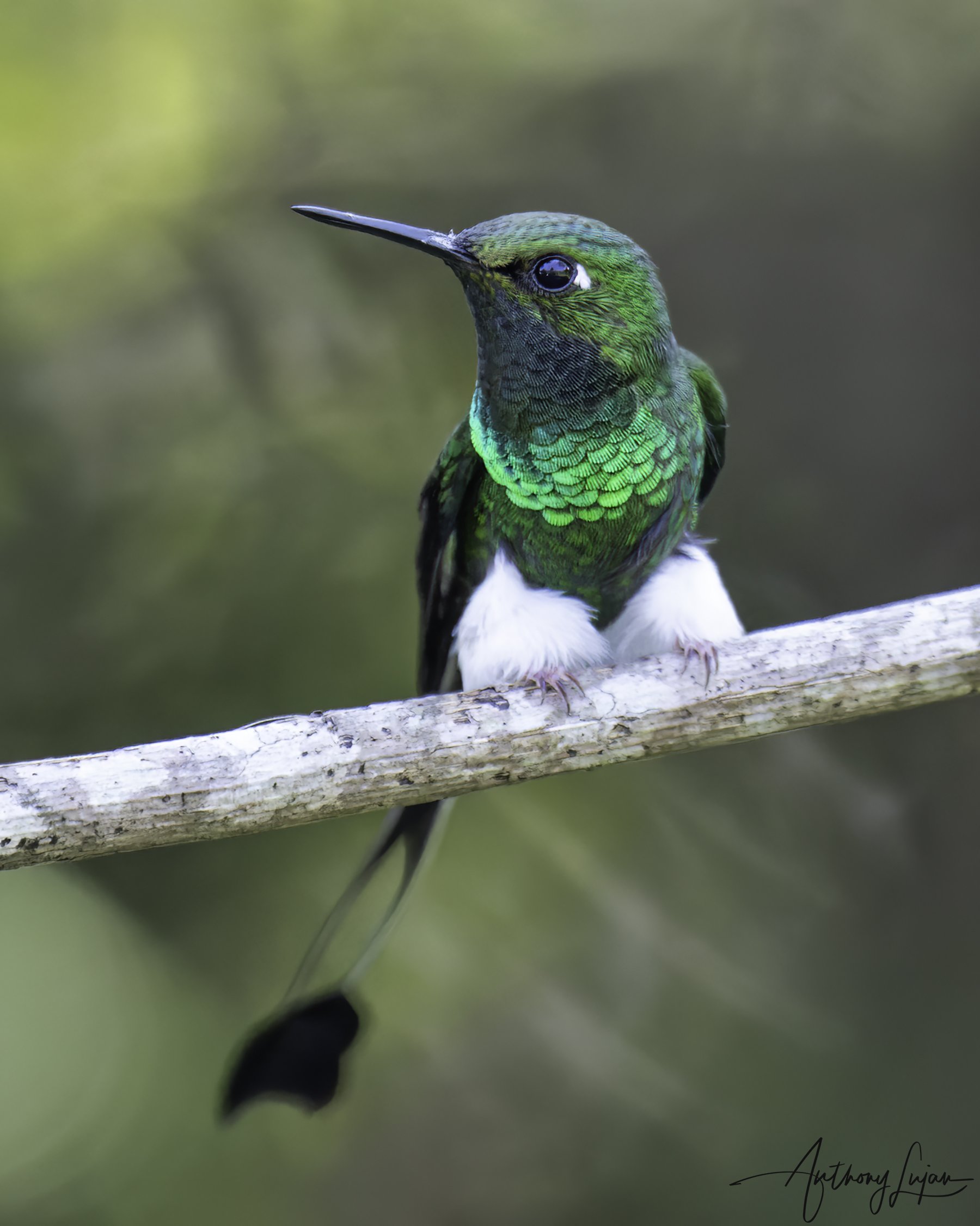
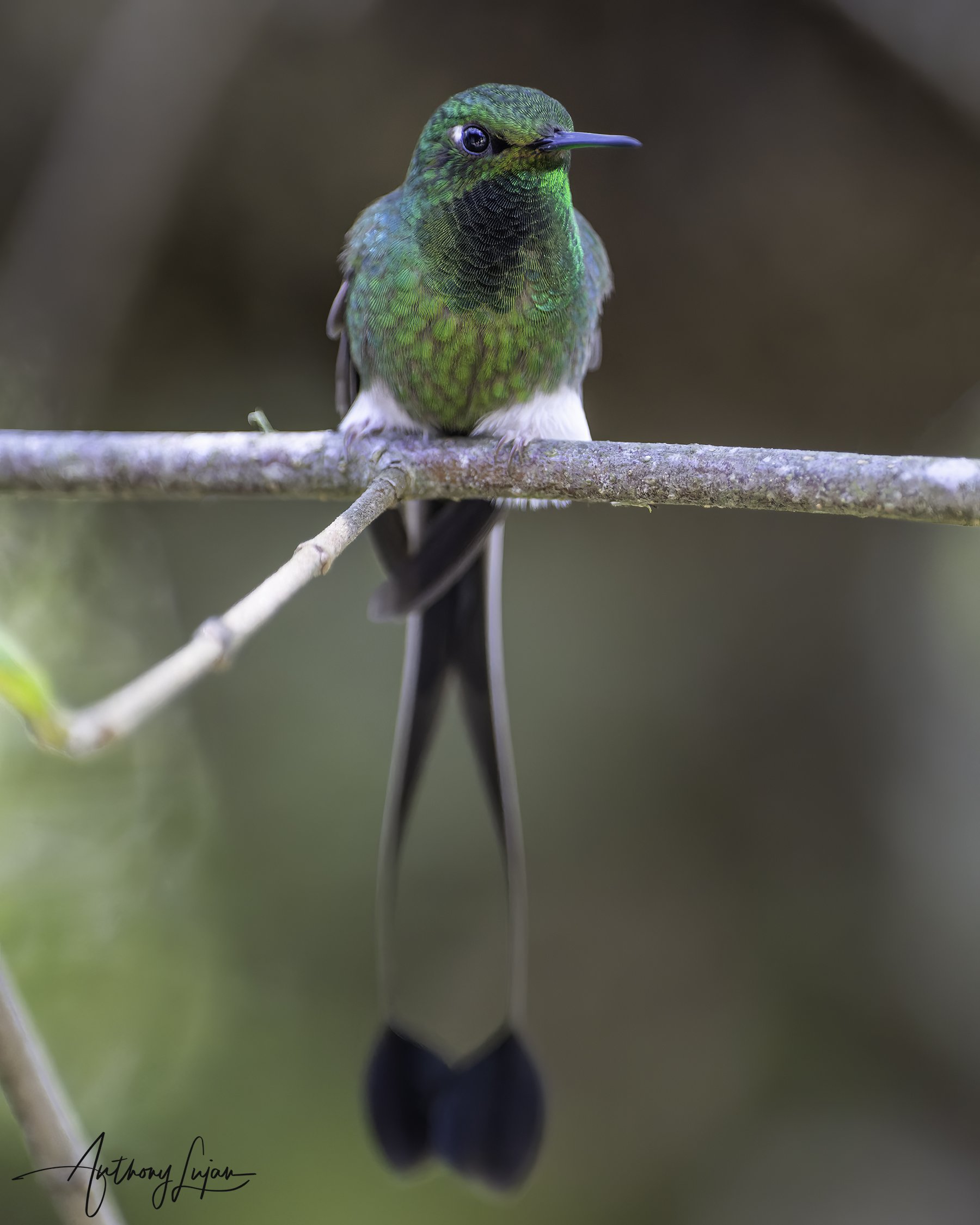
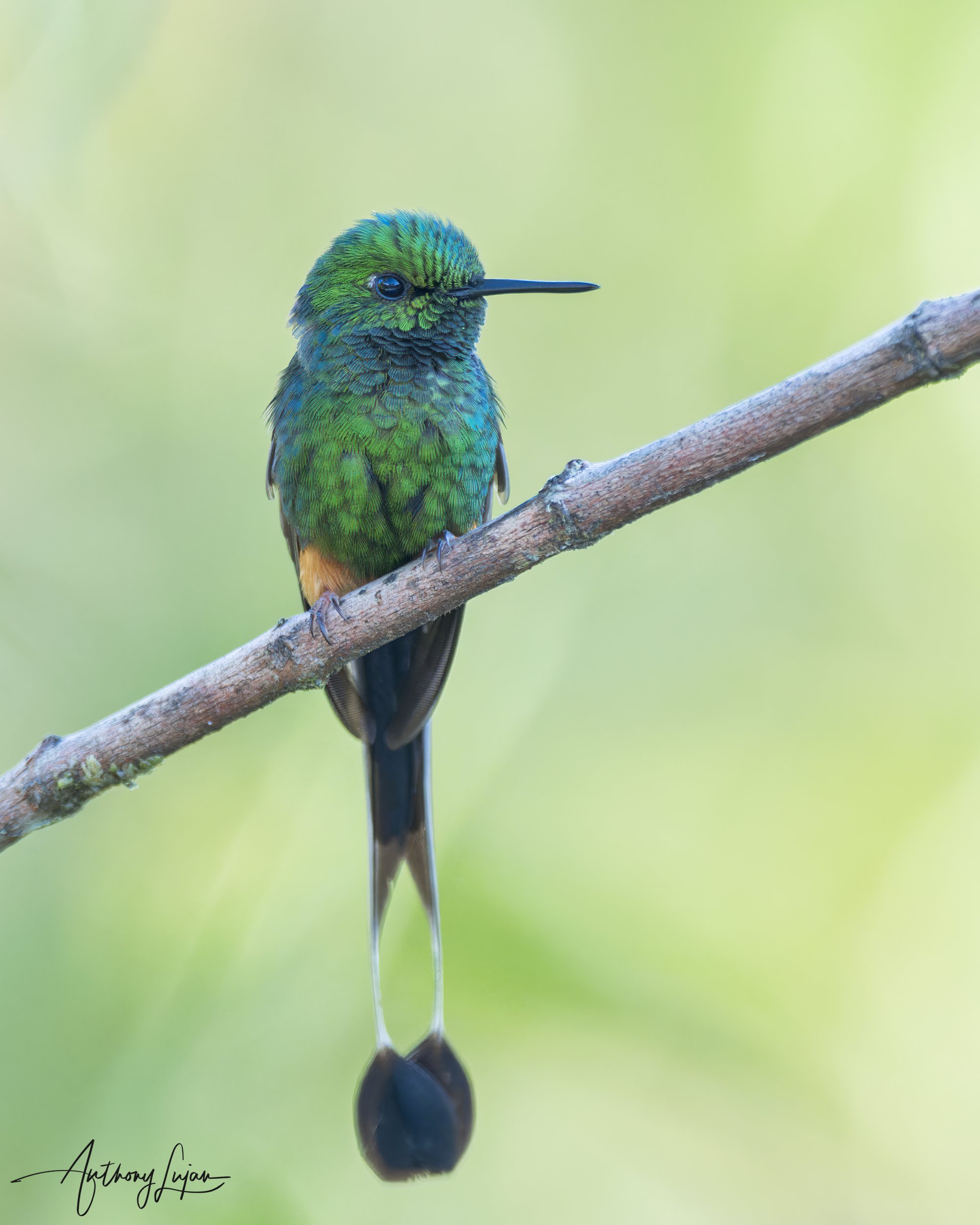
Adult males are tiny with compact bodies and very long outer tail feathers. The head and upperparts are bright metallic green, with a slightly darker crown and back. The throat and upper breast are glittering green, which can blend into a paler whitish or grayish belly. The legs are adorned with conspicuous, bushy white puffs of feathers, giving the “white‑booted” look.
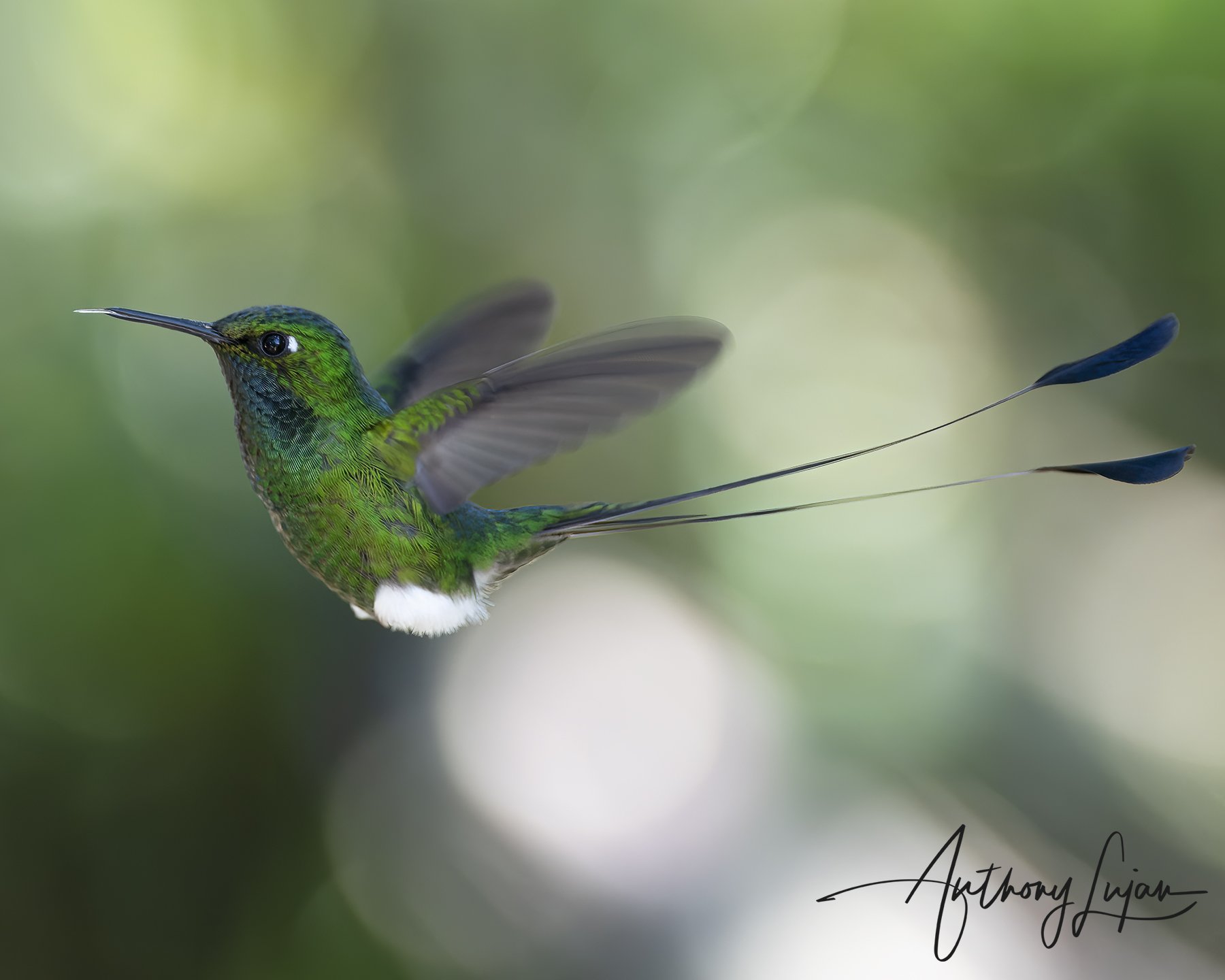
The tail is deeply forked, with the two central feathers relatively short and the outer tail feathers extended into long, narrow shafts that end in small, rounded or spatulate dark discs—rackets. These rackets do not cross but can be flicked and swung during flight and display. The bill is straight, short, and black. In hovering flight, the combination of glowing green body, white leg boots, and swinging rackets makes the male unmistakable.
Female Description
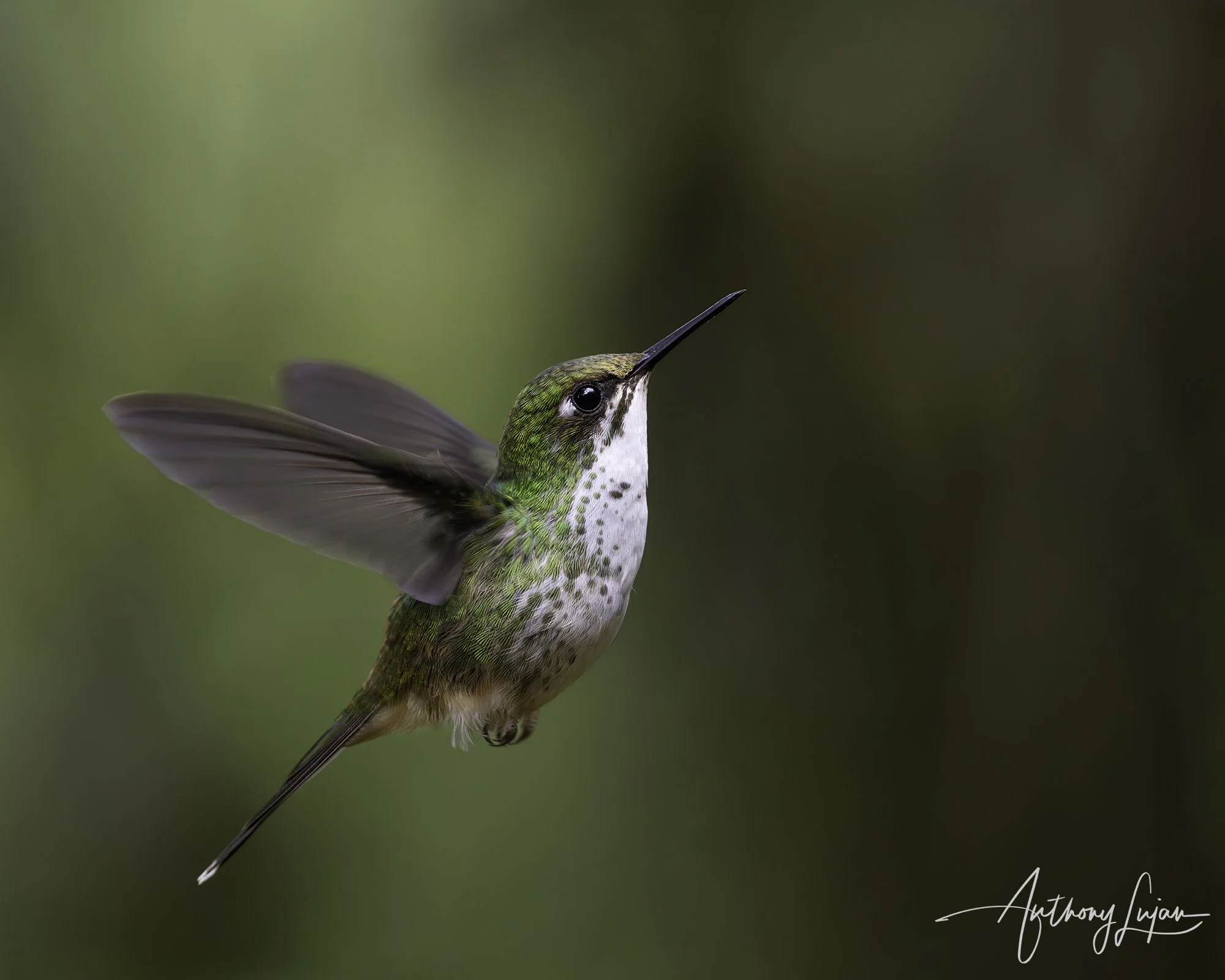
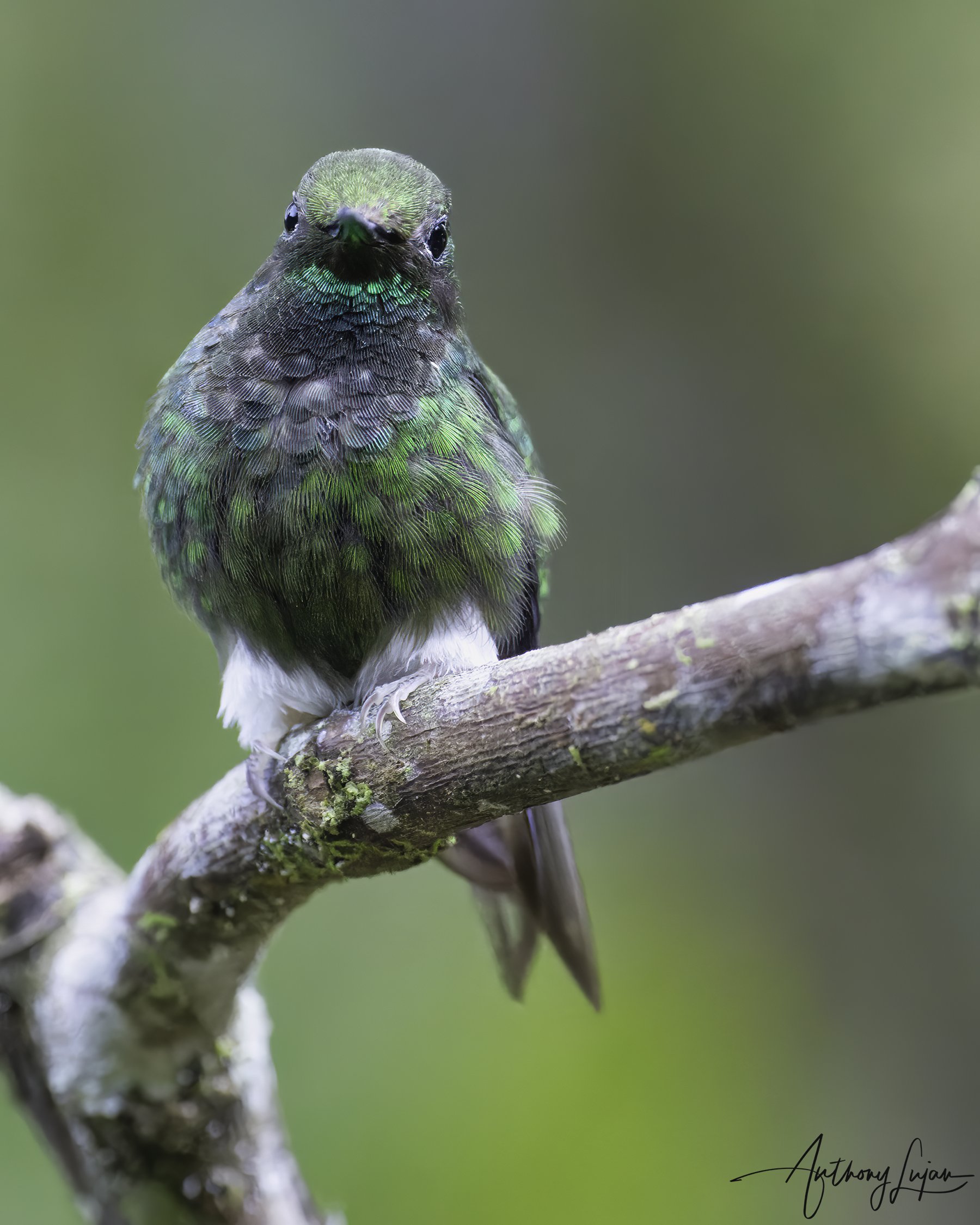
Females lack the elongated racket‑tipped outer tail feathers. The upperparts are green like the male’s, but the underparts are whitish or buffy with green spotting or scaling on the throat and sides, and a buff‑gray belly. The leg puffs are present but smaller and less flamboyant than in males. The tail is shorter and only moderately forked, with greenish central feathers and outer feathers that may show paler tips or edges but do not form distinct rackets. Juveniles resemble females; young males gradually develop more pronounced leg puffs and lengthen their outer tail feathers as they mature, with rackets forming after the first molt.
Habitat & Behavior
White-booted Racket-tails inhabit humid montane and cloud forests and their edges, as well as shrubby clearings, roadsides, and semi‑open secondary growth at mid to high elevations. They are most numerous between about 1,600 and 2,200 m, but occur from as low as 600 m up to around 4,000 m where suitable habitat and flowering plants exist. Birds often forage along forest borders, in clearings, and around gardens and feeders, making them relatively easy to observe where they occur.
They feed mainly on nectar from a wide variety of Andean flowers, including shrubs, vines, and small trees typical of cloud‑forest edges and disturbed habitats. Foraging is usually at mid‑levels, with birds hovering at blossoms or briefly perching to feed. They also take small insects, caught on the wing or gleaned near flowers. White-booted Racket-tails can be surprisingly aggressive for their size, often defending small feeding territories and chasing other hummingbirds away from favored flowers and feeders.
Breeding
The breeding season varies geographically but generally aligns with wet seasons and peaks in flower availability in Andean montane zones. As with other hummingbirds, the female alone is responsible for nest construction and chick‑rearing. She builds a tiny cup nest of soft plant fibers and moss bound with spiderweb, attached to a slender branch or fork in shrubs or small trees at forest edges or in semi‑open woodland. The outside of the nest is usually camouflaged with lichens and small bark fragments.
The clutch normally consists of two white eggs. The female incubates for around two weeks and continues to care for the chicks until fledging, which typically occurs about three weeks after hatching. Detailed timing can vary with local climate and altitude, but the overall breeding biology is similar to that of other small brilliants and racket‑tails.
Movement
The White-booted Racket-tail is an altitudinal migrant. It makes seasonal elevational movements along Andean slopes, moving between lower and higher zones as flowering patterns and climate change over the year. In some areas birds may descend to lower elevations outside the breeding season or move upslope when high‑elevation shrubs are in peak bloom. These movements occur along the same general mountain slopes and within the same regional ranges, rather than involving long‑distance latitudinal migration.
Population
The total number of mature individuals is unknown. The species has a fairly broad distribution from northern Venezuela through Colombia to southwestern Ecuador and is locally common in suitable habitats, especially near cloud‑forest edges and along popular birding routes and lodges. However, continued deforestation, forest degradation, and fragmentation at mid and high elevations likely contribute to a slow overall decline. The altitudinal migratory behavior means that birds rely on a vertical continuum of habitat, making them sensitive to habitat breaks along elevational gradients.

Conservation
The White-booted Racket-tail is currently assessed as Least Concern due to its wide range and regular occurrence in multiple protected areas and relatively intact montane forests. Its use of forest edges, secondary growth, and gardens gives it some resilience compared with more interior‑forest specialists. Nonetheless, ongoing clearing and fragmentation of Andean montane forests for agriculture, cattle pasture, and infrastructure development pose long‑term risks. Conservation of continuous cloud‑forest belts, maintenance of edge and secondary habitats with rich flowering plant communities, and protection of nectar resources around Andean communities and lodges are important for supporting healthy populations.
Below are individuals of the White-booted Racket-tail (Ocreatus underwoodii incommodus)
Photographed at:
La Florida - Bosque de Las Aves, Valle del Cauca, Colombia
Finca Alejandría "El Paraíso de Los Colibríes", Valle del Cauca, Colombia
These individuals belong to the subspecies incommodus, which occurs on the western and central Andes of Colombia. It is typically found along humid montane forest edges, often between 1,500–2,700 meters. Males are distinguished by their long, racket-shaped tail streamers and green upperparts with a white leg puff, while females have shorter tails and whitish underparts spotted with green.
Below are individuals of the White-booted Racket-tail (Ocreatus underwoodii underwoodii)
Photographed at:
Finca La Esperanza, Cundinamarca, Colombia
These individuals belong to the subspecies underwoodii, found on the eastern Andes of Colombia. This form is typically found at slightly higher elevations in montane cloud forest and shrubby clearings. Males display the characteristic racket tail and bright iridescent green plumage, but may have subtle structural or plumage differences compared to incommodus, often discernible only with close range observation or vocal differences.
Checkout Anthony’s playlist of this species! Click the top right dropdown to see all the videos.
Related species in the Ocreatus genus (3 species in total):
Please note: The content provided in this article reflects Anthony’s personal experience and photographic approach. Results can vary depending on light, weather, location, equipment, subject behavior, and field conditions.