
Recognizing a species involves more than comparing feathers. Hummingbirds that look nearly identical can differ in their genetics, vocalizations, movements, and ecology. Understanding those differences requires research, sometimes bringing together evidence collected over many years.
The 2026 eBird/Clements taxonomy update illustrates this process through two hummingbird changes: the recognition of two species within the former Giant Hummingbird and a revision to the subspecies groups of the Amazilia Hummingbird.
These updates do more than change names on a checklist. They shape how observations are recorded, how researchers study populations, and how we understand hummingbird diversity.
Giant Hummingbird: The Evidence for Two Species
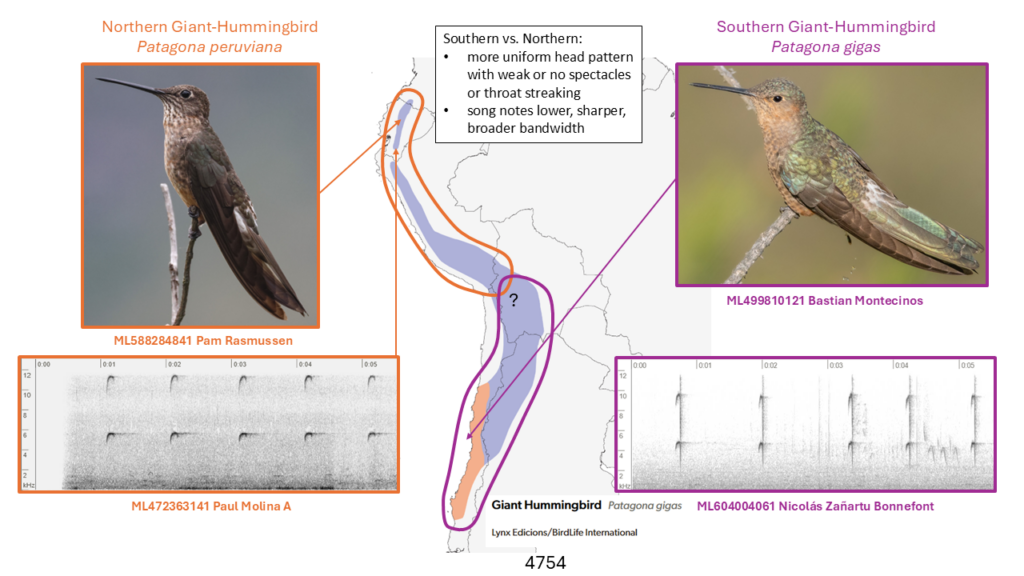
Previously, the eBird/Clements Checklist recognized the Giant Hummingbird (Patagona gigas) as one species with two subspecies. The 2026 update recognizes those forms as separate species:
Northern Giant-Hummingbird (Patagona peruviana)
Southern Giant-Hummingbird (Patagona gigas)
Both are monotypic, meaning neither currently has recognized subspecies.
The split reflects several lines of evidence, including differences in genetics, vocalizations, plumage, body proportions, ecology, and migration. Researchers also documented the two forms occurring together, helping establish that their differences represent distinct species rather than simply geographic variation within one species.
The scientific case rests on the combined evidence. Their similar appearance alone does not reveal the full extent of their differences.
Migration Reveals a Hidden Difference
One of the most striking distinctions is their movement through the Andes.
The Southern Giant-Hummingbird breeds in parts of Chile, Bolivia, and Argentina, then migrates northward, reaching central and northern Peru during the austral winter. The Northern Giant-Hummingbird, by contrast, is considered resident within its Andean range.
These different strategies help explain why location alone cannot always identify them. A giant hummingbird observed in Peru, for example, could be a resident Northern or a migrating Southern, depending on the location and circumstances.
Their seasonal overlap also creates opportunities for further research. Scientists are still working out the exact distributions and timing of movements of the two species.
Why Identification Requires Care
Recognizing two species does not automatically make them easy to distinguish in the field.
eBird identifies several potential visual clues for Northern Giant-Hummingbird, including a bolder white eye ring and spot behind the eye, more strongly marked throat, and subtly longer wings relative to the tail. These differences can be difficult to assess reliably.
Recordings of songs and calls are particularly valuable. Photographs can also help, especially when they document several features rather than a single suggestive marking.
For observations that cannot confidently be assigned to either species, eBird provides a Northern/Southern Giant-Hummingbird reporting option. Recording uncertainty preserves useful information without forcing an identification that the evidence cannot support.
Amazilia Hummingbird: A Change Below the Species Level
The second update concerns the Amazilia Hummingbird (Amazilis amazilia). This change affects subspecies groups rather than species boundaries.
The former “Amazilia” and “Blue-throated” groups have been combined into a “South Peruvian” group:
Former group Subspecies Updated group Amazilia Amazilis amazilia amazilia South Peruvian Blue-throated Amazilis amazilia caeruleigularis South Peruvian
The subspecies amazilia occurs in arid coastal areas of west-central Peru. Caeruleigularis occurs in the foothills of southwestern Peru, in the Nazca Valley of Ica.
Both subspecies remain recognized. The revision reduces the subspecies groups from six to five, without changing the number of species or recognized subspecies.
The five groups are now Green-tailed, Azuay, Montane, North Peruvian, and South Peruvian.
Details: Clements v2026 taxa 5160–5167
Two existing groups are combined for Amazilia Hummingbird Amazilis amazilia.
Was:
Amazilia Hummingbird (Green-tailed) Amazilis amazilia dumerilii (monotypic)
Amazilia Hummingbird (Azuay) Amazilis amazilia azuay (monotypic)
Amazilia Hummingbird (Montane) Amazilis amazilia alticola (monotypic)
Amazilia Hummingbird (North Peruvian) Amazilis amazilia leucophoea (monotypic)
Amazilia Hummingbird (Amazilia) Amazilis amazilia amazilia (monotypic)
Amazilia Hummingbird (Blue-throated) Amazilis amazilia caeruleigularis (monotypic)
Now:
Amazilia Hummingbird (Green-tailed) Amazilis amazilia dumerilii (monotypic)
Amazilia Hummingbird (Azuay) Amazilis amazilia azuay (monotypic)
Amazilia Hummingbird (Montane) Amazilis amazilia alticola (monotypic)
Amazilia Hummingbird (North Peruvian) Amazilis amazilia leucophoea (monotypic)
Amazilia Hummingbird (South Peruvian) Amazilis amazilia amazilia/caeruleogularis
subspecies: amazilia and caeruleogularis
This distinction matters because a subspecies group is not the same as a species. Combining groups does not necessarily mean that the populations within them have lost their recognized differences.
Why Taxonomy Updates Matter
More Accurate Research
Species are basic units in studies of distribution, behavior, migration, and population trends. When two distinct species are treated as one, their data can become mixed, potentially obscuring different movements or ecological needs.
Recognizing Northern and Southern Giant-Hummingbirds allows researchers to investigate each species more precisely, while retaining uncertain records for careful review.
Better Conservation Assessments
Understanding what a species is, and where it occurs, is fundamental to assessing its conservation needs.
A combined range or population estimate can conceal differences between distinct species. Separating them allows researchers to examine their habitats, threats, and population trends individually. A taxonomic split does not by itself establish that either species is threatened, but it provides a clearer basis for evaluating each.
More Useful Observations
Taxonomic revisions also guide birders' and photographers' contributions. Accurate locations, dates, photographs, and audio recordings can help researchers refine distributions and revisit historical records.
The Giant Hummingbird split shows why thoroughly documenting an observation can matter long after the original encounter. Evidence collected under an older name may help answer questions that were not yet being asked.
A Note from Behind the Camera
I have photographed the Southern Giant-Hummingbird, but have yet to photograph the Northern. This update gives those images a more precise scientific context and reinforces the value of keeping detailed records. Photography can support research, especially when images include reliable dates, locations, and, whenever possible, audio.
A Checklist That Changes with the Evidence
Taxonomy represents our current understanding of biological diversity. As new evidence becomes available, some populations are recognized as separate species, others are combined, and classifications below the species level are refined.
The 2026 hummingbird updates show two different outcomes of that process. The Giant Hummingbird split recognizes previously overlooked species diversity, while the Amazilia Hummingbird revision changes how existing subspecies are grouped.
Both demonstrate why continued research matters. Even well-known hummingbirds can have biological differences that remain hidden until scientists look beyond their appearance.
Sources and Further Reading
This article covers the changes documented in the sources reviewed. Cornell’s detailed 2026 subspecies changes section was still pending at the time of review.