
Brazil Hummingbird Expedition | November 2023

3 New Species | Endemics, Cerrado, and Campo Rupestre
Trip overview
Dates: November 15–27, 2023
Regions:
Bahia: Boa Nova, Lençóis
Distrito Federal: Brasília
Total hummingbird species observed: 16
New hummingbird species photographed: 3
Focus: Three ornamental Brazilian endemics and near-endemics in very different habitats
This was a return to Brazil with a narrower, sharper focus. The first Brazil expedition was about learning the Atlantic Forest and seeing how many endemics I could connect with in a short window. This time, the goal was specific. Track down three standout hummingbirds across two very different Brazilian landscapes, all of them highly ornamental and all carrying some level of conservation weight. Hook-billed Hermit, Hooded Visorbearer, and Horned Sungem.
Why Bahia and Brasília
Brazil is huge, and each region has its own hummingbird story. For this expedition, I split my time between Bahia and the Brasília region to follow three very different species through three very different habitats. Boa Nova and Lençóis gave access to Atlantic Forest fragments, transitional zones, and the rocky, open campo rupestre of Chapada Diamantina. Brasília added Cerrado and open savanna, where one of Brazil’s most distinctive hummingbirds thrives.
During this expedition, I photographed three hummingbird species, all of them new to my list:
#171 LC Horned Sungem, Heliactin bilophus
#172 VU Hook-billed Hermit, Glaucis dohrnii
#173 NT Hooded Visorbearer, Augastes lumachella
All three were primary targets, each representing a different piece of Brazil’s hummingbird diversity.
Hook-billed Hermit
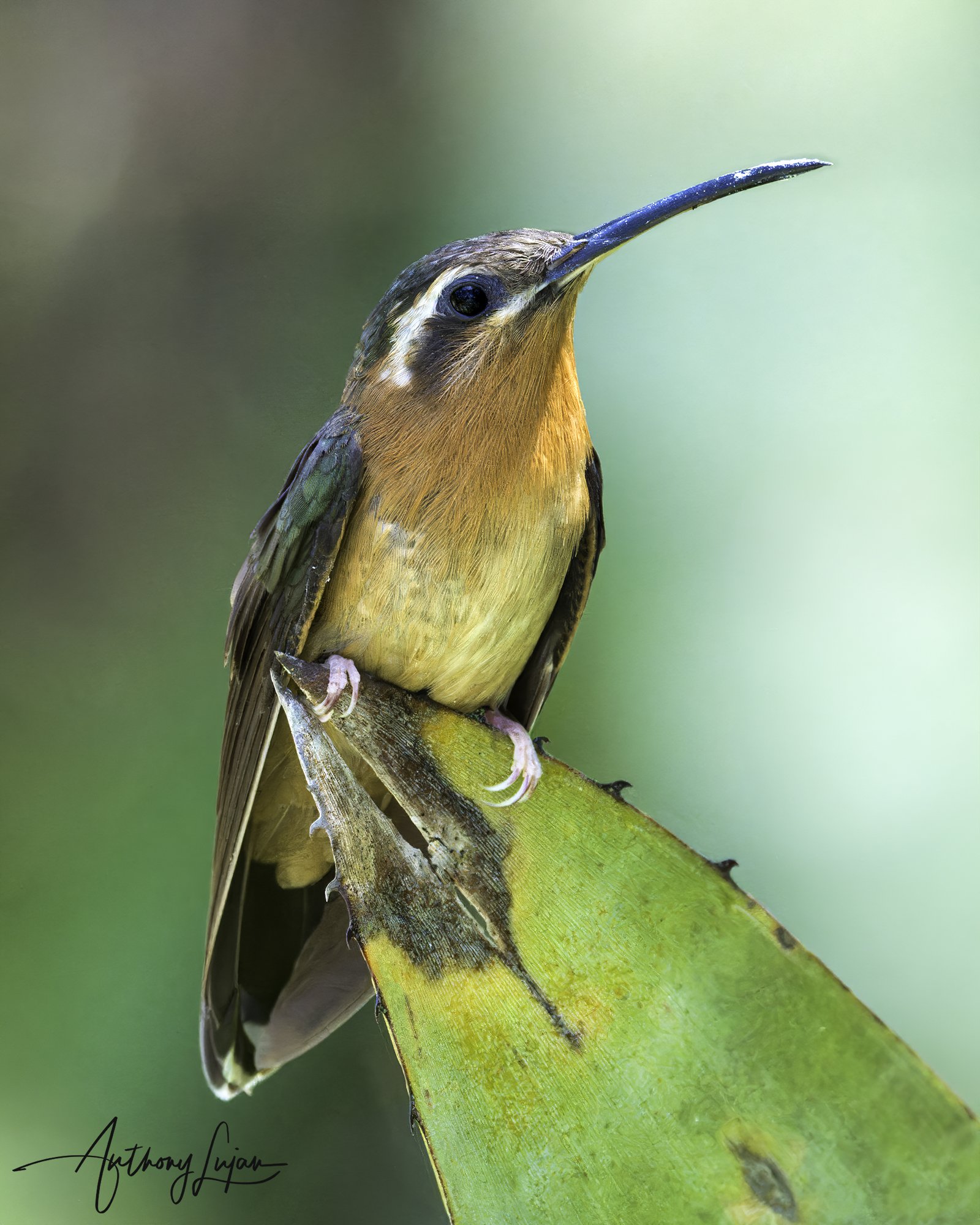
Endemic, Vulnerable, and hiding in the last Atlantic Forest fragments
Hook-billed Hermit is a hummingbird with a small, fragmented range and a big conservation story. It is endemic to the Atlantic Forest region of southeastern Brazil, restricted now to a handful of sites in Bahia and Espírito Santo. Much of its original forest has been cut, and what remains is fragmented, lying between agriculture, roads, and development.
In the field, this bird lives in the understory of humid forests, especially along streams and in ravines where Heliconia and other large-flowering plants still grow well. Light is low, trails are narrow, and visibility is limited. I spent long stretches moving quietly along stream corridors and forest paths, scanning for movement near Heliconia patches and listening for the soft sound of wings and calls. Photographing Hook-billed Hermits was a slow, careful process. High ISO, complex backgrounds, and very brief windows when the bird held still. It felt less like a typical “get the species” mission and more like a chance to document a hummingbird that is now confined to only a few protected and semi-protected pockets of forest.
Hooded Visorbearer
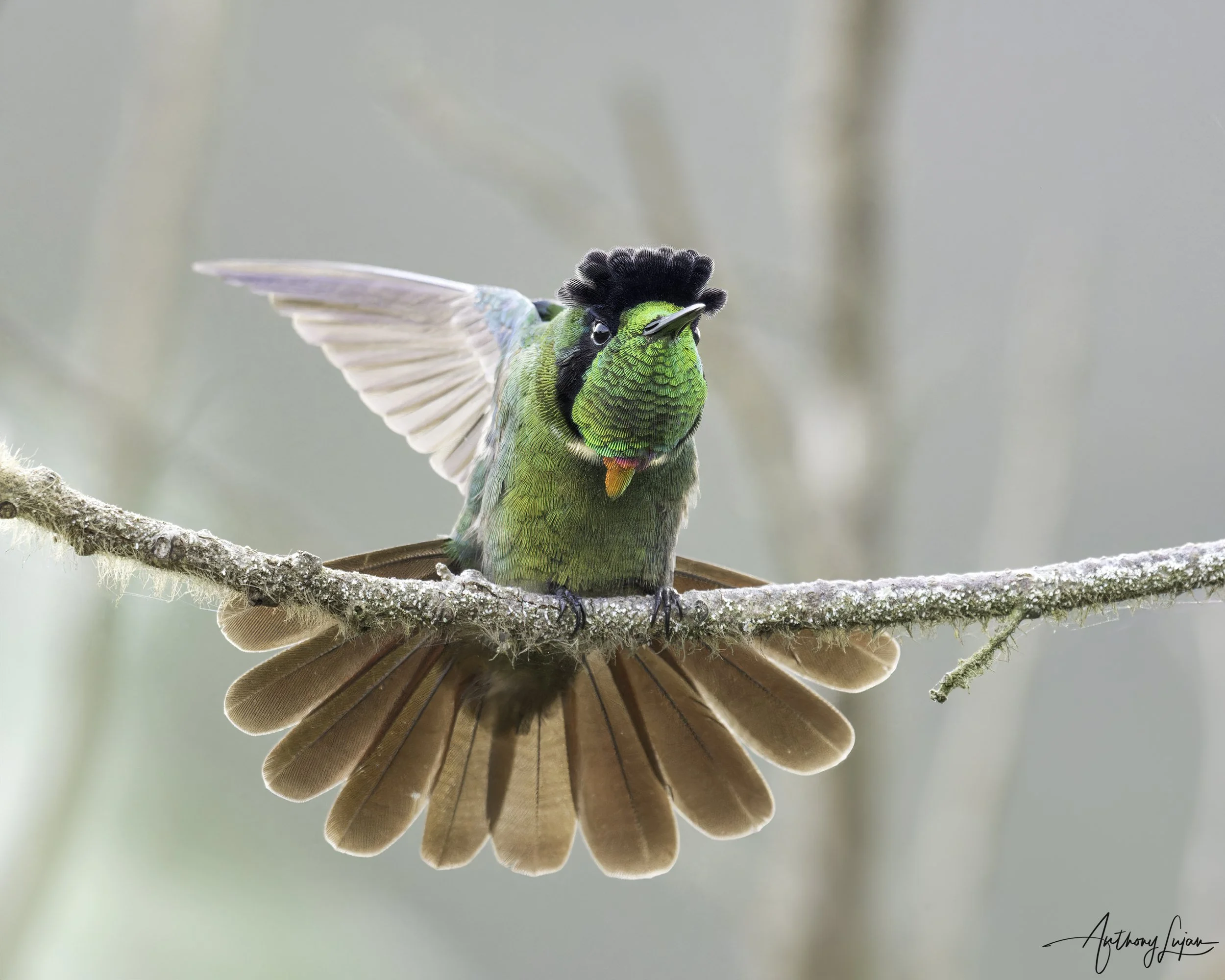
Endemic, Near Threatened, and made for rock and sky
Hooded Visorbearer lives in a completely different world. This Brazilian endemic is tied to the campo rupestre of Chapada Diamantina in Bahia. High elevation rocky grasslands, scattered shrubs, cacti, and harsh conditions. Poor soils, strong sun, wind, and big temperature swings between day and night. It is a landscape of stone and low vegetation, not the deep green most people associate with hummingbirds.
Seeing Hooded Visorbearers here felt like watching a bird that had been precisely designed for the habitat. Males carry an iridescent “visor” and bright throat patch that glow when they face the light. They perch on low shrubs, small trees, and exposed branches, moving between clumps of flowers in open terrain. Photographing them meant working in bright, often hard light, using the wide horizon and rocky outcrops as part of the composition. It was a reminder that some of South America’s most specialized hummingbirds do not live in a forest at all, but in open highland scrub that looks inhospitable until you see how well these birds use it.
Horned Sungem

Cerrado specialist and one of a kind
Horned Sungem is one of the most distinctive hummingbirds in Brazil. It is a species of open landscapes, especially the Cerrado, grasslands, and semi-open woodlands. Instead of dense canopy, it prefers lower blossoms, open areas, and human-influenced landscapes such as gardens and parklands that mimic aspects of its natural habitat.
In and around Brasília, Horned Sungems felt like bright, animated pieces of the landscape. The “horns” are formed by elongated crown feathers that show best when the bird is alert and facing you. It often feeds from flowers close to the ground, moves through open air rather than tight vegetation, and seems comfortable in places where other hummingbirds are less common. Photographing Horned Sungems meant changing my field rhythm. Instead of working on shaded forest edges, I spent more time in open sun, watching low-growing plants in savanna and park settings. It was one of those birds that made it impossible to forget that Brazil’s hummingbirds are not just forest birds. Some of the most memorable ones live in the sun, on the grass, and under the open sky.
Sixteen hummingbirds, three anchors
Although only three species were new to my list, I observed sixteen hummingbirds on this trip. Familiar faces from earlier Brazil expeditions and shared species from other countries filled the background: emeralds and mangoes in more open landscapes, hermits and other forest hummingbirds along the edges and in the fragments that still remain in Bahia, and Cerrado birds that tied Brasília back to the larger Brazilian hummingbird picture.
The difference this time was that everything revolved around the three main targets. Each day was structured around either Hook-billed Hermit’s forest understory, Hooded Visorbearer’s rocky highlands, or Horned Sungem’s open Cerrado. That gave the trip a tighter storyline. Instead of chasing variety, I spent more time on depth with each species, paying attention to behavior, field context, and how each hummingbird fit into its specific habitat.
What this expedition changed
Returning to Brazil with such a narrow focus confirmed two things. First, that this is a country you can keep revisiting without repeating yourself. Second, some of the most important hummingbird stories are now confined to very specific patches of habitat. Hook-billed Hermit in shrinking Atlantic Forest fragments. Hooded Visorbearer on high, exposed rock fields. Horned Sungem in an open Cerrado that is itself under long-term pressure.
This trip shifted my work in Brazil from “how many endemics can I see?” to “how well can I understand and document a handful of highly characteristic species in the landscapes that define them.” It was less about adding names and more about deepening the connection with three hummingbird species found only in these particular parts of Brazil.
If you want to explore the full list of species photographed during this trip, you can view the complete travel overview here: 2023 11 Brazil
Brazil hosts 87 hummingbird species; see the ones I’ve photographed.
Join me on future trips like this. You can find more details here: Visit Travel with Me!
Frequently asked questions
Follow up trips to Brazil that focus on specific endemics raise their own questions. This quick FAQ adds context before you move on to the next Hummingbird Travel Story.
-
Because Brazil holds a large number of range restricted and threatened hummingbirds, and a single trip cannot cover them all. Follow up expeditions allow for more focused work on a few key species.
-
It is endemic to a small part of the Atlantic Forest, classified as Vulnerable, and now confined to a few forest fragments in Bahia and Espírito Santo. That combination makes field documentation and habitat awareness especially important.
-
It lives in campo rupestre, a rocky, high elevation scrub environment. It is an endemic, Near Threatened species built for open, harsh conditions rather than closed forest.
-
Horned Sungem represents the Cerrado and open landscape side of Brazil’s hummingbird story. It is visually unique and tightly linked to semi open savanna habitats, which balances the forest and rocky highland targets.
Please note: The content provided in this article reflects Anthony’s personal experience and photographic approach. Results can vary depending on light, weather, location, equipment, subject behavior, and field conditions.