Building a Better Count: A Juan Fernández Firecrown Conservation Update
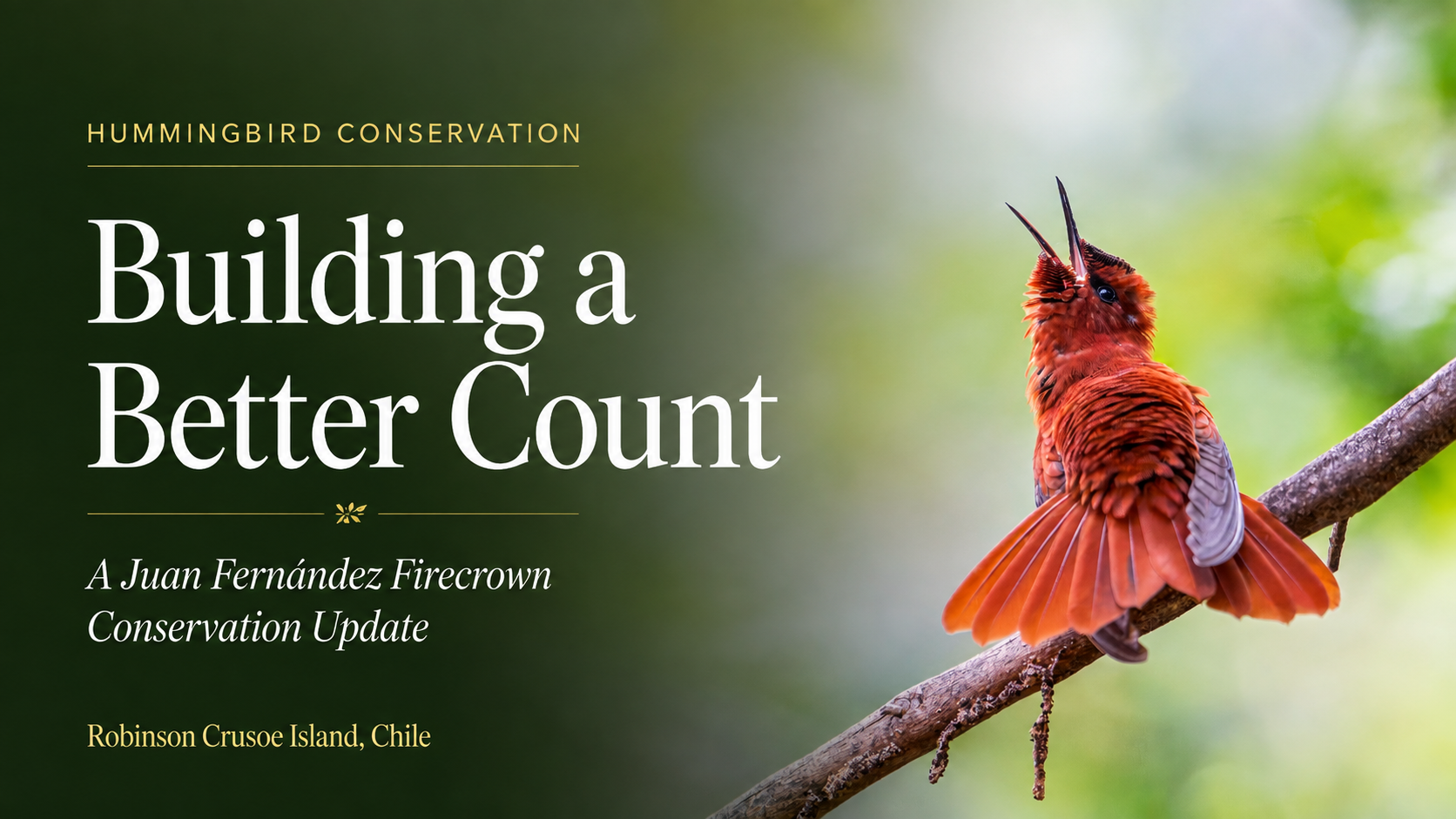
One of the biggest questions surrounding the Juan Fernández Firecrown is also one of the most basic:
How many remain today?
This extraordinary hummingbird exists only on Robinson Crusoe Island, and the last population estimate dates back to 2015. Understanding its current population, where the birds are occurring, and whether their numbers are changing is critical for guiding future conservation efforts.
I am excited to share that we're moving forward on the next step toward answering those questions.
The International Hummingbird Society has provided $4,000 to support a new pilot monitoring project for the Juan Fernández Firecrown.
Developing a Better Way to Monitor the Firecrown
Cristián F. Estades, PhD, and his graduate student have developed a survey protocol designed to do more than produce a one-time count.
If repeated over multiple years, the methodology could help researchers estimate the Firecrown population and track population trends over time.
That distinction matters.
Rather than simply asking how many birds can be found during one survey, conservationists need a consistent method that can eventually show whether the population is stable, increasing, or declining.
The survey design will also gather information on other terrestrial bird species on Robinson Crusoe Island at the same time. This does not require additional survey effort or take away from the Firecrown monitoring. Instead, it allows researchers to generate valuable information about the island's broader bird community while conducting the Firecrown work.
Testing the Method in the Field
The next step is a pilot project on Robinson Crusoe Island to determine how well the new survey methodology works under actual field conditions.
The pilot is expected to take place during the 2026 austral spring, likely in October or November.
What makes this project especially meaningful is that one incredibly generous International Hummingbird Society member donated the full $4,000 needed to cover the pilot project.
That support will help make the field work possible, covering the practical costs of getting researchers to Robinson Crusoe Island and conducting the pilot with assistance from the local conservation team.
For me, that kind of commitment is powerful. One person saw the importance of understanding the future of the Juan Fernández Firecrown and chose to make sure this next step could move forward.
If the pilot is successful, it could provide the foundation for a monitoring program that can be repeated in future years.
For a hummingbird found nowhere else on Earth, having reliable long-term population information is essential.
Habitat conservation is one part of protecting a species.
Understanding whether the population is actually stable, improving, or continuing to decline is another.
This project moves us closer to being able to measure that.
Help Anthony Reach the Next At-Risk Hummingbird
Like my journey to Robinson Crusoe Island to photograph the Juan Fernández Firecrown, many of the hummingbirds still ahead require travel into remote and difficult-to-reach regions across the Americas.
Your sponsorship helps make these expeditions possible, allowing me to reach and document these species through photography and video, share their stories, and bring greater attention to the challenges facing their survival.
Each expedition is about more than creating a photograph. It is about documenting a species, the habitat it depends upon, and the conservation story surrounding its future.
Help me continue the journey and reach the next hummingbird that needs its story told.
More on Juan Fernández Firecrown Conservation
Follow the ongoing research, monitoring, habitat work, and conservation efforts helping protect this remarkable hummingbird found only on Robinson Crusoe Island.