
How Hummingbirds Switch Between Two Flight Control Systems
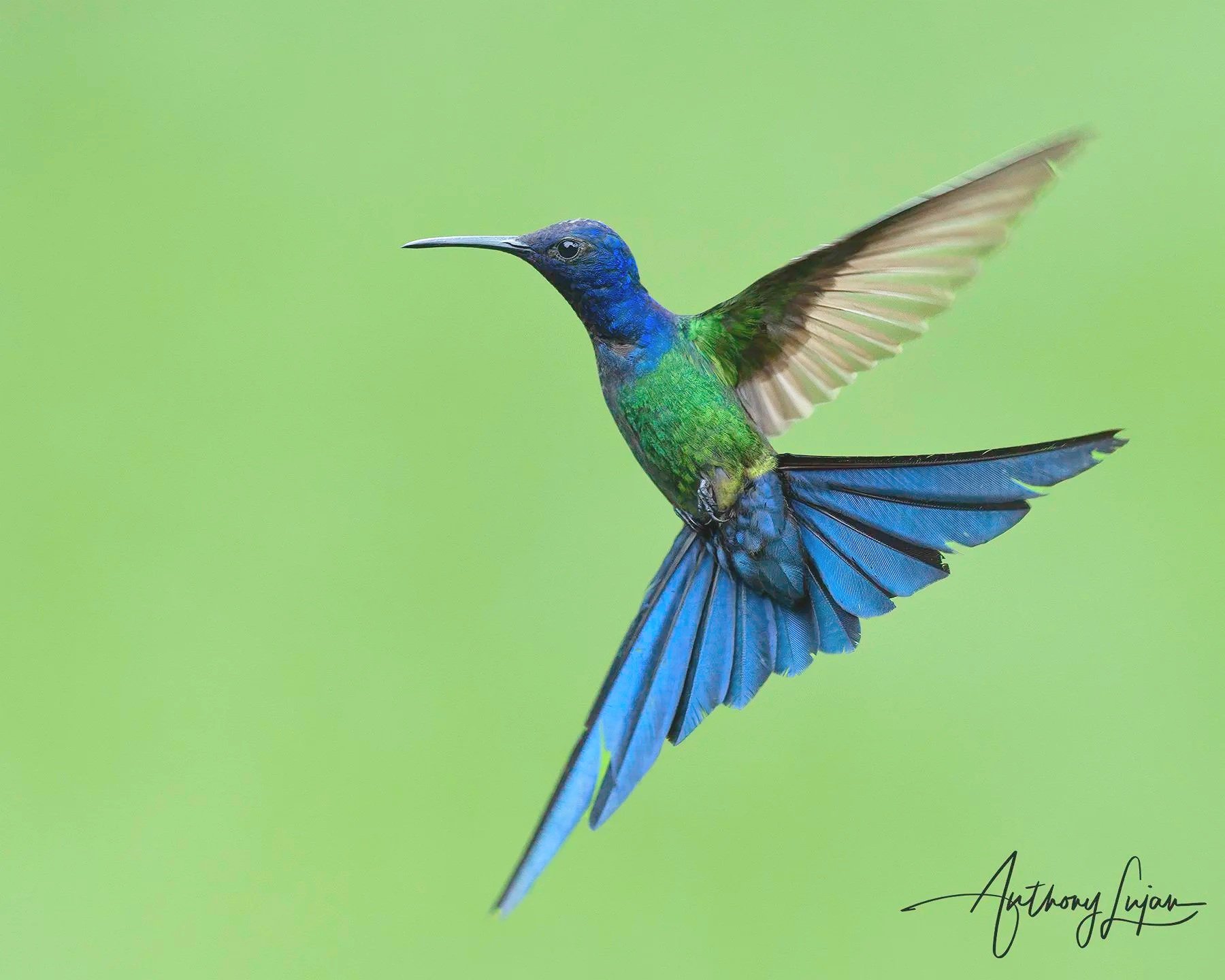
Hummingbirds seamlessly transition between hovering motionless at flowers and darting forward at high speed. These flight modes look effortless, but each requires dramatically different control strategies. New research reveals they use two distinct "mental gears" - one for forward flight, one for hovering.
A study published in Proceedings of the Royal Society B tested how rufous hummingbirds (Selasphorus rufus) control speed and position in a flight tunnel. Researchers discovered that forward flight relies on an internal model predicting expected optic flow, while hovering uses direct visual feedback from the environment.
What Scientists Studied
The research examined how hummingbirds control two key aspects of flight: forward speed and positional stability. During forward flight, birds must maintain consistent velocity through changing environments. During hovering, they must hold exact position relative to a flower or feeder.
Researchers hypothesized hummingbirds might use different sensory strategies for each mode. Forward flight generates predictable optic flow patterns (visual motion across the retina), while hovering requires responding to unpredictable environmental changes. The tunnel experiments tested whether birds rely on internal predictions or direct visual feedback for each scenario.
How the Research Was Conducted
Rufous hummingbirds flew repeated trials from perch to feeder in a 4-meter flight tunnel. Researchers projected visual patterns on tunnel walls to manipulate optic flow:
Side walls: Vertical stripes moved at different speeds to mimic forward motion
Side walls: Horizontal stripes simulated altitude changes
Front wall: Rotating spirals created position-change illusions
High-speed cameras recorded every flight. Birds naturally mixed forward flight with spontaneous hovering breaks, allowing researchers to compare control strategies across flight modes without artificial training.
What the Study Found
The results revealed two distinct control systems:
Forward flight (internal model):
Birds flew fastest with normal optic flow
Disrupted optic flow slowed all birds, regardless of stripe speed
No direct correlation between stripe speed and flight velocity
Vertical stripes did NOT trigger matching speed adjustments
Hovering (direct feedback):
Rotating front-wall spirals triggered precise position corrections
Horizontal side stripes caused immediate altitude adjustments
Responses matched visual stimuli direction and speed exactly
These patterns show forward flight uses an internal forward model - a predictive "autopilot" expecting specific optic flow. Hovering uses direct sensory feedback - real-time responses to immediate visual cues.
Why the Discovery Matters
This research reveals how hummingbirds solve the sensory overload of high-speed flight. The internal model filters overwhelming visual input during forward motion, preventing "analysis paralysis." Direct feedback handles hovering's need for pixel-perfect positioning.
The dual-system approach explains their fluid transitions between flight modes. Understanding these mechanisms could improve drone navigation - forward flight autopilot for efficiency, hovering feedback for precision landing.
For bird enthusiasts, this explains why hummingbirds hold steady at feeders (feedback control) yet fly purposefully between flowers (model-based control), even through complex gardens.
Research Credit
This article summarizes findings from the following scientific study:
Vikram B. Baliga, Kristen Hardy, Kenneth V. Welch, Douglas L. Altshuler (2024)
Hummingbirds use distinct control strategies for forward and hovering flight
Proceedings of the Royal Society B: Biological Sciences, Volume 291, Issue 2015
Readers interested in the full methodology, experiments, and analysis can consult the original publication.
Frequently Asked Questions
Scientific studies often raise additional questions about how hummingbirds behave and survive in the wild. Here are a few common questions related to this research.
-
They use the internal forward model during high-speed flight. This predictive system expects specific visual patterns and filters out confusing motion, preventing overload while maintaining stable velocity through complex environments.
-
Hovering uses direct visual feedback. Every tiny movement in their visual field triggers immediate corrections. Rotating spirals in the tunnel caused exact position matching, showing their hovering precision comes from real-time environmental responses.
-
Researchers expect yes. All hovering-capable hummingbirds face identical flight challenges. The dual strategy likely evolved once in their common ancestor, then refined across species for different body sizes and habitats.
-
Too much information. Forward flight generates overwhelming optic flow. The internal model predicts "normal" patterns, letting birds ignore noise and focus on navigation rather than reacting to every leaf or branch.
-
Absolutely. Drones could use forward-flight autopilot for battery-efficient cruising, switching to hovering feedback for precise delivery or inspection. Hummingbirds show exactly when each system works best.







Please note: The content provided in this article is for educational purposes only and summarizes published scientific research. Interpretations of research may evolve as new studies become available.