
If you search for Brazilian Ruby hummingbirds today, you’ll see two different scientific names in use: Clytolaema rubricauda and Heliodoxa rubricauda. It can feel like the same bird has split into two identities.
This Hummingbird Research article uses Brazilian Ruby as a case study to explain how modern genetics reshapes bird names, why global checklists sometimes disagree, and what you should do when your field guide and your favorite app don’t match.
Background: Who Is the Brazilian Ruby?
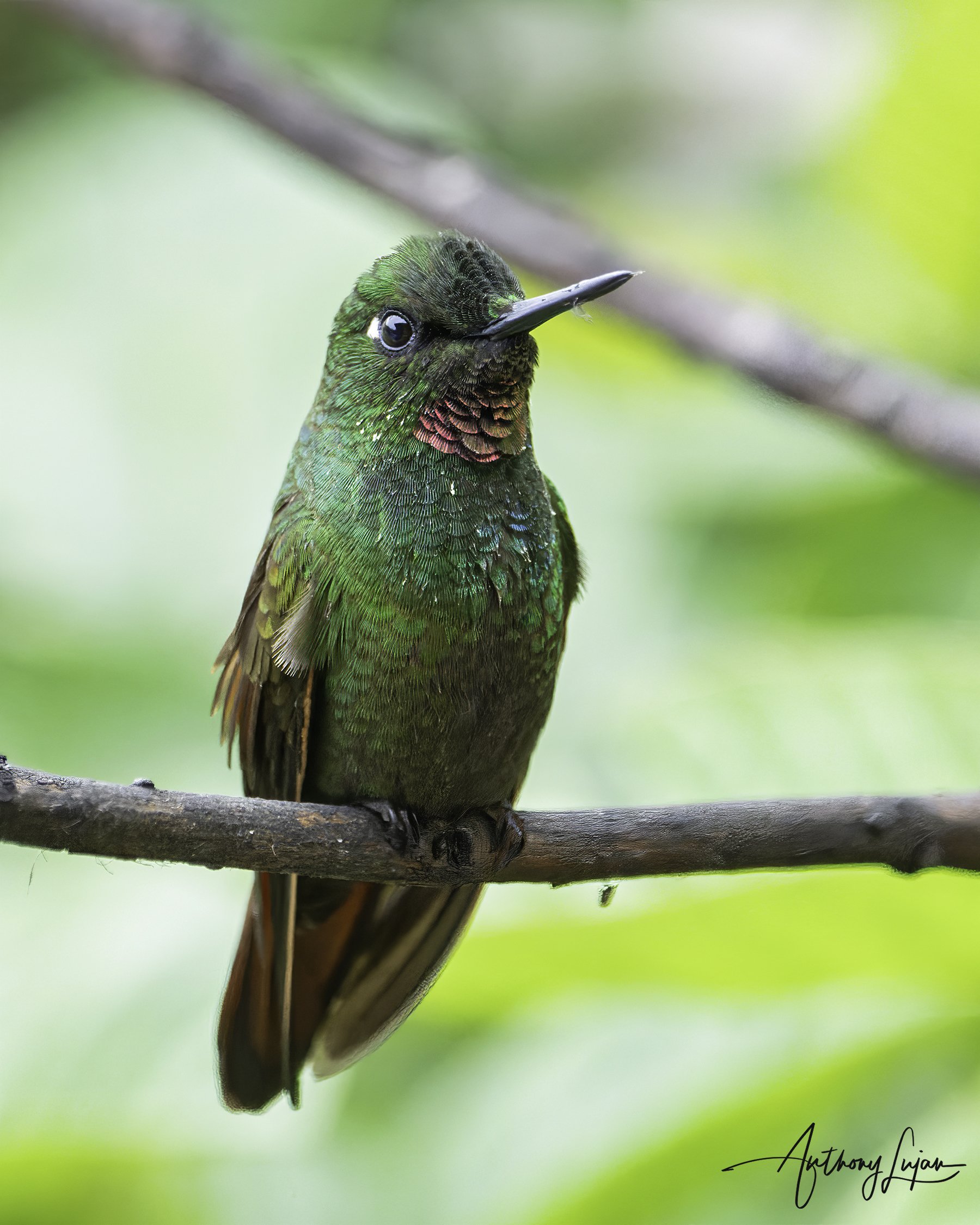
The Brazilian Ruby is a striking hummingbird from eastern Brazil, especially the Atlantic Forest region and adjacent highlands, where it uses forest edges, second growth, gardens, and parks. Males show a glittering ruby throat, green upperparts, and bronzy‑copper tail, while females are greener above and warmer, buffy below.
For much of the 20th and early 21st century, Brazilian Ruby was treated as the only member of its own genus, Clytolaema, giving it the scientific name Clytolaema rubricauda. In more recent global checklists and databases, however, the species appears as Heliodoxa rubricauda, grouped with other Heliodoxa hummingbirds.
The bird in the field has not changed—but our understanding of its place on the hummingbird family tree has.
What Changed Scientifically?
From monotypic genus to part of Heliodoxa
Brazilian Ruby was originally described in the late 18th century and later placed in the genus Clytolaema, where it sat alone as a monotypic genus for many decades. That arrangement made intuitive sense based on morphology and plumage: Brazilian Ruby looks distinctive compared to many other hummingbirds.
However, large molecular phylogenetic studies of hummingbirds, using both mitochondrial and nuclear DNA from many species, found that Brazilian Ruby does not form its own isolated branch. Instead, it falls squarely inside the clade currently recognized as the genus Heliodoxa. In other words, Clytolaema was nested within Heliodoxa rather than being a separate, sister group.
To keep genera reflecting true evolutionary relationships (monophyletic groups), taxonomists chose to move Brazilian Ruby into Heliodoxa and retire Clytolaema as a separate genus for this species.
When major lists adopted Heliodoxa rubricauda
Once the genetic evidence was published and evaluated, global committees began updating their checklists:
For years, Brazilian Ruby remained Clytolaema rubricauda in many regional and global lists.
In 2022, major authorities such as the South American Classification Committee (SACC) and the IOC World Bird List adopted the change to Heliodoxa rubricauda.
Around the same time, the Clements/eBird taxonomy also switched to Heliodoxa rubricauda, aligning major modern lists on the new genus placement.
Today, most up‑to‑date global taxonomies treat Heliodoxa rubricauda as the current scientific name and list Clytolaema rubricauda as a recent synonym.
Why Do Names Lag and Disagree?
Even after committees agree, the world doesn’t update overnight. You’ll still see Clytolaema rubricauda in many places for several reasons:
Different update cycles
Online taxonomies and bird‑data platforms usually update annually or on a fixed schedule.
Printed field guides, books, and static PDFs may only change when a new edition is published, which can take years.
Different philosophies about change
Some committees and platforms adopt changes as soon as they consider the evidence strong.
Others prefer to wait for multiple studies or broader consensus, especially when a change affects a familiar genus or a widely used name.
Practical workload
Updating names across apps, databases, museum collections, and citizen‑science portals is a massive task.
Some systems update the taxonomy first and then slowly work through all the associated media, checklists, and metadata.
The result is a transitional period when Brazilian Ruby is labeled Heliodoxa rubricauda in some places and Clytolaema rubricauda in others, even though they refer to the same species.
Why This Name Change Matters
For most people, a change from Clytolaema to Heliodoxa feels like a technical detail, but it touches several important themes:
Keeping names tied to real relationships
Modern taxonomy aims to have each genus represent a natural branch of the evolutionary tree. Moving Brazilian Ruby into Heliodoxa makes that genus better match the actual genetic relationships among hummingbirds.Helping researchers and data users stay aligned
When field observers, museum collections, and genetic studies all use the same current name, it’s easier to combine data and track conservation status accurately.Reducing confusion over time
Short‑term, two names cause confusion. Long‑term, a shared, up‑to‑date name reduces ambiguity—especially as field guides and apps converge on the same treatment.
For birders, photographers, and hummingbird enthusiasts, understanding why these changes happen makes the shifting names feel less like random chaos and more like progress toward a clearer picture of hummingbird diversity.
What This Means for You in Practice
If you’re logging sightings, captioning photos, or simply reading about Brazilian Ruby, here’s how to handle the two names:
Treat Heliodoxa rubricauda as the current standard
Use Heliodoxa rubricauda for new checklists, labels, and notes, since this is the name adopted by major modern taxonomies.Recognize Clytolaema rubricauda as a recent synonym
When you encounter Clytolaema rubricauda in older books, websites, or photo captions, understand that it refers to the same species under its former generic placement.Check which taxonomy your tools follow
Your favorite app or website likely follows a specific global list (for example, one aligned with the 2022 taxonomic updates). Knowing that helps you predict which name you’ll see.Use cross‑reference resources
Online databases that show multiple taxonomies side by side can confirm that Clytolaema rubricauda and Heliodoxa rubricauda represent the same species under different naming schemes.
In other words, when you see both names, think “older vs newer checklist,” not “two different hummingbirds.”
Frequently Asked Questions
-
It is not the current name in major modern taxonomies, but it remains a historically valid name and is now treated as a recent synonym of Heliodoxa rubricauda. You will continue to see it in older literature and in resources that haven’t updated yet.
-
No. The Brazilian Ruby you see in the field is the same species. The change reflects a better understanding of its relationships to other hummingbirds based on genetic data, not the discovery of an additional species.
-
Your field guide likely follows an older version of a global or regional checklist and has not been revised since the change. Your app probably updates its taxonomy on a regular schedule and has already adopted the newer name.
-
For new records, it’s best to use Heliodoxa rubricauda and, if helpful, add a note such as “formerly Clytolaema rubricauda” so you can connect older references and your own past notes.
-
Over time, yes. As field guides are reprinted, websites refreshed, and databases updated, Heliodoxa rubricauda will become the default name in most places. Historical uses of Clytolaema rubricauda will remain in older sources but will be recognized as referring to the same bird.









Please note: The content provided in this article is for educational purposes only and is intended as general information. Scientific understanding continues to evolve, and interpretations or findings may change as new research becomes available.