
How Hummingbirds See Colors Humans Cannot
Hummingbirds are already famous for their extraordinary flight abilities and their strong attraction to brightly colored flowers. But new scientific research has revealed that hummingbirds experience the world of color very differently than humans do.
For many years scientists suspected that birds might see colors outside the range of human vision. A groundbreaking study confirmed that hummingbirds can detect non-spectral colors, combinations of wavelengths that humans cannot perceive.
This discovery helps explain how hummingbirds locate nectar-rich flowers so efficiently and why certain flower colors have evolved specifically to attract them.
A Different Kind of Color Vision
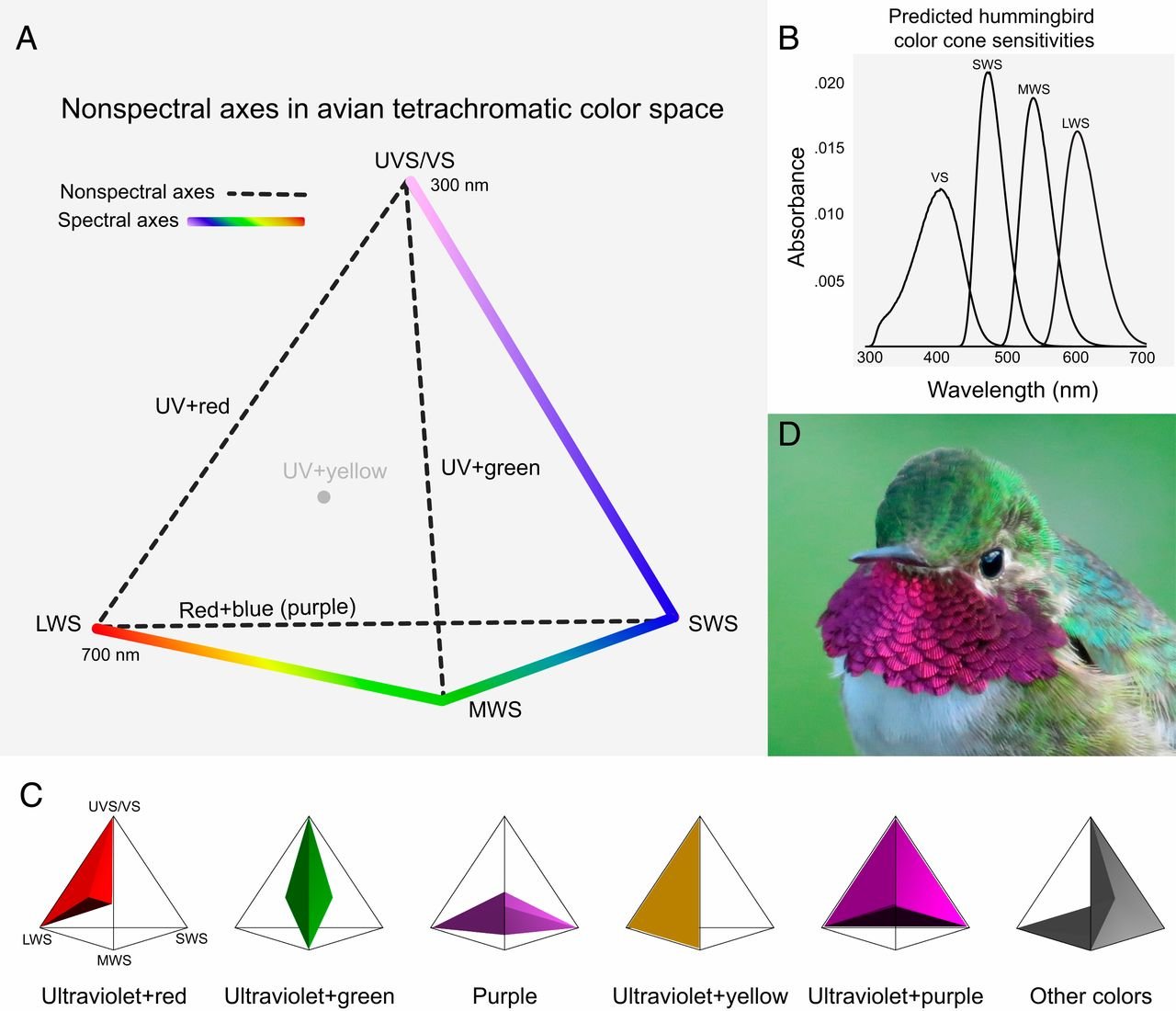
Humans see color using three types of cone cells in the eye that detect red, green, and blue wavelengths. Birds, including hummingbirds, have a fourth type of cone cell that is sensitive to ultraviolet light.
Because of this extra receptor, hummingbirds can see a broader spectrum of colors. But the research revealed something even more surprising. Hummingbirds can also detect combinations of ultraviolet and visible wavelengths that produce colors humans cannot imagine.
These colors are known as non-spectral colors.
What Are Non-Spectral Colors?
Non-spectral colors occur when two different wavelengths of light stimulate the eye at the same time. For hummingbirds, this means they can perceive color combinations such as:
• ultraviolet + green
• ultraviolet + red
• ultraviolet + yellow
• ultraviolet + purple
Humans cannot perceive ultraviolet light, so these colors are invisible to us. But for hummingbirds, these combinations may be quite vivid.
Testing Hummingbird Vision
To study hummingbird color perception, researchers conducted field experiments with wild hummingbirds. The scientists set up feeding stations with lights that displayed different color combinations.
Each color station contained either a sugar reward or plain water.
The hummingbirds quickly learned which colors contained nectar. Over time, they demonstrated the ability to distinguish between several different non-spectral color combinations, including ultraviolet mixtures.
This confirmed that hummingbirds are capable of seeing colors far beyond human perception.
Why This Matters for Flowers
Many flowering plants have evolved traits specifically designed to attract hummingbirds. These flowers often reflect ultraviolet light in patterns that guide birds toward nectar.
Because hummingbirds can see ultraviolet and non-spectral color combinations, flowers may appear much more visually complex to them than they do to humans.
Understanding hummingbird color vision helps scientists explain the close evolutionary relationship between hummingbirds and the flowers they pollinate.
A World of Color We Cannot See
For humans, hummingbirds already appear vibrant and colorful. But the research suggests that the visual world hummingbirds experience is even richer than we can imagine.
Their ability to see ultraviolet light and complex color combinations gives them an advantage when searching for food and navigating landscapes filled with flowers.
Studies like this reveal just how different the sensory world of animals can be compared to our own.
Research Credit
This article summarizes findings from the following scientific study:
Stoddard, Mary Caswell; Eyster, Harold N.; Hogan, Benedict G.; Morris, Dylan H.; Soucy, Edward R.; & Inouye, David W. (2020).
Wild hummingbirds discriminate nonspectral colors.
Proceedings of the National Academy of Sciences of the United States of America (PNAS).
Readers interested in the full methodology and experimental design can consult the original research publication.
Frequently Asked Questions
Research into hummingbird vision raises fascinating questions about how these birds see flowers and navigate their environment.
-
Yes. Hummingbirds have a fourth color receptor in their eyes that allows them to detect ultraviolet wavelengths that humans cannot see.
-
Non-spectral colors are combinations of two different wavelengths of light. Hummingbirds can perceive combinations such as ultraviolet mixed with green or red.
-
Many flowers reflect ultraviolet patterns that guide hummingbirds toward nectar sources.
-
Yes. Because hummingbirds can see ultraviolet light and additional color combinations, flowers may appear more vibrant and patterned to them.
-
Yes. Many bird species can see ultraviolet light, though the way different species perceive color may vary.



Please note: The content provided in this article is for educational purposes only and summarizes findings from published scientific research. Interpretations of scientific studies may evolve as new research becomes available.