
Antillean Crested Hummingbird
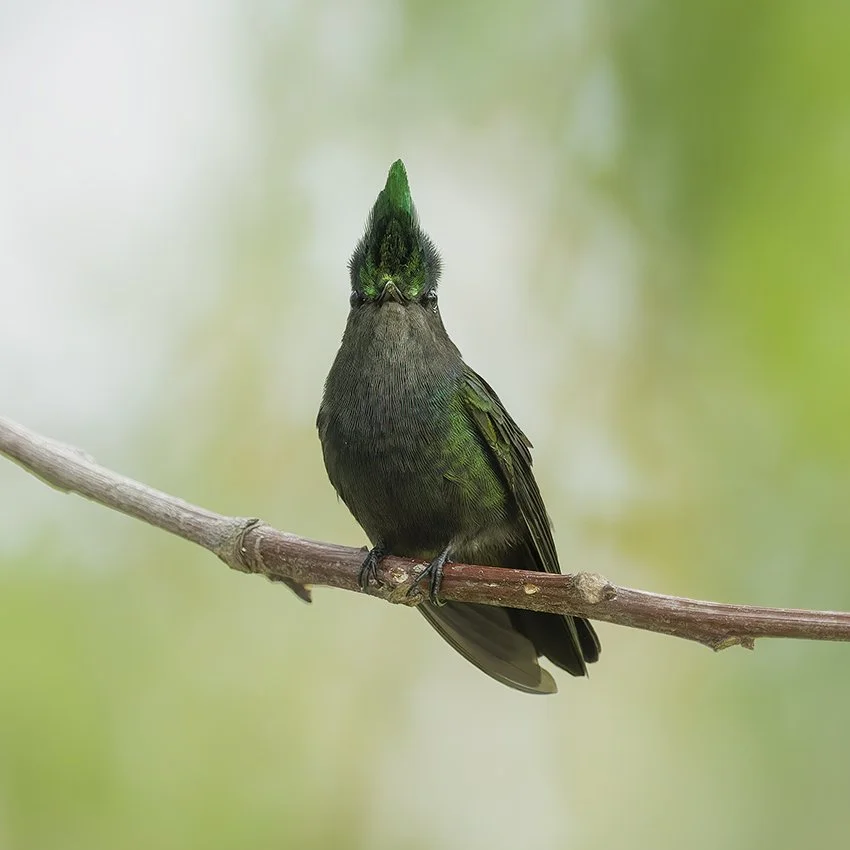
Scientific name: Orthorhyncus cristatus
The Antillean Crested Hummingbird is a small, perky hummingbird of the Lesser Antilles and eastern Puerto Rico, easily recognized as one of the few hummingbirds with a prominent crest. The number of mature individuals is unknown, the population trend is unknown, it is not a migrant, and it is currently assessed as Least Concern.
At a Glance
Family: Trochilidae (hummingbirds)
Tribe: Trochilini – Emeralds
Genus: Orthorhyncus — 1 species (monotypic genus)
Range: Eastern Puerto Rico and the Virgin Islands through the Lesser Antilles to Grenada and the Grenadines
Habitat: Subtropical and tropical moist lowland forest, semiarid forest, forest borders, degraded former forest, open vegetation, parks, plantations, and gardens
Elevation: Sea level to high mountains; commonest below 500 m
Length: About 8–9 cm (3.1–3.5 in)
Weight: About 2.5–3.5 g
Number of mature individuals: Unknown
Population trend: Unknown
Movement: Not a migrant
IUCN Red List category: Least Concern
Name Origin
The genus name Orthorhyncus comes from Greek roots meaning “straight bill,” referring to the short, straight bill typical of the species. The species name cristatus is Latin for “crested,” describing the tall, spiky crest that gives the bird its common name. The type locality is restricted to Barbados.
Taxonomy & Distribution
Orthorhyncus cristatus is the only species in the genus Orthorhyncus, placed within the tribe Trochilini (emeralds) in the family Trochilidae. The genus was introduced in 1799 by Bernard Germain de Lacépède. Genetic studies have found considerable sequence divergence between the Barbados population and those on Saint Lucia and Saint Vincent, suggesting deeper structure within the species than the subspecies classification alone might imply.
Subspecies and Distribution
Four subspecies:
Orthorhyncus cristatus exilis
Distribution: Puerto Rico and the Virgin Islands through the Lesser Antilles to Saint Lucia.Orthorhyncus cristatus ornatus
Distribution: Saint Vincent (southern Lesser Antilles).Orthorhyncus cristatus cristatus
Distribution: Barbados (southern Lesser Antilles).Orthorhyncus cristatus emigrans
Distribution: Grenada and the Grenadines (southern Lesser Antilles).
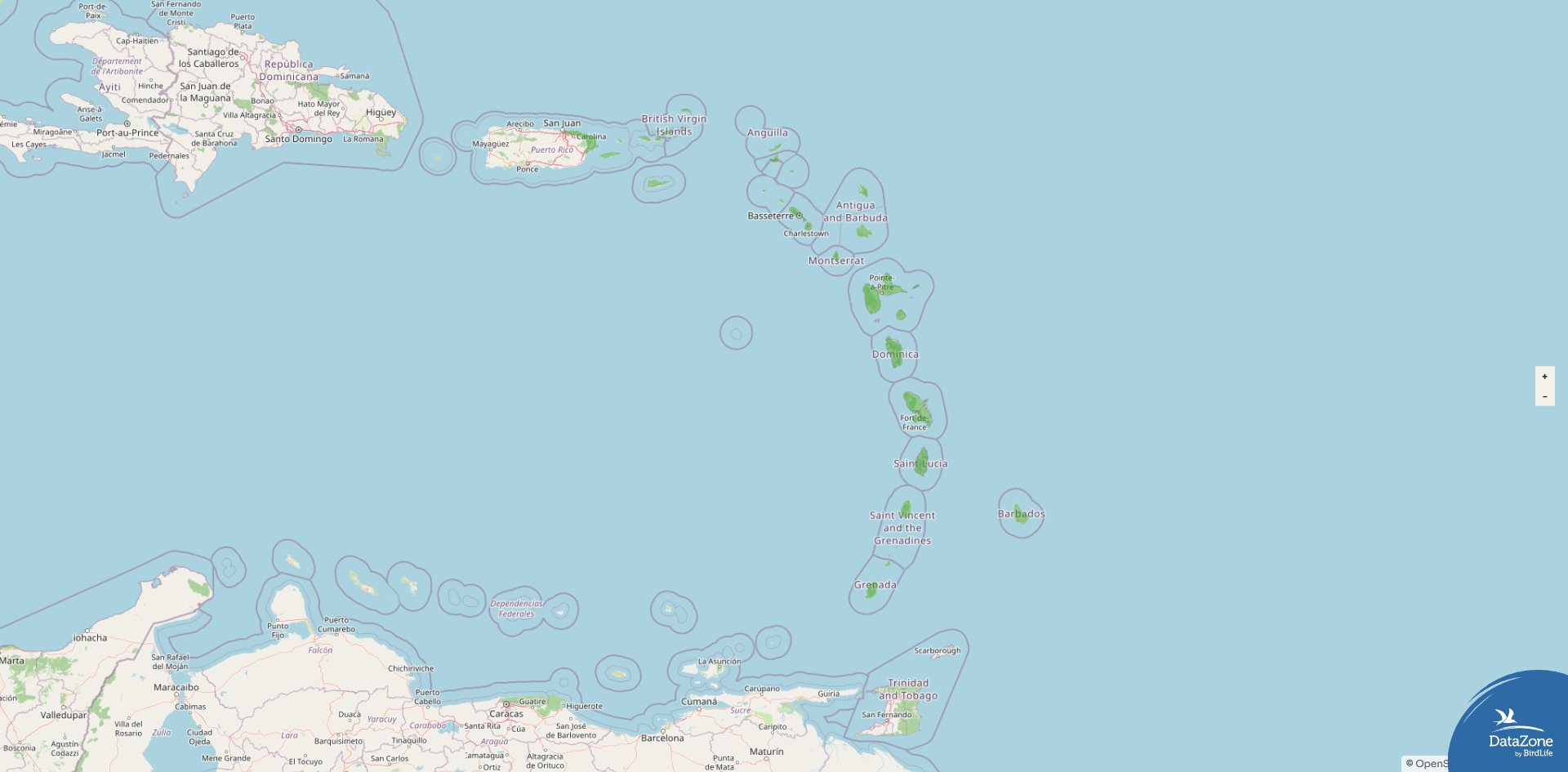
Legend
Green Resident
Yellow Breeding
Blue Non-breeding
Species Overview
The Antillean Crested Hummingbird is a tiny, iridescent green hummingbird notable for its tall, spiky crest—one of the few hummingbird species to have one. It shows strong sexual dimorphism: males are brightly colored with a colorful crest and dark underparts, while females are duller, lack a crest, and have pale gray underparts. The species is a common and conspicuous inhabitant of woodlands, scrub, parks, and gardens throughout its range, readily adapting to human-modified landscapes.
Male Description
Males have a short, straight black bill and a distinctive head crest tipped in metallic green to bright blue-green, depending on subspecies. The upperparts are dull metallic bronze-green, while the underparts are sooty black. The tail is black and rounded. Crest coloration varies by subspecies: exilis has a crest that is wholly green or slightly blue-tinged at the tip; ornatus shows an abruptly blue terminal portion; cristatus ranges from golden to emerald with violet tips; and emigrans resembles the nominate but is more bluish-violet, with a paler gray throat.
Female Description
Females have a bill similar to males but lack the crest entirely. The forehead, crown, and upperparts are metallic bronzy-green, while the underparts are light gray, with the degree of paleness varying by subspecies. The tail is blackish and rounded, with the four outer rectrices broadly tipped whitish-gray—a useful field mark distinguishing females from males.
Habitat & Behavior
Antillean Crested Hummingbirds occupy a wide range of habitats, including subtropical and tropical moist lowland forest, semiarid forest, forest borders, heavily degraded former forest, open vegetation, parks, plantations, and gardens. They occur from sea level up to high mountains but are most common below 500 m, and their willingness to use man-made habitats suggests habitat loss is unlikely to significantly threaten the species.
They feed on nectar from flowering shrubs such as Lantana and Euphorbia, vines, hedges, and large flowering trees including Hibiscus, Bauhinia, Tabebuia, and Delonix. Birds forage from near the ground up to the canopy but appear to favor understory flowering plants. Small arthropods are collected from plant surfaces or hawked in flight to supplement the nectar diet. Calls include short "tsip" or "tzip" notes and a longer series of "tslee-tslee-tslee-tslee."
Breeding
The Antillean Crested Hummingbird breeds year-round, but mainly from March to June (with some sources citing January to August as the broader window). The nest is a tiny cup built of cotton or fine plant fibers, coated with lichens on the outside and firmly bound with spiderweb. It is typically placed on thin branches of a shrub or vine, 1–3 m above the ground, often shaded by leaves.
The female lays two eggs and incubates them alone. She alone feeds the young after hatching, and chicks fledge after about three weeks.
Movement
The Antillean Crested Hummingbird is not considered a migrant and lives a largely sedentary lifestyle. Some individuals may disperse to higher altitudes during July and August. The exilis subspecies is a rare straggler recorded in the United States, including Florida and disputed sightings in Texas.
Population
The total number of mature individuals is unknown, and the population trend has not been quantified. The species is described as a common resident throughout the Lesser Antilles, with recorded densities of at least 6–10 pairs per square kilometer on Saint Lucia, 4–8 pairs per square kilometer on Guadeloupe, and 3–5 pairs per square kilometer on Dominica. It is widespread across all altitudes and habitat types within its range.

Conservation
The Antillean Crested Hummingbird is assessed as Least Concern, reflecting its large range and general abundance across the Lesser Antilles and eastern Puerto Rico. It is listed under CITES Appendix II and is considered a restricted-range species associated with the Puerto Rico and Virgin Islands Endemic Bird Area and the Lesser Antilles Endemic Bird Area. Its readiness to occupy man-made habitats such as parks, plantations, and gardens suggests that habitat loss is unlikely to pose a major threat, though the Barbados population has been flagged as potentially invasive on that island.
Checkout Anthony’s playlist of this species! Click the top right dropdown to see all the videos.
No related species in the Orthorhyncus genus (1 species in total):
Please note: The content provided in this article reflects Anthony’s personal experience and photographic approach. Results can vary depending on light, weather, location, equipment, subject behavior, and field conditions.