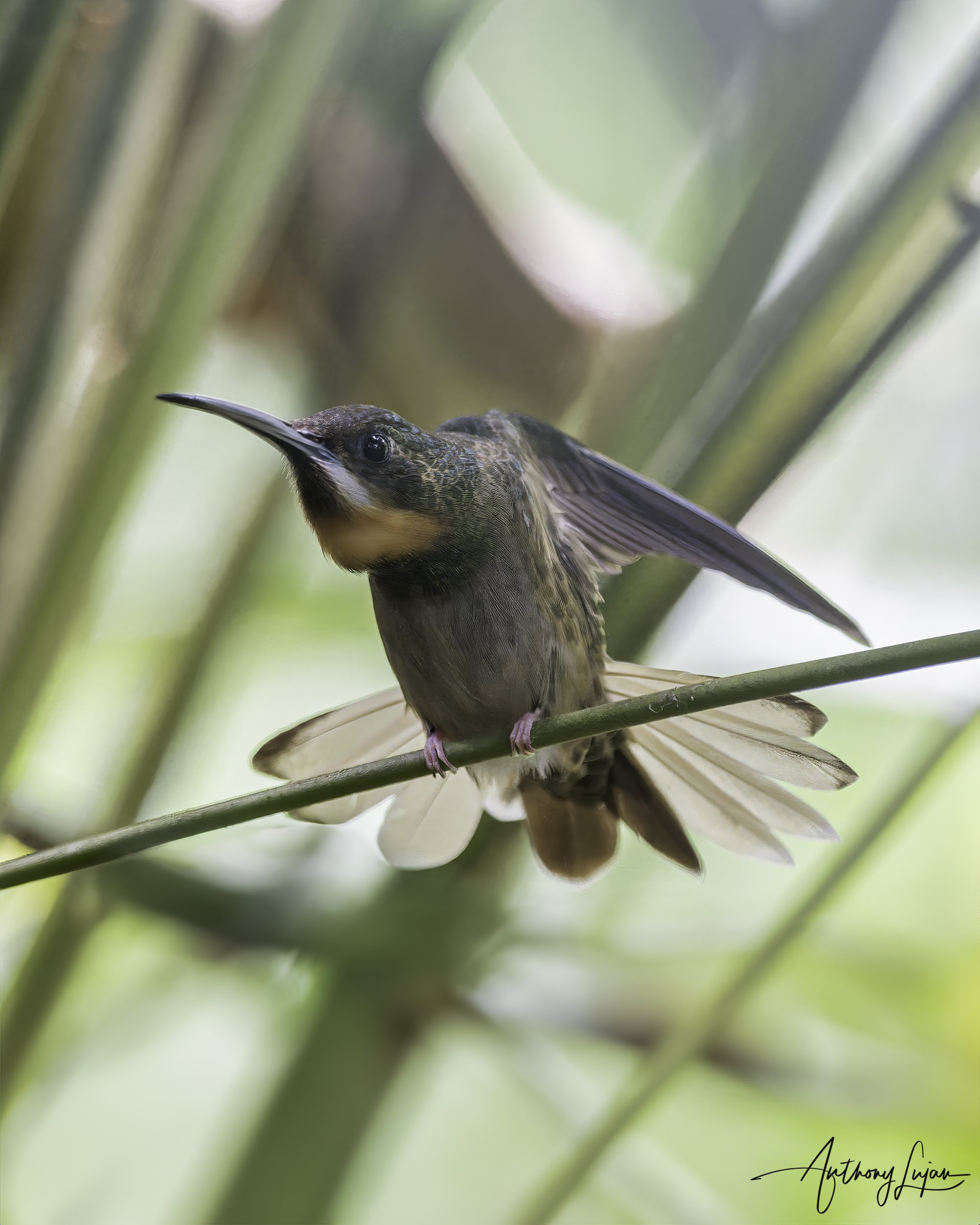
Band-tailed Barbthroat
Scientific name: Threnetes ruckeri
Band-tailed Barbthroat is a medium-sized hermit hummingbird of humid lowland and foothill forests from southern Central America into the Chocó and northern Andes. Its name comes from the dark tail with contrasting white bases and tips that form a pale band near the end of the tail, a key field mark in flight. Like many hermits, it forages by “trap‑lining,” visiting a circuit of flowers rather than defending a single patch, and it remains fairly common in suitable habitats despite a decreasing overall population.
At a Glance
Family: Trochilidae (hummingbirds)
Clade: Phaethornithinae – Hermits
Genus group: Threnetes — forest hermits of Central and northern South America.
Range: Southeastern Guatemala and Belize through Honduras, Nicaragua, Costa Rica, and western Panama, south into northern and western Colombia, western Ecuador almost to Peru, and northwestern Venezuela.
Habitat: Humid lowland and foothill forest understory, forest edges, riparian woodland, shaded secondary growth, and dense Heliconia‑rich thickets.
Elevation: Sea level to about 1,200 m (3,900 ft).
Length: about 10–12 cm (4.0–4.7 in).
Weight: about 5–6.5 g (0.18–0.23 oz).
Number of mature individuals: 500,000–4,999,999 (large population within its range).
Population trend: Decreasing.
Status: Least Concern (IUCN).
Name Origin
The genus name Threnetes comes from Greek roots related to “wailing” or “lament,” a reference to the thin, plaintive vocalizations typical of hermit hummingbirds. The species name ruckeri honors a 19th‑century naturalist and collector associated with Central America; taken together, Threnetes ruckeri can be read as “Rucker’s hermit,” tying the bird’s name to both its vocal, forest‑hermit identity and its namesake.
Subspecies and Distribution
Band-tailed Barbthroat has three recognized subspecies.
Threnetes ruckeri ventosus
Distribution: Eastern Guatemala and Belize south through Honduras, Nicaragua, Costa Rica, and western Panama.
Threnetes ruckeri ruckeri
Distribution: Northern and western Colombia and western Ecuador (south to El Oro), in humid lowland and foothill forests, especially along the Pacific slope.
Threnetes ruckeri venezuelensis
Distribution: Northwestern Venezuela (east to western Apure and western Barinas).
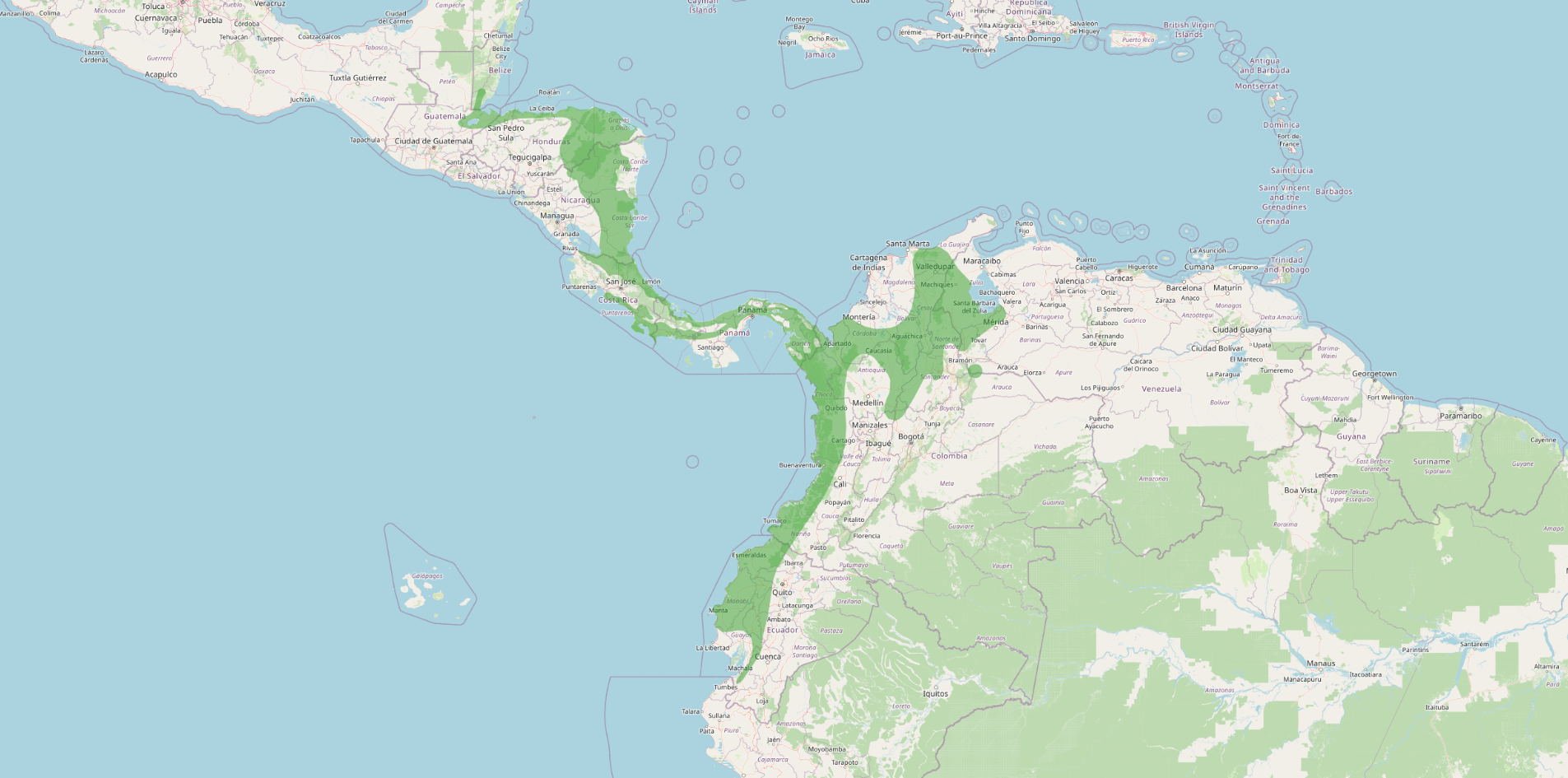
Map provided by Datazone Birdlife.org
Species Overview
Band-tailed Barbthroat is a distinctive forest hermit built for life in dim, dense understory. Its bronzy‑green upperparts, warm buff‑to‑rufous throat, and banded tail make it stand out among other lowland hummingbirds when seen well, even though it often stays in the shadows. The species follows a trap‑line foraging strategy, visiting a circuit of Heliconia and other tubular flowers and returning to favored patches repeatedly rather than defending a single territory. With a broad distribution from southern Central America into northwestern South America and an estimated 500,000–4,999,999 mature individuals, it remains generally common where humid forest and older second growth are still intact, though its population is thought to be gradually declining.
Identification
Male
Adult males have olive‑bronze to bronzy‑green upperparts, a dusky face with a darker ear patch, and a small whitish spot behind the eye. The throat is warm buff to ochraceous, bordered below by a darker band, with paler buff‑gray underparts shading to cinnamon or buff on the flanks. The tail is dark with rufous bases and pale to whitish tips on the feathers, producing a clear banded effect that is one of the best field marks. The bill is long and slightly decurved, mostly dark with some reddish at the base of the lower mandible, well‑suited to deep tubular flowers.
Female
Females resemble males but are slightly paler overall, often with more cinnamon wash on the underparts and an even more decurved bill. Both sexes show subtle tail flicking and a low, humming wing sound typical of hermits when in active flight. Juveniles are similar to adults but display more extensive ochraceous fringes to the plumage, giving them a somewhat warmer, more mottled appearance until they molt into adult feathers.
Habitat and Behavior
Band-tailed Barbthroat prefers humid lowland rainforest, foothill forest, riparian corridors, and shaded secondary growth, especially where Heliconia and other large, tubular flowers are abundant. It often forages low to mid‑level in the understory, moving quickly along forest edges, streambanks, and thickets, and pausing frequently on low perches. The species is a classic trap‑liner: rather than holding a single feeding territory, individuals follow a repeated route that links scattered flowering patches.
Nectar from Heliconia, gingers, and other tubular blossoms forms the bulk of the diet, taken both by inserting the bill into the flower and, at times, by “robbing” through holes near the base of the corolla. Small arthropods, including insects and spiders, are also captured by hawking from perches or gleaning from foliage and spiderwebs, providing vital protein. The species is believed to be largely resident throughout its range, with only local, short‑distance movements, particularly by young birds dispersing along forested river valleys and edges.
Population and Threats
Band-tailed Barbthroat is assessed as Least Concern, with a large estimated population of 500,000–4,999,999 mature individuals spread across Central America and northwestern South America. However, its population trend is considered Decreasing, mainly due to ongoing deforestation and degradation of humid lowland and foothill forests for agriculture, cattle ranching, logging, and infrastructure expansion. These pressures reduce and fragment forest habitat, simplify understory structure, and diminish the availability of key nectar plants like Heliconia, likely driving a slow but continuing decline in numbers.

Conservation
Because Band-tailed Barbthroat is strongly tied to humid forest understory and Heliconia‑rich thickets, conserving lowland and foothill forests throughout its range is essential. Protecting riparian forests, limiting further conversion of forest to pasture or crops, and promoting shade‑grown and agroforestry systems that retain native flowering plants all help sustain this species. Continued protection and effective management of reserves in Costa Rica, Panama, Colombia, and Ecuador will play a key role in maintaining healthy populations of this important understory pollinator.
Below is the Band-tailed Barbthroat (Threnetes ruckeri ruckeri)
Photographed in RN San Cipriano–Escalerete, Valle del Cauca, Colombia
This individual belongs to the nominate subspecies ruckeri, which occurs along the Pacific slope of western Colombia and extends south into western Ecuador as far as El Oro. It inhabits humid lowland and foothill forest, favoring streamside vegetation and dense Heliconia thickets in the shaded understory.


For more details on the trips behind this species, visit the Costa Rica Hummingbird Expedition | July 2025 page and explore My Travel 2025-05 Costa Rica for guides and trip reports.
Checkout Anthony’s playlist of this species! Click the top right dropdown to see all the videos.
Related species in the Threnetes genus (3 species total):