
Puerto Rican Emerald
Scientific name: Riccordia maugaeus
The Puerto Rican Emerald is a small, lively hummingbird endemic to Puerto Rico, where it occurs in nearly every type of wooded habitat from coastal mangroves to montane forest. Its global population is estimated at 30,000–39,999 mature individuals; the population trend is stable, it is not a migrant, and it is currently assessed as Least Concern.
At a Glance
Family: Trochilidae (hummingbirds)
Tribe: Trochilini – Emeralds
Genus: Riccordia — Caribbean emerald hummingbirds
Range: Endemic to Puerto Rico, including the main island and associated islands
Habitat: Mangroves, dry forest, moist forest, montane forest, woodland edges, secondary forest, shade-coffee plantations, gardens, parks, and urban green spaces
Elevation: Sea level to the highest montane forests
Length: About 8.5–10 cm (3.3–3.9 in)
Weight: About 3–4 g
Number of mature individuals: 30,000–39,999
Population trend: Stable
Movement: Not a migrant
IUCN Red List category: Least Concern
Subspecies: Monotypic — no subspecies recognized
Endemic to: Puerto Rico
Name Origin
The genus name Riccordia honors Italian naturalist Paolo Emilio Riccordi. The species name maugaeus honors René Maugé, a French naturalist and zoological illustrator associated with early scientific exploration in the Caribbean. The common name “Puerto Rican Emerald” refers to the male’s shimmering green plumage and the species’ restricted Puerto Rican range.
Taxonomy
Riccordia maugaeus is a member of the emerald hummingbirds in the tribe Trochilini. It was formerly placed in the genus Chlorostilbon as the Puerto Rican Emerald (Chlorostilbon maugaeus), but modern taxonomy now places it in Riccordia with several other Caribbean emeralds. It is monotypic, with no recognized subspecies.
Subspecies
Monotypic — no subspecies recognized.
Distribution:
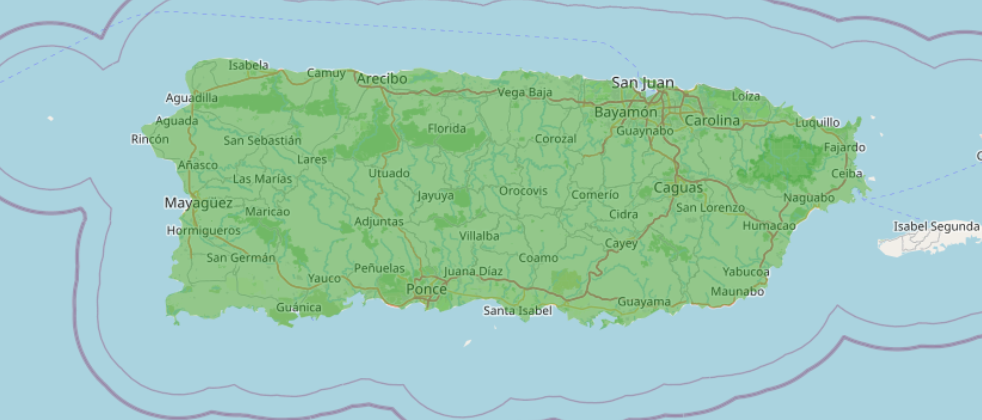
The Puerto Rican Emerald is endemic to Puerto Rico and occurs throughout much of the main island and its associated islands. It inhabits nearly all wooded landscapes, from coastal mangroves and dry coastal forest to humid montane forest in the central mountains. It is also common in shade-coffee plantations, second growth, gardens, parks, and urban areas where flowering plants are available.
Legend
Green Resident
Species Overview
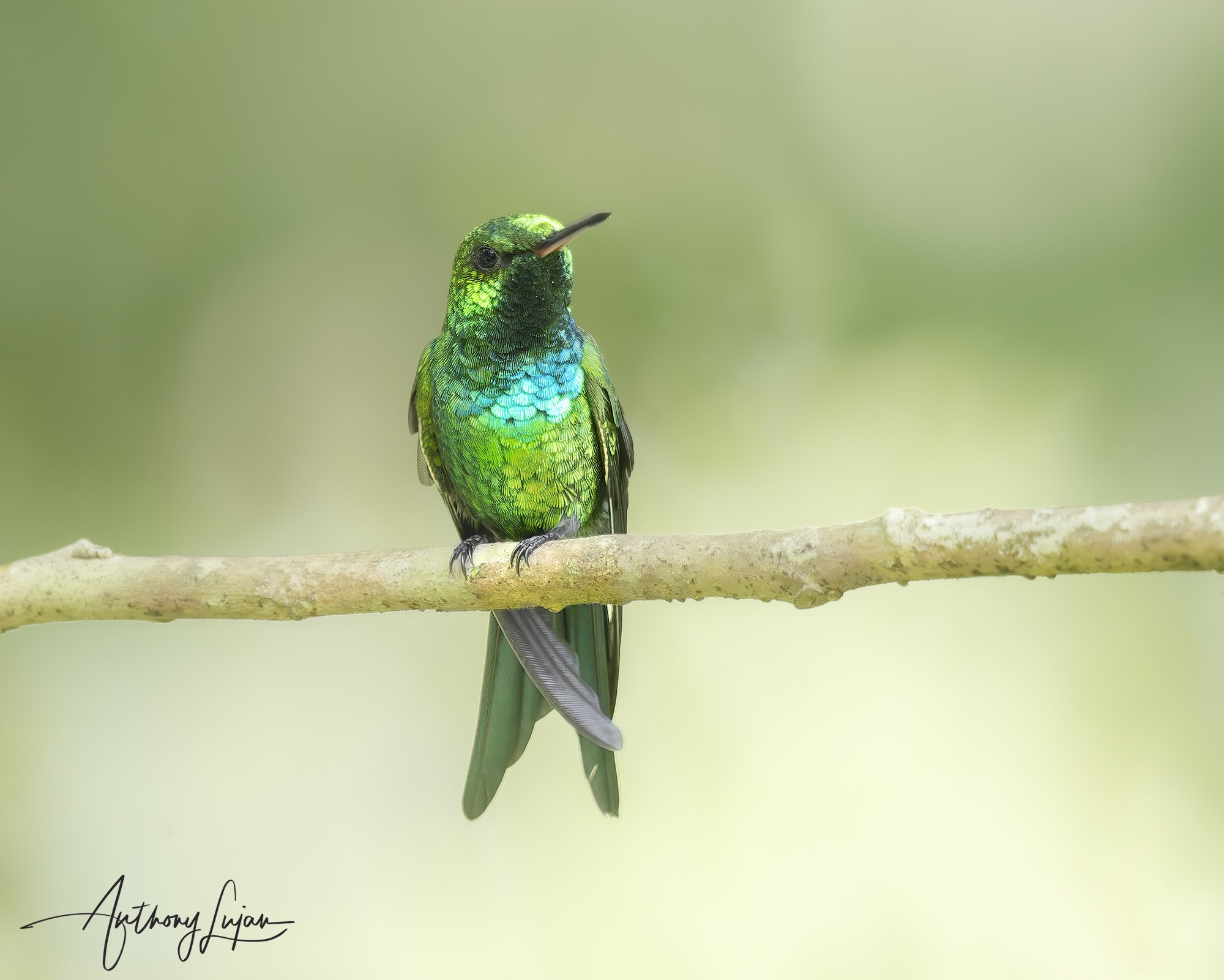
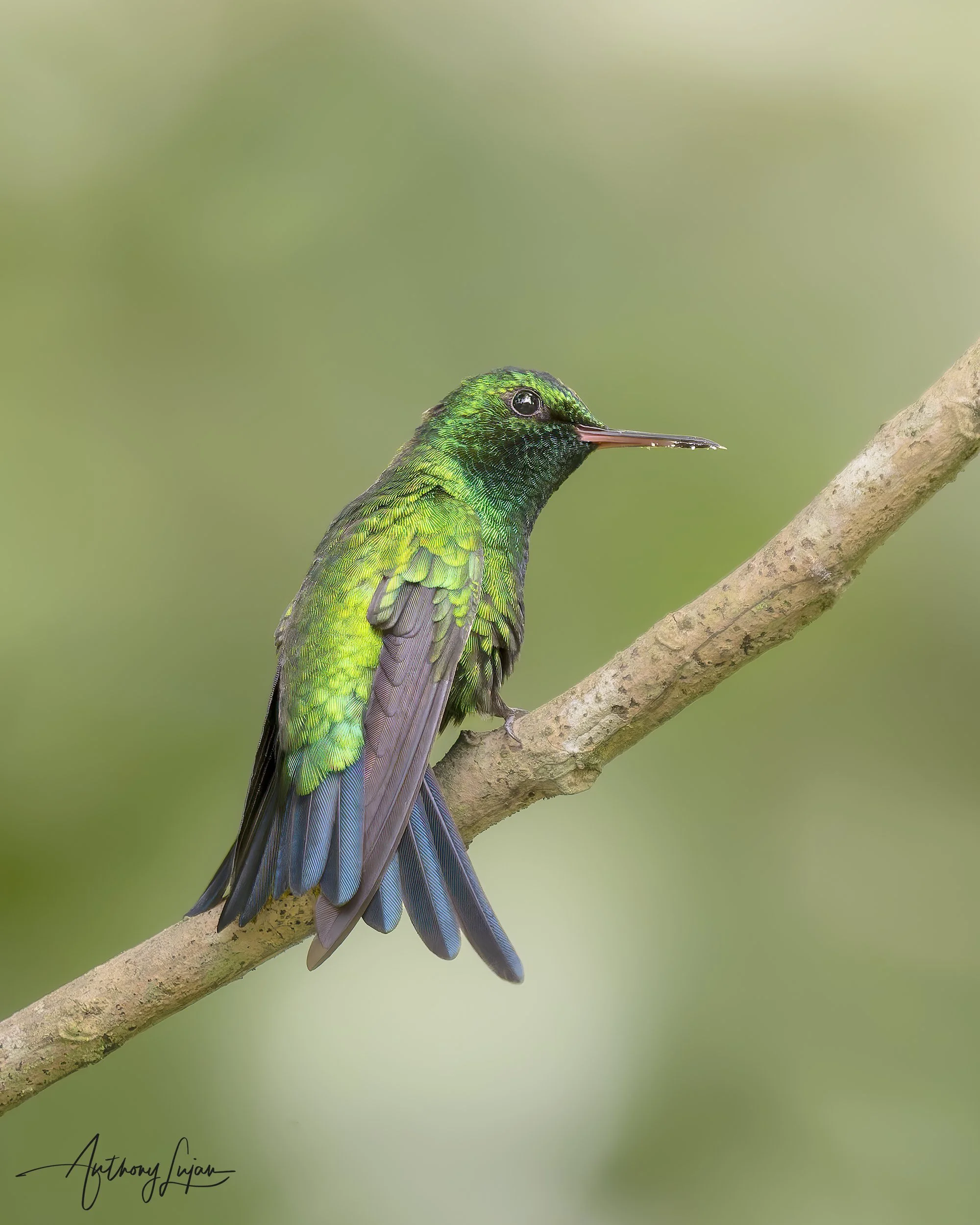
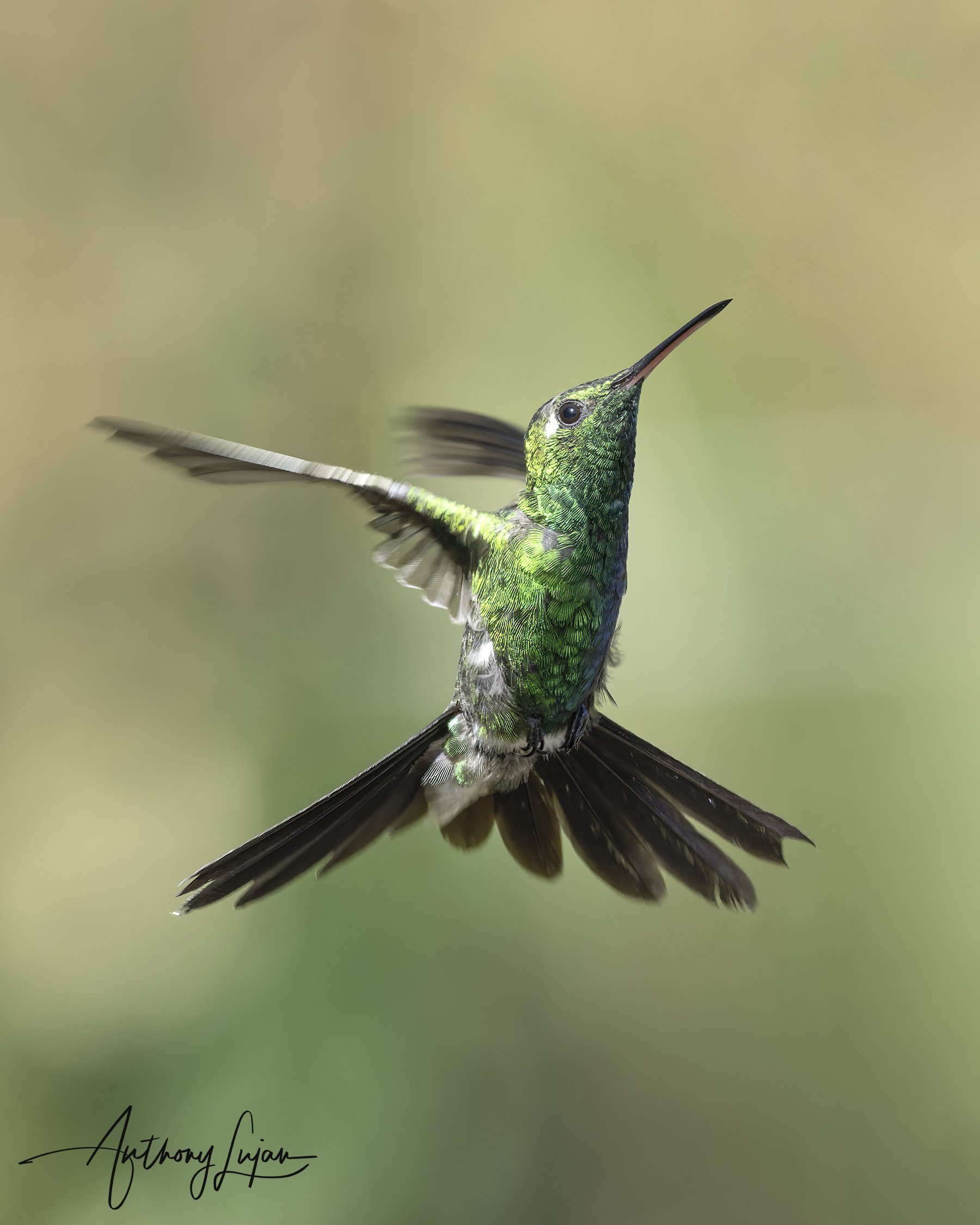
The Puerto Rican Emerald is Puerto Rico’s smallest bird species and one of the island’s most widespread hummingbirds. It is compact and short-billed, with glossy green upperparts and a relatively long tail. Adult males are almost entirely iridescent green, while females are paler below with a white belly and green spotting along the sides. Its rapid, twittering song and high, thin “tsip” calls are often heard around gardens, coffee plantations, and forest edges before the bird is seen.
Male Description
Males measure about 8.5–10 cm in length and weigh roughly 3–4 g. They are nearly uniform metallic emerald-green from crown to belly, although the lower belly and undertail coverts can appear slightly grayer in some light. The upperparts shine bright green, the tail is greenish to blue-green and relatively long, and the bill is short, straight, and black. Unlike many Caribbean hummingbirds, the male lacks a strongly contrasting throat patch, instead appearing as a continuously glowing green bird in favorable light.
Female Description
Females are similar in structure but less uniformly green. Upperparts are metallic green, while the throat and breast are pale grayish-white. The belly is usually white, with green spotting or a green wash along the sides and flanks. The tail is greenish, and the outer tail feathers have pale grayish or whitish tips that can be visible in flight or while perched. Juveniles resemble females but often show softer plumage, less distinct pale tail tips, and duller green upperparts.
Habitat & Behavior
Puerto Rican Emeralds use nearly every type of wooded habitat on the island, from coastal mangroves, dry forest, and open woodland to moist foothill forest and high-elevation montane forest. They are equally at home in shade-coffee plantations, forest edges, secondary growth, gardens, and city parks, provided flowering plants and suitable cover are present. This ecological flexibility helps explain their wide distribution across Puerto Rico.
They feed mainly on nectar from a wide variety of native and cultivated flowering plants, foraging mostly from low to middle levels of vegetation. They also take small insects and spiders, gleaning them from leaves and branches or making quick aerial sallies. Males may defend productive flower patches, but the species also moves frequently through gardens and forest edge vegetation, visiting scattered flowers in quick succession.
Breeding
Puerto Rican Emeralds probably nest during much of the year, with the main breeding period from February through May. The female builds a small cup-shaped nest of dry plant fibers and soft materials, held together with spiderweb and often covered with lichens for camouflage. Nests are usually placed in a low to medium-height shrub or tree, often in a shaded fork or on a horizontal branch.
The clutch consists of two white eggs. The female alone incubates the eggs for about 14–16 days and raises the young after hatching. Nestlings typically fledge about 20–22 days after hatching, then remain dependent on the female for a short period as they learn to forage.
Movement
The Puerto Rican Emerald is not a migrant. It is resident across Puerto Rico throughout the year, though individuals may shift locally between flowering areas, gardens, forest edges, and seasonal habitats as nectar supplies change. These movements are short-distance adjustments rather than regular migration.
Population
The global population is estimated at 30,000–39,999 mature individuals and is considered stable. The species remains widespread and generally common across Puerto Rico, especially where mature vegetation, flowering shrubs, and woodland cover persist. Its adaptability to gardens, shade coffee, and secondary forest provides resilience in a landscape that includes substantial human modification.

Conservation
The Puerto Rican Emerald is assessed as Least Concern because it is widespread, adaptable, and stable across its restricted Puerto Rican range. It benefits from wooded gardens, shade-coffee plantations, forest edges, and other managed habitats that retain flowering plants. As an island endemic, however, it remains vulnerable to severe hurricanes, prolonged droughts, loss of native woodland, and loss of flowering resources. Maintaining connected forest patches, native flowering vegetation, and structurally diverse gardens and agricultural landscapes supports the long-term health of its population.
Checkout Anthony’s playlist of this species! Click the top right dropdown to see all the videos.
Related species in the Riccordia genus (6 species in total, 2 possibly extinct):
Brace’s Emerald (Riccordia bracei, possibly extinct)
Gould’s Emerald (Riccordia elegans, possibly extinct)

Please note: The content provided in this article reflects Anthony’s personal experience and photographic approach. Results can vary depending on light, weather, location, equipment, subject behavior, and field conditions.