
How Bill Color Is Driving Speciation in Jamaica’s Streamertail Hummingbirds
Hummingbirds are famous for their iridescent feathers and acrobatic flight, but sometimes the most important features are the ones we barely notice. On the island of Jamaica, two nearly identical streamertail hummingbirds differ in just one obvious trait: the color of the male’s bill. That small difference, red versus black, may be helping push these birds along the path toward becoming two distinct species.
A study published in the journal PNAS Nexus examined how Jamaica’s Red‑billed and Black‑billed Streamertail hummingbirds meet, hybridize, and yet remain distinct along a very narrow contact zone. The research uses museum specimens and modern genetic tools to show how female choice for male bill color can maintain a sharp boundary between the two forms, even while genes continue to flow between them.
What Scientists Studied
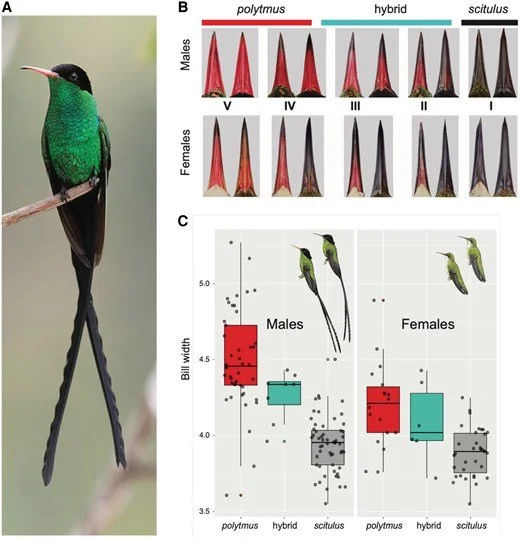
Researchers focused on two endemic species: the Red‑billed Streamertail (Trochilus polytmus), Jamaica’s national bird, and the Black‑billed Streamertail (Trochilus scitulus). Males of both species share the same basic look—bright green plumage and long, ribbon‑like tail feathers—but differ strikingly in bill color: vivid red in one, jet black in the other. The team wanted to understand how these two forms can remain distinct on a relatively small island, especially where their ranges come together and they sometimes interbreed.
The study centered on a narrow region in northeastern Jamaica, the Rio Grande Valley, where the two species meet and produce hybrids. This area, known as a hybrid zone, is where the researchers measured both physical traits and genetic patterns. By comparing birds across and around this valley, they could see how quickly bill color and underlying genes change from one form to the other.
How the Research Was Conducted
To explore this question, scientists examined 186 streamertail specimens collected across the hybrid zone and surrounding areas. For each bird, they recorded detailed measurements of the bill, including color and width, and noted plumage characteristics that might distinguish the two forms and their hybrids. These specimens, stored in museum collections, provided a historical and geographic snapshot of variation across the valley.
The team also generated genomic data, analyzing thousands of genetic markers (SNPs) distributed across the hummingbird genome, along with a segment of mitochondrial DNA. By combining physical measurements with genetic information, they could estimate how much the two forms differ overall, where genes are mixing freely, and where particular regions of the genome show sharp differences that might be tied to bill color.
What the Study Found
The results revealed a strikingly narrow boundary between Red‑billed and Black‑billed Streamertails. The transition from red to black bills happens over a distance of only a few kilometers in the Rio Grande Valley. Despite the birds’ strong flight abilities and the lack of a major physical barrier, the change in bill color is very steep—one of the sharpest transitions in a visible trait documented in a bird hybrid zone.
Genetically, the picture is more blended. Across most of the genome, the two forms are only modestly differentiated, and there is clear evidence of ongoing gene flow between them. However, a small set of genetic markers shows abrupt changes in frequency across the same narrow region where bill color shifts. Some of these markers lie on the Z chromosome (the sex chromosome in birds), while others map to a chromosome known from other species to affect melanin‑based coloration. Together, these patterns suggest that strong selection is acting on bill color and on specific genomic regions tied to that trait, even as the rest of the genome continues to mix.
Why the Discovery Matters
This study provides a rare, detailed look at speciation in progress on a small island. In many classic bird examples, new species arise after populations are separated by oceans, mountains, or large distances. In contrast, Jamaica’s streamertails can potentially traverse the entire island, yet still maintain a very narrow and stable hybrid zone. The findings show that geographic isolation is not the only path to speciation.
Instead, sexual selection—specifically, female choice for male bill color—appears to be playing a central role. Hybrid males often have mottled or two‑tone bills that resemble immature Red‑billed males, and these intermediate bills may be less attractive to females from both forms. If females consistently prefer males with their own species’ bill color and avoid hybrids, they help maintain the sharp boundary and reinforce divergence. Over time, this kind of preference can push populations further apart, even when they live on the same island and can still interbreed. For hummingbird enthusiasts, it’s a powerful reminder that subtle traits, like bill color, can shape the evolutionary future of entire lineages.
Research Credit
This article summarizes findings from the following scientific study:
Caroline Duffie Judy, Gary R Graves, John E McCormack, Katherine Faust Stryjewski, Robb T Brumfield (2025)
Speciation with gene flow in an island endemic hummingbird.
PNAS Nexus, Volume 4, Issue 4, April 2025, page 95
Readers interested in the full methodology, experiments, and analysis can consult the original publication.
Frequently Asked Questions
Scientific studies often raise additional questions about how hummingbirds behave and survive in the wild. Here are a few common questions related to this research.
-
In streamertails, males use their bills prominently in courtship displays, making bill color a highly visible signal. If females use this signal to choose mates, bill color becomes more than just decoration—it directly influences which males reproduce. Over many generations, this kind of mate choice can help keep two forms distinct, even when their ranges overlap.
-
Yes. In the narrow Rio Grande Valley contact zone, the two forms meet and sometimes interbreed. Hybrids often show intermediate bill colors and shapes, which can make them look different from males of either parent species. Current research suggests that these intermediate traits might be less attractive to females, which limits how far hybrid genes spread.
-
Species boundaries are not always all‑or‑nothing. Many closely related birds can produce hybrids where their ranges meet. In this case, most of the genome still mixes, but strong selection on bill color and associated genes helps maintain a sharp boundary. The study presents this system as an example of speciation “with gene flow,” where divergence continues even though the two forms are not completely reproductively isolated.
-
This study focused on bill color primarily as a sexual signal, not as a tool for feeding or fighting. While bill size and shape can influence how birds feed, the key result here is that color differences—and the way females respond to them—align with steep genetic differences across the hybrid zone. Other studies would be needed to test whether bill color also affects aggression or resource use in these hummingbirds.
-
Yes, several hummingbird groups show strong differences in plumage color between closely related species, and hybrid zones are known in a few of them. In many cases, color is thought to play a role in mate choice and species recognition. What makes the Jamaican streamertail system especially valuable is the combination of a very narrow hybrid zone, an island setting, and detailed genomic data that point specifically to bill color as a key trait under selection.







Please note: The content provided in this article is for educational purposes only and summarizes published scientific research. Interpretations of research may evolve as new studies become available.