
Mexico Hummingbird Expedition | June 2023
9 New | Mission for a Critically Endangered Coquette
Trip overview
Dates: June 10–17, 2023
Regions: Acapulco, Atoyac de Álvarez, Chilpancingo de los Bravo, General Heliodoro Castillo
Total hummingbird species observed: [add final count]
New species photographed: 9
Focus: Endemic and threatened hummingbirds of the Sierra Madre del Sur
Mexico is home to 59 hummingbird species, spread across deserts, cloud forests, coastal slopes, and high volcanic mountains. For a hummingbird project, it is not a side trip. It is a core country. For my first expedition here, I did not try to cover everything. I focused on one region and a small set of endemics, led by one of the most threatened hummingbirds in the world, the Short-crested Coquette.
Earlier trips had been about broad discovery. This one was about a very specific goal. Reviewing photos on eBird and other platforms, I saw that most images of Short-crested Coquette were distant, heavily cropped, or soft. I wanted to stand in front of this bird and create detailed photographs that would show people what it really looks like.
Why this part of Mexico, and why these hummingbirds
With 59 species in the country, you cannot see everything in one go. You have to choose. For this expedition, the Sierra Madre del Sur in Guerrero set the map. From there, three endemics and one highland specialist defined the plan:
Over the course of this expedition, I photographed nine hummingbird species that were new to my list:
#134 CR Short-crested Coquette, Lophornis brachylophus
#135 NT White-tailed Hummingbird, Eupherusa poliocerca
#136 LC Green-fronted Hummingbird, Leucolia viridifrons
#137 LC Golden-crowned Emerald, Cynanthus auriceps
#138 LC Amethyst-throated Mountain-gem, Lampornis amethystinus
#139 LC White-eared Hummingbird, Basilinna leucotis
#140 LC Mexican Hermit, Phaethornis mexicanus
#141 LC Dusky Hummingbird, Phaeoptila sordida
#142 LC Turquoise-crowned Hummingbird, Cynanthus doubledayi
Four of these carried the emotional weight of the trip.
Four hummingbirds that defined the expedition
Short-crested Coquette
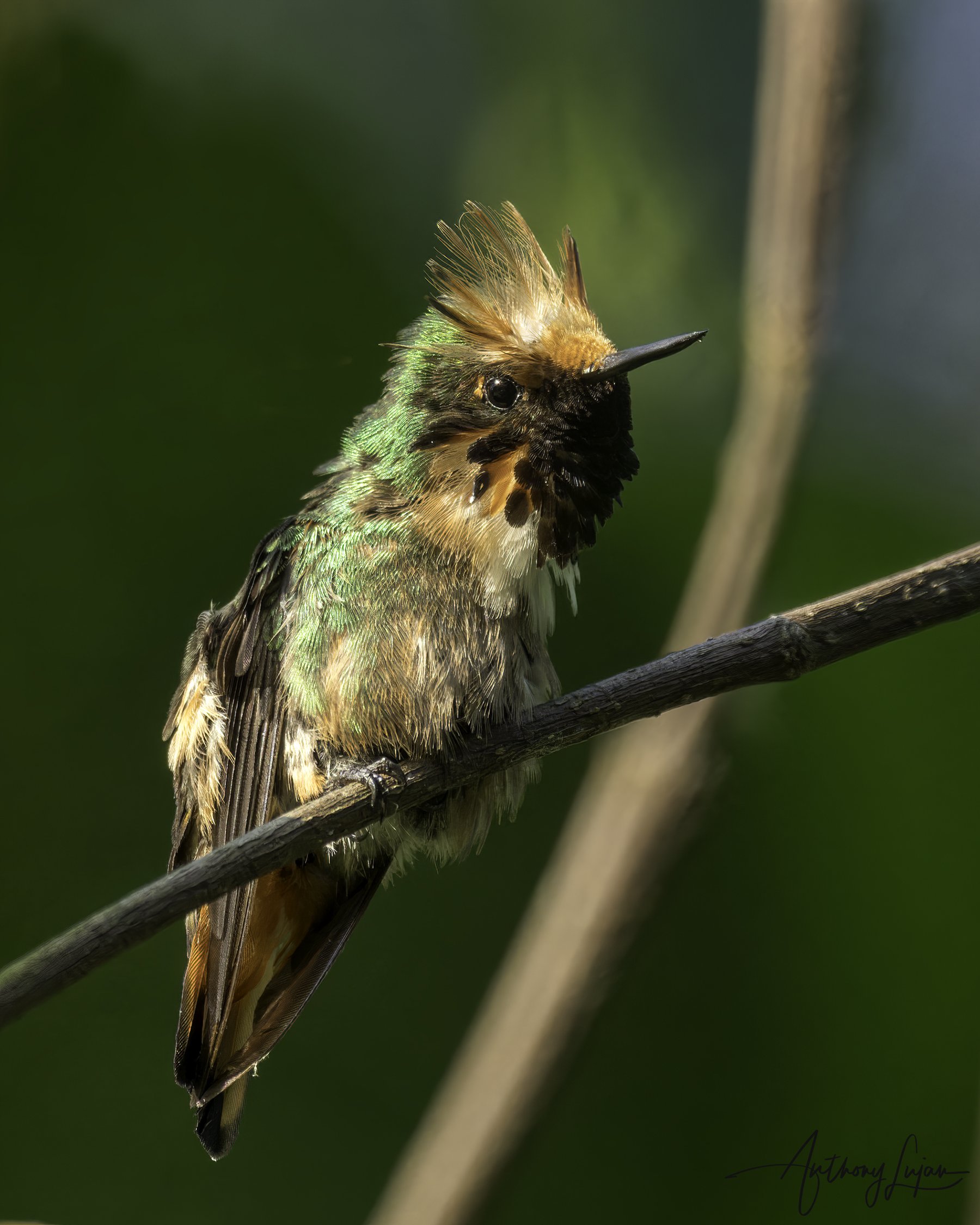
Endemic, Critically Endangered, and narrowly confined
Short-crested Coquette lives in a world that feels too small for a hummingbird this special. Its range is restricted to a short section of the Sierra Madre del Sur in Guerrero, centered on steep slopes and roadside habitat in a narrow elevation band. Before you ever see the bird, the landscape tells you how precarious its situation is. Patches of forest and coffee, cuts in the slope, and a sense that any change on that road could ripple through the entire population.
Most published images showed the bird as a tiny shape in the frame, proof that it was there, but not enough detail to share its full beauty. I planned this trip to change that. Days were built around that elevation band, specific flowering trees, and stretches of road where recent sightings had come in. When a Short-crested Coquette finally appeared at workable distance, held a flower, and turned just enough to show the crest and pattern sharply, it felt like the culmination of months of planning and a lot of quiet time on the roadside.
Those close, detailed frames were not only a personal milestone. They were a way to give this Critically Endangered endemic a clearer visual presence and, hopefully, make it easier for people to connect with what is at stake.
White-tailed Hummingbird
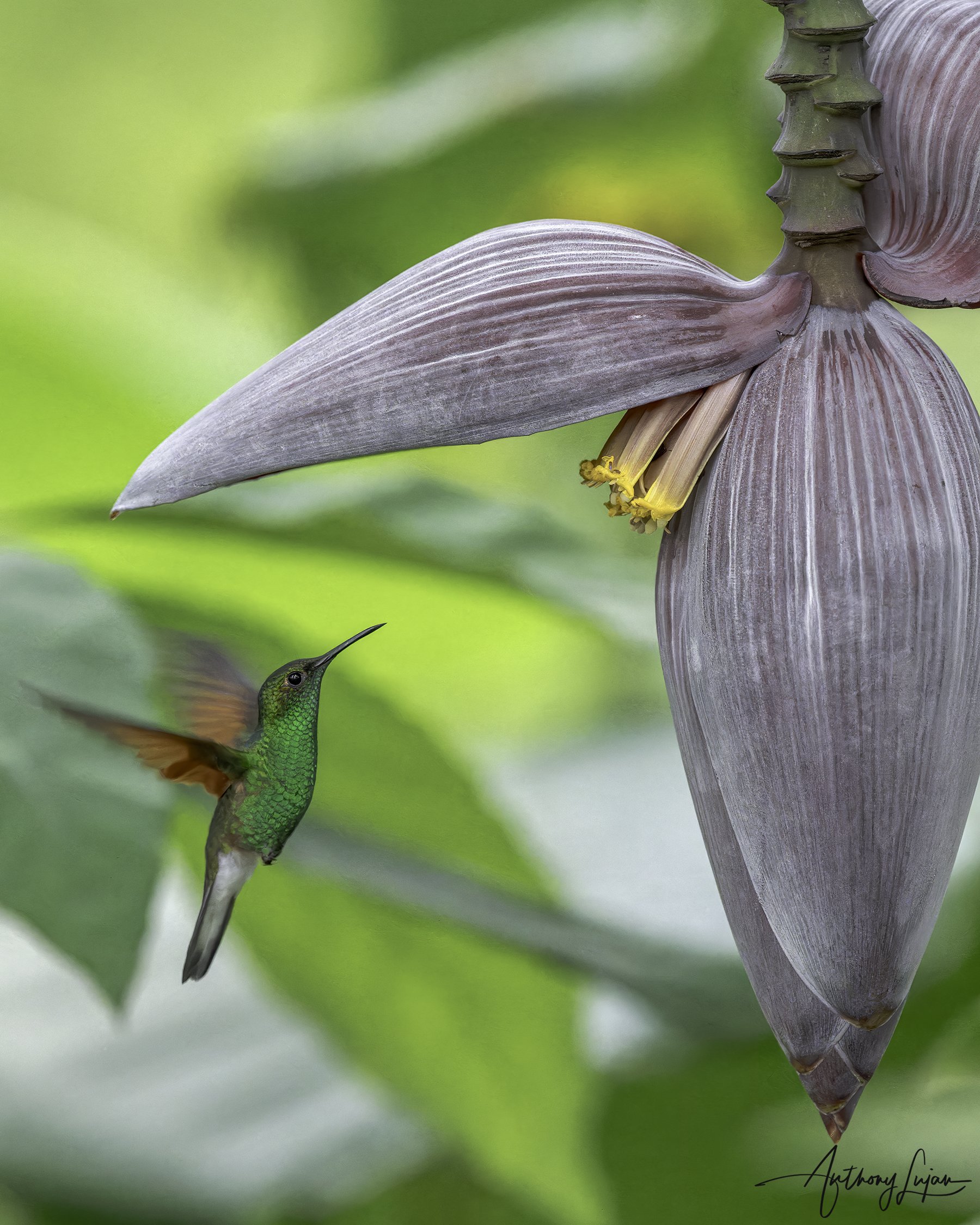
Endemic, Near Threatened, forest dependent
White-tailed Hummingbird is another Mexico endemic with a small range along the Pacific slope. It favors humid and semi-deciduous forest and pine oak forest, and it does not respond well to heavy habitat loss. In the field, you feel that connection. You find it where the forest still has structure, along edges, ravines, and slopes that have not been completely opened up.
The white tail is the key. It flashes as the bird moves and feeds, a quick, clean signal against the background of green and brown. Photographing White-tailed Hummingbirds meant putting time into those smaller patches of good habitat and staying patient when activity seemed slow. This species felt like a parallel thread to the Short-crested Coquette. Different look, different behavior, but the same underlying tension between a limited range and ongoing pressure on the forest it needs.
Golden-crowned Emerald

Endemic, dry and semi-open habitats
Golden-crowned Emerald brings a different piece of Mexico into focus. It is endemic to western Mexico, but its heart is in drier habitats and semi-open landscapes. Tropical dry forest, scrub, and edges where flowering shrubs and trees stand in stronger light and warmer air.
On this expedition, Golden-crowned Emeralds helped balance the story. After hours in humid, forested slopes, it was grounding to step into more open country and work with a hummingbird that feels built for that setting. The golden crown, forked tail, and quick, direct movements around flowers made it easy to pick out once you tuned your eye. Photographing them required a different approach to light and background. Brighter skies, harder edges, and more contrast in the scene. It was a reminder that Mexico’s endemics are not confined to a single habitat type, even within one region.
Amethyst-throated Mountain-gem

Highland anchor in a crowded community
Amethyst-throated Mountain-gem is not endemic, but it is a defining highland hummingbird across parts of Mexico and Central America. On this trip, it played a crucial role. It gave structure to the higher parts of the route, where cooler air, conifers, and cloud influenced forest changed the feel of everything.
In mixed hummingbird communities, Amethyst-throated Mountain-gems hold their ground. They work flowering shrubs, edges, and clearings, often using mid-level perches with good visibility. Photographing them meant paying more attention to how the whole community interacted. Who was dominant, who gave way, and how a larger, more imposing hummingbird moved differently from the tiny coquettes and emeralds I was also tracking. This species helped tie Mexico back to the broader mountain hummingbird story I had been building in other countries.
The rest of the cast and the shape of the region
The other six species completed the picture of this part of Mexico:
Green-fronted Hummingbird and Turquoise-crowned Hummingbird added more color and variety along the Pacific slope, both visually and behaviorally.
White-eared Hummingbird reinforced the highland element, a familiar face from elsewhere in Mexico and the southwest that grounded the scene.
Mexican Hermit and Dusky Hummingbird showed how understory and localized species fit into the same landscape, using dense cover and smaller spaces that bigger, bolder hummingbirds often ignore.
Taken together, the nine new species made the Sierra Madre del Sur feel layered: roadside flowers, forest edges, high elevation patches, and drier, more open country all stitched together by hummingbirds that are uniquely Mexican.
What this trip changed
Working in a country with 59 hummingbird species, but focusing on a single region and a handful of targets, changed how I think about “coverage.” It is tempting to treat Mexico as one giant goal. This expedition reminded me that each mountain range and slope can hold its own set of urgent stories.
Planning around the Short-crested Coquette sharpened everything. I spent more time studying previous photos, more time cross-checking elevation and habitat, and more time thinking about how to use images once I had them. It also reinforced the idea that not all hummingbird work is equal in terms of urgency. Some trips are about learning and variety. Others, like this one, are about giving one or two species the attention they have rarely received.
If you want to see the full list of species photographed during this trip, you can view the complete travel overview here: 2023 06 Mexico
Mexico hosts 59 hummingbird species; see the ones I’ve photographed.
Join me on future trips like this. You can find more details here: Visit Travel with Me!
Frequently asked questions
Every time I share images of the Short-crested Coquette, a set of questions comes up. This quick FAQ adds context before you move on to the next Hummingbird Travel Story.
-
Because Mexico holds 59 hummingbird species, including several endemics with very limited ranges. It is a key country if you want a serious view of hummingbird diversity.
-
It is Critically Endangered, endemic to a very small area, and underrepresented in sharp, close photographs. That combination made it a clear candidate for a targeted expedition.
-
They show different sides of Mexico’s hummingbird story. Two more endemics with conservation concerns or limited ranges, and one highland species that anchors the mountain community.
-
It confirmed that Mexico deserves multiple focused expeditions, each aimed at specific regions and groups of hummingbirds, rather than a single broad pass through the country.