
Trinidad and Tobago Hummingbird Expedition | September 2022
10 New | Island Firsts
Trip overview
Dates: September 2–10, 2022
Regions: Rio Claro–Mayaro, Sangre Grande, Tobago, Tunapuna–Piarco
Total hummingbird species observed: 20
New species photographed: 10
Focus: First island expedition and a full-country hummingbird run
Twenty hummingbird species on Trinidad and Tobago was all it took to pull me in. I had never been on an island before, and the idea of a contained hummingbird list was impossible to ignore. Could I photograph all 20 species in a single trip? That was the question that sat behind every plan and every early alarm.
Why Trinidad and Tobago stood out
After several mainland expeditions, the appeal of Trinidad and Tobago was simple. The list was finite. The geography was defined. For once, I was not looking at a massive continental range. I was looking at two islands with a known hummingbird community and a clear ceiling of 20 species.
Over the course of the trip, I photographed 10 new hummingbird species:
#83 LC White-chested Emerald, Chrysuronia brevirostris
#84 LC White-tailed Goldenthroat, Polytmus guainumbi
#85 NT White-tailed Sabrewing, Campylopterus ensipennis
#86 LC Green-throated Mango, Anthracothorax viridigula
#87 LC Little Hermit, Phaethornis longuemareus
#88 LC Rufous-breasted Hermit, Glaucis hirsutus
#89 LC Tufted Coquette, Lophornis ornatus
#90 LC Blue-chinned Sapphire, Chlorestes notata
#91 LC Long-billed Starthroat, Heliomaster longirostris
#92 LC Copper-rumped Hummingbird, Saucerottia tobaci
Four of these became the core of the story: White-tailed Sabrewing, Tufted Coquette, Blue-chinned Sapphire, and Long-billed Starthroat.
Four hummingbirds that defined the islands
White-tailed Sabrewing
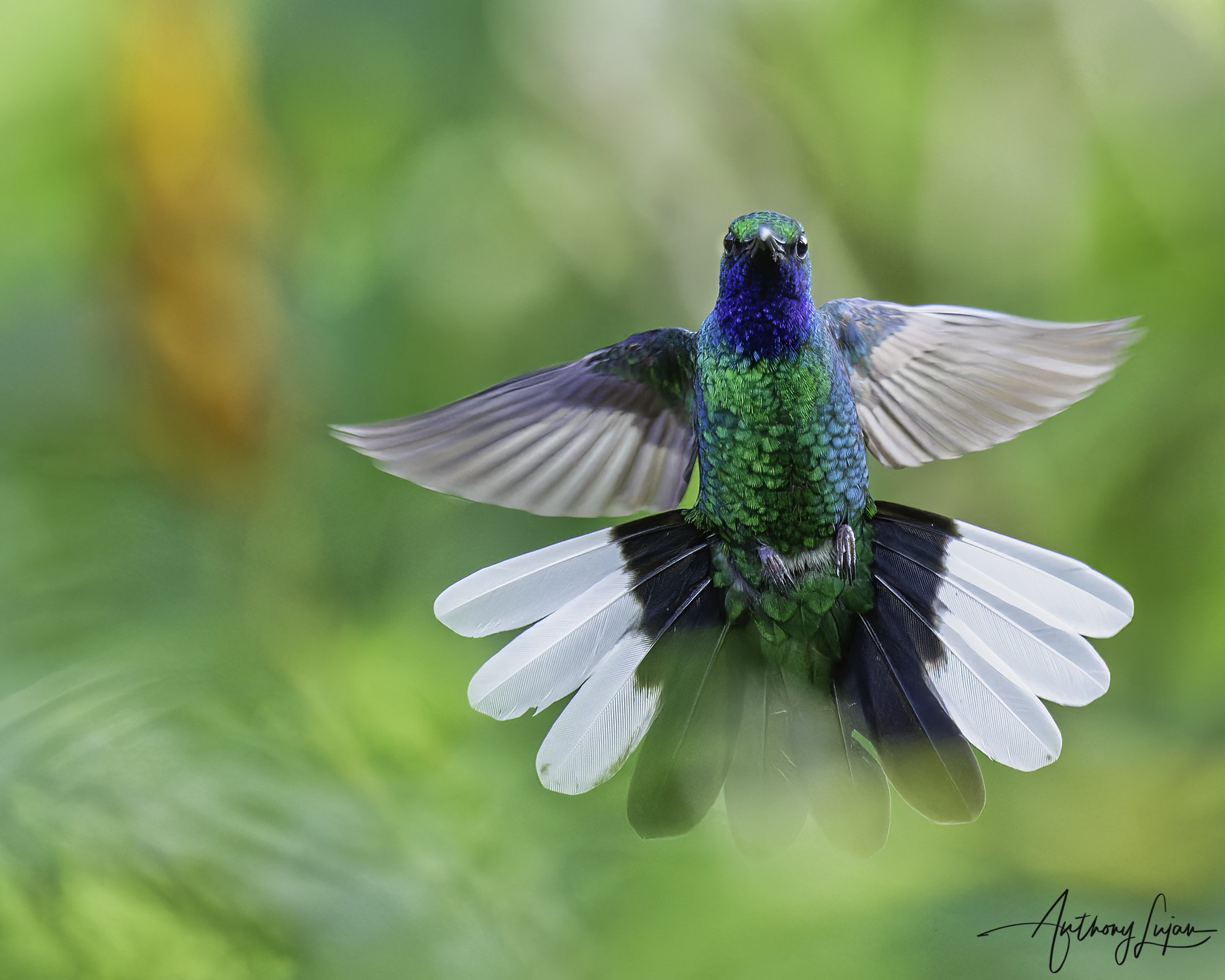
Near Threatened, island stronghold
White-tailed Sabrewing was the conservation anchor of this trip. On paper, it is listed as Near Threatened. In person, it feels like a bird that carries the weight of its habitat on its wings.
Seeing a large sabrewing swing through that space, white tail flashing in the shadows, was a reminder that even on relatively small islands, some hummingbirds live in very specific pockets of habitat. Every clean frame with a White-tailed Sabrewing felt like evidence that this forest, and the bird tied to it, are still holding on.
Tufted Coquette

Small, ornate, and unforgettable
Tufted Coquette is one of my favorite hummingbird genera. It is tiny and ornate, with a crest and patterning that look almost unreal when you finally see them well. On Trinidad and Tobago, it added a burst of personality to every site where it appeared.
Photographing Tufted Coquettes is an exercise in timing. They are quick, precise, and focused, often working specific flowers with short, intense visits. I had to learn which blossoms were pulling them in and then wait for the brief moments when they held still just long enough to show the crest and body pattern cleanly. For a small bird, the Tufted Coquette carried a huge share of the visual impact of this trip.
Blue-chinned Sapphire

Color that rewards patience
Blue-chinned Sapphire is one of those hummingbirds that look simple at first glance and then unfold the longer you watch them. The key is light and angle. Depending on how the bird turns, the throat and chin can shift from dark to vibrant, and the rest of the plumage picks up subtle hues that are easy to miss if you only see it in passing.
On this expedition, Blue-chinned Sapphire became a lesson in staying put. Instead of chasing every movement, I picked where it would often perch and waited. When the angle and light finally came together, the bird looked completely different from the “dark hummingbird” it first appeared to be. It was a reminder that some species ask you to slow down if you want to see what is actually there.
Long-billed Starthroat

Structure and silhouette
Long-billed Starthroat brought a different kind of presence to the list. The proportions are what stand out first, especially the long, straight bill and overall shape. It feels built for reach, for working deeper flowers, and for using space differently than many of the smaller hummingbirds around it.
Most of my encounters with Long-billed Starthroats involved higher, more exposed perches and quick drops to flowers, followed by returns to vantage points with clear views. Photographing them was less about tight, foliage-framed shots and more about clean silhouettes and strong lines. This species added a sense of structure to the trip, helping balance the compact, energetic hummingbirds I was also working with.
Island birding pressure, island birding rewards
Trying to cover a full island list in one trip creates a different kind of pressure. The geography feels smaller, but the logistics can be just as complex. Each day you are aware that there are only so many places to work with and only so many combinations of sites and conditions you can realistically attempt.
On Trinidad and Tobago, that pressure came with real rewards. The more I moved through the islands, the more the hummingbird community started to feel like a complete set rather than a random collection of species. I could see how different habitats, elevations, and coastlines divided the birds, and I could also see where they overlapped and shared space.
By the end of the expedition, the question that brought me here, could I knock out all 20 species in one trip, felt less important than the understanding I had built by trying.
Why this trip still matters
This expedition was my first true hummingbird island experience, and it changed how I think about scope. On the mainland, the list can feel endless.
I didn’t photograph all 20 species initially, some are migrants and others prefer to stay hidden. I was beyond pleased to capture 10 amazing new species. As I write this today, I have photographed all 20 species found on the islands, 10 of which were photographed in nearby countries.
Trinidad and Tobago hosts 20 hummingbird species; see the ones I’ve photographed.
Even in a compact setting, the four focus hummingbirds showed how much variety there is. A Near Threatened sabrewing in deep forest, a tiny ornate coquette, a sapphire that rewards patience, and a long-billed starthroat that turns perches into portraits. Together, they turned this from a simple numbers challenge into a genuine island story.
If you want to explore the full list of species photographed during this trip, you can view the complete travel overview here: 2022 09 Trinidad and Tobago
Join me on future trips like this. You can find more details here: Visit Travel with Me!
Frequently asked questions
Every expedition brings up a few of the same questions about where these hummingbirds live and what it takes to find them. This quick FAQ adds context before you move on to the next trip.
-
The islands offer a compact, high quality hummingbird list with clear habitat divisions, which makes them ideal for a focused trip where you can realistically aim to see the full community.
-
It is ambitious, and conditions, access, and timing all matter. Even if you do not reach all 20, planning around the full list forces you to understand the habitats and movements that shape the islands.
-
White-tailed Sabrewing brings a conservation and habitat story to the trip, while Tufted Coquette shows how small, ornate hummingbirds can define the visual identity of a place.
-
On an island, the list is finite and the geography is contained. That creates both pressure and clarity. Every day feels like a step toward a complete picture rather than a small sample of something much larger.
Please note: The content provided in this article reflects Anthony’s personal experience and photographic approach. Results can vary depending on light, weather, location, equipment, subject behavior, and field conditions.