
Colombia Hummingbird Expedition | March 2022
Trip overview
Dates: March 15–26, 2022
Regions: Caldas, Cundinamarca, Tolima, Valle del Cauca
Total hummingbird species observed: [add final count]
New hummingbird species photographed: 41
Focus: First deep dive into Colombia’s Andes, from extreme bills and tails to high elevation specialists
This Colombia expedition was my first serious attempt to see what happens when you spend nearly two weeks inside one of the richest hummingbird countries in the world. From high páramo around Nevado del Ruiz to lush Andean slopes and foothills, the goal was simple. Put myself in front of as many Colombian hummingbirds as possible and pay close attention to the ones that push form and behavior to extremes. Four species became the anchors of the trip. Buffy Helmetcrest, Golden-tailed Sapphire, Sword-billed Hummingbird, and Ruby-topaz Hummingbird.
Why these regions in Colombia
Caldas, Cundinamarca, Tolima, and Valle del Cauca gave me a cross-section of Colombia’s Andean story. High elevation páramo in the Central Andes. Montane forest and sunangel country. Mid-elevation slopes and foothills where sapphires, emeralds, and mangoes thrive. Lowland and drier areas where species like Ruby-topaz Hummingbird appear. It was a route designed to feel like multiple countries in one, tied together by the same mountain system.
During this expedition, I photographed 41 hummingbird species, all of them new to my list:
#37 LC Sword-billed Hummingbird, Ensifera ensifera
#38 LC Black-tailed Trainbearer, Lesbia victoriae|
#39 LC Coppery-bellied Puffleg, Eriocnemis cupreoventris
#40 LC Blue-throated Starfrontlet, Coeligena helianthea
#41 LC Sparkling Violetear, Colibri coruscans
#42 LC Glowing Puffleg, Eriocnemis vestita
#43 LC Lazuline Sabrewing, Campylopterus falcatus
#44 LC White-Booted Racket-tail, Ocreatus underwoodii
#45 LC Bronzy Inca, Coeligena coeligena
#46 LC Green-bellied Hummingbird, Saucerottia viridigaster
#47 LC Golden-tailed Sapphire, Chrysuronia oenone
#48 LC Sooty-capped Hermit, Phaethornis augusti
#49 LC Buff-tailed Coronet, Boissonneaua flavescens
#50 LC Rainbow-bearded Thornbill, Chalcostigma herrani
#51 LC Shining Sunbeam, Aglaeactis cupripennis
#52 VU Buffy Helmetcrest, Oxypogon stuebelii
#53 LC Fawn-breasted Brilliant, Heliodoxa rubinoides
#54 LC Tourmaline Sunangel, Heliangelus exortis
#55 LC Collared Inca, Coeligena torquata
#56 LC Long-tailed Sylph, Aglaiocercus kingii
#57 LC Ruby-topaz Hummingbird, Chrysolampis mosquitus
#58 LC White-whiskered Hermit, Phaethornis yaruqui
#59 LC White-bellied Woodstar, Chaetocercus mulsant
#60 LC White-vented Plumeleteer, Colibri serrirostris
#61 LC Tyrian Metaltail, Metallura tyrianthina
#62 LC Longuemare's Sunangel, Heliangelus clarisse
#63 LC Great Sapphirewing, Pterophanes cyanopterus
#64 LC Gorgeted Woodstar, Chaetocercus heliodor
#65 LC Violet-fronted Brilliant, Heliodoxa leadbeateri
#66 LC Western Emerald, Chlorostilbon melanorhynchus
#67 LC Velvet-purple Coronet, Boissonneaua jardini
#68 LC Steely-vented Hummingbird, Saucerottia saucerottei
#69 LC Black-thighed Puffleg, Eriocnemis derbyi
#70 LC Greenish Puffleg, Haplophaedia aureliae
#71 LC Black-throated Mango, Anthracothorax nigricollis
#72 LC Green-tailed Trainbearer, Lesbia nuna
#73 LC Violet-tailed Sylph, Aglaiocercus coelestis
#74 LC Empress Brilliant, Heliodoxa imperatrix
#75 LC Rufous-gaped Hillstar, Urochroa bougueri
#76 LC Green-fronted Lancebill, Doryfera ludovicae
#77 LC Andean Emerald, Uranomitra franciae
Four hummingbirds I had at the top of my list of the trip: Buffy Helmetcrest, Golden-tailed Sapphire, Sword-billed Hummingbird, and Ruby-topaz Hummingbird.
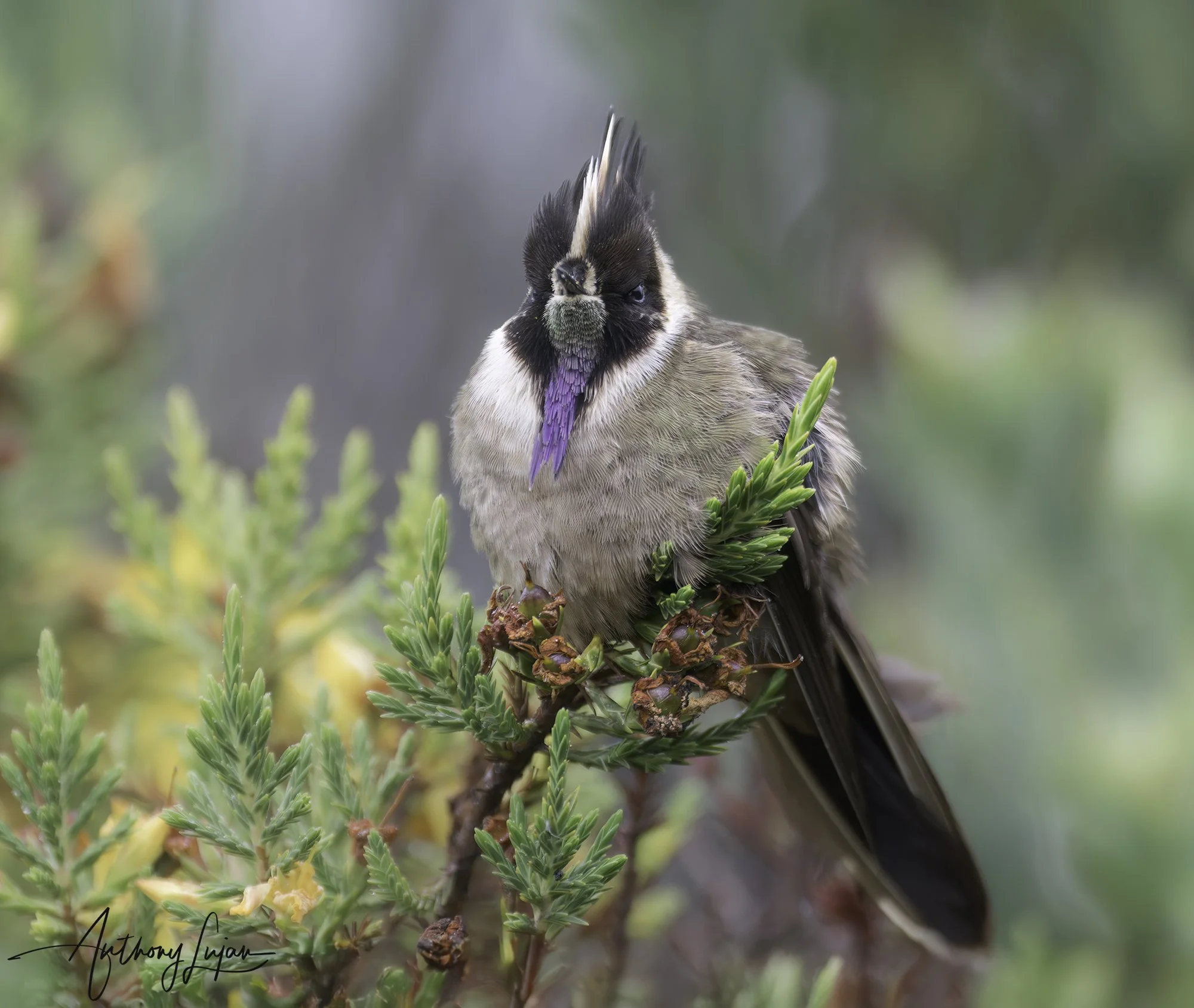
Buffy Helmetcrest
Endemic, Vulnerable, and tied to a single volcano
Buffy Helmetcrest is the kind of hummingbird you build an entire day around. It is endemic to Colombia and is essentially confined to the high-elevation páramo around Nevado del Ruiz and to nearby Central Andes sites in Tolima and Caldas. Open páramo grasslands, rocky slopes, and fields of frailejones (Espeletia) define its world. Wind, cold, and thin air are constants.
Standing in that landscape, you immediately feel how specialized this bird is. It moves among frailejones and low shrubs, clinging to flowers and sometimes even walking on the ground to lurch for insects. The buffy crest and beard, combined with its compact shape, make it look perfectly built for this high, exposed environment. Photographing Buffy Helmetcrests was about embracing that harshness. Big sky, low vegetation, and a bird that looks like it belongs exactly there and nowhere else. Every clean frame felt like a small piece of a very localized story.
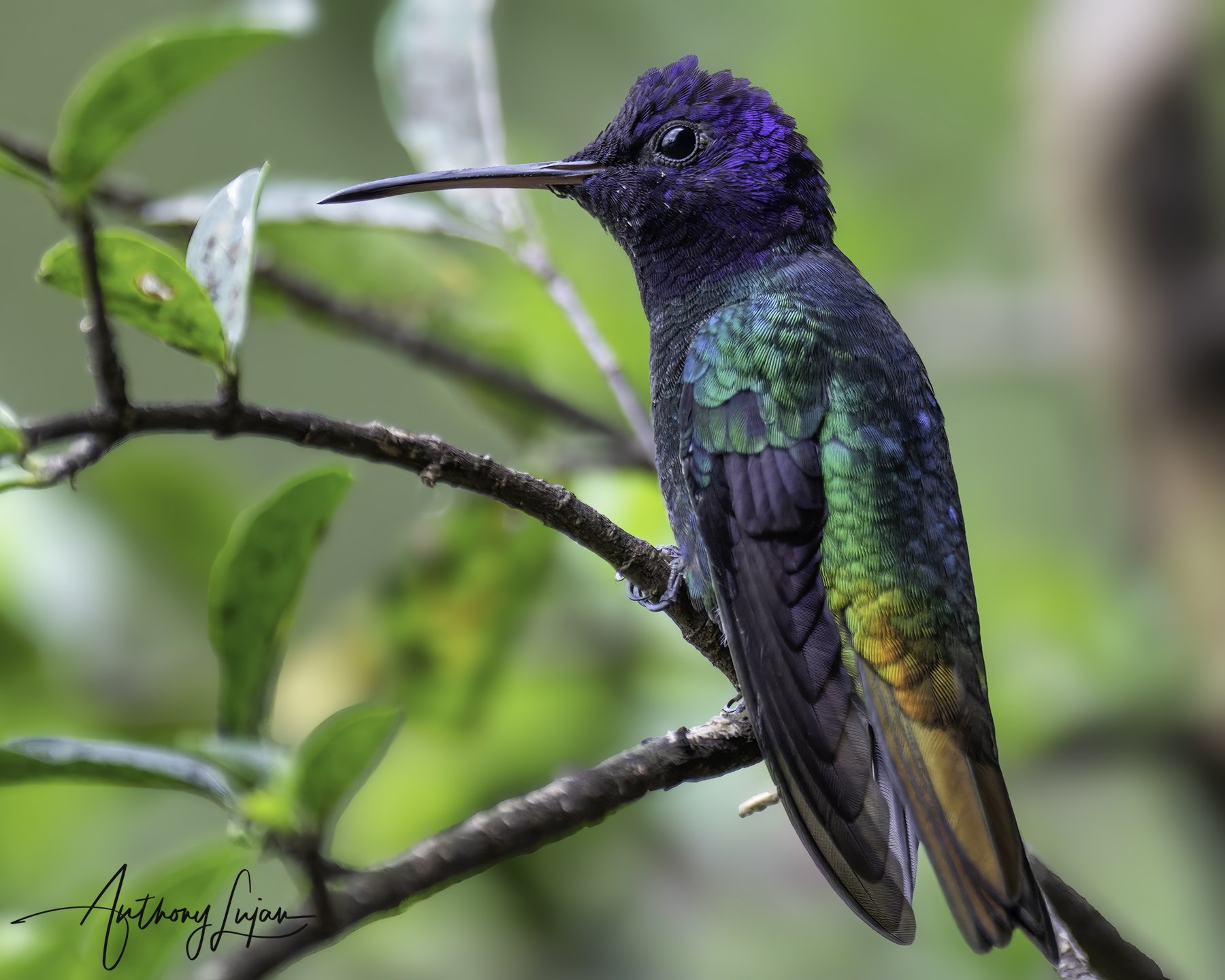
Golden-tailed Sapphire
Color, light, and personality
Golden-tailed Sapphire was one of the most charismatic hummingbirds of the lower and mid-elevation parts of this route. It favors semi-open habitats such as the edges of humid forests, clearings, secondary growth, riverine forests, and even shaded cacao or coffee. In Colombia, that meant a lot of time along forest edges, near clearings, and in foothill landscapes where light and flowers were easier to work with.
The bird’s combination of strong head and body color with a glowing golden tail makes it stand out quickly once you know what you are looking for. Males often work the canopy and upper layers of flowering trees, sometimes gathering in noisy, quarrelsome groups. Females move on more individualized trap lines through lower flowers and shrubs. Photographing Golden-tailed Sapphires was about reading those layers. I spent time watching for quarrels in the canopy and for quieter, more systematic foraging lower down. It quickly became one of those species where behavior and personality are as memorable as the colors.
Sword-billed Hummingbird

Longest bill of any hummingbird
Sword-billed Hummingbird looks like a bird drawn around a bill. It is among the largest hummingbirds, and it is the only bird known to have a bill longer than the rest of its body, if you exclude the tail. That bill is not just a showpiece. It allows the bird to feed from long corolla flowers that are inaccessible to other hummingbirds.
In the field, everything about the bird is influenced by that bill. It perches in ways that keep the bill balanced and clear. It grooms differently. It approaches flowers at angles that accommodate the bill's length and weight. Photographing Sword-billed Hummingbirds meant respecting that scale. Close enough to show detail, but wide enough that the bill never feels cramped or forced into the frame. It also meant paying attention to how often the bird returned to certain long tubular blossoms that clearly favored its unique adaptation. Seeing it in Colombia’s Andean zones made one thing very clear. This hummingbird is built for a very particular set of flowers and slopes.
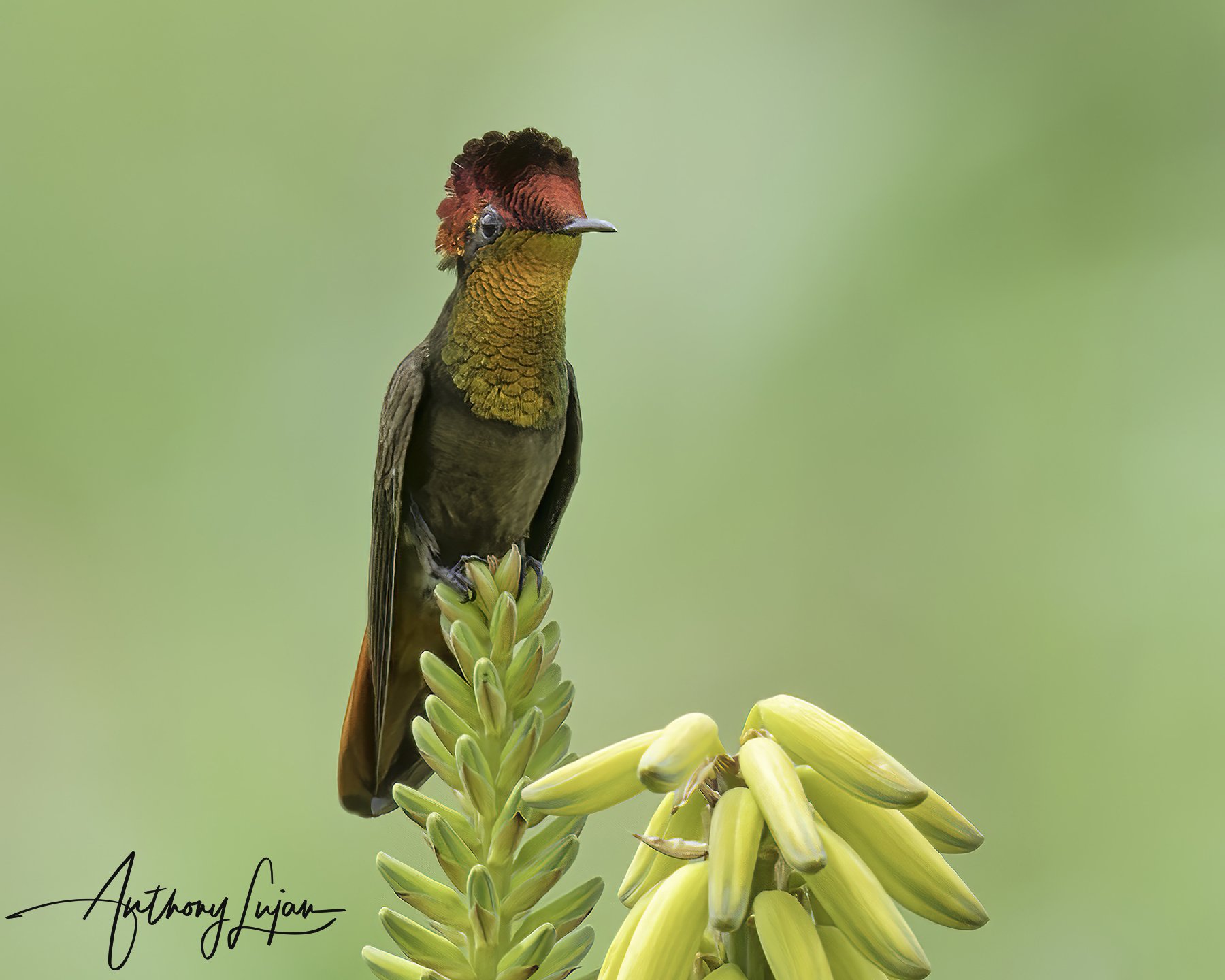
Ruby-topaz Hummingbird
A show stopper in the lowlands and dry edges
Ruby-topaz Hummingbird is a species that looks almost unreal when the light hits at the right angle. The combination of intense ruby and topaz tones in the crown and throat can switch from dark to explosive in a fraction of a second. In Colombia, it occurs in drier hills, scrub, gallery forest edges, and arid enclaves, often at lower elevations and in more open or seasonal environments.
On this trip, Ruby-topaz Hummingbirds felt like sudden flares of color in places where the background was more subdued. They tended to work on flowering trees and tall shrubs, often taller than many understory species. Photographing them required patience with light. In neutral or flat conditions, the bird can look relatively plain. In strong, directional light, everything changes. I spent time waiting for those conditions. When they finally happened, the bird lived up to its reputation as a true show stopper, transforming a fairly ordinary patch of scrub or edge into something electric.
Everything that filled the space between
Between these four anchors was a dense community of Andean and foothill hummingbirds that made Colombia feel like an entire hummingbird world to itself. Pufflegs like Coppery-bellied, Glowing, Black-thighed, and Greenish. Brilliants from Fawn-breasted to Violet-fronted and Empress. Large, impressive birds such as Great Sapphirewing and Shining Sunbeam. Delicate woodstars, rackettails, and sylphs that turned small movements into displays.
Some species were common and present at multiple sites. Others felt tied to very specific elevations, ridges, or forest types. Together, they turned this trip into an education in how hummingbirds stack up along Colombia’s Andean gradients, from páramo at the top down into warmer foothills and dry edges.
What this expedition changed
This first deep Colombia expedition changed how I saw the entire project. It showed me what happens when you spend enough time in one hummingbird country to let patterns emerge. Which species define high elevation landscapes, which dominate mid-level cloud forest, which specialize in foothills and semi-open country, and which seem to tie everything together?
Buffy Helmetcrest, Golden-tailed Sapphire, Sword-billed Hummingbird, and Ruby-topaz Hummingbird each pushed one part of that spectrum to an extreme. High altitude endemism. Foothill color and social behavior. Specialized bill length. Lowland and dry edge brilliance. Around them, dozens of other hummingbirds filled in the gradient. By the end of the trip, Colombia no longer felt like a place I could summarize quickly. It felt like a country that would require multiple expeditions, each with its own theme, just to begin to represent what is really there.
If you want to explore the full list of species photographed during this trip and eBird Trip Summary, you can view the complete travel overview here: 2022 03 Colombia
Colombia hosts 167 hummingbird species, see the ones I’ve photographed.
Join me on future trips like this. You can find more details here: Visit Travel with Me!
Frequently asked questions
Colombia trips always spark questions about scale, difficulty, and how to choose priorities. This quick FAQ adds context before you move on to the next Hummingbird Travel Story.
-
Because Caldas, Cundinamarca, Tolima, and Valle del Cauca together offer páramo, high Andean forest, cloud forest, and foothill habitats, which is exactly what you need for a first pass at Colombia’s Andean hummingbird diversity.
-
Buffy Helmetcrest required dealing with altitude, cold, and exposure in páramo. Sword-billed Hummingbird required patience around very specific flowers and perches, plus careful framing to handle the bill.
-
Because they define what Colombia’s hummingbird communities look like day to day. Conservation categories are important, but understanding the “common” species is just as critical for seeing the full picture.
-
Yes. This trip mapped out where certain groups and elevations perform best. Future Colombia expeditions can now focus more tightly on specific themes, such as endemics, coastal hummingbirds, or particular Andean ranges.