
Colombia Hummingbird Expedition | December 2022
11 New Species | Trekking for a “Lost” Helmetcrest
Trip overview
Dates: December 31, 2022 – January 14, 2023
Regions: Cundinamarca, Distrito Capital de Bogotá, Magdalena
Total hummingbird species observed: 29
New hummingbird species photographed: 11
Focus: High elevation Santa Marta endemics and the Blue-bearded Helmetcrest
This expedition was built around one idea. Walk into the high Santa Marta Mountains and spend enough time there to find and photograph one of the rarest hummingbirds in the world, the Blue-bearded Helmetcrest. Everything else, from the Bogotá highlands to the valleys leading into the Sierra Nevada de Santa Marta, was designed to support that goal and make the most of the region's multiple localized hummingbird species.
Why the Santa Marta Mountains and Bogotá highlands
Colombia’s Sierra Nevada de Santa Marta holds one of the highest concentrations of range-restricted birds anywhere, and several of those are hummingbirds. Pair that with access to the Bogotá area páramo and high Andean forest, and you have a route that can deliver both nationally endemic helmetcrests and Santa Marta specialties in one trip. The centerpiece was a two-day trek through the Santa Marta Mountains and a three-night stay in a high-elevation habitat centered on one bird.
During this expedition, I photographed eleven hummingbird species, all of them new to my list:
#115 EN Blue-bearded Helmetcrest, Oxypogon cyanolaemus|
#116 LC Bronze-tailed Thornbill, Chalcostigma heteropogon
#117 LC Coppery Emerald, Chlorostilbon russatus
#118 LC Golden-bellied Starfrontlet, Coeligena bonapartei
#119 LC Green-bearded Helmetcrest, Oxypogon guerinii
#120 LC Purple-backed Thornbill, Ramphomicron microrhynchum
#121 VU Santa Marta Blossomcrown, Anthocephala floriceps
#122 LC Santa Marta Woodstar, Chaetocercus astreans
#123 NT White-tailed Starfrontlet, Coeligena phalerata
#124 LC White-vented Plumeleteer, Chalybura buffonii
#125 NT Black-backed Thornbill, Ramphomicron dorsale
The trip was centered on Blue-bearded Helmetcrest, with Black-backed Thornbill, Santa Marta Blossomcrown, and White-tailed Starfrontlet as key additional targets.
Blue-bearded Helmetcrest
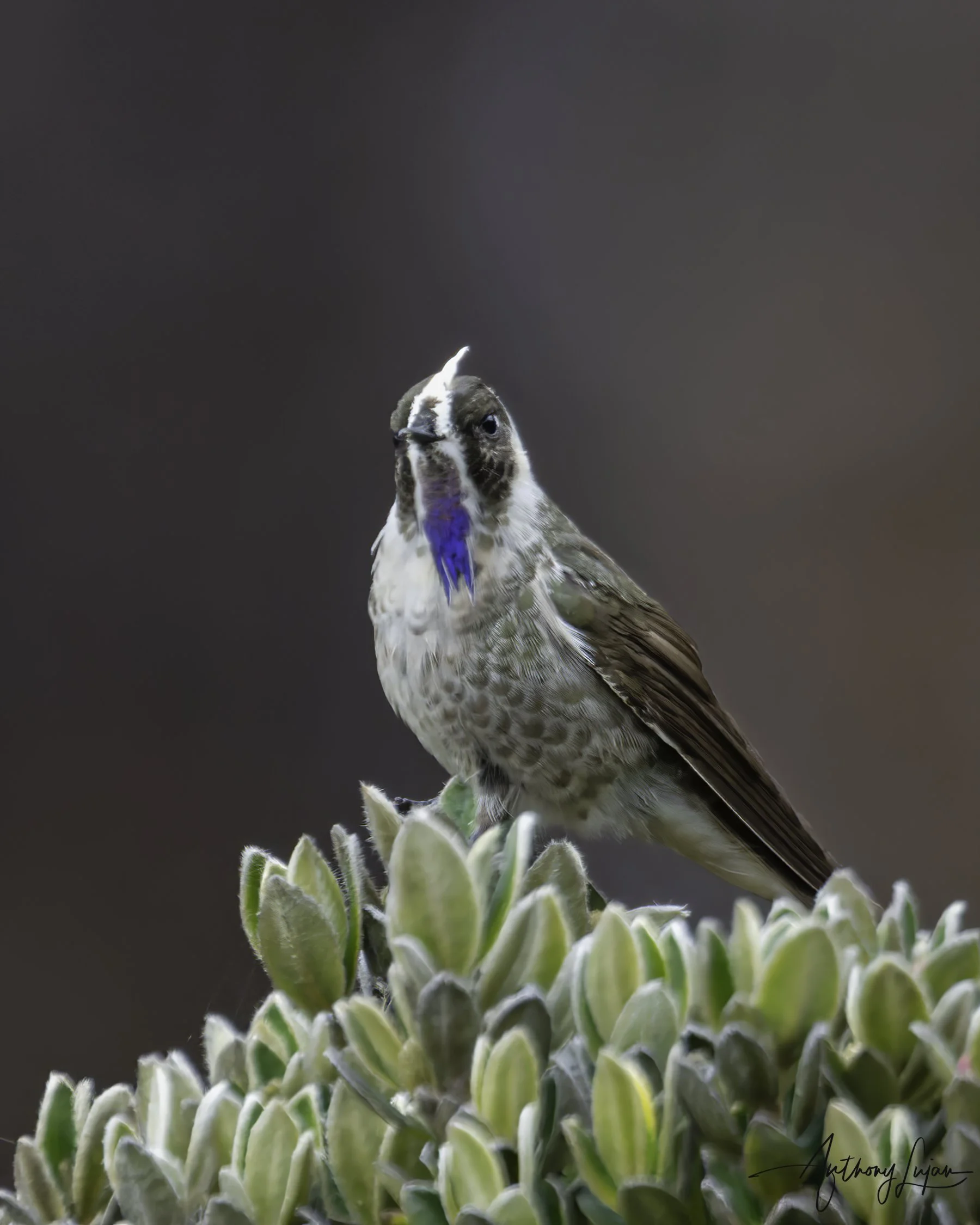
Endemic, Endangered, and rediscovered
Blue-bearded Helmetcrest is a hummingbird that, for decades, was known only from museum specimens and old field notes. It is endemic to the Sierra Nevada de Santa Marta and lives in high-elevation páramo. Frailejones, tussock grass, low shrubs, bare rock, wind, and thin air define its world. It was considered possibly gone for a long time before being rediscovered and confirmed in recent years.
My entire Santa Marta trek revolved around this bird. Two days of walking into the high country, followed by three nights in a habitat where it has been seen again. The landscape feels exposed and raw. You are above the trees, and everything is about sky, wind, and the structure of páramo plants. The helmetcrest moves through this space with a purpose that matches the environment. It hunts for nectar on frailejones and shrubs, and sometimes drops to the ground to pick at insects. When it finally appears in front of you, crest and blue beard visible against the bleak background, it feels like meeting a bird that should not have survived the last century but did. Photographing it was less about making something pretty and more about documenting a hummingbird that spent nearly 70 years off the radar.
Black-backed Thornbill (male juvenile)
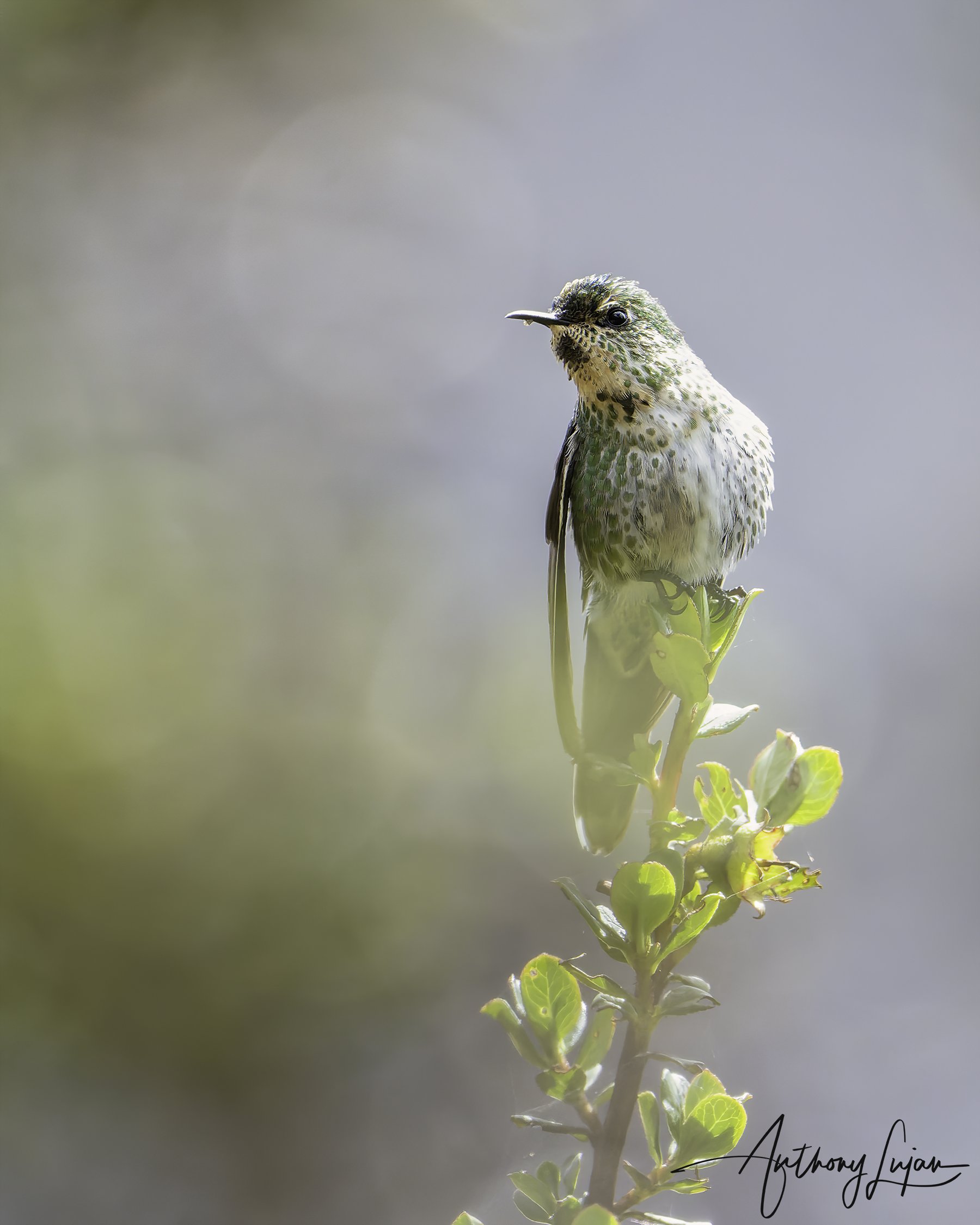
Endemic, Near Threatened, and living on narrow ridges
The Black-backed Thornbill is another Santa Marta endemic, a tiny hummingbird with a very short bill and a distinctive tail that lives at high elevations. It uses montane and páramo edge habitats, often along ridges and steep slopes where shrubs and low trees cling to the wind. The species has a limited range and is considered at risk because of its small distribution and ongoing habitat pressures.
In the field, this bird felt like a needle in a very complicated haystack. It is small, fast, and often works in places where footing is not easy, and the cover is uneven. I spent time watching flowering shrubs along ridge lines and steep, brushy slopes, waiting for brief visits and quick pauses on small perches. Getting clean views meant anticipating flight paths more than reacting. When a Black-backed Thornbill finally held still long enough to show its structure and coloring clearly, it felt like another piece of the Santa Marta high elevation puzzle snapping into place.
Santa Marta Blossomcrown
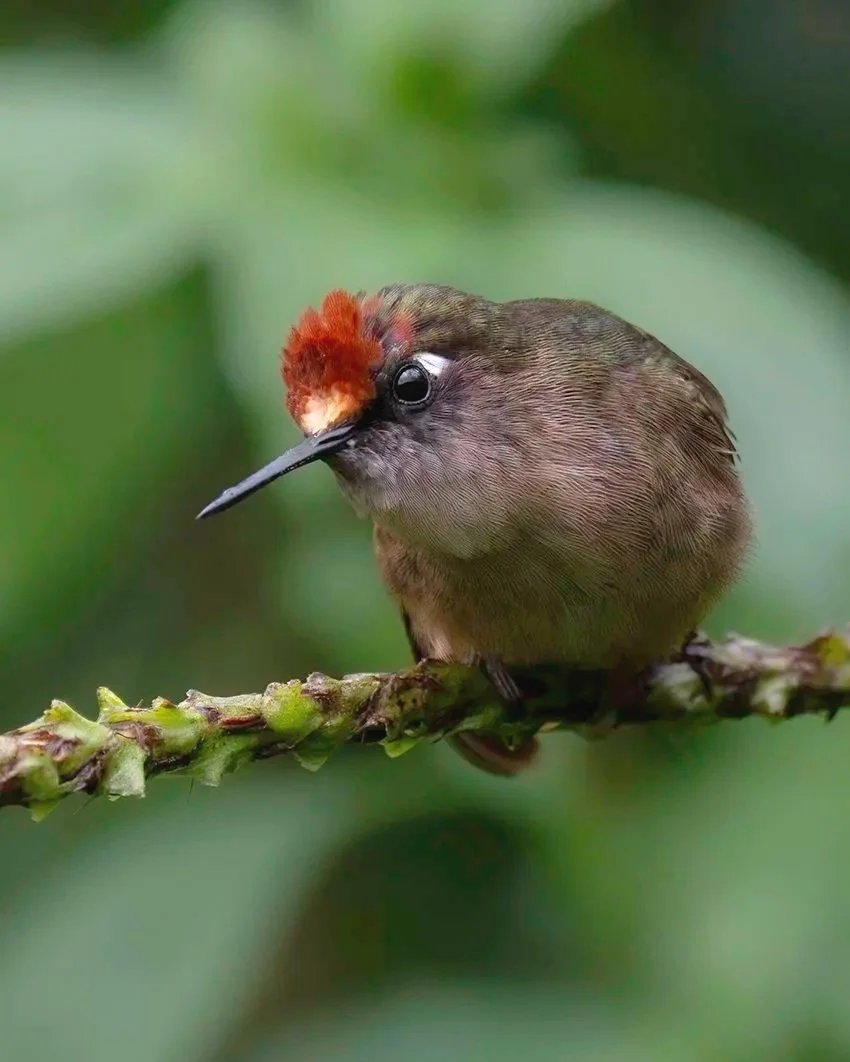
Endemic, Vulnerable, and tucked in a humid forest
Santa Marta Blossomcrown is a compact hummingbird that lives lower down the slopes than the helmetcrest and thornbills, in humid and mature secondary forest. It is endemic to the Sierra Nevada de Santa Marta and classified as Vulnerable due to its small range and ongoing habitat loss. Its world is made of forest edges, interior trails, and pockets of older forest that have survived clearing.
Working with this species meant dropping back below the harsh páramo line, into forest with more structure and more shelter. Light levels fell, humidity rose, and the soundtrack changed from wind to forest noise. Blossomcrowns do not spend much time out in the open. They dart into flowering understory and mid-level shrubs, then retreat to semi-hidden perches. Photographing them required slowing down on trails, watching specific flowering patches over long stretches, and accepting that most views would be partial. The clear, open looks were rare and earned, which made them all the more valuable.
White-tailed Starfrontlet
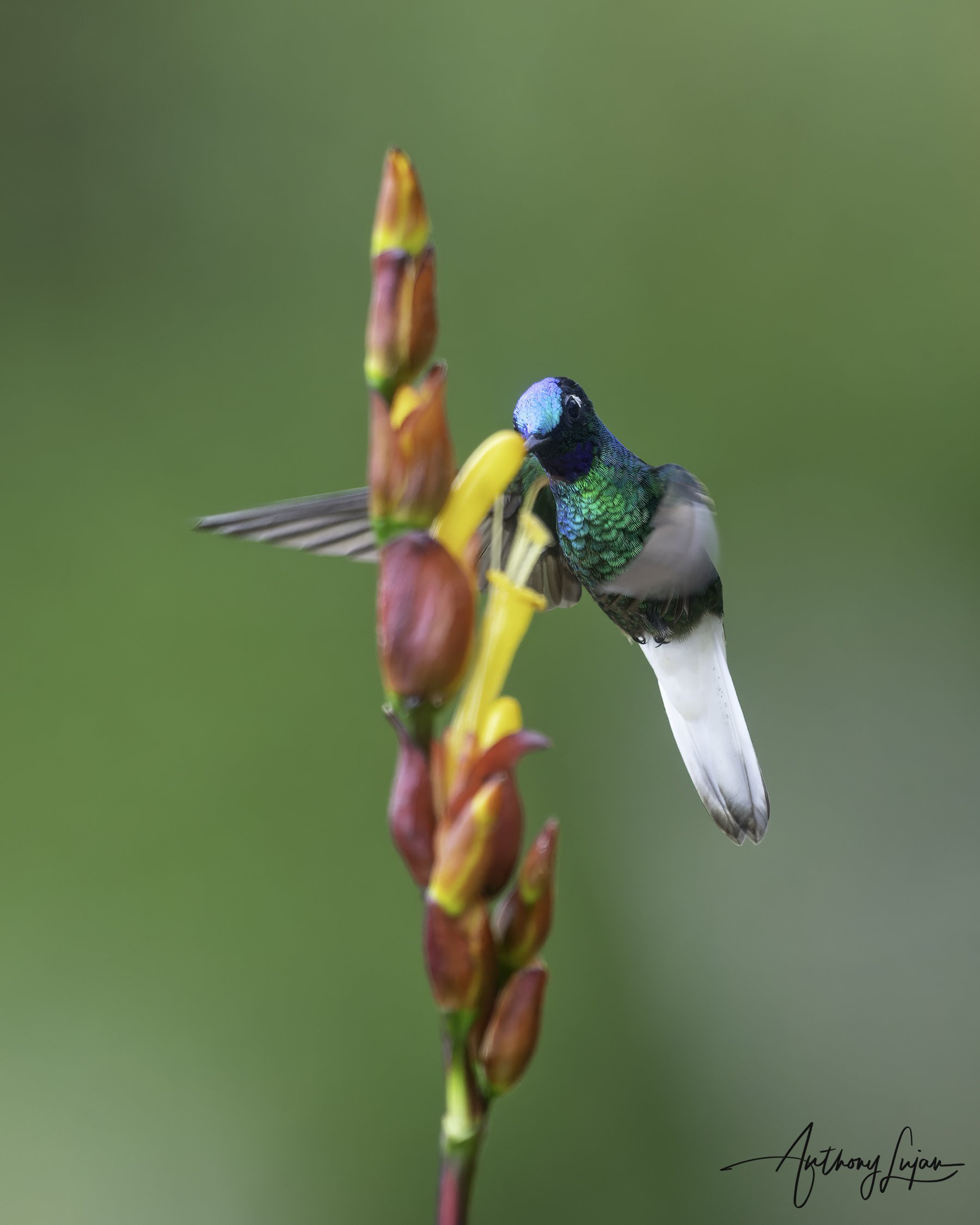
Endemic, Near Threatened, and standing out in the mist
White-tailed Starfrontlet is another Santa Marta endemic, a striking hummingbird with a bright white tail and strong body color. It lives in humid montane forest and forest edges at mid and high elevations in the range. Its distribution is limited, and habitat loss and fragmentation have led to its assessment as Near Threatened.
In misty forests and along openings, this bird is often the one that catches your eye first. The white tail flashes as it moves and feeds, and males in particular can be surprisingly conspicuous at good flower patches. On this trip, I encountered White-tailed Starfrontlets along forest edges, clearings, and flowering trees that sat on the border between more intact forest and disturbed areas. Photographing them was about controlling bright highlights and misty backgrounds, and about waiting for poses where the tail and body structure both read clearly. It felt like documenting the bolder, more visible side of Santa Marta’s localized hummingbird story.
A trek defined by one hummingbird, shaped by many
The two-day trek and three-night stay in the Santa Marta Mountains were planned for one species, but the other ten hummingbirds turned the trip into a complete story. Bronze-tailed Thornbill and Purple-backed Thornbill added more high-elevation character. Green-bearded Helmetcrest tied this Colombia expedition back to the other Helmetcrest I had worked with around Bogotá. Golden-bellied Starfrontlet, Coppery Emerald, Santa Marta Woodstar, and White-vented Plumeleteer filled in different elevation bands and forest types.
Each day swung between very different worlds: the Bogotá highlands, the Santa Marta foothills, the cloud forest, and the high páramo. The common thread was that all four main target species occur only in Colombia, and three occur only in the Santa Marta range.
What this expedition changed
This trip changed how I think about “rare” and “rediscovered” hummingbirds. Blue-bearded Helmetcrest is not just a difficult bird. It is a species that went unseen for decades, whose habitat has been burned and grazed, and whose remaining population is still uncertain. Building a trek around it forced me to think carefully about impact, time on site, and how to work in fragile environments that are recovering from fire and grazing.
At the same time, spending time with Black-backed Thornbill, Santa Marta Blossomcrown, and White-tailed Starfrontlet made it clear that Santa Marta’s hummingbird story is not about a single icon. It is about an entire set of birds that exist only on one isolated mountain block, each living in its own narrow slice of elevation and habitat. By the end of the trip, the Sierra Nevada de Santa Marta felt less like a destination and more like a responsibility.
If you want to see the full list of species photographed during this trip, you can view the complete travel overview here: 2022 12 Colombia
Colombia hosts 167 hummingbird species; see the ones I’ve photographed.
Join me on future trips like this. You can find more details here: Visit Travel with Me!
Frequently asked questions
Every trip raises its own set of questions. This quick FAQ adds context before you move on to the next Hummingbird Travel Story.
-
Because Blue-bearded Helmetcrest is one of the rarest hummingbirds in the world, endemic to a small high elevation area in the Santa Marta range, and it requires real effort just to reach its habitat.
-
It involved long days at high elevation, walking through exposed páramo with unpredictable weather, thin air, and basic conditions. The trek itself is not technical, but the combination of altitude and distance makes it demanding.
-
They are easier in some ways, since they live at slightly lower elevations and in forested habitats, but they still have small ranges and fragmented habitat. None of them are “easy” in the way common lowland hummingbirds can be.
-
Yes. There is more to document in terms of behavior, seasonal changes, and how these species are coping with ongoing habitat pressures across different parts of the range.










Please note: The content provided in this article reflects Anthony’s personal experience and photographic approach. Results can vary depending on light, weather, location, equipment, subject behavior, and field conditions.