
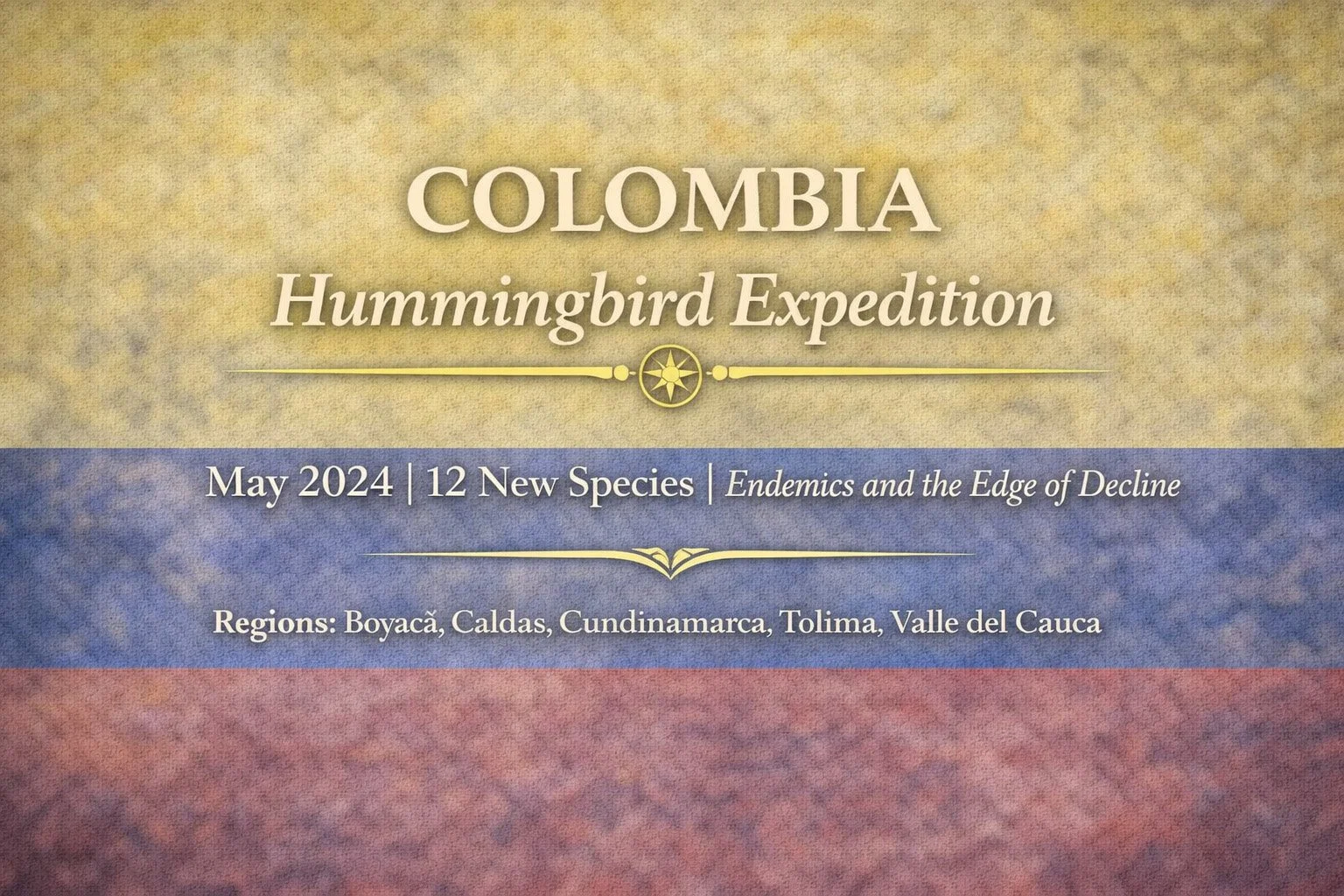
Colombia Hummingbird Expedition | May 2024
Trip overview
Dates: May 14–28, 2024
Regions: Boyacá, Caldas, Cundinamarca, Tolima, Valle del Cauca
Total hummingbird species observed: 53
New hummingbird species photographed: 9
Focus: Colombian endemics with Vulnerable and Near Threatened status
This was a return to a country I had already started to fall in love with. Unlike my first big Colombia expedition, which focused on scale and variety, this trip was centered on endemics and threatened hummingbirds. I wanted to spend real time with species that exist only in Colombia and are already showing clear signs of pressure. Four birds led the way: Black Inca, Tolima Blossomcrown, Chestnut-bellied Hummingbird, and Indigo-capped Hummingbird.
Why this Colombia expedition mattered
Colombia holds more hummingbird species than almost any other country, but not all of them are doing equally well. The departments of Boyacá, Caldas, Cundinamarca, Tolima, and Valle del Cauca together cover a critical stretch of Andean slopes and valleys where several endemics are either Vulnerable or Near Threatened. This expedition was built to connect those dots. Follow the elevation bands and forest types where these species still hold on, and document them with the attention they deserve.
During this expedition, I photographed fifteen hummingbird species, all of them new to my list:
#174 VU Black Inca, Coeligena prunellei
#175 LC Short-tailed Emerald, Chlorostilbon poortmani
#176 NT Chestnut-bellied Hummingbird, Saucerottia castaneiventris
#177 LC Indigo-capped Hummingbird, Saucerottia cyanifrons
#178 LC Mountain Velvetbreast, Lafresnaya lafresnayi
#179 LC Buff-winged Starfrontlet, Coeligena lutetiae
#180 LC Golden-breasted Puffleg, Eriocnemis mosquera
#181 LC Viridian Metaltail, Metallura williami
#182 LC Purple-throated Woodstar, Philodice mitchellii
#183 LC Red-billed Emerald, Chlorostilbon gibsoni
#184 VU Tolima Blossomcrown, Anthocephala berlepschi
#185 LC Tawny-bellied Hermit, Phaethornis syrmatophorus
#186 LC Blue-headed Sapphire, Chrysuronia grayi
#187 LC Purple-bibbed Whitetip, Urosticte benjamini
#188 LC Band-tailed Barbthroat, Threnetes ruckeri
Four of these species defined the heart of the trip: Black Inca, Tolima Blossomcrown, Chestnut-bellied Hummingbird, and Indigo-capped Hummingbird.
Black Inca

Endemic, Vulnerable, and quietly at risk
Black Inca is a hummingbird that could easily slip past you if you did not know what you were looking for. It is endemic to Colombia and classified as Vulnerable. Its range is confined to humid montane forests on the west slope of the Eastern Andes and a few nearby ridges. Much of that forest has already been cleared or fragmented, and the remaining habitat often exists as patches woven between agriculture and human settlement.
In the field, Black Inca feels like a bird of edges and interior forest all at once. I saw it in mature cloud forest and in patches of forest already under pressure, where oaks and tall trees still stood, but farmland was not far away. Photographing it meant paying attention to those transitions. Perches at forest margins, flowering plants that grew along narrow trails, and small clearings where light finally reached the understory. Every good look was shadowed by the knowledge that its total population is believed to be small and decreasing. It is a bird that carries a lot of quiet urgency.
Tolima Blossomcrown

Endemic, Vulnerable, and tied to the upper Magdalena
Tolima Blossomcrown is another Colombian endemic assessed as Vulnerable. It is centered in the upper Magdalena Valley, especially in parts of Tolima and nearby departments, where humid forest and mature secondary growth still cling to slopes and ridges. Its range is small, its population is estimated at a few thousand mature individuals, and much of its habitat has been altered or lost.
In the forest, the blossomcrown is compact and easy to overlook until it turns just right and the crown and pattern flash into view. I spent time in forest edges, interior trails, and older second growth that still held good structure, listening for movement and watching flowering patches that had been productive in recent seasons. Photographing Tolima Blossomcrowns felt like trying to catch small moments in narrow windows. It does not spend much time out in the open, and the places it prefers are not always easy to work in. When it finally presented itself clearly, it felt like a privilege rather than a routine encounter.
Chestnut-bellied Hummingbird

Endemic, Near Threatened, and living in a changing valley
Chestnut-bellied Hummingbird is a Near Threatened endemic that lives in drier parts of Colombia’s Magdalena system and adjacent valleys. Its core range is surprisingly small and lies in areas that have undergone significant human change: mining, agriculture, logging, and infrastructure expansion. The combination of limited range and rapid land use shifts has put real pressure on its habitat.
In the field, this species felt different from many of the lush-forest hummingbirds I had been working with. It used thorny scrub, dry forest edges, and patches of vegetation that did not look like “classic” hummingbird habitat at first glance. That contrast made it stand out. Photographing Chestnut-bellied Hummingbirds meant standing in hotter, more exposed country, watching flowering shrubs and trees that had adapted to those conditions. It is the kind of bird that teaches you not to overlook dry or disturbed landscapes. Important hummingbirds live there, too.
Indigo-capped Hummingbird

Endemic, adaptable, and part of everyday Colombia
The Indigo-capped Hummingbird is endemic to Colombia, but its story is different from that of the others. It is currently considered Least Concern, with a broader range that includes forest edges, savanna, shrubby areas, and even gardens, from lower to mid and high elevations. It is an endemic that has learned to live in semi-open and human-influenced landscapes, which helps its status for now.
On this trip, Indigo-capped Hummingbirds were a recurring presence at edges, in clearings, and in places where flowering shrubs and ornamental plants created small oases. Males showed off their namesake indigo crown when the light hit them just right, and their behavior around feeders and natural flowers was both assertive and familiar. Photographing them felt like documenting the everyday endemic side of Colombia. A bird that many people can see without traveling far, and a reminder that not all endemics are confined to remote or fragile habitats.
The rest of the cast
The other hummingbirds on this trip rounded out the picture of how these Andean regions work:
Short-tailed Emerald, Red-billed Emerald, and Blue-headed Sapphire added color and structure to semi-open and lower-elevation habitats.
Mountain Velvetbreast, Buff-winged Starfrontlet, Golden-breasted Puffleg, and Viridian Metaltail anchored the higher elevation and cloud forest side of the route.
Purple-throated Woodstar and Purple-bibbed Whitetip brought tiny, high-impact shapes into the mix, especially in humid forest zones.
Tawny-bellied Hermit and Band-tailed Barbthroat represented the hermit and barbthroat presence, reminding me that understory and edge nectar routes are just as important as the more obvious canopy feeders.
Together, they made this Colombia expedition feel less like a checklist and more like a map of how different hummingbird communities overlap around a core of vulnerable and endemic species.
What this expedition changed
Coming back to Colombia with a clear focus on endemics and conservation status changed the tone of the work. I was not just asking “What lives here” but “Which of these hummingbirds exist only here, and how are they doing.” Black Inca, Tolima Blossomcrown, Chestnut-bellied Hummingbird, and Indigo-capped Hummingbird each answered that question in a different way.
Some are struggling in small, fragmented ranges. One is Near Threatened in rapidly changing valleys. One is still doing relatively well, but only because it has enough flexibility to live with us in modified landscapes. Putting all of that together made Colombia feel even more layered. It confirmed that this is a country I will keep returning to, not only for diversity, but for the chance to follow how these stories evolve over time.
If you want to see the full list of species photographed during this trip, you can view the complete travel overview here: 2024 05 Colombia
Colombia hosts 167 hummingbird species; see the ones I’ve photographed.
Join me on future trips like this. You can find more details here: Visit Travel with Me!
Frequently asked questions
Return trips to Colombia that focus on endemics raise a specific set of questions. This quick FAQ adds context before you move on to the next Hummingbird Travel Story.
-
Because Colombia’s hummingbird diversity is so high that a single trip can only scratch the surface. Follow up expeditions allow you to target endemics and threatened species with much more intention.
-
Both are Colombian endemics listed as Vulnerable, with small ranges and fragmented habitats. That combination makes them clear candidates for focused field time and careful documentation.
-
It is endemic and Near Threatened, but it lives in drier, more human impacted valleys. It shows how threatened hummingbirds are not limited to lush forests and remote reserves.
-
Because it is an endemic that is still doing relatively well and uses semi open, human influenced landscapes. It illustrates how some endemics can adapt, at least for now.



Please note: The content provided in this article reflects Anthony’s personal experience and photographic approach. Results can vary depending on light, weather, location, equipment, subject behavior, and field conditions.